
Sommaire
Why a Dishwasher Breaks Down: Understanding the Causes, Diagnosing Quickly, and Avoiding Bad Repairs
Understanding why a dishwasher breaks down is not just about looking for “the broken part.” In many cases, the problem comes from a blockage, a water supply issue, difficult drainage, clogging, or a safety element that deliberately prevents the appliance from operating.
The right approach is therefore to start from the visible symptom, eliminate simple causes, then decide whether the breakdown requires maintenance, targeted repair, or replacement. The goal: save time, avoid risky handling, and not replace a pump, a heating element, or an electronic board at random.
In Brief
🔎 A broken dishwasher does not always have a defective part: a clogged filter, a poorly locked door, or a mispositioned hose can be enough to block a cycle.
⚠️ Before any check, you must cut off the power supply and avoid working on internal parts if the breakdown involves a burning smell, a circuit breaker trip, or a significant leak.
🧩 The most reliable diagnosis is to link the symptom to a category of causes: power supply, hydraulic, mechanical, or electronic.
💶 A repair is often relevant for a seal, a filter, a spray arm, or a drain pump, but it becomes less rational if the appliance is old and accumulates costly breakdowns.
Why is it important to understand the breakdown before disassembling anything?
A symptom gives a clue, not a verdict. A dishwasher that won’t start may be suffering from a defective socket, a poorly closed door, a worn lock, a lack of water, or a faulty electronic board. Disassembly should therefore come after simple checks, not before.
The first mistake is to confuse symptom and cause. For example, water at the bottom of the dishwasher suggests a faulty drain pump. However, a clogged filter, a kinked hose, a blocked siphon, or a stuck valve can produce exactly the same result. In other words, replacing a pump without checking the circuit is sometimes throwing money down the drain.
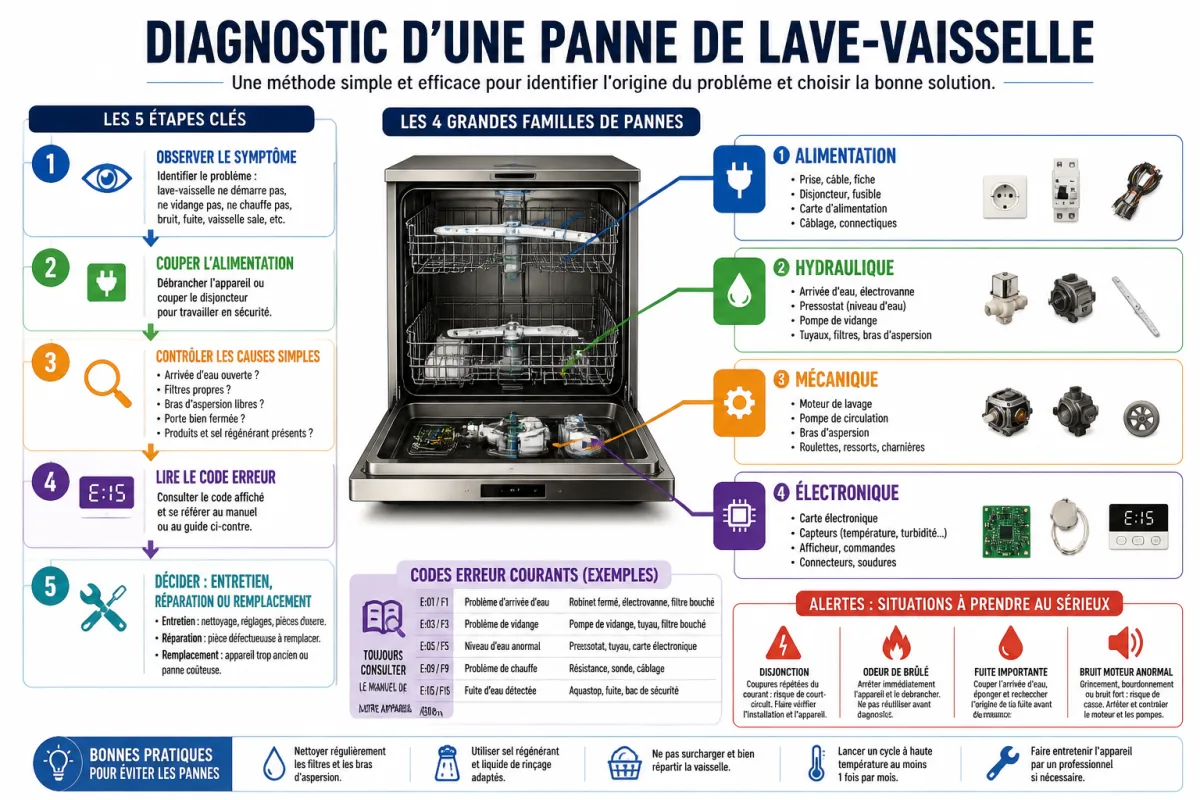
Overall, a dishwasher breakdown often falls into one of these categories:
- Electrical supply or control: plug, circuit breaker, door lock, control panel, electronic board.
- Water supply: closed tap, pinched hose, solenoid valve, overflow safety.
- Drainage and circulation: filter, drain pump, circulation pump, spray arm, drain hose.
- Sealing and safety: door gasket, anti-leak float, hose, fitting.
- Heating and drying: heating element, sensor, ventilation, program setting, rinse aid.
The right diagnosis is not the one that leads fastest to disassembly, but the one that first eliminates simple, visible, and reversible causes.
Good to know: manufacturers' manuals generally require cutting off the electrical supply before maintenance or any intervention. This precaution is not decorative. Water and electricity never mix well, especially if the appliance leaks, trips the breaker, or shows signs of overheating.
What are the most common breakdowns and what do they reveal?
The most common breakdowns can be read through a few signs: the appliance does not start, water stagnates, dishes come out dirty, a leak appears, or drying becomes ineffective. Each symptom points to a specific area, but several causes remain possible.
To diagnose quickly without skipping steps, the table below serves as a reading grid. It does not replace the model's manual or a repair technician's opinion, but it helps distinguish a simple check from a potentially serious breakdown.
| Observed symptom | Probable causes | Cautious check | When to call a professional |
|---|---|---|---|
| The dishwasher does not start | Plug, circuit breaker, door not properly locked, active safety | Check the plug, the lock, the selected program | If the appliance trips the breaker or if the control panel remains unresponsive |
| Water at the bottom of the tub | Clogged filter, bent hose, blocked drain pump | Clean filter and grille, check visible drain hose | If the pump buzzes, strains, or does not respond |
| Dishwasher not cleaning well | Blocked arms, clogged nozzles, weak circulation pump | Turn the arms by hand, clean the holes, avoid overloading | If water circulates poorly despite thorough maintenance |
| Dishwasher leak | Worn gasket, excessive foam, hose, overflow, fitting | Inspect the gasket, remove excess foam, check accessible fittings | If the leak comes from underneath or triggers a safety feature |
| The dishwasher no longer dries | Rinse aid, program, heating element, ventilation, sensor | Check settings, rinse aid level, program used | If water no longer heats or if an error code appears |
The dishwasher does not start
A dishwasher that does not start may simply be without power. The plug, circuit breaker, visible cable, and door closure are therefore the first points to check. A door not properly locked is enough to block the start of the cycle, as the appliance must prevent any water projection during operation.
If the indicator lights come on but nothing happens, the door lock, start button, water supply, or an internal safety may be the cause. If no light comes on, the electrical issue becomes more serious. In this case, it is better to avoid dismantling the control panel without appropriate skills.
Water remains at the bottom of the tub
A drainage problem is one of the scenarios most easily confused. The filter traps food residues, but if it is saturated, water circulates poorly and the pump strains. A piece of glass, a jar label, or a small bone can also block a pump impeller depending on the model.
The drain hose also deserves a visual check: bend, crushing, poor connection to the siphon, or clogging at the drainage point. If the dishwasher makes an unusual noise, buzzes without draining, or displays a dishwasher error code, the pump or a sensor may be involved.
The dishes come out poorly washed
When a dishwasher no longer washes, the product is often blamed. Sometimes wrongly. The spray arms must rotate freely and spray water through their nozzles. A utensil that is too tall, a plate poorly placed, or clogged holes can greatly reduce washing efficiency.
One must also consider internal clogging: grease, limescale, product residues, neglected filter. The circulation pump serves to send water under pressure to the arms. If it weakens, the dishes come out dull or dirty, even with a long program.
The appliance leaks
A dishwasher leak visible on the front often indicates a dirty, crushed, or worn door seal. Excess foam can also cause an overflow, especially if a regular dishwashing liquid was mistakenly used. In this case, the appliance may go into safety mode.
A leak under the appliance is more delicate: hose, tub, fitting, pump, anti-leak float, or retention tray may be involved. If water reaches near an outlet, if the floor is extensively wet, or if the circuit breaker trips, the priority is no longer home diagnosis: safety must be ensured.
Drying no longer works
A dishwasher no longer dries for sometimes trivial reasons: wrong program, absence of rinse aid, plastic dishes that retain moisture, opening too late or too early depending on the model. Drying also depends on the type of appliance and its condensation or ventilation system.
If the dishes remain cold at the end of the cycle, the heating issue becomes more likely: heating element, temperature sensor, relay, or electronic board. Again, remote diagnosis has its limits, as several components can produce the same effect.
How to diagnose a dishwasher breakdown without taking risks?
The safest method is to cut the power, observe the symptom, check accessible parts, then consult the manual and error code before making any decision. This reasoning avoids random repairs and limits risks related to electricity, water, and internal parts.
The diagnosis should proceed from the simplest to the most involved. Start with what requires no deep disassembly: power supply, door, filters, arms, visible hoses, water inlet valve, water level in the tub, noise during the cycle, indicator light or displayed code.
Here is a practical method, to be adapted to the model and always with the appliance powered off as soon as physical handling is necessary:
- Identify the moment of the breakdown: at startup, during filling, washing, draining, drying.
- Observe associated signs: noise, smell, leak, indicator light, error code, cold water, stagnant water.
- Check accessible parts: filter, spray arms, seal, visible hose, valve, poorly placed basket.
- Read the model's manual: error codes do not mean the same thing depending on the brand.
- Decide the level of action: maintenance, simple part, repair technician, or replacement.
It should be noted that error codes are useful but not magical. They often indicate a malfunction area, not always the exact part. A code related to draining can signal a pump, but also a clogged hose or a sensor fooled by water that does not evacuate properly.
An error code is a technical clue: it guides the diagnosis but should not replace observing the symptom and simple causes.
When does home repair become risky?
Home repair becomes risky as soon as the breakdown involves electricity, heating, a significant internal leak, repeated tripping, or an abnormal smell. In these situations, continuing to test the appliance can worsen the breakdown or create a domestic hazard.
Certain signals require immediately easing off. Repeated tripping can indicate an insulation fault, a short-circuited heating element, or water infiltration on an electrical component. Even a slight burnt smell requires stopping the appliance and not restarting it “just to see.”
Alerts to take seriously:
- Tripping at every start: electrical risk or faulty component.
- Smell of heat or burning: immediate stop recommended.
- Leak under the appliance: possible hose, pump, tank, or anti-leak safety device.
- Metallic noise or forced motor: blocked part or mechanical wear.
- Unstable control panel: possible electronic fault.
Poor repairs often start with good intentions. Changing a part without diagnosis, forcing a plastic cover, tilting the appliance without draining the water, using an aggressive drain cleaner, or working on wiring without skills can turn a simple breakdown into an expensive one.
Repair or replace: how to decide wisely?
You need to compare the estimated cost of the part, labor, the age of the appliance, frequency of breakdowns, and its practical value. A simple repair can be rational; an expensive electronic board on an old and already fragile appliance is much less so.
Costs vary greatly depending on the brand, model, parts availability, region, and repair technician. It is better to think in terms of magnitude and request a quote if the breakdown involves an important part. Public or sectoral repair-related programs may also exist depending on the period and conditions; the most reliable is to check up-to-date information with official organizations.
| Type of intervention | Potential benefit | Limit to check | Often logical decision |
|---|---|---|---|
| Cleaning filter, arms, seal | Low cost, accessible, useful for prevention | Does not fix a real electrical or mechanical breakdown | To do first |
| Replacing seal or wash arm | Generally targeted and understandable repair | Check exact part compatibility | Often relevant if the appliance otherwise works well |
| Drain pump or solenoid valve | Can solve a clear drainage or water supply failure | Diagnosis needed before buying the part | To consider after checking for blockages |
| Heating element, circulation pump, electronic board | Can save a quality appliance | Sometimes high cost and labor | Quote recommended |
| Repeated breakdowns on an old appliance | Repair can postpone purchase | Risk of new close expenses | Replacement to consider |
In practice, repairing a dishwasher is often wise when the breakdown is identified, the part is available, and the appliance still fits the household’s needs. Conversely, replacement becomes more logical when breakdowns accumulate, parts become rare, or the repair approaches a significant portion of the price of an equivalent appliance.
How to prevent dishwasher breakdowns in the long term?
Prevention relies on three habits: keeping the water circuit clean, avoiding overload, and using appropriate products. These actions reduce blockages, dirt buildup, bad odors, and premature wear of components stressed at each cycle.
The filter is the first barrier against residues. If it is not cleaned regularly, the pump works under poor conditions and dirt can return onto the dishes. The wash arms must also remain free: a single protruding utensil can block their rotation throughout a cycle.
Useful maintenance checklist:
- Remove and rinse the filter according to the manufacturer's recommendations.
- Check that the spray arms rotate freely and that the nozzles are not clogged.
- Wipe the door seal to limit deposits, mold, and loss of sealing.
- Visually inspect the accessible drain hose: bends, crushing, poor support.
- Use regenerating salt and rinse aid if the model and water hardness require it.
- Avoid overloading, which hinders water circulation and hides surfaces to be washed.
In other words, preventing a dishwasher breakdown is not about doing mechanical work every weekend. It is mainly about avoiding the appliance working continuously with a saturated filter, blocked arms, or a clogged circuit.
Useful sources to consult
For safety instructions, error codes, and possible repair assistance, the most reliable sources remain the manufacturers' manuals, public organizations, and official systems. Forums can provide leads, but they do not replace the model documentation or a professional diagnosis.
| Source | Useful information | Practical use | Warning |
|---|---|---|---|
| Service-Public.fr | General information on legal warranties | Check your rights if the appliance is recent or under warranty | Conditions depend on the purchase situation |
| ecosystem | Information on collection, reuse, and recycling of electrical equipment | Know what to do with a replaced appliance | Solutions vary depending on location and type of equipment |
| Ministry of Ecological Transition | Information on the reparability index | Assess the potential ease of repair of an appliance | The index does not replace a repair estimate |
| Official manufacturer manual | Error codes, maintenance, safety, compatible parts | Identify the exact meaning of a light or code | Use the precise model reference |
Key takeaways
- 🔎 A symptom guides the diagnosis but does not always indicate the faulty part.
- ⚡ Any physical handling begins with a complete power cut-off.
- 🧼 Filter, spray arms, seal, and visible hose are the first useful checks.
- 🧩 Error codes must be cross-checked with the manual and observed signs.
- 💶 Repairing is relevant if the breakdown is clear, targeted, and consistent with the appliance's age.
FAQ
Why does my dishwasher fill with water but not wash?
If the appliance fills but the dishes remain dirty, the cause may be blocked spray arms, clogged nozzles, or a circulation pump that no longer circulates water properly. Start by checking the loading, arms, and filter before suspecting an internal part.
Why is there water left at the bottom of the dishwasher?
Standing water often indicates a drainage problem: clogged filter, bent hose, blocked siphon, or blocked drain pump. If cleaning the filter and checking the visible hose changes nothing, it is better to avoid forcing and have the pump diagnosed.
What does a dishwasher error code mean?
An error code signals a problem area: water supply, drainage, heating, leak, door, or electronics depending on the brand. Always consult the model's manual, as the same code can have different meanings from one manufacturer to another.
When should I call a repair technician for a broken dishwasher?
Call a professional if the appliance trips the circuit breaker, smells burnt, leaks from underneath, makes abnormal motor noise, or displays a persistent error code after simple checks. It is also recommended if the breakdown involves a heating element, electronic board, or a hard-to-access pump.
Should you repair or replace an old dishwasher?
It all depends on the age, overall condition, cost of the part, and labor. A small repair can still make sense, but repeated breakdowns or an expensive electronic board may make replacement more rational.