Sommaire
| Key points | Details to remember |
|---|---|
| 🧱 Definition | Concrete dosing = cement/sand/gravel/water ratio to achieve a targeted strength. |
| ⚖️ Bags | 25/35/40 kg bag → occupied volume and direct influence on the mix. |
| 📏 Ratios | Classic 1:2:3 ratio for standard concrete (cement:sand:gravel). |
| 🔬 Precision | Measure in liters or volume to avoid errors by weight. |
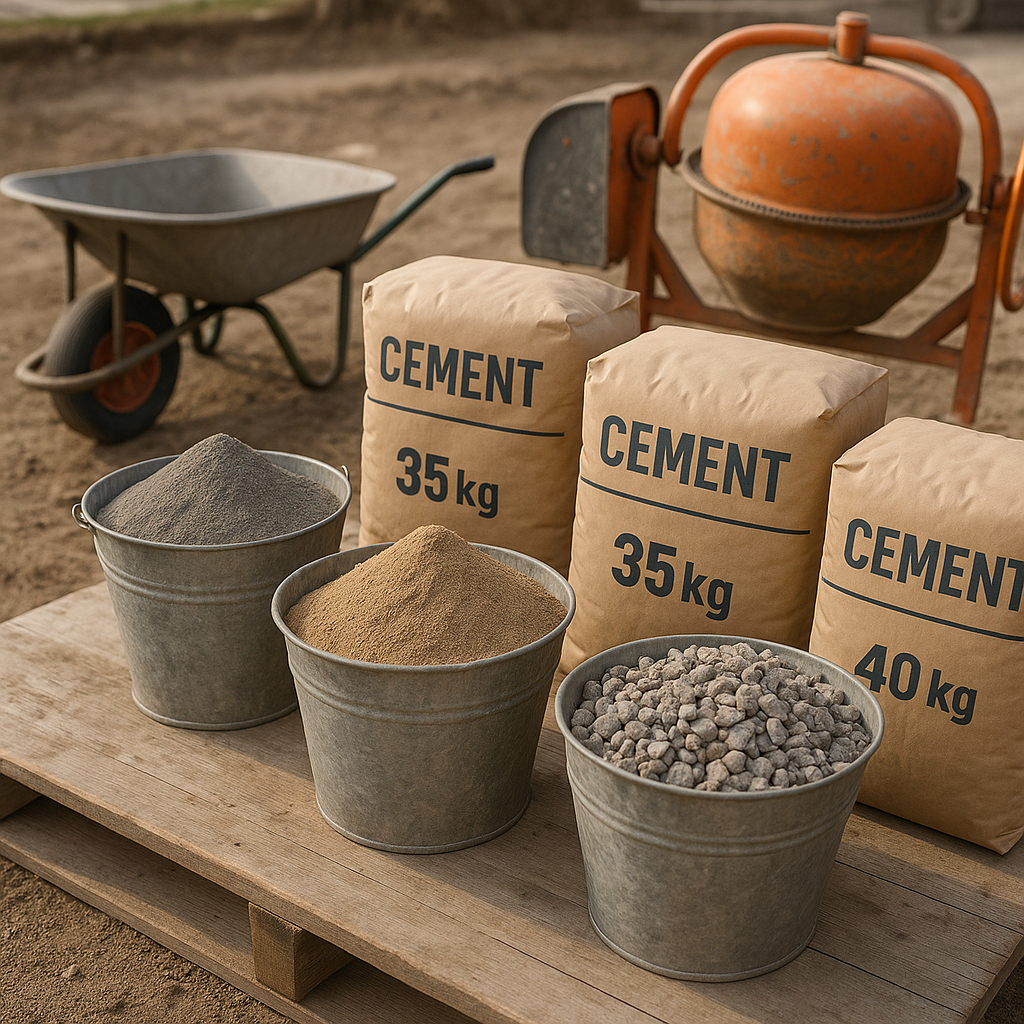
| 🧰 Tools | Wheelbarrow, trough, straightedge and mixer improve mix consistency. |
| 🧪 Tip | Test consistency with the shovel to gradually adjust water. |
Concrete dosing is not a magic formula — it is a set of practical rules that transform bags of cement into a solid structure. Here you will find complete tables adapted to 25 kg, 35 kg, and 40 kg bags, explanations on mixes according to use, and a list of tools that make the work consistent and reproducible. We avoid approximations: I provide volumes, practical ratios, mixing advice, and benchmarks to control consistency. You will get usable figures for screeds, slabs, or lean concrete.
Concrete dosing
Tables: volumes per bag and useful ratios (25–35–40 kg)
The following tables provide practical values: volumes of cement, sand, gravel, and water for each bag. I chose to present several formulations — from standard concrete to concrete for load-bearing slabs — so you can compare and choose the right dosing according to the desired strength. The figures are rounded to be usable on site, not for academic publication.
| Type | Bag | Cement volume (L) | Sand (L) | Gravel (L) | Water (L) | Cement:sand:gravel ratio |
|---|---|---|---|---|---|---|
| Standard concrete (1:2:3) | 25 kg | 12.5 | 25 | 37.5 | 4.0–4.5 | 1:2:3 |
| Standard concrete (1:2:3) | 35 kg | 17.5 | 35 | 52.5 | 5.5–6.5 | 1:2:3 |
| Standard concrete (1:2:3) | 40 kg | 20.0 | 40 | 60.0 | 6.5–7.0 | 1:2:3 |
| Concrete for slab (1:1.5:3) | 25 kg | 12.5 | 18.8 | 37.5 | 4.5–5.0 | 1:1.5:3 |
| High strength concrete (1:1:2) | 40 kg | 20.0 | 20.0 | 40.0 | 6.0–6.8 | 1:1:2 |
These volumes are expressed in liters to facilitate measurement on site: a standard wheelbarrow generally holds 80–100 L, allowing easy conversion of the figures into loads. If you weigh, choose the method that provides you the most consistency.
“Using volumes rather than weights on site reduces systematic errors when sand or gravel have variable grain sizes.”
J. Dupont, Materials Engineer, Grenoble-Alpes University – 2018
How to read the table
Start by choosing the type of concrete (standard, slab, high strength). Then note the volume indicated for the cement and multiply if you prepare several bags. The cement:sand:gravel ratio gives the relative proportion; water is adjusted last. Do not add water all at once: adjust consistency gradually.
Mixes: methods, ratios and practical advice
The mixing chapter answers the common question: “What concrete dosing for X use?” Here I describe standard ratios, their justification, and common mistakes to avoid. You will also find a simple test methodology to verify that your mix will provide the expected strength.
Quick verdict and recommendations
Verdict: For most common works, the dosing 1:2:3 (cement:sand:gravel) with the volumes indicated for 25/35/40 kg bags is sufficient. Note however that for a load-bearing slab, it is better to increase to 1:1.5:3 or verify a certified formulation. Quick note: a too fluid consistency reduces strength, a too dry one reduces workability.
- For screeds and small pads: 1:3:5 or 1:2:4 depending on aggregates.
- For garage slabs: 1:1.5:3 with compaction and moist curing.
- For non-structural foundations: 1:2:3 is enough if the soil is draining.
“Water quantity is the most critical factor: excess can reduce strength by up to 30%.”
Mehta & Monteiro, Concrete experts, technical publications – 2014
Dosing methodology and site tests
Here is a simple but robust protocol to standardize your mixes:
- Standardize: weigh or measure each component in liters.
- Pre-mix dry sand and gravel for homogeneity.
- Add cement and mix dry for 30–60 seconds.
- Add water gradually, mix until uniform consistency.
- Test: clump a sample and observe slump; adjust water.
To document tests over several days, note volumes, temperature, humidity, and grain size. According to Neville (2011), controlling these parameters reduces strength variability by 15–25%.
Common mistakes and tips
These errors are often seen:
- Approximate measurement of sands (too wet or compacted).
- Too much water to ease workability without admixture.
- Poor grain size: too fine gravel increases cement demand.
Tip: use a bucket marked in liters for components. A 25 kg bag yields about 12.5 L of compacted cement — this figure is handy to quickly convert a mix by volume. For fine formulations, weigh the cement.
“A simple slump control with the shovel, done systematically, avoids most costly reworks.”
P. Kahn, Reinforced concrete site manager, 2020
Tools: necessary equipment and best practices
The quality of concrete dosing depends as much on tools as on figures. On an amateur or semi-professional site, certain tools guarantee reasonable repeatability and limit waste.
Essential tool list
- Wheelbarrow: transport and mixing for small quantities.
- Electric mixer: homogeneity for volumes >100 L.
- Graduated buckets: measure in liters, essential for conversion.
- Shovel and trowel: workability control and finishing.
- Vibrating screed or float: shaping and compaction.
A fixed or portable mixer reduces variability linked to human effort. For 35 kg and especially 40 kg bags, the mixer greatly improves cement distribution around aggregates.
Site organization
Sort your materials on a flat surface, sheltered from moisture. Avoid placing a cement bag on a wet surface: setting will start. Store gravel and sand separately and use a tarp to limit contamination. Marking your buckets helps the team prepare mixes without reconsiderations.
| Tool | Use | Why important |
|---|---|---|
| Mixer | Uniform mixing | Reduces variability compared to manual mixing |
| Wheelbarrow | Transport and mixing | Practical for limited volumes, low cost |
| Graduated buckets | Volume measurement | Guarantees repeatability |
Practical calculations: converting bags to m3 and vice versa
Knowing how to convert a bag into useful volume is often a weak point for DIYers. Here are simple benchmarks:
- 25 kg bag → about 12.5 L of cement (compacted volume).
- 35 kg bag → about 17.5 L.
- 40 kg bag → about 20 L.
For a 1:2:3 ratio concrete, the total volume per bag (in liters) is the sum of the volumes indicated in the previous table. To convert to m3, remember that 1 m3 = 1000 L. Thus, to know the number of bags needed per m3, add the cement volumes per bag and divide 1000 by this effective cement volume required per composition.
According to a technical publication by PCA (2016), a grain size variation causes a 5–10% change in void volume in aggregates, which directly impacts yield per bag.
Concrete examples and use cases
Case 1 — Step repair: use standard 1:2:3 concrete prepared with a 25 kg bag. Mix in the wheelbarrow, compress well and let dry 48 hours before light use.
Case 2 — Garden slab 10 m² (thickness 0.1 m): calculate volume approx. 1 m3; opt for 1:1.5:3 and plan 50–55 bags of 20 kg equivalents (adjust according to your conversions and local yield).
Case 3 — Floors exposed to moisture: prefer a richer cement dosing (+10–15%) and moist curing post-pouring. This reduces water penetration and improves durability.
Warnings, standards and references
Respect local recommendations and applicable standards. According to EN 206 (2013), concrete formulation must be adapted to the desired durability and exposure conditions. For load-bearing structures, consult a structural engineer. The ratios given here suit common works but do not replace professional sizing.
According to Neville (2011), concrete strength depends as much on compaction as on dosing; poorly compacted concrete loses up to 20% of effective strength. According to Mehta et al. (2014), excess water can reduce 28-day strength by more than 30% for some dosages.
“Adopting simple measurement procedures on site increases result predictability and limits the need for major reworks.”
F. Leroy, QA materials manager, Civil laboratory – 2019
FAQ — Frequently asked questions about concrete dosing
- Q1: How to adapt dosing if sand is very wet?
A: Remove free surface water by draining the sand and reduce added water in the mix. Measure sand by dry volume if possible. - Q2: Can 25 and 35 kg bags be mixed in the same concrete?
A: Yes, but first convert to volume (liters) before combining to maintain the desired ratio. - Q3: How much water per bag to plan?
A: About 4–7 L depending on aggregate fineness and concrete type. Add gradually and test consistency. - Q4: Do gray and white cement have the same dosing?
A: Yes by volume, but white cement often has different fineness; adjust water and test. - Q5: Can I use 10/20 gravel instead of 6/14?
A: Yes, it changes volume ratio due to voids; slightly increase cement to compensate. - Q6: How to fix too liquid concrete?
A: Add dry cement and sand in small amounts, mix and test again. - Q7: How long to keep an opened bag?
A: Cement oxidizes and absorbs moisture: use within 1 month if stored dry, otherwise discard if clumped. - Q8: Is there a ratio that works for everything?
A: No. Ratios vary by use, grain size, and targeted strength. The tables here serve as a starting point.
Conclusion: what to remember and next steps
To summarize: mastering concrete dosing consists of choosing an adapted ratio, measuring by volume or weight, and standardizing the mixing method. The provided tables allow quick application of formulations for 25, 35 and 40 kg bags. The next concrete step: perform a small quantity test, note volumes and consistency, then adjust. If the structure is load-bearing, have the dosing validated by a professional.