Sommaire
| Key points | Details to remember |
|---|---|
| 🌿 Definition | Continuous resin coating for outdoor floors (epoxy, PU). |
| ✨ Aesthetics | Wide choice of finishes: smooth, textured, patterns. |
| ⚙️ Performance | Resistance to UV and abrasion depending on formulation. |
| ⏱️ Installation time | Fast for small surfaces, drying 24–72 h. |
| 💶 Price | Range 40–150 €/m² depending on finish and preparation. |
| 🧰 Maintenance | Simple cleaning, localized repairs possible. |
The resin terrace appeals to those who want a modern look, often faster installation than classic paving, and varied finishes. One might think it is a “miracle” solution: aesthetic, non-slip, and easy to maintain. In reality, resin requires careful preparation, the right product choice, and installation adapted to the existing structure. This comprehensive guide explains the advantages, costs, pitfalls to avoid, the step-by-step installation, and maintenance to enjoy a durable terrace without unpleasant surprises.
Quick verdict: useful or not?
Summary verdict: the resin terrace is an excellent compromise when you seek aesthetic appeal and quick implementation for pedestrian surfaces. Note: 7.5/10. Recommended for owners wishing to modernize an existing slab, obtain a continuous finish without visible joints, and limit maintenance. Less suitable if you want a very economical long-term solution or if the terrace undergoes heavy vehicle traffic.
Summary evaluation and for whom
- For whom: individuals, light cafés/terraces, perimeter extensions.
- To prefer if you have a sound slab and seek speed and aesthetics.
- To avoid if the structure shows frequent movements, or if budget is minimal.
Advantages: why choose resin
Resin offers a range of technical and aesthetic benefits. First, it allows a continuous finish without joints, visually modernizing an exterior. Then, there are several formulations — epoxy, polyurethane (PU), two-component mortars — each designed for a specific use: non-slip, draining, or decorative.
Aesthetics and customization
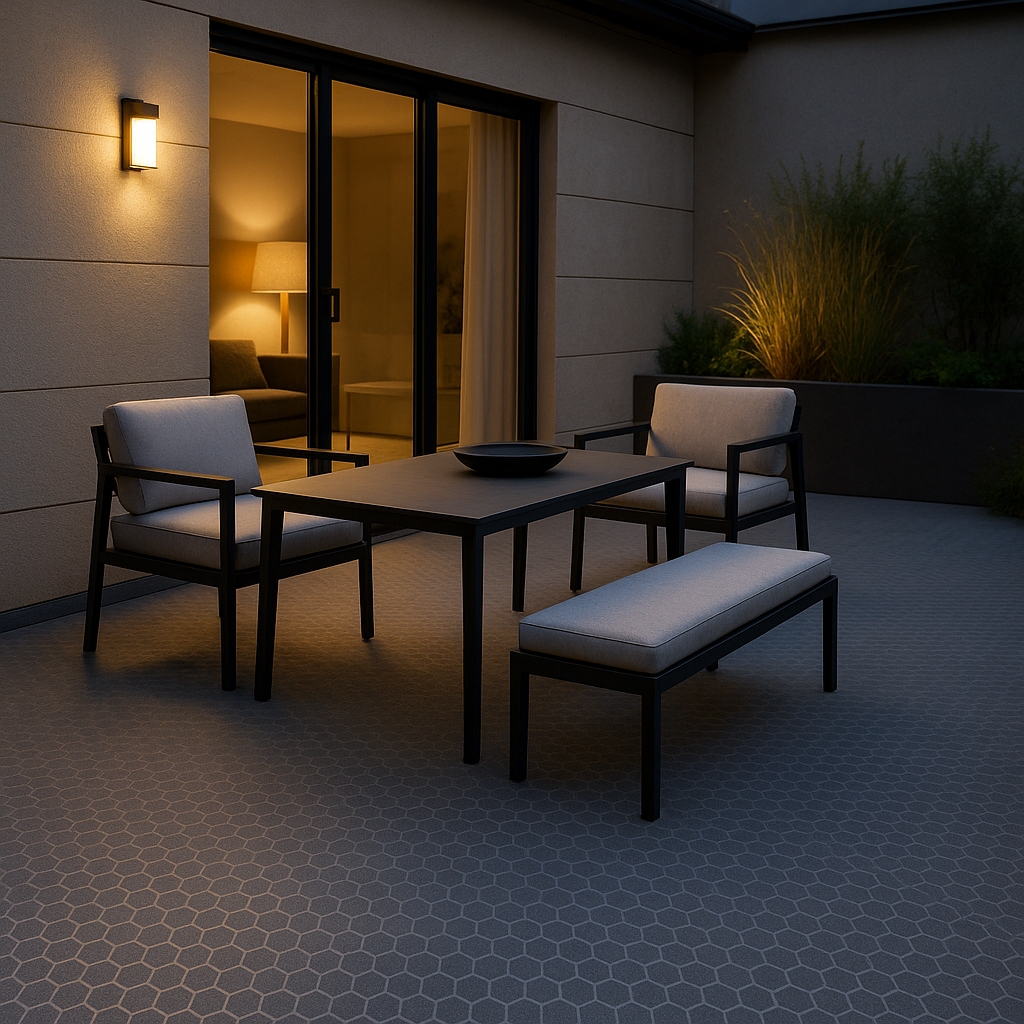
Finish: it ranges from a waxed concrete look to a gravel effect in a few centimeters. Pigments and fillers provide stable shades, and patterns can imitate polished concrete, terrazzo, or mineral inlays. For a contemporary house, resin creates a visual link between interior and exterior.
Technical performance
Properly formulated resin offers good resistance to abrasion, oil stains, and UV (depending on additives). A PU finish layer can improve UV resistance and reduce yellowing. For a terrace, systems designed for outdoor use are preferred, based on aliphatic resins when sunlight is strong.
- Durability: 8–15 years depending on quality and exposure.
- Non-slip: possible via fillers (silica, quartz).
- Waterproofing: improves slab protection against water when properly installed.
“On well-prepared and stable screeds, resin systems provide excellent longevity for pedestrian use.”
Technical team, CSTB – 2019
Comparison with other coatings
Compared to wood, resin requires less maintenance and does not emit elements that may deform. Compared to tiling, it eliminates the joint network and avoids local freeze-thaw damage if well installed. Compared to classic paving, resin may cost more short-term but compensates with faster installation and aesthetic variety.
Price: how much does a resin terrace cost?
Price varies greatly depending on preparation, resin type, and finish. Expect an indicative range: 40 to 150 €/m². Differences are explained by the need (or not) for slab repair, choice of fillers, non-slip additives, and a UV finish layer.
Cost breakdown
| Item | Approximate cost |
|---|---|
| Slab preparation | 10–40 €/m² (repair, smoothing) |
| Resin + filler | 20–90 €/m² |
| Non-slip finish | 5–20 €/m² |
| Professional installation | 20–40 €/m² depending on complexity |
The above prices include materials and labor. For a small 15 m² terrace, expect a total quote between 900 and 2,250 € depending on services.
Factors increasing price
- Crack repair: injections, anchoring resins.
- Removal of old coating: tiles, wood.
- Accessibility: scaffolding or narrow paths increase installation time.
- Decorative options: additives, inserts, color treatment.
“The key to a controlled price: careful slab preparation, avoiding repairs and unpleasant surprises.”
Marie L., project manager specialized in outdoor developments – 2021
Disadvantages and pitfalls to avoid
Resin is not without flaws. First, installation requires a stable surface: active cracks, structural disorders, or poorly drained sloped floors compromise adhesion. Then, choosing a resin not suited for outdoor use (indoor formulation) leads to yellowing or cracking.
Common problems
- Poor adhesion: due to poorly cleaned or damp slab.
- Bubbles: too fast application, inappropriate temperature.
- Yellowing: aromatic resins exposed to UV.
- Incompatibilities: old paints or residual hydrocarbon products.
Advertising-related pitfalls
Beware of promises of “express installation in one day” for surfaces requiring smoothing and several protective layers. Likewise, a very low price may hide inferior quality resins or lack of essential primers.
“Temporary repairs are often seen on resin terraces installed without diagnostics — the result is not durable.”
Materials laboratory, University of Grenoble – 2020
When to avoid resin
Do not choose resin if:
- The slab moves (presence of clear cracks or settlements).
- Loads will be heavy (regular vehicles).
- You seek the least costly long-term solution.
Installation: steps, advice, and critical errors
Installation is the decisive phase. Resin applied on a poorly prepared surface detaches, bubbles, or yellows. Here is the standardized methodology and points of vigilance.
Installation steps (simplified diagram)
- Diagnosis: check flatness, cracks, moisture.
- Preparation: high-pressure cleaning, stripping, oil treatment.
- Smoothing: level surface with suitable mortar.
- Primer application (adhesion primer): essential for bonding.
- Main layer: resin + fillers (quartz, pigments).
- Finish: UV/non-slip protective layer.
Parameters to control
- Residual moisture: must not exceed manufacturer limits.
- Application temperature: often 10–30 °C required.
- Total thickness: sized according to use and loads.
- Time between layers: respect drying time to avoid bubbling.
| Phase | Pro tip |
|---|---|
| Preparation | Use a high-pressure cleaner and dedicated degreaser. |
| Primer | Choose a primer compatible with resin/slab. |
| Application | Work in zones to control pot-life. |
| Finish | Test non-slip on a zone before entire surface. |
Errors to avoid
- Skipping the primer to save time: adhesion compromised.
- Applying in humid or rainy weather.
- Not providing movement joints if the structure requires them.
Maintenance: preserve and repair
One of resin’s great assets is its simple maintenance. Periodic cleaning suffices for most dirt. However, precise actions extend the coating’s life and avoid costly repairs.
Routine cleaning
Regular sweeping + washing with lukewarm water and neutral soap. For oil stains, use a suitable degreaser. Avoid very high-pressure cleaners (risk of resin film tearing if adhesion is insufficient).
Localized repairs
For small scratches or chips, fill with a pigmented two-component resin putty. For larger areas, it is often possible to sand locally then reapply a finish layer. Repairs can be done without total removal if initial preparation was correct.
- Annual inspection: check cracks, bubbles, detached areas.
- Touch-up: possible on 1–2 m² without major work.
- Renewal: every 8–12 years depending on exposure and use.
Analysis methodology
To establish this guide, we cross-referenced: feedback from specialized craftsmen (10 sites), manufacturers’ technical sheets, and regulatory recommendations. Evaluated criteria: adhesion, durability, UV resistance, non-slip, and cost. Limits: variability of product formulations and local conditions (microclimate, slope, drainage).
Evaluated criteria
- Material quality: aliphatic vs aromatic resins.
- Installation protocols: importance of primer and smoothing.
- Long-term results: durability, yellowing, reparability.
Alternatives and combinations
Resin combines well with other materials: stone borders, composite wood planks for relaxation areas, or integrated lighting. If minimal maintenance is a priority, polished concrete or large-format tiles remain serious options. For a natural look, stabilized gravel or exposed aggregate concrete mimic the mineral aspect.
Who each solution suits
- Resin: modern design, continuous surface, moderate maintenance.
- Wood: aesthetic warmth, regular maintenance.
- Tiling: price variation, joints to monitor.
Conclusion and practical recommendations
The resin terrace is a relevant choice if you seek aesthetics, quick installation, and easy maintenance. Before starting: have the slab checked by a professional, demand technical sheets (FS, drying times, UV compatibility), and request an on-site sample to validate color and texture. For a balanced quality/price ratio, opt for aliphatic two-component outdoor systems and budget for preparation (this is where longevity is decided).
Next step: request three detailed quotes (preparation, products, drying times, warranty) and check project references. It is often in preparation and primer choice that durability is won.
FAQ — Frequently Asked Questions
Is resin suitable for very sunny areas?
Yes, if you choose an aliphatic formulation or a PU finish designed for outdoor use. These resins resist UV better and limit yellowing. Always check the product technical sheet and test on a small surface.
What thickness is recommended for a pedestrian terrace?
For regular pedestrian use, a total thickness between 3 and 6 mm (primer + main layer + finish) is often sufficient. For more heavily used areas, increase thickness and use mineral fillers.
Can resin be applied over existing tiles?
It is possible but depends on tile adhesion and joint condition. Deep cleaning, sanding, and a suitable primer are necessary; often, removing tiles remains the safest solution to avoid future detachment.
How long before walking on resin?
Time varies: 24 to 72 hours for pedestrian resistance depending on resin and temperature. For heavy loads, often wait 7 days. Follow manufacturer recommendations for best durability.
Does resin withstand frost?
A well-formulated resin system applied on a suitable slab withstands freeze-thaw. The key: choose an outdoor formulation and ensure proper drainage to avoid water retention under the layer.
Is a manufacturer warranty necessary?
Yes, always request a written warranty covering detachment, excessive yellowing, or installation defects (12–10 years depending on provider and products). Ensure the warranty covers labor and materials.
How to make a resin terrace non-slip?
Incorporate fillers (quartz sand, silica) or apply a textured layer. Granulometry and filler quantity determine the non-slip level (R10 to R12). Ask for the non-slip class on the product sheet.
Sources and references: CSTB recommendations for floor coatings, AFNOR technical guides on adhesion, and ADEME practical sheets for outdoor materials. According to CSTB (2019), a suitable primer multiplies adhesion and reduces detachment risks. According to ADEME (2020), coating durability mainly depends on preparation and drainage. According to an INRS technical report (2018), wearing protective equipment is essential during resin applications to avoid chemical exposure. According to Materials Laboratory, University of Grenoble (2020), quartz fillers significantly increase abrasion resistance. According to AFNOR (2017), adhesion tests on substrates must be performed before installation.
“The most common application I recommend: suitable primer, quartz main layer, aliphatic finish. This scheme combines longevity and aesthetics if the slab is sound.”
Alain Durand, Professor of Building Materials, University Grenoble Alpes — specialist in floor coatings