Sommaire
| Key Points | Details to Remember |
|---|---|
| 🏠 Definition | Relative humidity: proportion of water in the air relative to its maximum capacity. |
| 🛏️ Bedrooms | 40–50% recommended for sleep and respiratory health. |
| 🛁 Wet rooms | 50–60% max with active ventilation to prevent mold. |
| 🌡️ Comfort | 40–60% balances warmth, comfort and microbial risk. |
| 🛠️ Solutions | Mechanical ventilation, dehumidifier, insulation: priority actions. |
| ⚠️ Risks | Mold, dust mites, structural damage and respiratory discomfort. |
For 2025, the question “What is the ideal humidity level in a house?” keeps coming up because our living environments are changing: better insulation, new ventilation habits, and health concerns post-pandemic. In short: a stable humidity level between 40% and 60% relative covers most needs — but reality varies depending on the room, usage, season, and vulnerability of occupants. Here I provide precise values by room, risks when the air is too humid, and practical solutions — both technical and low-cost — to restore a healthy and sustainable interior.
Ideal Humidity
Humidity by Room: Useful Ranges and Why
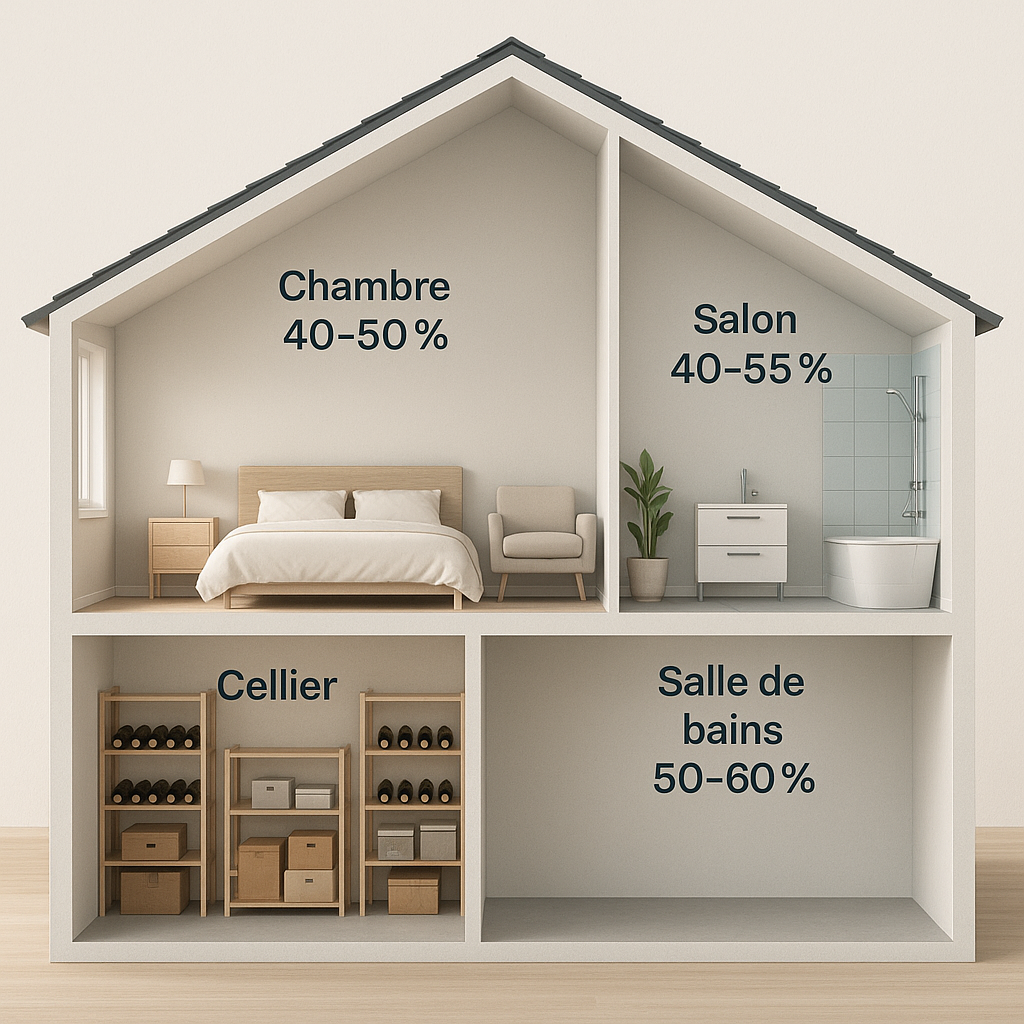
One might think a single rule suffices. In reality, each room imposes its constraints: the bedroom favors respiratory comfort, the bathroom experiences sporadic water input, the kitchen receives steam and cooking vapors, and the basement is often cooler and more humid. Adapting humidity levels to usage reduces microbial proliferation, improves thermal sensation, and protects the building.
Bedroom (comfort and health)
To sleep better and reduce mucous membrane dryness, aim for a level between 40% and 50%. Too low humidity (below 30%) dries respiratory tracts; too high (above 60%) promotes growth of mold and dust mites, responsible for allergies. Maintaining a stable range at night also limits awakenings related to dry throat or irritated eyes.
Living room, lounge and offices
In these living spaces, the optimal range is slightly wider: 40–55%. Slightly more humid air feels warmer at the same temperature, which can allow lowering the thermostat by one or two degrees without discomfort. This is a subtle but effective energy-saving lever.
Kitchen and bathroom
Humidity peaks during showering or cooking are accepted, but the air must drop quickly afterward. The target is 50–60% during use, with effective ventilation to bring the level back to 40–50% afterward. Without extraction, surfaces remain damp and mold settles within weeks on joints and paint.
Basement, garage, pantry
These spaces are often colder and thus more prone to condensation. Aim for 50–65% depending on temperature, but the real goal is to avoid condensation on walls and pipes: insulation and drainage are priorities. A basement consistently at 80% will quickly become a source of material deterioration.
| Room | Recommended Level | Main Risk |
|---|---|---|
| Bedroom | 40–50% | Allergies, comfort |
| Living room | 40–55% | Thermal comfort |
| Bathroom | 50–60% | Mold |
| Kitchen | 45–55% | Condensation |
| Basement | 50–65% | Deterioration |
“Maintaining relative humidity around 40–60% limits the survival of respiratory viruses and reduces microbial load on surfaces.”
Shaman & Kohn – Environmental Health (2009)
Danger of Too High Humidity: Health and Building
Beyond a certain threshold, humidity stops being comfortable and becomes dangerous. Too much water in the air quickly turns imperfections into visible problems: blistered paint, musty odors, black mold spots. But the most serious is health-related: chronic exposure to overly humid air increases the risk of asthma and respiratory infections.
Dust mites multiply when humidity exceeds 60%. Mold can release volatile organic compounds and allergenic spores; in vulnerable people, this triggers cough, rhinitis, and asthma exacerbations.
“A review shows that the presence of humidity and mold in housing is associated with a 30–50% increase in respiratory symptoms in children.”
Fisk et al. (2007)
Structurally, humidity promotes corrosion of metal elements, rots wooden frameworks, and deteriorates insulation. Repeated condensation creates a cycle: wet materials → loss of thermal efficiency → more humidity. Correcting this costs far more than prevention.
- Mold: health and visual damage.
- Condensation: stains and wallpaper peeling.
- Deterioration: wood rot and corrosion.
- Respiratory problems: worsening asthma and allergies.
According to WHO (World Health Organization, 2009), indoor humidity is a factor correlated with health risks related to indoor air quality. And according to ASHRAE (2017), the recommended comfort and biological risk reduction range is between 30% and 60%, with particular interest in maintaining 40–60% when temperatures are temperate.
Practical Cases: Window Condensation
If your windows show dew in the morning, it often means the ambient air has reached its dew point — liquid water forms on the cold surface. Solution: increase ventilation, lower humidity, or improve window insulation. Leaving curtains closed at night reduces air circulation and worsens the phenomenon.
Dehumidification Solutions: From Simple Actions to Professional Devices
Here we list immediate actions (daily habits), technical interventions (ventilation, insulation), and use of devices (dehumidifiers). The choice depends on severity: a slight excess can be managed by habits; persistent humidity requires diagnosis and targeted work.
Daily Actions and Ventilation
- Air out 5–10 minutes morning and evening to renew air without excessively cooling the home.
- Extract steam and odors at the source: hood during cooking, mechanical ventilation in the bathroom.
- Avoid indoor drying of laundry in living areas.
Installing or maintaining an efficient mechanical ventilation system remains one of the best investments to continuously control humidity. A properly sized mechanical fan evacuates humidity where it forms.
Dehumidifiers: Types and Uses
Two main types: condensation dehumidifiers (compressor) and adsorption dehumidifiers (desiccants). The first is effective from 12–15°C and consumes less at normal temperature; the second works better at low temperature and for construction sites.
| Type | Advantage | Disadvantage |
|---|---|---|
| Compressor | Good efficiency, economical above 20°C | Less effective below 12°C |
| Desiccant | Works at low temperature | Higher electrical consumption |
| Hybrid | Optimized for season | Higher purchase cost |
Choosing a device: look at air flow (m³/h), capacity in liters/day, and energy coefficient (W/l). For a standard apartment, a 10–20 L/day model suffices; for a damp basement, prefer equipment 20–30 L/day or more.
Insulation, Airtightness and Drainage
If humidity comes from the ground or exterior walls, no dehumidifier will solve the problem permanently. First invest in airtightness, peripheral drainage, and wall insulation. These interventions increase initial cost but avoid repeated repair expenses.
“Treating the source of humidity is more cost-effective than multiplying surface devices.”
Jeffrey B. Siegel, Professor, University of Toronto, ventilation and indoor air quality specialist
Additional Solutions
- Chemical absorbers (silica gel): useful for closets and small areas.
- Targeted heating: limit cold surfaces promoting condensation.
- Hydrophobic surfaces: paints and treatments for exposed walls.
Finally, regular monitoring with a hygrometer (digital, precise) allows you to act at the right time and avoid prolonged peaks. Placing a sensor in each main room provides a simple humidity map of your home.
Practical Methodology to Measure and Act
For reliable diagnosis: measure humidity at three times (morning, midday, evening) for 7 days, note temperature and identify rooms with regular peaks. Then prioritize interventions: ventilation → devices → insulation. If values remain >65% despite actions, call a professional to check airtightness defects or infiltration.
According to Mendell et al. (2011), interventions on ventilation and repair of humidity defects significantly reduce respiratory symptoms in sensitive households.
FAQ
What is the ideal humidity level for sleeping?
Aim between 40% and 50%. This range protects mucous membranes, limits dust mite proliferation, and promotes restorative sleep. If you have asthma, staying stable around 45% is often recommended.
Is the ideal humidity the same in summer and winter?
Not exactly. In winter, cold outside air contains less absolute humidity; maintaining 40–50% may require heating and ventilation. In summer, higher temperature makes 50–60% tolerable. The important thing is to avoid extremes and rapid fluctuations.
How do I know if I have a humidity problem?
Signs: black spots, musty smell, regular condensation on windows, recurring allergies. Measure with a hygrometer; chronic levels above 60% indicate a real problem requiring action.
Do plants reduce humidity?
No: plants often emit water (transpiration) and are not a dehumidification solution. They improve aesthetics and filter some compounds but do not replace ventilation or devices.
Which dehumidifier to choose for a basement?
For a cold basement, prefer a desiccant or a hybrid model specified for low temperature. Ensure sufficient capacity (20–30 L/day depending on volume) and continuous drainage if humidity is persistent.
Can too dry air also be a problem?
Yes: air too dry (<30%) causes dry skin, irritated mucous membranes, and increases transmission of some viruses. Balance is key: neither too dry nor too humid.
What to do if the problem persists despite a dehumidifier?
If humidity remains high, look for a source (leak, infiltration, capillary rise). Have a building diagnosis done: thermal camera, infiltration test, and point-by-point measurement. Repairing the source is often more cost-effective than multiplying devices.
Controls, Tests and Mistakes to Avoid
Common mistakes: ignoring cleaning of ventilation outlets, placing the hygrometer in direct drafts (false readings), buying an improperly sized device, or letting a dehumidifier clog with dust. Test interventions one by one — for example, run ventilation for a week before buying a device — and document measurements.
According to Fisk et al. (2007), interventions on the indoor environment (ventilation and leak repairs) often bring more health improvement than isolated actions.
Actionable Conclusion: What to Do Now
Here is a concrete plan:
- Measure humidity everywhere for 7 days (digital hygrometer).
- Ventilate: 5–10 minutes twice a day and use mechanical ventilation/hood.
- Treat sources: dry laundry outside, repair leaks, insulate cold walls.
- Invest if necessary in a suitable dehumidifier (capacity & type).
If you have children, elderly people, or asthma sufferers at home, prioritize stability around 45% ±5. In an older home, consider professional humidity diagnosis before major work.
“Measuring and acting quickly avoids much more costly repair work a few years later.”
National Environmental Health Agency – Technical Opinion (2018)