
Sommaire
Gnats in the House: Causes, Solutions, and Sustainable Prevention
| 📌 | Definition: gnats include several small flying insects attracted to moisture, organic waste, or fermented foods. |
| 🧭 | Common Origins: kitchen, sink, trash bin, damp potting soil, bathroom, and poorly ventilated areas. |
| ⚠️ | Key Point: killing the adults is not enough; the breeding site where larvae develop must be eliminated. |
| 🧪 | Useful Solutions: targeted cleaning, vinegar traps, maintenance of traps, watering management, and drying of surfaces. |
| ⏱️ | Realistic Timeline: a visible decrease may appear within 24 to 48 hours, but it often takes 7 to 10 days to break the full cycle. |
| 🌿 | Sustainable Prevention: a simple weekly routine addressing waste, moisture, plumbing, and indoor plants. |
They often appear without warning, buzzing around the fruit bowl, the sink, or the green plants, then seem to multiply within a few days. GNATS are not just annoying: their presence almost always reveals a source of moisture or poorly managed organic matter. By precisely understanding where they come from, you can choose the right method, avoid unnecessary treatments, and implement truly sustainable prevention.
Gnats in the House: What Exactly Are We Talking About?
People often lump all small flying insects together, even though they do not have the same behavior or breeding sites. Distinguishing gnats from mosquitoes or houseflies allows you to quickly find the right solution, as a fruit gnat is not treated the same way as a sink or potting soil gnat.
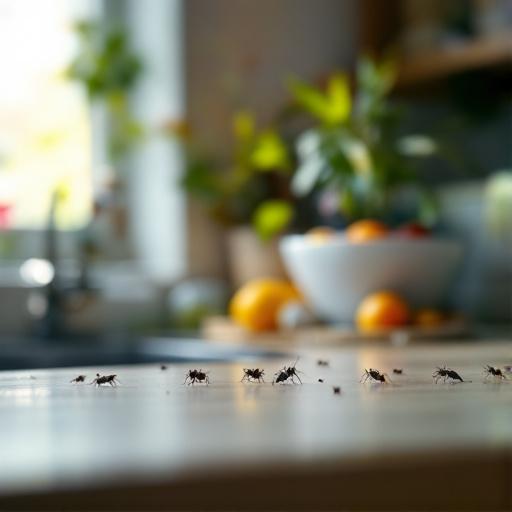
In a home, the most common species are drosophilids attracted to ripe fruits and fermented liquids, psychodids found near drains and pipes, and sciarids that proliferate in overly damp potting soils. Their common point is simple: they thrive in an environment rich in water and organic matter, with rapid reproduction when indoor temperatures are around 20 to 25 °C.
In practice, it is observed that residents often confuse a “general invasion” with a very localized breeding site. A few dozen visible adults in several rooms may actually come from a single point, for example a forgotten trash bin, a siphon clogged with deposits, or a plant saucer that remains wet for several consecutive days.
The Main Types of Gnats Present in the House
- Fruit Gnats: attracted to overripe foods, juices, wine, beer, compost, and sticky surfaces.
- Sink Gnats: linked to pipes, biofilms, and invisible residues present in drains.
- Plant Gnats: favored by compact and damp potting soil, especially in winter when ventilation decreases.
The right reflex is therefore to observe where they fly, when they are most active, and on what they land. It is this reading of the environment, much more than the simple number of insects, that allows effective action.
Why do I have fruit flies in the house?
The question comes up repeatedly, and the answer is rarely “by chance.” FRUIT FLIES take advantage of small daily imbalances: organic waste left out too long, condensation in a poorly ventilated room, overwatering plants, or superficial cleaning of damp areas. As long as these conditions persist, adults return, even after a thorough occasional cleaning.
According to the INSEE, a large part of the French residential stock is exposed to ventilation and indoor air quality issues; a poorly aired dwelling retains more humidity. Meanwhile, the ANSES on biocidal products reminds that chemical treatment does not replace eliminating the cause. In other words, spraying an insecticide without addressing the source is often an incomplete response.
The most common causes in the kitchen
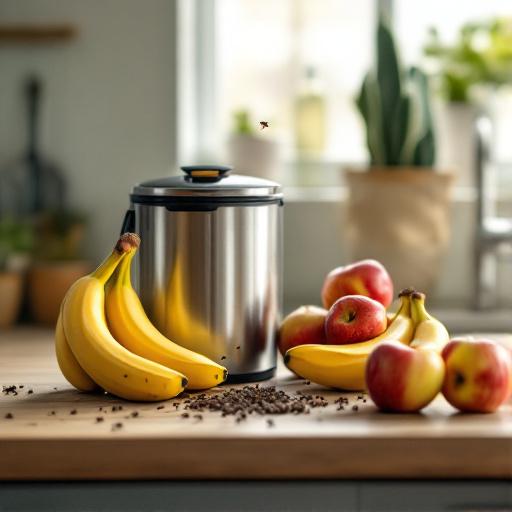
The kitchen remains the main hotspot in many cases. An overripe banana, a forgotten fruit basket, a sugary bottle bottom, an organic trash bin emptied too late, or splashes under small appliances are enough to attract fruit flies. If you notice short, quick flights near the countertop, it may be useful to compare your situation with these typical cases of fruit flies in the kitchen, as the treatment logic depends greatly on the food residues present.
The tricky point is that the surface may seem clean while the source hides elsewhere: under the trash bin, in a sticky seal, in the drip tray of an appliance, or at the drain. A single dirty spot a few centimeters wide can suffice if it remains damp for several days.
Common causes elsewhere in the house
Outside the kitchen, indoor plants are a classic source. Fungus gnats lay eggs in the top centimeters of constantly moist soil, especially if water pools in the saucer. The bathroom favors drain flies when traps accumulate hair, soap, and organic deposits. Finally, laundry rooms, rarely used toilets, and poorly ventilated rooms sometimes become secondary hotspots.
A cleaning professional observes that persistent infestations are often linked not to a lack of overall cleaning, but to a specific spot poorly maintained repeatedly. This is especially true in homes where windows remain mostly closed in winter or when drying laundry indoors without proper ventilation.
How to identify the source of fruit flies room by room?
To identify the source, you need to follow the adults where they return most often and check three types of hotspots: food, moisture, organic matter. Generally, a 10 to 15-minute observation in the affected rooms is enough to spot whether the problem comes from the kitchen, the sink, the plants, or a stagnant water area.
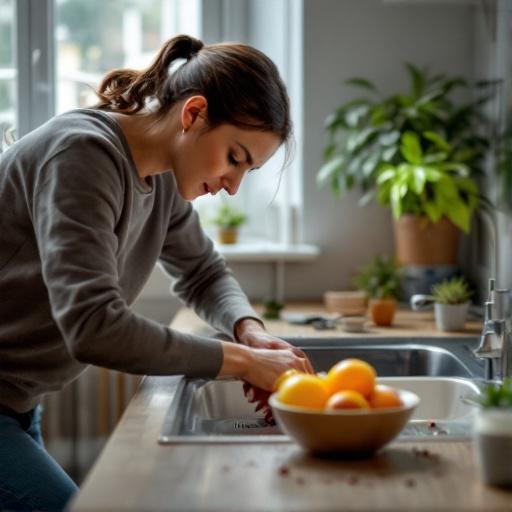
Start by looking at the areas where the fruit flies concentrate at the end of the day. If they hover around the fruit basket, compost, or open bottles, the source is probably food-related. If they stay near the drains, under the sink, or the toilets, the plumbing route becomes a priority. If they fly low around the pots, the plants are often the cause.
Quick diagnostic checklist
- Inspect the fruit basket, vegetables, opened bottles, and forgotten food.
- Check the trash bin, under the lid, the sorting bin, and kitchen compost.
- Open and smell the drains, traps, and under the sink to spot deposits and moisture.
- Check the plant saucers, potting soil, and superficial roots.
- Observe areas of condensation: bathroom, laundry room, window sills, washing machine.
If the presence concentrates near a drain, the treatment must be much more targeted than a simple trap. In this case, a guide dedicated to fruit flies in the sink can help you check the cleaning steps of the trap, the drain, and the internal walls, often neglected.
What solutions to effectively get rid of fruit flies?
The temptation is great to use only a spray or a homemade trap. However, lasting results come from a simple but complete strategy. First, remove what attracts or feeds the fruit flies, then clean the surfaces and corners where larvae develop, then only capture the remaining adults. Without this logic, the nuisance is reduced for a few hours, but the cycle restarts.
Immediate actions that work
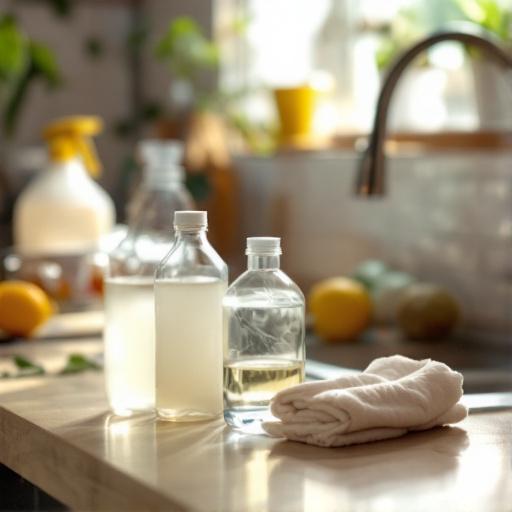
Start by throwing away very ripe fruits, emptying the trash bin, washing its lid, degreasing the countertop, and cleaning sticky surfaces. Rinse juice, beer, or wine bottles before storing them. Regarding the sink, if possible, dismantle the accessible drain and brush the soiled parts. For plants, let the top few centimeters of soil dry between waterings and empty stagnant water from the saucers.
In practice, the most stubborn hotspots are those cleaned “on the surface.” A trap may look clean while keeping an internal biofilm. A trash bin washed without cleaning the rim or the underside of the bag remains attractive. A plant watered a little less but never repotted can retain larvae in saturated substrate.
Targeted solutions according to the origin
| Probable origin | Typical signs | Priority action | Typical timeframe |
|---|---|---|---|
| Fruits / fermentation | Flying around fruits, bottles, compost | Remove the source + vinegar trap | 24 to 72 hours for a strong decrease |
| Sink / pipes | Presence near drains, especially morning and evening | Brushing, internal cleaning, repeat 2 to 3 days | 3 to 7 days |
| Indoor plants | Small low flights around pots | Reduce watering, dry the substrate, trap adults | 1 to 2 weeks |
The vinegar fruit fly trap remains useful for drosophilids, as the fermented smell attracts them well. However, it works less well against gnats originating from a siphon or very wet soil. That is why it should be considered as a complement, not as a universal solution.
Concrete examples according to the most affected areas of the house
The best strategy always depends on the actual infested room. A kitchen affected by drosophilids, a sink colonized by psychodids, and a Monstera pot filled with fungus gnats are not managed in the same way. By adapting the action to the area, one avoids treating too broadly and often obtains a faster result.
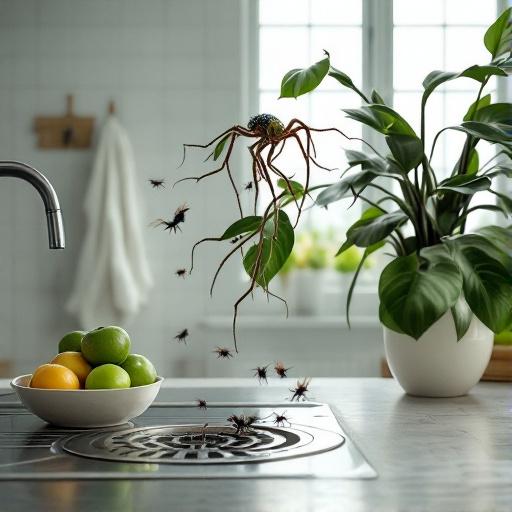
In the kitchen
The most common case combines a fruit basket, an organic trash bin, and some invisible residues on surfaces. One family reported that adults returned every morning despite daily cleaning; the real cause was a forgotten bag of onions in a warm cupboard and a sticky area behind the coffee maker. In this type of situation, you need to look beyond the immediate visible.
If you want to go faster on food-related scenarios, the detailed causes of gnats in the kitchen clearly show why fruits, fermented leftovers, and organic waste attract adults so quickly when the indoor temperature exceeds about 22 °C.
In the sink and pipes
Psychodids are often noticed when they remain resting near a washbasin or shower. Their presence signals organic deposits that adhere to the internal walls. In this case, pouring a random product is not always enough: you must first mechanically remove what sticks, then repeat the maintenance over several days. A simple “clean-up” can reduce adults without touching the larval source.
Using very hot water can help loosen some residues, but it must be accompanied by brushing and cleaning accessible areas. According to ANSES, the use of biocidal products must remain reasoned, respecting usage precautions; for gnats, source sanitation is generally more relevant than systematic spraying.
In indoor plants
Fungus gnats mainly settle in pots where water drains poorly. Plants like Monstera, pothos, or certain ficus do not tolerate a soggy substrate over time, and this environment also benefits the larvae. Here, the priority is to let the top few centimeters dry out, aerate the substrate, reduce stagnant water, and, if necessary, repot in a more draining soil.
For a case focused on pots and substrate, this file on plant gnats usefully complements the actions to take without weakening the plant itself.
Durable prevention: how to avoid the return of gnats?
Durable prevention is based on a simple idea: prevent a small humid and organic hotspot from remaining active for several days. In practice, this means storing food more cleanly, emptying organic waste quickly, maintaining traps, ventilating humid rooms, and adjusting plant watering. Regularity matters more than occasional deep cleaning.

ADEME reminds, in its content on ventilation and indoor air, the importance of regular air renewal to limit humidity and condensation. This is not an “anti-gnat” solution in itself, but it is a useful link in prevention. Likewise, public data released by Data.gouv.fr and publications from INSEE show how much housing conditions influence indoor humidity, a factor often underestimated in infestations.
A home does not attract gnats “by nature”: it either offers them or not a place where their cycle can complete. All prevention lies in this detail.
Weekly habits to adopt
- Empty organic waste every 1 to 2 days during warm periods.
- Wash the trash bin, its lid, and the floor area at least once a week.
- Brush drains and rinse traps regularly, especially in seldom-used rooms.
- Monitor fruit ripeness and avoid storing opened food for long periods.
- Let the soil dry slightly between waterings and do not leave water in saucers.
- Ventilate humid rooms after showering, cooking, or drying laundry.
If you’re looking for a quick strategy when the infestation has just started, these tips to eliminate gnats in 24 hours can be useful, provided they are combined with treating the source. Without this second step, the result rarely lasts more than a few days.
FAQ about gnats in the house
Are gnats dangerous?
They are mainly nuisances rather than truly dangerous in an ordinary home. However, their presence can signal a localized hygiene issue, excess humidity, or poorly managed organic waste. Near food, it is better to act quickly to avoid any surface contamination.
Can gnats be eliminated in 24 hours?
Yes, the number of visible adults can often be greatly reduced in 24 to 48 hours with targeted cleaning and traps. However, if larvae remain in the trap, soil, or waste, the infestation restarts. The realistic timeframe to stabilize the situation is often 7 to 10 days.
Is baking soda or boiling water enough?
Not always. These actions can help loosen some of the residues in certain pipes, but they do not replace mechanical scrubbing and repeated cleaning. If organic deposits remain stuck to the walls, the fruit flies continue to reproduce.
Why do fruit flies come back after cleaning?
Most often, it is because a hidden breeding site has not been treated: under the trash bin, bottom of the basket, sticky seal, wet saucer, or clogged trap. The visible adults are only the easiest part to see. As long as the laying area remains, the return is frequent.
Is bleach recommended against fruit flies?
It is generally not the first solution to prioritize. It can disinfect certain surfaces, but it is not necessarily the most effective against biofilms or hidden larvae. ANSES recommends using biocidal products with caution and first addressing the material cause of the problem.
Do fruit flies disappear in winter?
Not necessarily, because the inside of a home often remains heated between 19 and 22 °C, a range compatible with their cycle. In winter, overwatered plants, poorly ventilated rooms, and waste stored longer can even maintain the problem. The season therefore does not replace prevention.