Sommaire
| Key Points | Details to Remember |
|---|---|
| 📌 Definition | ST25 = commonly used welded mesh for slabs and floors |
| ⚙️ Composition | Welded wires in steel, mesh and diameter vary |
| 🧭 When to use | Concrete slabs, screeds, light foundations |
| 🔬 Choice | Diameter, mesh, steel quality, CoA certificate |
| 🔁 Alternatives | ST20, ST25C, galvanized or electro-welded mesh |
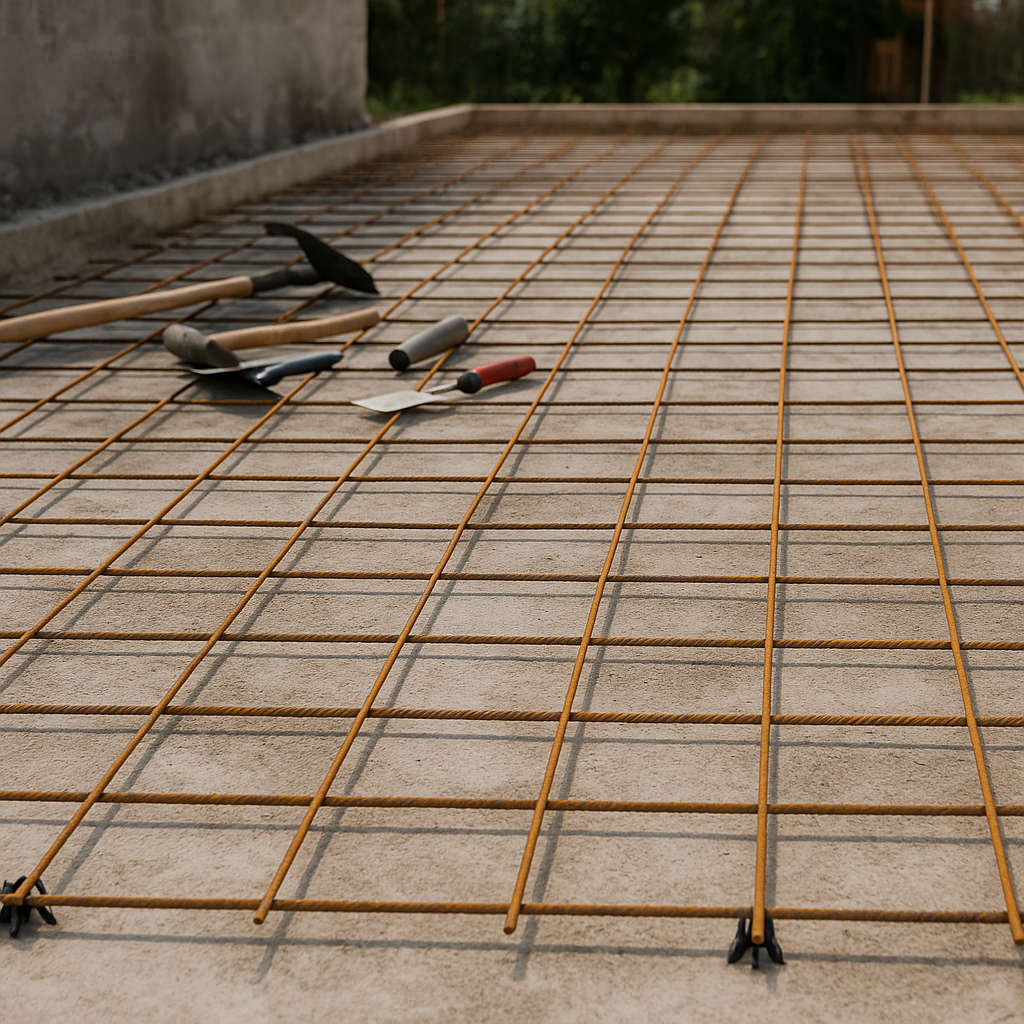
The ST25 welded mesh is a widespread solution to reinforce concrete in slabs, screeds, and small foundations. Easy to install, it offers a good cost/performance ratio when stresses remain modest. But how to navigate between the different types (ST20, ST25, ST25C), which rules to follow, and above all how to choose the right mesh for a given site? This practical guide answers point by point, with technical criteria, comparison, and implementation advice to limit cracks and ensure durability.
Quick verdict and recommendations
In summary: ST25 is recommended for residential slabs, interior screeds, and light walkways. It combines efficiency and ease of installation, but is not universal: for rare spans, heavy loads, or dynamic stresses, other reinforcements are more suitable. Overall rating: 7.5/10.
- Pros: quick installation, controlled cost, good resistance to shrinkage cracks.
- Cons: limited for heavy loads, requires overlap and corrosion protection.
Recommended for: homeowners, craftsmen, project managers on non-structural projects (house slabs, garages, screeds). For load-bearing structures, consult a concrete engineer.
What is an ST25: characteristics and meaning
The acronym ST25 identifies a category of welded mesh where the number usually refers to the nominal wire diameter or a commercial designation. In common practice, ST25 consists of steel wires welded at intersections, forming a regular mesh. This structure limits the development of shrinkage cracks and distributes tensile forces in the concrete layer.
On a product sheet, you will find three key indications: wire diameter, mesh dimensions (e.g., 150 x 150 mm), and length/width of the sheets. These elements determine mechanical performance and ease of installation.
The steel quality, often compliant with European standards, influences toughness and corrosion resistance. A certificate of conformity (CoA) is proof that must be requested for any professional quantity purchase.
“Choosing the mesh is not just about price: mesh geometry, diameter, and anti-corrosion treatment determine the durability of a slab.”
Jean Martin, Materials Engineer, CSTB, concrete reinforcement specialist (20 years experience)
Composition and manufacturing variants
Two main processes dominate: electrowelding and resistance welding. The result is a flat sheet, delivered in rolls or panels. Some meshes include a galvanized treatment to resist moisture, useful outdoors or in persistent water contact.
Manufacturers also specify packaging: sheets that stack easily and marking for site identification. To consider during purchase and storage.
Types of mesh: ST25 and relatives
Several types exist: electrowelded mesh, galvanized mesh, panel welded mesh, and commercial variants like ST20, ST25, and ST25C. Each variant meets a range of uses and constraints.
Main technical differences
- ST20: thinner wire, suitable for light screeds and superficial slabs.
- ST25: robust compromise for slabs and small foundations.
- ST25C: reinforced or treated version (C for “corr”), often galvanized or with stronger wires.
Choice is made by comparing diameter, mesh, and anti-corrosion treatment. For most domestic applications, ST25 offers an interesting safety margin without excessive extra cost.
“Eurocode 2 reminds that in the absence of continuous longitudinal reinforcement, welded meshes effectively reduce surface cracking but must not replace reinforcement sized for bending.”
EN 1992-1-1 (Eurocode 2) – 2004
Comparison table: ST20 vs ST25 vs ST25C
| Characteristic | ST20 | ST25 | ST25C |
|---|---|---|---|
| Wire diameter | ~2.0 mm | ~2.5 mm | 2.5 mm + treatment |
| Typical use | screeds, lightly stressed slabs | domestic slabs, sidewalks | outdoors, wet areas |
| Corrosion protection | standard | standard | galvanized / reduced corrosion |
| Relative price | lowest | medium | higher |
When to use an ST25: applications and limits
ST25 is commonly recommended for:
- House slabs: medium thickness, domestic loads.
- Screeds: improved surface tensile behavior.
- Pedestrian walkways and terraces: support for light point loads.
- Repairs: local reinforcement under repair concrete layer.
Conversely, avoid ST25 for:
- Load-bearing structures sized (beams, long load-bearing slabs), where longitudinal reinforcement is necessary.
- Industrial zones with heavy traffic or high dynamic loads.
- Highly corrosive environments (saltwater, aggressive products) without anti-corrosion treatment.
Concrete application examples
On a 15 cm interior slab, installing an ST25 with 20 cm overlap and C25/30 concrete provides good resistance to shrinkage cracks. Outdoors, prefer a galvanized ST25 (type ST25C) to limit corrosion.
“According to NF EN 10080, weldability and mechanical performance of welded wires must be verified by certificates. Never substitute the technical sheet for the supplier’s certificate.”
NF EN 10080 – 2005
How to choose an ST25: precise criteria
Correct choice requires evaluating four axes: wire diameter, mesh size, anti-corrosion treatment, and normative compliance.
1. Wire diameter
Diameter directly influences tensile strength. A thicker wire better withstands cracking forces. For ST25, verify that the displayed diameter matches the commercial designation and site needs.
2. Mesh size and shape
The mesh (e.g., 150 x 150 mm) conditions stress distribution. Smaller meshes improve distribution but increase cost. Choice depends on concrete nature and slab span.
3. Anti-corrosion treatment
Galvanization, electrolytic coating, or stainless steel: choose according to exposure. By the sea or in wet areas, galvanization is almost indispensable.
4. Standards and certificates
Request CoA and technical sheet. Documents must indicate manufacturing standard (e.g., NF EN 10080) and mechanical values (yield strength, tensile strength).
- Overlap: respect prescribed lengths (often 20–30 cm depending on thickness).
- Concrete cover: maintain minimal cover (e.g., 3–5 cm) to prevent corrosion.
- Installation: plastic spacers to ensure correct height clearance.
Installation and best practices on site
A common mistake: placing the mesh directly on the ground. The mesh must be positioned in the middle of the effective concrete thickness (or slightly towards the upper part for screeds) using spacers. Without this support, the reinforcement loses effectiveness during pouring.
Key steps
- Preparation: clean surface, firmly fixed formwork.
- Placement: unroll sheets, respect overlaps.
- Support: use spacers and ties to avoid slipping.
- Control: check cover and absence of visible corrosion before pouring.
For heated slabs or specific floors, adjust positioning to avoid direct contact with ducts or pipes.
“On most domestic sites, poor concrete cover is the main cause of long-term failure.”
Technical observations, Quality Service, GROUPE BTP France – 2019
Alternatives and practical comparison: ST20 / ST25 / ST25C
The simple rule: the higher the number (and treatment), the more robustness and cost. Here’s how to choose according to need:
- Tight budget: ST20 for non-load-bearing interior screeds.
- Standard use: ST25 for domestic slabs and walkways.
- Wet exposure or mechanical stress: ST25C (galvanized) or alternative stainless system.
One might think ST25 is always enough; in reality, nuance comes from long-term stresses and environment. Also, for structures subject to concentrated loads (e.g., garage for heavy vehicle), add sized longitudinal reinforcement.
Quick choice criteria (check-list)
- Type of structure: slab, screed, foundation.
- Exposure: interior / exterior / marine.
- Loads: pedestrian, car, machinery.
- Budget: cost of anti-corrosion treatments.
- Standards: request CoA and EN/NF compliance.
Errors to avoid and expert advice
Avoid these pitfalls:
- Installing without spacers: risk of reinforcement on surface.
- Omitting overlaps: break in mechanical continuity.
- Ignoring corrosion: significant reduction in lifespan.
Practical advice: store sheets on pallets and protected from rain. If the mesh is wet, dry before pouring or choose a galvanized version.
Costs, supply, and durability
Price varies according to diameter, steel quality, and treatment. In volume, mesh remains an economical solution. Request quotes mentioning CoA and delivery conditions. Serious suppliers provide documentary tracking (batch, mechanical test).
Durability: a properly covered galvanized mesh often lasts several decades. Without protection, corrosive attack may appear in 10–20 years depending on environment.
Sources, standards, and technical references
For further reading:
- EN 1992-1-1 (Eurocode 2) — design of reinforced concrete structures.
- NF EN 10080 — rules relating to steel for welded reinforcements.
- CSTB: practical guides on concrete and reinforcement (technical documents).
“According to EN 1992-1-1 (2004), tensile cracking must be controlled by appropriate reinforcements.”
“According to NF EN 10080 (2005), mechanical characteristics of wires are required on certificate.”
FAQ — Frequently Asked Questions
Short and actionable answers for your doubts about ST25.
1. Is ST25 sufficient for a garage slab?
For a domestic garage, ST25 is suitable if the slab is properly sized (thickness ≥15 cm) and loads remain moderate. For heavy traffic frequency, add longitudinal reinforcements.
2. What is the minimum concrete cover?
Respect the recommended cover (generally 30–50 mm for exterior slabs). The goal is to protect steel from moisture and corrosive agents.
3. How to overlap two sheets?
Respect the prescribed overlap (often 20–30 cm). Use crimped ties or staples to maintain mechanical continuity.
4. Can ST25 be placed on a gravel bed?
Yes, provided spacers are used and sufficient cover is ensured. The gravel bed must be stable and compacted to avoid settling.
5. Galvanized vs non-galvanized ST25: which to choose?
In dry interiors, non-galvanized is acceptable; outdoors or in wet areas, prefer galvanized (ST25C) to limit long-term corrosion.
6. Which mesh to choose to avoid cracks?
Tighter meshes improve stress distribution. For domestic slabs, a 150 x 150 mm mesh is common; adapt according to specification.
7. Does the mesh replace longitudinal reinforcement?
No. The mesh controls surface cracks but does not replace reinforcement sized for bending in load-bearing elements.
8. How to verify batch conformity?
Request the CoA, check batch traceability, and inspect on site for absence of visible defects (broken welds, corrosion).
9. What concrete thickness for ST25?
For domestic slabs, 12–18 cm is common; 15 cm is a good compromise. For heavier loads, increase thickness or reinforce reinforcement.
10. Can the mesh be bent on site?
Sheets can be slightly bent to follow shapes, but avoid severe folds that weaken welds and mechanical continuity.