
Sommaire
Are you considering reducing noise disturbances in your home studio, living room or office? Between acoustic foam, rock wool and decorative panels, each solution has its own specificities. This article breaks down their performance, implementation and value for money to guide you towards the system best suited to your project.
| Material | Absorption (at 500 Hz) | Insulation | Average price | Installation |
|---|---|---|---|---|
| 🧩 Acoustic foam | 0.4 to 0.8 αw | low | € | simple gluing |
| 🧧 Rock wool | 0.6 to 0.9 αw | medium | €€ | embedded or fixed |
| 🧶 Acoustic panels | 0.45 to 1.0 αw | variable | €€€ | wall mounting |
| 🧢 Mixed solution | optimal | optimal | €€€ | more complex |
To refine your choice, this soundproofing comparison details the strengths and limits of each option, illustrating how they affect sound waves and transmission.
Why soundproof a room?
One might think that a simple rug already provides a first barrier to noise, but the acoustics of a space obey more subtle physical laws. Absorption limits echo inside, while insulation blocks incoming or outgoing noise. Whether you want a home studio worthy of a pro or a cocoon against traffic noise, the requirements are not the same.
Comparison of materials
Acoustic foam
Foam is often chosen for its modest cost and quick installation. Made of polyurethane or melamine, it has a decent absorption coefficient for mid and high frequencies. In practice, trapezoids or pyramids capture echo in a small to medium-sized room without breaking the budget.
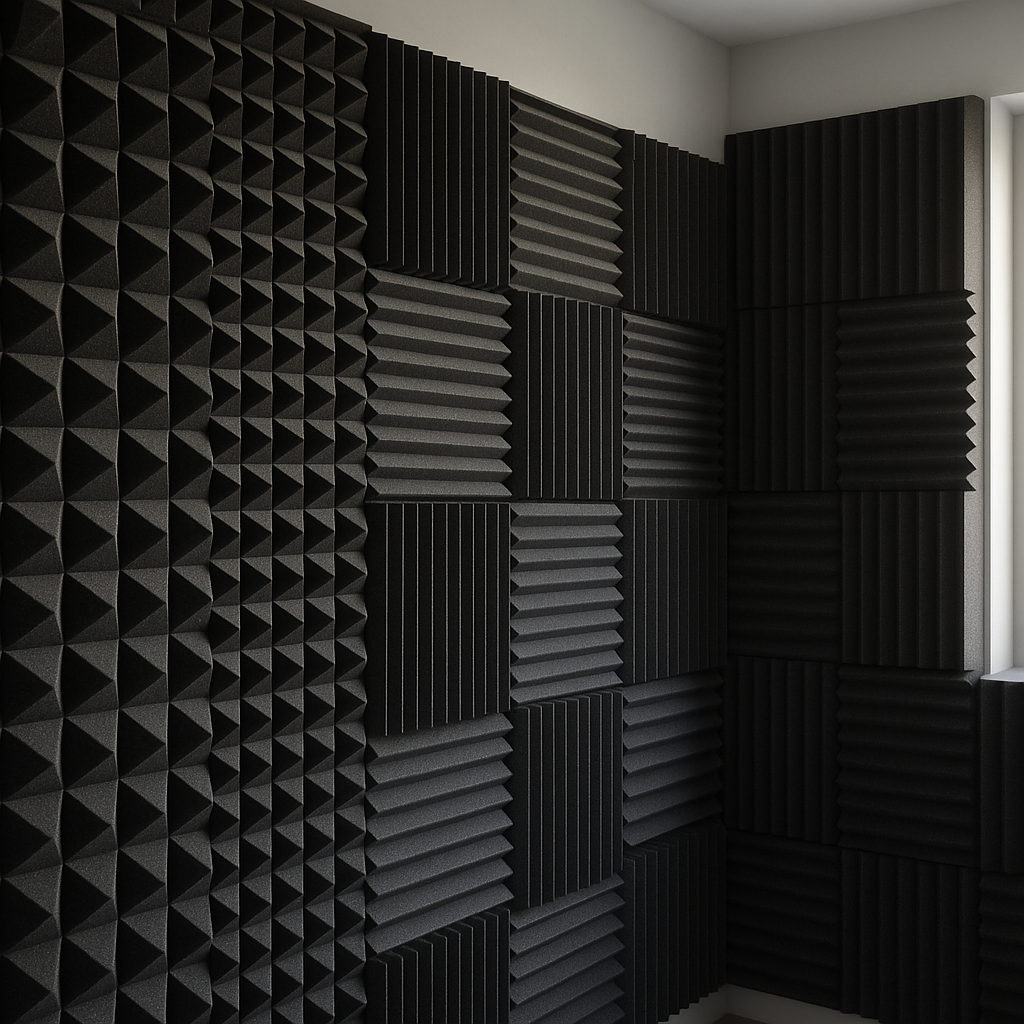
- Advantages: lightweight, easy to cut, self-adhesive.
- Limits: low density, limited sound insulation.
In a recording corner, foam may suffice to tame reverberations, but it will not stop street noise.
Rock wool
Introduced in the building industry for its insulating power, rock wool offers a compromise between absorption and sound blocking. Its mineral fibers, often combined with a facing, intercept a wide frequency range. Installation, which involves embedding between a frame or fixing behind a facing, requires a bit more care (gloves, mask).

- Strengths: excellent acoustic inertia, fire resistant.
- Constraints: fiber dust, necessary thickness.
Acoustic panels
Beyond function, these panels play on aesthetics. Made from wood wool, polyester or recycled fibers, they are fixed like a picture. Performance varies according to density and thickness, but the most expensive rival rock wool while offering a refined finish.
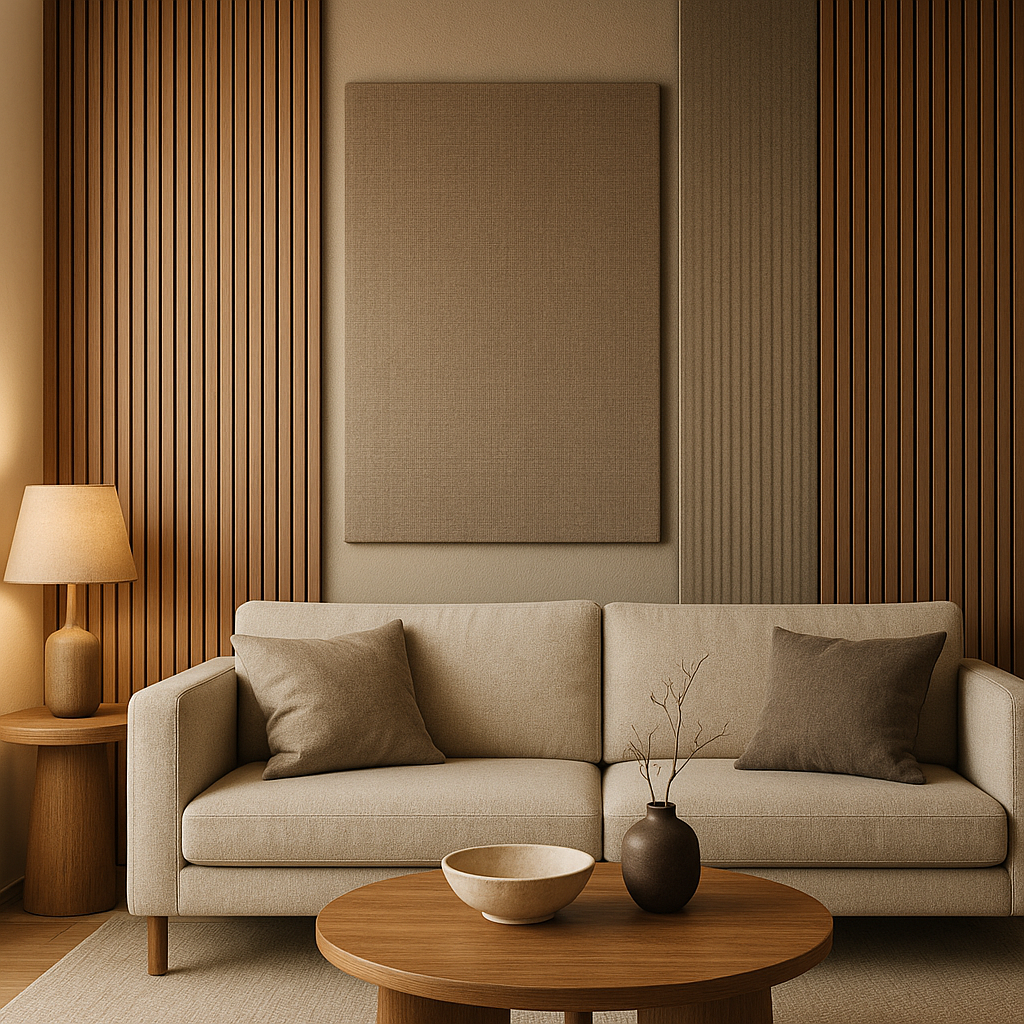
- Assets: customizable look, non-invasive mounting.
- Drawbacks: higher budget, efficiency linked to density.
Choice criteria according to use
Home studio and rehearsal room
When every decibel counts, foam and rock wool are often combined. The former traps high frequencies close to the sources, the latter attenuates bass and protects against external noise. The operation may require multi-layer treatment, but the result justifies the effort for clearer recording.
Living room, office or home cinema room
If the goal is not Dolby Surround but acoustic comfort, decorative panels are a good solution. Their design integrates into an interior while the fibrous structure softens the space. You limit resonance effects without turning the room into a sterile studio.
Verdict and recommendations
Each material finds its place depending on the goal and budget. For a purely absorbing result, foam remains an entry-level choice. Rock wool offers a middle ground between absorption and insulation. Finally, acoustic panels combine utility and style, provided you accept a higher cost. Often, combining several techniques guarantees an optimal result: foam for primary treatment, rock wool for structure, panels for aesthetics and comfort.
FAQ
Does acoustic foam block external noise?
No, it mainly absorbs internal reflections. To reduce ambient noise, a greater mass like rock wool or a specific partition is needed.
Does rock wool withstand humidity?
It generally resists ambient humidity, but a vapor barrier and good ventilation are essential to avoid excessive condensation.
Can I paint my acoustic panels?
Some finishes accept light acrylic paint, but it is advisable to choose light colors and a neutral pH to avoid altering absorption.
Which material offers the best value for money?
With comparable performance, rock wool remains the most balanced, especially if you install it yourself.
How to install panels without drilling walls?
Adhesive systems or lightweight rails allow fixing elements without drilling, provided maximum loads are respected.