
Sommaire
.mib-widget{–mib-accent:#4f46e5;–mib-bg:#f8fafc;–mib-border:#e2e8f0;–mib-text:#0f172a;–mib-muted:#475569;border:1px solid var(–mib-border);background:var(–mib-bg);border-radius:14px;padding:20px 22px;margin:28px 0;font-family:inherit;color:var(–mib-text);line-height:1.5;box-shadow:0 1px 2px rgba(15,23,42,.04)}
.mib-widget *{box-sizing:border-box}
.mib-title{margin:0 0 6px;font-size:1.15em;font-weight:700;color:var(–mib-text)}
.mib-description{margin:0 0 14px;color:var(–mib-muted);font-size:.95em}
.mib-field{display:flex;flex-direction:column;gap:4px;margin-bottom:12px}
.mib-field label{font-weight:600;font-size:.9em;color:var(–mib-text)}
.mib-field input,.mib-field select{padding:9px 11px;border:1px solid var(–mib-border);border-radius:8px;font-size:1em;background:#fff;color:var(–mib-text);width:100%}
.mib-field input:focus,.mib-field select:focus{outline:2px solid var(–mib-accent);outline-offset:1px}
.mib-btn{appearance:none;border:0;background:var(–mib-accent);color:#fff;font-weight:600;font-size:.95em;padding:10px 18px;border-radius:8px;cursor:pointer;margin-top:4px}
.mib-btn:hover{filter:brightness(1.06)}
.mib-btn[disabled]{opacity:.5;cursor:not-allowed}
.mib-result{margin-top:14px;padding:14px 16px;border-radius:10px;background:#fff;border:1px solid var(–mib-border)}
.mib-result–good{border-color:#86efac;background:#f0fdf4}
.mib-result–warning{border-color:#fde68a;background:#fffbeb}
.mib-result–danger{border-color:#fca5a5;background:#fef2f2}
.mib-result .mib-btn{display:block;margin-top:14px}
.mib-result .mib-cta{display:inline-block}
.mib-result-title{font-weight:700;margin:0 0 4px}
.mib-result-value{font-size:1.4em;font-weight:800;color:var(–mib-accent);margin:0 0 6px}
.mib-q{margin:0 0 12px}
.mib-q-text{font-weight:600;margin:0 0 8px}
.mib-options{display:flex;flex-direction:column;gap:8px}
.mib-option{display:block;width:100%;text-align:left;padding:10px 14px;border:1px solid var(–mib-border);border-radius:8px;background:#fff;color:var(–mib-text);cursor:pointer;font-size:.95em}
.mib-option:hover{border-color:var(–mib-accent)}
.mib-option–correct{border-color:#86efac;background:#f0fdf4}
.mib-option–wrong{border-color:#fca5a5;background:#fef2f2}
.mib-explain{font-size:.88em;color:var(–mib-muted);margin:8px 0 0}
.mib-progress{font-size:.82em;color:var(–mib-muted);margin:0 0 10px}
.mib-cta{display:inline-block;margin-top:12px;font-weight:600;color:var(–mib-accent);text-decoration:none}
.mib-cta:hover{text-decoration:underline}
.mib-disclaimer{margin:14px 0 0;font-size:.8em;color:var(–mib-muted);font-style:italic}
.mib-noscript{font-size:.9em;color:var(–mib-muted)}
@media (max-width:520px){.mib-widget{padding:16px}}
/*!
* Magic Interactive Blocks — runtime maison (BUILD MIB-V1, 2026-06-21)
*
* Ce fichier est INLINÉ dans l’article publié (via ),
* car la page WordPress du client ne charge pas les assets de Magic. Il n’est JAMAIS généré par l’IA.
*
* Sécurité :
* – Aucune eval / new Function. Les calculs n’utilisent QUE des formules whitelistées (FORMULAS).
* – Tout texte issu de la config (titre, labels, résultats) est inséré via textContent — jamais innerHTML.
* – La config est lue depuis l’attribut data-mib-config (déjà validée + échappée côté serveur).
*
* Après toute modification de ce fichier : `php cli/build-js-minify.php`
* (Apache sert le .min.js ; le Renderer inline le .min.js s’il existe, sinon ce fichier).
*/(function(){
‘use strict’;if(window.MagicInteractiveBlocks){try{window.MagicInteractiveBlocks.init();}catch(e){}return;}var FORMULA_ARGS={bmi:[‘height’,’weight’],loan_monthly_payment:[‘principal’,’annual_rate’,’months’],percentage:[‘part’,’total’],surface_cost:[‘surface’,’price_per_unit’],simple_ratio:[‘numerator’,’denominator’],custom_linear:[‘x’,’slope’,’intercept’]};var FORMULAS={bmi:function(height,weight){var m=height/100;return m>0?weight/(m*m):NaN;},loan_monthly_payment:function(principal,annualRate,months){var r=annualRate/100/12;if(!months)return NaN;if(r===0)return principal/months;var p=Math.pow(1+r,months);return principal*r*p/(p-1);},percentage:function(part,total){return total?(part/total)*100:0;},surface_cost:function(surface,pricePerUnit){return surface*pricePerUnit;},simple_ratio:function(numerator,denominator){return denominator?numerator/denominator:0;},custom_linear:function(x,slope,intercept){return slope*x+intercept;}};function el(tag,cls,text){var n=document.createElement(tag);if(cls)n.className=cls;if(text!=null)n.textContent=text;return n;}function safeUrl(u){u=String(u||”);return/^(https?://|/|#)/i.test(u)?u:’#’;}function ctaLink(cta){if(!cta||!cta.label)return null;var a=el(‘a’,’mib-cta’,cta.label);a.href=safeUrl(cta.url);if(/^https?:/i.test(a.getAttribute(‘href’))){a.target=’_blank’;a.rel=’noopener’;}return a;}function round2(v){return Math.round(v*100)/100;}function matchBand(bands,val){if(!Array.isArray(bands))return null;for(var i=0;i=lo&&val=questions.length)return showScore();var q=questions[idx];clear();body.appendChild(el(‘p’,’mib-progress’,’Question ‘+(idx+1)+’ / ‘+questions.length));var block=el(‘div’,’mib-q’);block.appendChild(el(‘p’,’mib-q-text’,q.text||”));var opts=el(‘div’,’mib-options’);var answered=false;(q.answers||[]).forEach(function(a){var btn=el(‘button’,’mib-option’,a.label||”);btn.type=’button’;btn.addEventListener(‘click’,function(){if(answered)return;answered=true;if(a.correct){correct++;btn.className=’mib-option mib-option–correct’;}else{btn.className=’mib-option mib-option–wrong’;}if(a.explanation)block.appendChild(el(‘p’,’mib-explain’,a.explanation));var next=el(‘button’,’mib-btn’,idx+1>=questions.length?’Voir mon score’:’Question suivante’);next.type=’button’;next.addEventListener(‘click’,function(){idx++;showQuestion();});block.appendChild(next);});opts.appendChild(btn);});block.appendChild(opts);body.appendChild(block);}function showScore(){clear();var pct=questions.length?Math.round((correct/questions.length)*100):0;var box=el(‘div’,’mib-result mib-result–good’);box.setAttribute(‘role’,’status’);box.appendChild(el(‘div’,’mib-result-value’,correct+’ / ‘+questions.length+’ (‘+pct+’%)’));var band=matchBand(cfg.score_results,pct);if(band){if(band.title)box.appendChild(el(‘div’,’mib-result-title’,band.title));if(band.text)box.appendChild(el(‘p’,null,band.text));}var again=el(‘button’,’mib-btn’,’Recommencer’);again.type=’button’;again.addEventListener(‘click’,function(){idx=0;correct=0;showQuestion();});box.appendChild(again);body.appendChild(box);}showQuestion();}function initWidget(node){if(node.getAttribute(‘data-mib-ready’)===’1′)return;var body=node.querySelector(‘.mib-body’);if(!body)return;var cfg;try{cfg=JSON.parse(node.getAttribute(‘data-mib-config’)||'{}’);}catch(e){return;}node.setAttribute(‘data-mib-ready’,’1′);var type=node.getAttribute(‘data-mib-type’)||cfg.type;try{if(type===’calculator’)renderCalculator(body,cfg);else if(type===’diagnostic’)renderDiagnostic(body,cfg);else if(type===’quiz’)renderQuiz(body,cfg);}catch(e){}}function init(){var nodes=document.querySelectorAll(‘.mib-widget[data-mib-config]’);for(var i=0;i<nodes.length;i++)initWidget(nodes[i]);}window.MagicInteractiveBlocks={init:init};if(document.readyState==='loading'){document.addEventListener('DOMContentLoaded',init);}else{init();}})();
Washing machine broken down: the method to diagnose without error
A broken washing machine rarely gives a clear answer at first glance. Water remaining in the drum, soaked laundry, blocked porthole, worrying noise during spinning, program stopping: the same symptom can come from a clogged filter, a worn part, or an electronic fault.
The right approach is to start from the visible symptom, check the simple causes, then decide whether repairing the washing machine is reasonable to do yourself or if it is better to call a professional. The goal is simple: save time, avoid replacing a part at random, and limit unnecessary expenses.
In brief
🔎 A broken washing machine is first diagnosed by its main symptom: draining, water inlet, spinning, leak, noise, or blocked porthole.
🛠️ The most accessible causes are often a clogged pump filter, a kinked hose, an overload of laundry, or a dirty seal.
⚠️ Faults related to the electronic board, motor, bearings, heating element, or wiring require more caution, especially if the appliance needs to be disassembled.
✅ The right reflex: unplug the appliance, turn off the water if necessary, check the simple elements, then decide between repair and replacement depending on age, cost, and recurrence of faults.
Why is a washing machine breakdown not always what it seems?
A broken washing machine is not just a defective part. The symptom helps guide the diagnosis, but it is not enough to prove the cause. If the appliance no longer drains, no longer heats, leaks, or is stuck on the door, the fault can range from simple dirt buildup to an electronic failure.
This is precisely where many mistakes begin. You see water in the drum, and immediately blame the pump. You hear a metallic noise, and instantly think of the bearings. You read an error code, and order a part. Yet, in practice, a clogged filter, a blocked hose, or poor distribution of laundry can produce symptoms very similar to a more serious breakdown.
The symptom points in a direction, not a verdict: replacing a part without verification often amounts to repairing blindly.
The most reliable method is to proceed from the simplest to the most technical. First, observe: at what point does the cycle stop? Then, check: does the water arrive, drain, heat, does the drum turn? Finally, decide: is the problem accessible without risky disassembly or does it require a professional diagnosis?
This logic avoids two common pitfalls: underestimating a dangerous fault, such as an internal leak near electrical components, or overestimating a simple problem, like a pump filter clogged by a coin, a button, or a forgotten wipe.
What symptom to observe when a washing machine breaks down?
The first reflex is to identify the dominant behavior: the washing machine no longer drains, does not take in water, no longer spins, makes noise, leaks, or keeps the door locked. This simple classification already greatly reduces the possible causes before any intervention.
Here is a useful reading grid to move from observation to probable cause, without skipping steps. It does not replace the manufacturer’s manual or an on-site diagnosis, but it provides a solid basis to avoid hasty assumptions.
| Observed Symptom | Common Causes to Check | Accessible Action | When to Stop |
|---|---|---|---|
| Washing machine no longer drains | Clogged pump filter, bent drain hose, blocked pump | Clean the filter, check the hose, listen if the pump runs | If the pump hums without draining or if a leak appears |
| Washing machine does not take in water | Closed tap, pinched hose, dirty inlet filter, solenoid valve | Check the water supply and the hose | If water arrives but the machine remains silent |
| Washing machine does not spin | Overload, belt, motor, sensor, door safety | Lighten the drum and restart a short cycle | If the drum remains immobile despite a normal load |
| Washing machine makes spinning noise | Imbalance, stuck object, shock absorbers, bearings | Distribute the laundry, check the drum by hand | If the metallic noise returns every cycle |
| Washing machine leaks water | Seal, hose, detergent drawer, pump, door not properly closed | Identify the wet area without disassembling under power | If the leak comes from underneath or inside |
Washing machine that no longer drains
When water remains in the drum at the end of the cycle, the pump filter is often the first suspect. This filter collects small objects and fibers that can hinder drainage. An impossible drain can also come from a hose pushed in too far, bent behind the appliance, or partially blocked.
Before blaming the drain pump, it is therefore necessary to look at accessible elements. A pump can be perfectly functional but blocked by an object. Conversely, if the filter is clean, the hose is not bent, and the machine hums without draining, the intervention becomes more technical.
Washing machine that does not take in water
A program that starts but leaves the drum empty points to the water supply. The tap may be closed, the hose pinched, or the small inlet filter dirty. The solenoid valve, which controls water entry, can also be at fault, but it should not be replaced without prior verification.
It is also necessary to consider the door lock. On many washing machines, if the door is not properly locked, the appliance may refuse to start the water intake. In other words, a door problem can resemble a water supply failure.
Washing machine that no longer spins or spins poorly
An immobile drum does not automatically mean that the motor is out of order. An excessive load, unevenly distributed laundry, or a sensor detecting an imbalance can prevent spinning. This is common with heavy items such as towels, throws, or bath mats.
If the drum spins freely by hand but not during the cycle, several possibilities exist: loose or broken belt, motor, door safety lock, sensor, or control board. As soon as it is necessary to open the back of the appliance or check electrical components, it is better to be cautious.
Washing machine making noise or vibrating strongly
A noise during spinning must be described precisely. A clicking sound may indicate an unbalanced load or a trapped object. A dull and steady rumble more likely suggests worn bearings. A metallic rubbing noise may come from an element caught between the drum and the tub.
Excessive vibrations can also be related to the installation: machine not leveled properly, uneven floor, feet not adjusted, or appliance too tightly fitted in its space. This point seems basic, but it sometimes avoids looking for a mechanical failure where the problem simply comes from stability.
Washing machine leaking or door locked
A leak on the floor requires a quick reaction: stop the cycle if possible, unplug the appliance if the area is safe, then shut off the water supply. The door seal, detergent drawer, pump, and hoses are common areas to visually inspect without dismantling randomly.
A locked door, on the other hand, may be a simple safety feature after an interrupted cycle or a sign that the water has not been drained. Forcing the door is rarely a good idea: the lock can break and turn a simple fault into a more costly repair.
What are the most common causes, from simple to expensive?
Washing machine breakdowns often follow a logical progression: clogging, mechanical wear, faulty functional part, then electronics. Starting with simple causes helps avoid ordering a pump, a heating element, or an electronic board when cleaning would have sufficed.
The easiest cause to address is clogging. The pump filter, detergent drawer, seal, and hoses accumulate residues. Too much detergent, repeated washes at low temperature, very fluffy textiles, or forgotten objects in pockets can promote these blockages.
- Clogged pump filter: stagnant water, slow draining, unusual noise during evacuation.
- Dirty detergent drawer: poor product distribution, visible residues, imperfect flow.
- Folded or blocked hose: irregular draining, stopping at the end of the cycle, laundry still soaked with water.
- Dirty door seal: odors, small leaks, black deposits, or objects stuck in the seal fold.
Next comes mechanical wear. A worn belt can prevent the drum from turning properly. Worn shock absorbers can cause strong vibrations. Degraded bearings can produce a marked rumble, especially during spinning. These repairs vary: some remain feasible on an accessible model, others require extensive disassembly.
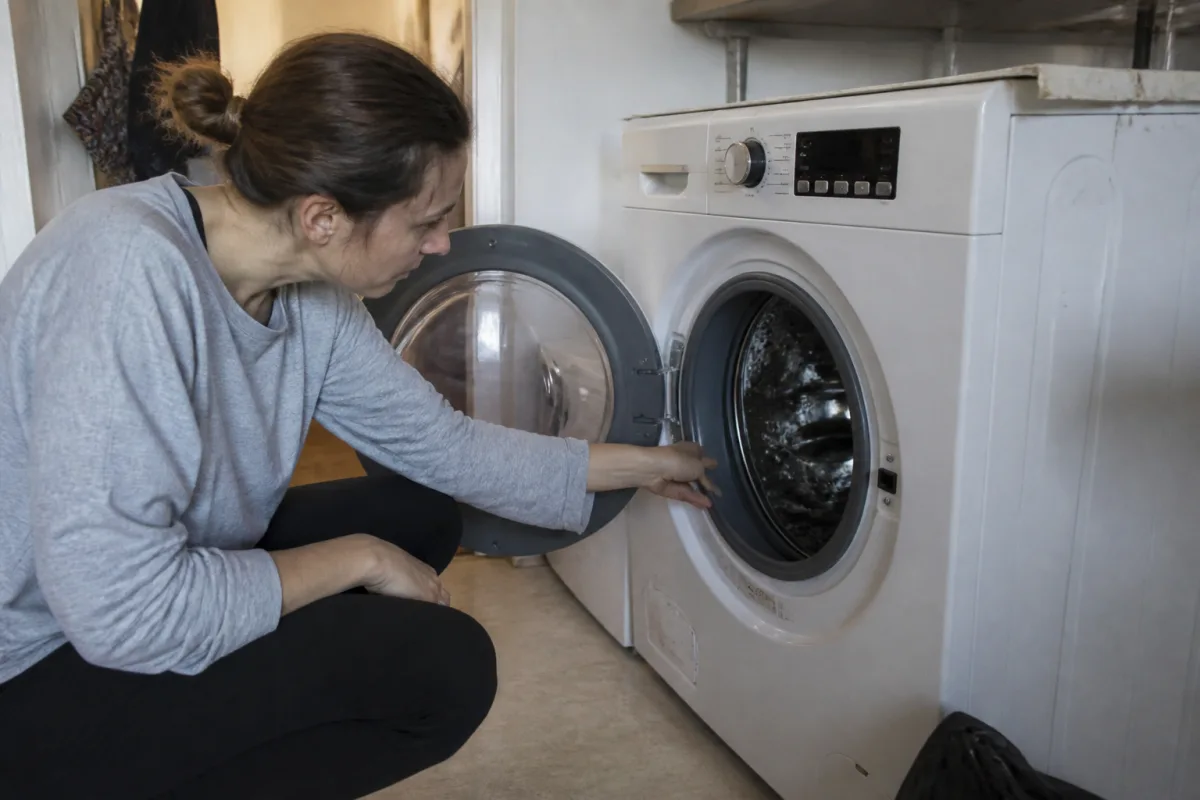
Functional failures concern parts that perform a specific action: drain pump, door lock, heating element, solenoid valve. They often give clear symptoms but can be confused with peripheral problems. A suspicious heating element, for example, may be preceded by a heating error code, but the diagnosis must take into account the wiring and associated sensors.
The more the fault involves electronics or wiring, the more methodical the diagnosis must be: chance quickly costs more than the repair.
Electronic failure is the most delicate to confirm remotely. Control board, sensors, wiring harness, bad contact, or intermittent error: symptoms can change depending on the cycles. In this case, the appliance may work once, then stop without apparent logic. This is typically the situation where a repair technician’s opinion becomes relevant.
How to read a washing machine error code without making mistakes?
A washing machine error code indicates a category of problem, not always the exact part to replace. It can signal an impossible drain, abnormal water supply, absent heating, door lock, or faulty electronic communication. The actual context remains essential.
Error codes vary depending on the brands and models. Therefore, you should consult the device manual or the manufacturer’s official support, rather than relying on a randomly found correspondence. The same display can sometimes change meaning depending on the range or year of manufacture.
| Code category | What the code may indicate | Reasonable check | Error to avoid |
|---|---|---|---|
| Water supply | Filling too slow or absent | Tap, hose, pressure, inlet filter | Replacing the solenoid valve without checking the supply |
| Drain | Water not evacuated or evacuation too slow | Pump filter, hose, visible obstruction | Blaming the pump before cleaning the filter |
| Heating | Water not heating or inconsistent sensor | Observe cycles, consult the manual | Changing the heating element without proper testing |
| Locking | Door not properly closed or faulty safety | Seal, closure, obstacle, waiting for unlocking | Forcing the stuck door |
| Communication | Board, sensor, wiring harness, or intermittent error | Simple restart, observe circumstances | Replacing multiple parts without electrical diagnosis |
The manufacturer’s manual remains the most reliable source to interpret a code. Appliance manufacturers’ help pages generally remind basic checks: power supply, water supply, filter cleaning, laundry load, door closing. These actions are consistent with good first-level troubleshooting practices.
The error code becomes especially useful when linked to an observation. For example, a drain code accompanied by a drum full of water and a clogged filter clearly points to evacuation. Conversely, an intermittent code after vibration, without stagnant water or visible leak, may require a more thorough check.
What checks can you safely do yourself?
Before any intervention, unplug the washing machine, turn off the water supply if the check concerns a hose or leak, and prepare a mop with a container. Useful actions are those that remain visible, accessible, and without contact with internal electrical components.
A reasonable home repair starts with the machine’s environment. Is the drain hose crushed against the wall? Is the appliance stable? Does the door close properly? Is the detergent drawer clean? These checks do not require complex tools and can solve some common breakdowns.
- Unplug the appliance before opening a hatch, handling a hose, or wiping a leak.
- Turn off the water supply if you touch the supply hose or if water appears on the floor.
- Gently open the pump filter, as water may flow out even if the drum seems empty.
- Check the drain hose without pulling the appliance roughly or forcing the fittings.
- Inspect the door seal to remove visible small objects and clean deposits.
- Restart a short cycle after properly loading the laundry and closing all hatches.
The pump filter deserves special attention. It is often located behind a small hatch on the lower front panel. It can contain fibers, hair, coins, hairpins, buttons, or wipes. The opening must be done gradually, as the remaining water can come out quickly. If the plug resists strongly, there is no need to force it at the risk of breaking the housing.
The drain hose must remain properly positioned. Too low, too inserted, or pinched, it can cause drainage or abnormal filling problems depending on the installation. In case of doubt, the device’s manual usually specifies the installation constraints to be respected.
Safety point: do not disassemble the bodywork, the heating element, the motor, the electronic board, or the wiring if you do not have the necessary skills. A machine contains water, electricity, and moving parts: the wrong action can worsen the breakdown or create a risk.
When to repair yourself and when to call a professional?
DIY repair is mainly justified for visible, simple, and reversible causes: clogged filter, improperly positioned hose, dirty detergent drawer, overload, or object stuck in the seal. As soon as the breakdown involves disassembly, electricity, internal leakage, or electronic diagnosis, the intervention of a professional becomes more rational.
The real criterion is not only the price of the part. It is also the level of certainty. Buying a drain pump may seem economical, but if the fault comes from a wiring harness, a sensor, or a blockage elsewhere, the expense solves nothing. The same logic applies to an electronic board, often more expensive and more delicate to diagnose.
- Rather accessible: cleaning the pump filter, checking the drain hose, removing a visible object, cleaning the seal or detergent drawer.
- To be evaluated with caution: replacing a door seal, a belt, or an external hose depending on the model’s accessibility.
- Rather professional: motor, bearings, heating element, internal pump difficult to access, electronic board, wiring, leak under the tub.
- Urgent: burnt smell, repeated tripping, significant leak, violent metallic noise, appliance heating abnormally.
To decide without losing money, three elements must be cross-checked: the age of the appliance, the frequency of breakdowns, and the estimated cost of repair. A recent washing machine with a simple fault often deserves repair. An old appliance, noisy for a long time, that chains leaks, weak spinning, and error codes, raises a different question.
You should also check any rights related to the legal warranty of conformity or a commercial extension if the appliance was purchased recently. In France, general information on the legal warranty is available on Service-Public.fr, and the precise conditions depend on the purchase date, the seller, and the situation.
How to prevent a new washing machine breakdown?
Preventing a washing machine breakdown means reducing repetitive causes: overload, excess detergent, dirt buildup, forgotten objects, and poor seal ventilation. Regular maintenance does not guarantee the absence of breakdowns, but it limits blockages, odors, and unnecessary mechanical stresses.
Overloading is one of the most common traps. A fully loaded drum washes less well, strains the spin cycle, and increases vibrations. Conversely, a too unbalanced load can prevent the machine from spinning properly. Heavy textiles should ideally be distributed, especially when they absorb a lot of water.
- Empty pockets before each wash to avoid coins, keys, tissues, and small objects in the pump.
- Clean the seal regularly to remove residues, hair, and small trapped elements.
- Leave the door slightly open after use to limit stagnant humidity and odors.
- Measure detergent according to the load, the dirtiness of the laundry, and the water hardness, without systematic excess.
- Monitor new noises: a repeated sound change is often more telling than an isolated noise.
Manufacturers generally recommend following the user manual for maintenance of the filter, detergent drawer, seal, and any cleaning programs. This is a more reliable source than a generic tip, as the filter location, drainage procedures, and compatible products vary according to models.
Should you repair or replace the washing machine?
Repairing remains relevant when the fault is identified, isolated, and reasonable in relation to the overall condition of the washing machine. Replacing becomes more coherent if faults recur, if several major components are suspected, or if the repair cost approaches the value of an equivalent appliance.
The decision should not be limited to the emotion of the moment. A washing machine breaking down just before an urgent laundry load makes you want to act quickly, sometimes too quickly. However, a calmly made diagnosis prevents throwing away a repairable appliance or, conversely, funding multiple repairs on a model nearing the end of its life.
| Situation | Repair rather relevant | Replacement to consider |
|---|---|---|
| Simple and localized fault | Filter, hose, visible seal, identifiable lock | Rarely a priority if the rest works well |
| Significant mechanical noise | If the cause is minor or accessible | If bearings, drum, or motor are strongly suspected |
| Intermittent electronic fault | If diagnosis confirmed and part available | If the fault recurs despite several attempts |
| Old appliance with repeated faults | Only if repair is very simple | To compare with a more reliable replacement |
Another important point: the availability of spare parts. Since the implementation of the repairability index in France for several equipment categories, including some household appliances, consumers have an additional benchmark to assess repair ease. The official details can be consulted on the website of the ministry responsible for ecological transition.
Useful sources to consult
For a washing machine fault, the most reliable sources are those that allow checking a rule, a warranty, or a procedure related to a specific model. Forums can help recognize a symptom, but they do not replace the manufacturer’s manual or a secure diagnosis.
| Source | Useful data | Use | Warning |
|---|---|---|---|
| Service-Public.fr — legal warranty of conformity | General information on consumer rights | Check if recourse is possible after purchase | Conditions depend on the real case and supporting documents |
| Ministry of Ecological Transition — repairability index | Principle of the index and concerned categories | Evaluate the repairability of an appliance when buying | The index does not diagnose a specific fault |
| Official manufacturer’s manual | Error codes, maintenance, safety, model-specific procedures | Correctly interpret a displayed message | Use the exact washing machine reference |
| Qualified repairer or after-sales service | On-site diagnosis, electrical test, repair estimate | Confirm a complex or risky fault | Request a quote or estimate before intervention |
Key takeaways
- 🔎 The symptom guides the diagnosis but never alone proves the faulty part.
- 🧰 Filter, hose, seal, and overload are the first accessible checks.
- ⚡ Electronics, motor, heating element, and wiring require real caution.
- 💧 A leak requires stopping, unplugging if possible, and quickly shutting off the water.
- 📘 The manufacturer’s manual remains essential to correctly interpret an error code.
FAQ
Why does my washing machine no longer drain?
The simplest cause is often a clogged pump filter or a kinked drain hose. You need to unplug the appliance, prepare something to catch the water, then check the filter and drainage. If everything is clean and the pump does not work properly, a professional diagnosis may be necessary.
Why is the drum of my washing machine no longer spinning?
The drum may remain stationary due to an overload, a loose or broken belt, a faulty door lock, a motor, or a sensor. Start by lightening the load and restarting a short cycle. If the drum still does not respond, avoid electrical disassembly without expertise.
Why does my machine make noise during spinning?
A noise during spinning can come from unevenly distributed laundry, a stuck object, worn shock absorbers, or worn bearings. An isolated noise after a heavy load does not have the same meaning as a repeated rumble during each cycle. If the noise becomes metallic or very loud, it is better to stop the appliance.
What to do if the door remains locked?
You must first wait a few minutes, as the door safety lock may remain active after the cycle stops. If water is still present, the machine may prevent opening to avoid flooding. Do not force the door: rather check the drainage and consult the model’s manual.
When should you call a repair technician for a washing machine breakdown?
Call a professional if the breakdown concerns the electronic board, the motor, the heating element, the bearings, the wiring, or an internal leak that is difficult to locate. It is also recommended in case of a burning smell, repeated tripping, or loud mechanical noise. The goal is to avoid worsening the breakdown or creating an electrical hazard.