
Sommaire
Radiator cold at the top or bottom: identify the fault and act quickly
A radiator cold at the top but hot at the bottom often contains air, especially if it is a water radiator accompanied by gurgling sounds: bleeding can then improve heating. Conversely, a radiator hot at the top and cold at the bottom rather suggests sludge, insufficient flow, or poor balancing. A radiator cold everywhere first requires checking the settings and the general operation of the heating system.
The diagnosis depends on the type of device, the cold area, the number of radiators affected, and the noises observed. This guide distinguishes probable causes, explains how to bleed a water radiator without burning yourself, and specifies the manipulations not to perform yourself.
In brief
🔥 A cold top and a hot bottom often indicate air in a water radiator; bleeding may be appropriate if the radiator is cooled and in good condition.
💧 A hot top and a cold bottom more likely suggest sludge or insufficient flow, especially if several radiators heat poorly.
⚠️ An electric radiator is not bled and a leak, repeated pressure drop, or general failure justifies consulting a professional.
Radiator cold at the top or bottom: diagnosis at a glance
The cold area of a radiator indicates how heat circulates in the device, but it is not enough to confirm a fault. A central heating radiator contains hot water whose diffusion depends notably on the flow and temperature of the water; the type of device and the condition of the circuit must therefore be checked.
| Observed symptom | Possible cause | First cautious action |
|---|---|---|
| Cold top, hot bottom | Air accumulated in a water radiator, valve or insufficient flow | Listen for gurgling, check the valve and consider bleeding |
| Hot top, cold bottom | Sludge, slowed circulation or imperfect hydraulic balancing | Compare other radiators and avoid improvised descaling |
| Radiator cold everywhere | Closed valve, inactive control, stuck valve or general problem | Check settings, thermostat and boiler condition |
| Several radiators affected | Circulation, pump, control or boiler | Check installation indications and contact a heating engineer if necessary |
The direction of the temperature difference is more useful than the mere sensation of cold. A slight gradient between top and bottom can exist when the radiator is working normally, while a clearly cold area, recent or associated with discomfort, should be examined.
What the cold area of the radiator reveals
Air tends to concentrate in the upper part of a water radiator. Deposits, on the other hand, can hinder circulation in the lower parts, but insufficient flow or poor balancing can produce a similar result.
A single cold radiator rather points to a local problem, such as a stuck thermostatic valve or a closed valve. Several devices heating poorly at the same time more likely indicate a circulation, control, or boiler problem.
A radiator cold at the top or bottom provides a diagnostic clue, not a definitive verdict.
Radiator cold at the top: check for air presence and need for bleeding
A water radiator cold in its upper part while its lower part heats may contain air. Bleeding releases this air through a small screw located at the top of the radiator, but it does not fix a broken boiler, a defective pump, or a poorly supplied circuit.
The noise is an additional clue: gurgling or irregular circulation noise reinforces the air hypothesis. Bleeding is especially consistent when the problem affects one or a few radiators and the heating works elsewhere.
When Bleeding Is Probably Appropriate
- The upper part remains cold while the lower part becomes hot.
- The radiator produces gurgling or air noises.
- The problem concerns only one device or a small number of radiators.
- No leak is visible around the bleed screw, fittings, or valves.
A radiator that regularly fills with air still deserves a diagnosis. Repeated bleeding can mask a leak, a pressure defect, or another circuit problem.
Bleeding mainly concerns the air present in the upper part; it is not a general treatment for all heating faults.
Cold Radiator at the Bottom: Check for Sludge or Circulation Fault
A radiator hot at the top but cold at the bottom may have slowed circulation in its lower part. Sludge, that is deposits present in the circuit water, is a possible hypothesis, but poor hydraulic balancing or insufficient flow can cause a similar symptom.
The difference becomes more significant when several radiators are hot at the top and cold at the bottom, heat slowly, or have persistent cold spots. Bleeding does not directly remove deposits accumulated in the lower part of the circuit.
Check Simple Causes Before Talking About Desludging
Start by observing the thermostatic valve and the return valve. Both elements must be open according to the installation configuration, without being forced or disassembled. Then compare the affected radiator with neighboring devices.
- Note if the problem is limited to one radiator or present in several rooms.
- Observe the heating speed after restarting the heating.
- Listen for circulation or clicking noises.
- Check if the temperature remains homogeneous after several minutes of operation.
- Do not add desludging product and do not drain the circuit without suitable equipment or skills.
When Desludging Becomes Plausible
Desludging becomes a possibility when several radiators heat unevenly despite correct settings, or when a professional confirms the presence of deposits. The intervention consists of cleaning the circuit with a method adapted to the installation; its usefulness cannot be deduced from temperature alone.
Hydraulic balancing may also be necessary. This operation distributes the flow between radiators to prevent a device near the boiler from receiving too much water while a more distant radiator receives too little.
Radiator Cold Everywhere: Perform Checks Without Dismantling the Installation
A radiator cold over its entire surface does not correspond to the classic diagnosis of a simple excess of air. A thermostatic valve set to minimum, a closed valve, an inactive programmer, or a boiler problem can prevent any temperature rise.
The first clue is the extent of the fault. A single cold radiator suggests a local anomaly, while several cold radiators require checking the control and general circulation.
Only One Radiator Does Not Heat
- Check that the thermostatic valve is not set to minimum.
- Observe if the return valve has been closed by mistake.
- Compare the radiator with neighboring devices.
- Look for a stuck mechanism without forcing or removing the thermostatic head.
A stuck thermostatic valve can prevent hot water from arriving even if the boiler is working. If the mechanism remains stuck or if a part must be removed, the intervention of a professional limits the risk of leaks or damage.
Several Radiators No Longer Heat
When several radiators remain cold, check the heating mode, the thermostat, any error messages, and the boiler indications. Consult the equipment manual to interpret the pressure: no universal value suits all installations.
Do not dismantle the boiler, do not handle a gas valve, and do not intervene on the circulator without qualification. These elements may be under pressure, electrically powered, or linked to the safety of the installation.
A common mistake is to automatically bleed all radiators as soon as one device heats poorly. This method can waste time if the problem comes from an inactive control, a closed valve, or a general failure.
Bleeding a radiator safely: method and checks
Bleeding a water radiator involves releasing the air trapped inside the heating element through the designated valve. The procedure requires little equipment, but it must be done on a radiator that is turned off and sufficiently cooled to avoid burns.
Steps to follow for bleeding
- Turn off the heating and allow the radiator to cool down sufficiently.
- Prepare an appropriate bleed key, a shallow container, and a cloth.
- Place the container under the bleed valve, usually located at the top.
- Loosen the valve very slightly until you hear air escaping.
- Close the valve as soon as a steady stream of water appears, without trying to empty the radiator.
- Wipe the valve, turn the heating back on, and observe the heating performance.
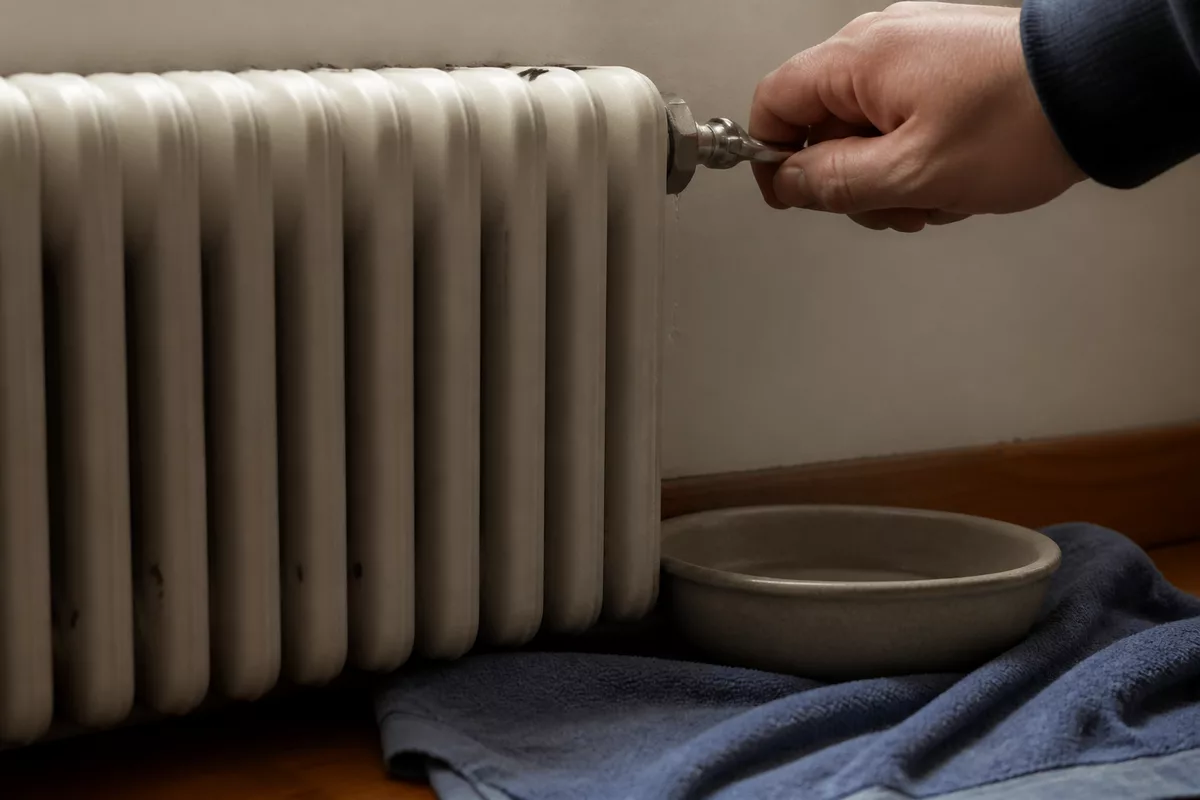
A successful bleed releases the air without requiring the removal of a large amount of water. After restarting, the radiator may take a few minutes to regain more even heating.
After bleeding: knowing if the problem is resolved
A radiator that heats more evenly after bleeding confirms that air could have contributed to the problem. Persistent noise, a cold lower part, or a complete lack of heating point to another cause.
Check the boiler pressure only according to the manufacturer’s instructions. Do not add water automatically: repeated pressure drops, a leak, or a damaged valve require stopping any further attempts and seeking professional advice.
In case of abnormal resistance, leakage, or damaged part, close the valve if possible without forcing and request a diagnosis.
When to call a heating engineer and what level of intervention to expect
A heating engineer should be contacted when the radiator remains cold after simple checks, when multiple units are affected, or when the problem recurs frequently. The professional can identify a stuck valve, circulation fault, hydraulic imbalance, sludge buildup, or boiler failure.
The cost depends on the actual cause, the region, access to equipment, time spent diagnosing, and type of installation. A simple bleed, valve unblocking, balancing, sludge removal, or boiler repair do not require the same tools or time; a local quote is therefore more reliable than a universal price.
Difficulty and cost according to the problem
| Intervention | Typical difficulty | Prudent decision |
|---|---|---|
| Bleeding a radiator in good condition | Low, if the valve works normally | Possible with precautions and following the instructions |
| Unblocking a valve or leak detection | Intermediate | Call a professional if a part needs to be removed |
| Hydraulic balancing | Technical | Request a diagnosis of the complete circuit |
| Sludge removal or circulator failure | High | Request a quote and do not drain yourself |
A gas smell constitutes a distinct emergency situation. Leave the premises, avoid any flame, and do not operate any switches; immediately contact the emergency service from outside.
The cost of an intervention cannot be deduced from the radiator’s cold zone alone: diagnosing the cause always precedes a serious estimate.
Key Takeaways
- 🌡️ A cold top and a warm bottom often indicate air in a water radiator.
- 💧 A warm top and a cold bottom rather suggest sludge, insufficient flow, or poor balancing.
- 🔧 An electric radiator is not bled like a central heating radiator.
- 🛑 A leak, repeated pressure drops, a general breakdown, or a gas smell requires stopping any handling.
- 📋 A heating engineer is necessary for sludge removal, balancing, the circulator, and boiler interventions.
Frequently Asked Questions About a Radiator That Heats Poorly
Why is my radiator cold at the top?
A water radiator cold at its upper part often contains air, especially if gurgling sounds are audible and the bottom is warm. Bleeding may be indicated when settings are correct and no leak is visible.
Why is my radiator cold at the bottom?
A cold lower part with a warm top can indicate sludge, insufficient flow, or poor circuit balancing. Bleeding does not directly remove these deposits; a diagnosis becomes relevant if the problem persists or affects several radiators.
Should I bleed a radiator that is cold at the bottom?
Bleeding can be useful if the radiator is also cold at the top or produces air noises. It does not directly address clogging located in the lower part nor a circulation defect.
Why does only one radiator not heat up?
A stuck thermostatic valve, a closed valve, or a local imbalance can explain an isolated failure. Check the settings without forcing the mechanisms, then call a professional if the radiator remains cold.
What to do if the radiator stays cold after bleeding?
Compare the radiator with other units and check accessible controls. If the problem persists, if the pressure drops, or if a leak appears, stop handling and request a diagnosis of the installation.