
Sommaire
Cloudy pool water after winter: the complete method to restore clear water
To treat cloudy pool water after winter, start by removing debris, cleaning the pool and filter, then check the pump and analyze the water. Then adjust the pH and disinfectant according to the product instructions. A shock treatment or clarifier should only be applied after this diagnosis, never before.
Gray, green, white, or colored water does not necessarily indicate the same problem. This method follows the useful order to restart a pool after winter: observe, clean, measure, correct, disinfect if necessary, filter, then check before any swimming.
In brief
- 🧹 Remove leaves, dust, and deposits before stirring up impurities.
- 🔍 Analyze the pH, disinfectant, and alkalinity before adding any product.
- ⚙️ A faulty pump, clogged filter, or low flow can keep the water cloudy.
- 🧪 Shock chlorine and clarifier are conditional treatments, to be used according to the diagnosis and instructions.
- 🚫 Do not swim until parameters are compliant and the safety delay has passed.
Why does pool water become cloudy after winterizing?
Cloudy pool water after winter is water whose transparency decreases due to suspended matter, chemical imbalance, algae, or filtration failure. Winterizing promotes the accumulation of leaves, pollen, dust, insects, and organic matter under or around the cover.
The color and texture of the water guide the diagnosis but are not enough to choose a product. Gray water may simply be loaded with dirt, while green water more likely indicates algae proliferation; white or milky water may come from fine particles, unbalanced pH, or mineral precipitation.
Identify the water’s appearance before acting
| Observed appearance | Possible cause | First check |
|---|---|---|
| Gray or dirty water | Debris, dust, pollen, or organic matter | Condition of the pool, baskets, and filter |
| Green or greenish water | Algae favored by insufficient disinfection | Disinfectant level, walls, and bottom |
| White or milky water | Fine particles, unbalanced pH, or precipitation | pH, alkalinity, filtration, and deposits |
| Yellow or brown water | Soil, organic matter, or possible presence of metals | Filling source and complete analysis |
Cloudy water can also indicate insufficient circulation. A pump that does not start properly, air intake, a mispositioned valve, or a saturated filter prevent particles from being retained, even if chemical parameters seem acceptable.
How to restore the pool and filtration system before any treatment?
Restarting a pool begins with a mechanical inspection and physical cleaning. The water level, skimmers, jets, baskets, valves, pipes, and pump must be checked before any chemical correction.
Treating cloudy water with a clogged filter is like adding products into a system that can no longer distribute them or properly retain impurities. Therefore, remove the largest debris before brushing or vacuuming to avoid unnecessarily overloading the filtration.
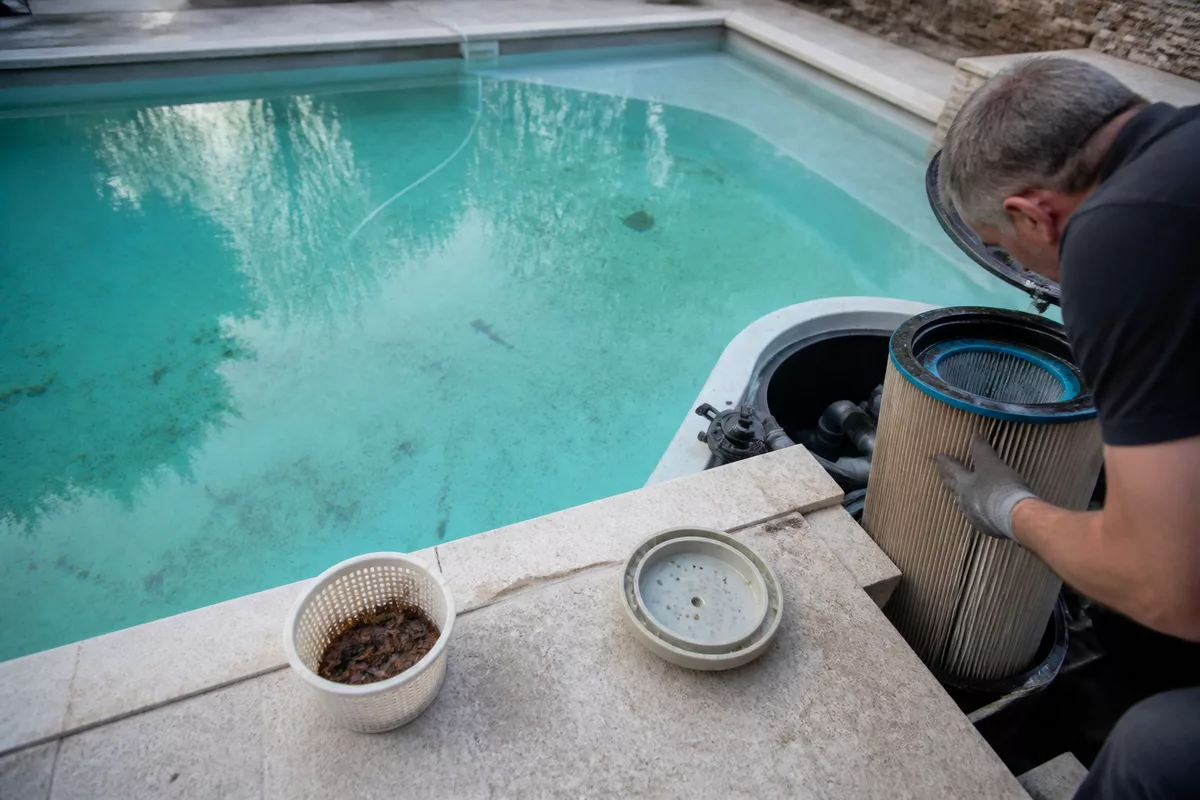
Cleaning the pool without worsening the turbidity
- Remove leaves, insects, and floating debris with a net.
- Brush the walls, corners, steps, and waterline to detach deposits.
- Clean the skimmer baskets and the pump pre-filter.
- Vacuum the bottom using the mode provided by the system, avoiding sending deposits back into the pool.
- Rinse and clean the cover before storing it to limit new dirt deposits.
Cleaning the filter according to its technology
A sand filter may require washing and then rinsing when the system provides for it. A saturated cartridge must be cleaned or replaced depending on its condition and the manufacturer’s recommendations. A diatomaceous earth filter also requires a procedure specific to its equipment.
Monitor the filter pressure and the return flow to the jets after restarting. An increasing pressure or decreasing flow generally indicates that the filter is loading with particles and must be checked again.
How to measure the water before correcting its parameters?
Measuring the water involves recording the necessary parameters before any product addition. Start with the pH and disinfectant level, then check alkalinity when the pH remains unstable. Stabilizer, hardness, and metals become relevant if turbidity persists or if the water takes on an unusual color.
Note each result with the date, the actual volume of the pool, and the product used. Quantities depend on the water volume, the type of disinfectant, and its concentration; therefore, a universal dosage cannot be applied without consulting the label.
- Measure the pH with equipment suitable for pool maintenance.
- Check the disinfectant used: chlorine, bromine, or other compatible treatment.
- Add the TAC to the analysis if the pH varies greatly or remains difficult to correct.
- Check the stabilizer, hardness, or metals in case of persistent turbidity or discoloration.
Why the pH must be checked first
An inappropriate pH can reduce the disinfectant’s effectiveness and complicate water clarification. The target pH value must remain compatible with the disinfectant, the system, and the manufacturer’s instructions.
Correct gradually, let the water circulate, then measure again before a new addition. The pool volume and the concentration of the corrector must be known to avoid overcorrection.
What is the complete method to clarify pool water after winter?
The method follows a simple progression: clean, measure, correct, disinfect if necessary, filter, then check. This sequence limits unnecessary treatments and allows identifying the step that blocks when the water remains cloudy.
Never mix two chemical products directly and do not pour them simultaneously in the same place. Follow the instructions, wear the indicated protective equipment, and keep swimmers away during application and the safety delay.
Step 1: correct the water balance
Adjust the pH according to the recommended range for your treatment. Do not apply several correctors consecutively without new analysis: excessive correction can shift the problem instead of solving it.
Restart filtration during the time indicated by the instructions, then measure again. The expected result is water whose parameters approach the range provided before possibly using a strengthened disinfectant.
Step 2: disinfect when the analysis justifies it
A shock treatment can be considered if the water is heavily cloudy or green and if the analysis shows that disinfection needs to be reinforced. Shock chlorine, bromine, or active oxygen are not interchangeable: choose a product compatible with the usual treatment and equipment.
Calculate the quantity based on the actual pool volume and the concentration indicated on the label. Do not rely on a generic dosage expressed in grams per cubic meter, as formulations differ.
Step 3: brush, vacuum, and filter long enough
Brush the surfaces to loosen algae and deposits, then vacuum the bottom using the mode suitable for the installation. After an intensified treatment, the filtration must run long enough to retain particles, sometimes several hours or more depending on turbidity and the manufacturer’s instructions.
Regularly check the pressure and flow rate. Clean the filter as soon as the pressure rises or the return to the jets becomes weak, because a clogged filter slows down clarification.
Step 4: reserve the clarifier for very fine particles
A clarifier groups certain fine particles to facilitate their retention by the filter. The product does not replace cleaning, water balance, or disinfection when algae are present.
Check compatibility with the filter technology before use. Flocculation can cause problems with some cartridge filters; the filter manufacturer’s instructions and those of the product should take precedence.
What to do according to the color and texture of the water?
The color of the water is an indicator, not a definitive diagnosis. A cloudy pool in spring can have several causes combined: organic deposits, pH imbalance, algae, fine particles, and insufficient filtration.
Always associate the observed appearance with a measurement and equipment check. This precaution avoids successively adding an algaecide, a clarifier, and a disinfectant without knowing which one actually addresses the problem.
Green or greenish water after wintering
Look for the presence of algae on the walls, in the corners, and at the bottom of the pool. Check the disinfectant level, brush the surfaces, then consider an intensified treatment only if the water condition and instructions justify it.
The filtration must remain active long enough to retain dead algae and loosened particles. Clean the filter when it becomes clogged and check the parameters before resuming swimming.
White or milky water
Milky water first requires checking the pH, alkalinity, and filtration. Mineral precipitation, excess product, or very fine particles can explain this appearance.
Let the filtration capture the particles when the system is working properly. Adding several products in succession risks increasing the water load and complicating the identification of the cause.
Yellow, brown, or persistent water despite treatments
A yellow or brown coloration can come from soil, organic matter, or metals present in the filling water. Examine the water source, the filter condition, and visible deposits before renewing a treatment.
A complete analysis with reliable equipment becomes necessary if the coloration persists. A leak, circulation failure, or equipment problem justifies the intervention of a professional.
How long does it take to restore clear water?
A simple filterable deposit can decrease after a few hours of effective circulation, while green or heavily unbalanced water may require several days of monitoring. The delay depends on the pool volume, actual flow rate, filtration power, filter condition, and the cause of the cloudiness.
Visual clarity alone is not sufficient to allow swimming. Repeat measurements after corrections and respect the delay mentioned on the product instructions, even if the pool bottom becomes visible again.
Signs that show the method is working
- The bottom and walls gradually become visible again.
- The filtration flow remains steady at the return jets.
- The filter pressure does not rise abnormally after cleaning.
- Measurements stabilize within the recommended ranges for treatment.
- Turbidity decreases without the appearance of new deposits or new colors.
What mistakes to avoid and what are the limits of a home treatment?
The most frequent mistakes consist of adding disinfectant without measuring pH, multiplying products, or neglecting filtration. Cloudy water can also hide air intake, a leak, insufficient pump, or abnormal pressure.
- Adding chlorine without measuring the pH: the disinfectant may be less effective and the result difficult to interpret. Measure before adjusting.
- Mixing products: dangerous reactions or incompatibility may occur. Use only one product at a time according to its instructions.
- Using a household product: the composition and concentration are not intended for pool water. Use only a product designed for this purpose.
- Neglecting a clogged filter: particles remain suspended and the pump may operate under poor conditions. Clean the filter and check the flow rate.
- Completely emptying the pool without diagnosis: draining is not the first reflex for cloudy water and may pose structural constraints. Seek professional advice if the situation requires it.
When to stop trying and have the installation checked
Request a professional inspection if the flow remains low despite cleaning, if the pump makes unusual noises, if air appears in the circuit, or if the water level drops without explanation. Colored water that persists after several documented cycles also warrants further analysis.
Electrical equipment, pump repairs, and interventions on an installation with a leak should not be improvised. Turn off the power before any operation as specified in the instructions and entrust technical interventions to a qualified person when the risk exceeds routine maintenance.
How to prevent cloudy water next spring?
Preventing cloudy pool water after winter starts before winterizing. The choice between active and passive winterizing depends on the type of pool, local climate, water temperature, and treatment method; the manufacturer’s instructions remain the reference.
A logbook with dates, analysis results, and actions taken avoids approximate dosing in spring. This record also helps detect a gradual pH drift, an increase in filter pressure, or an unusual drop in water level.
- Clean the pool, baskets, waterline, and filter before winterizing.
- Install a clean and properly secured cover suitable for the pool.
- Adjust filtration duration to the water temperature and winterizing method.
- Regularly check the condition of the cover, water level, and equipment.
- Keep product and filtration system manuals in the same folder.
- When restarting, wait until the conditions specified by the manufacturer are met for your installation.
For precautions related to products and equipment, follow the manufacturers’ instructions, especially for storage, handling, protective equipment, and waiting times before swimming.
Key Takeaways
- 🧹 Clean the pool and filter before adding treatment.
- 🔍 Analyze the pH, disinfectant, and parameters useful for treatment.
- ⚙️ Check the pump, valves, flow rate, and absence of leaks.
- 🧪 Use a shock treatment or clarifier only if the diagnosis and instructions justify it.
- 🚫 Wait for compliant parameters and the end of the safety delay before swimming.
Frequently Asked Questions about Cloudy Pool Water after Winter
Is it safe to swim in a cloudy pool after winter?
No, the appearance of the water is not enough to decide on swimming. Check the parameters, verify the absence of ongoing treatment, and respect the waiting time indicated by the product’s instructions.
Should a pool with cloudy water be drained?
Draining is generally not the first reflex. First identify the cause, clean the pool, check the filter, and analyze the water; a decision to drain then depends on the installation and the actual condition of the pool.
Can shock chlorine be added with a pH that is too high?
An inappropriate pH can reduce the effectiveness of the disinfectant. Measure the pH, correct it gradually according to the treatment instructions, then check the water again before considering a reinforced treatment.
Why does the water remain cloudy after treatment?
Filtration may be insufficient, the filter clogged, or the pH still unsuitable. Fine particles, high stabilizer levels, mineral deposits, a faulty pump, or poor circulation can also explain the persistence of cloudiness.
How long should the filtration run?
The duration depends on the cause of the cloudiness, the volume of the pool, the actual flow rate, and the type of filter. Maintain sufficient filtration after treatment, monitor the pressure, and clean the filter as soon as the flow rate decreases.