
Sommaire
Heat pump no longer heating: possible causes and quick checks
A heat pump that no longer heats may be set to the wrong mode, deprived of power, hindered by a clogged filter, or simply in a defrost cycle. Start by checking the circuit breaker, thermostat, filters, and outdoor unit without removing any covers. Stop any handling if you detect a burning smell, leakage, loud noise, or repeated tripping.
The symptom alone is not enough to identify the fault: an air-to-air, air-to-water, or geothermal heat pump does not have exactly the same points of control. This guide distinguishes accessible checks, possible causes, urgent situations, and information to provide to a heating technician.
In brief
🔎 A heat pump that no longer heats should first be checked at the power supply, thermostat, heating mode, and filters.
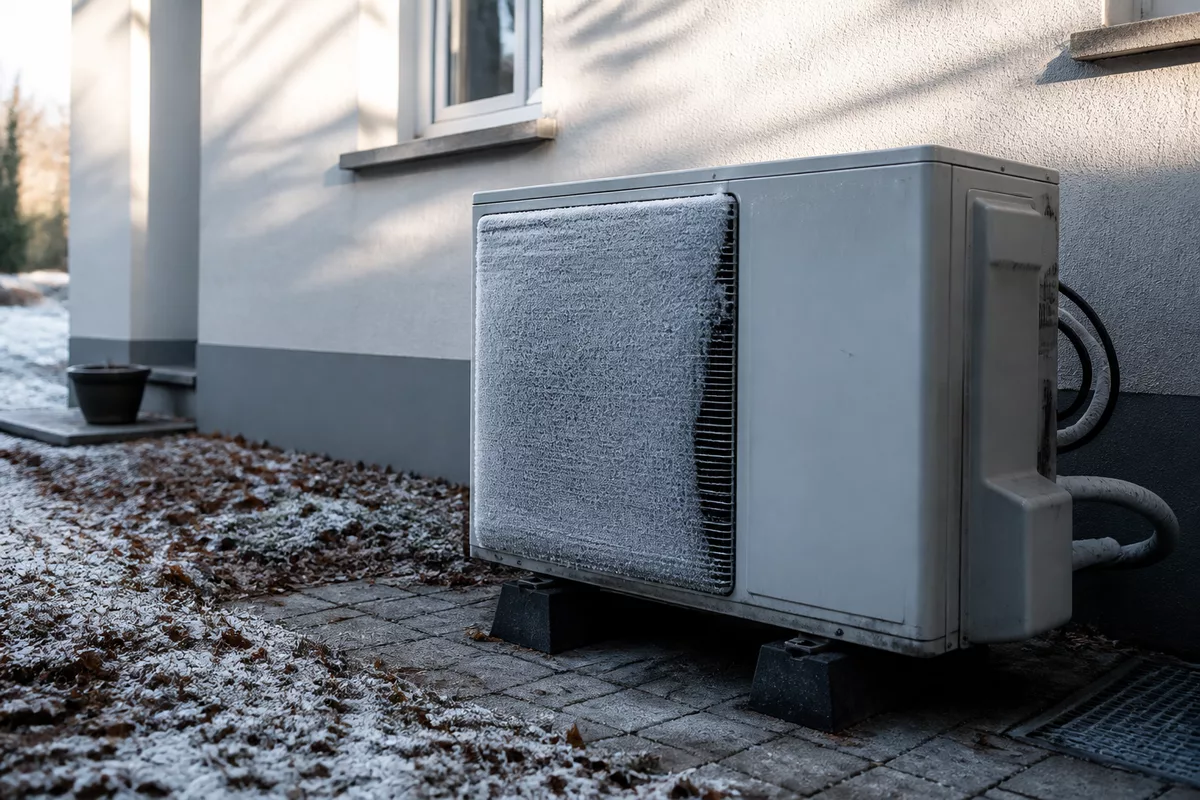
❄️ Slight frosting or a short burst of cold air may correspond to an automatic defrost cycle. Persistent frost or a blocked fan is abnormal.
⚠️ The refrigeration circuit, electrical connections, compressor, and leaks require the intervention of a qualified professional.
📋 Note the error code, date of occurrence, outside temperature, and checks already performed before requesting a repair.
1. Identify the symptom before intervening
A heat pump is a heating system that transfers heat from one environment to another using a thermodynamic circuit. A total lack of heating, insufficient heat, intermittent operation, and temporary cold air do not necessarily indicate the same fault.
The first goal is to precisely describe what is happening before changing any settings or turning off the system. Note the type of heat pump, outside temperature, date of problem onset, indicator lights, and any displayed error code.
| Observed symptom | Accessible check | Possible cause to confirm | Professional intervention |
|---|---|---|---|
| No start | Power supply, circuit breaker, thermostat, display | Setting, power cut, control fault | If the circuit breaker trips or the device remains inactive |
| Insufficient heating | Setpoint, filters, vents, radiators or underfloor heating | Air or water circulation, sensor, sizing, maintenance | If the drop persists after simple checks |
| Temporary cold air | Duration of the phenomenon and display | Possible automatic defrost | If the cycle is long, frequent, or heating does not resume |
| Outdoor unit frosted | Observation from a distance, without scraping or disassembling | Occasional frost, obstruction, or defrost fault | If the ice persists or blocks the fan |
The heat pump does not start at all
Check if the indoor unit, thermostat, or control module still displays anything. A blank screen may indicate a lack of power, but it does not allow concluding a specific electrical fault.
Observe the electrical panel without opening the device. If the associated circuit breaker has tripped, a temporary reset can be considered only if there is no burning smell, smoke, damaged cable, or signs of overheating. A new trip requires stopping the tests.
The heat pump runs but heats poorly
Compare the actual temperature obtained with the setpoint and usual operation. For an air-to-air heat pump, observe the airflow at the vents; for an air-to-water heat pump, check if the radiators or underfloor heating emit heat.
Outside temperature, insulation, sizing, and regulation can influence performance. These elements are diagnostic hypotheses, not proof that a component is defective.
The heat pump blows cold air for a few minutes
An air-to-air or air-to-water heat pump may temporarily stop heating to defrost its outdoor heat exchanger. During this phase, a less warm, or even cold, airflow may occur depending on the technology and the system’s settings.
A very long cycle, frequent repetitions, or the absence of heating resumption do not correspond to a simple reassuring observation. In this case, note the duration of the phenomenon and request an inspection if the situation repeats.
2. What quick checks can be done safely?
Safe checks start with settings and accessible components, then stop before any disassembly. This method allows ruling out incorrect settings or obstructed air circulation without interfering with internal electricity, the hydraulic circuit, or the refrigerant.
The manufacturer’s manual remains the reference for restart times, filter cleaning, and any values displayed by the system. Do not remove any cover and never force a fan or heat exchanger covered with ice.
Check the heating mode, the setpoint, and the programming
Verify that the heat pump is indeed in heating mode. A cooling mode, automatic mode, absence mode, or frost protection mode can explain a temperature lower than expected without constituting a technical fault.
- Check the setpoint and increase it slightly to observe the system’s reaction.
- Verify the time slots and absence program.
- Replace the thermostat batteries if they are weak or if the screen is unstable.
- Observe the communication between the thermostat and the indoor unit.
Check the electrical supply
Examine the electrical panel and the circuit breaker identified for the heat pump, without opening the unit or touching the connections. After a power outage, respect the restart delay indicated in the manual before changing several settings.
A circuit breaker that trips again, an unusual smell, or an electrical noise is a stop signal. Repeated resets can worsen a fault and complicate diagnosis.
Clean the filters and clear airflows
The accessible filters of an air-to-air heat pump can trap dust and fibers. Dirt buildup reduces airflow and can contribute to a gradual heating decrease or noisier operation.
- Clean only the filters designed to be removed by the user.
- Clear the supply and return vents from curtains, furniture, and objects.
- Remove leaves or obstacles placed around the outdoor unit, without tools or disassembly.
- Never pour hot water on an iced unit and do not break the ice.
Check the emitters of an air-to-water heat pump
Verify that the radiator valves or the relevant circuits are open. If a pressure gauge is provided, observe the pressure only according to the manual’s instructions, without repressurizing the circuit yourself.
The presence of air, a clogged hydraulic filter, or a faulty circulator can reduce water flow. Bleeding, repressurizing, or intervention on the circulator should be entrusted to a professional when the manual does not clearly specify the procedure.
3. What are the common causes of a heat pump that no longer heats?
A heat pump that no longer heats may have a regulation fault, air circulation issue, water circulation problem, or refrigerant circuit defect. The same symptom can correspond to several causes, which prevents turning an error code or noise into a certain diagnosis remotely.
Clogged filters or insufficient air exchange
Weak airflow, a gradual decrease in performance, or a ventilation noise may be consistent with a lack of air circulation. Cleaning accessible filters is then a reasonable first step.
If the flow remains low after cleaning, the heat exchanger, fan, or another part of the unit may require inspection. Opening the device is not part of the checks intended for a private individual.
Frosted, obstructed, or defrosting outdoor unit
A thin layer of frost may appear in cold and humid weather, then disappear during an automatic cycle. An outdoor unit completely covered in ice, a fan that no longer spins, or frost that persists after several cycles indicates an anomaly that should be checked.
Light temporary frost is not necessarily a fault, but persistent or blocking ice should never be removed with a tool.
Faulty thermostat, sensor, or programming
A poorly positioned thermostat, weak batteries, an inaccurate sensor, or a loss of communication can cause an inappropriate setpoint. Compare the thermostat display with the perceived room temperature, without considering this difference as proof of failure.
A persistent error code or interrupted communication must be reported to the technician along with the brand and model of the installation.
Insufficient flow on an air-to-water heat pump
An air-to-water heat pump may heat less effectively if water circulates poorly in the radiators or underfloor heating. Closed valves, the presence of air, a clogged hydraulic filter, or a faulty circulator are possible causes.
The circuit pressure should only be interpreted with the manufacturer’s manual, as the expected value depends on the installation. Low pressure, a leak, or frequent need to refill water justify a professional appointment.
Refrigerant, compressor, or electronics
A gradual loss of power, prolonged operation, unusual frost, or an error code may be consistent with a technical problem in the refrigeration circuit. However, none of these signs alone is sufficient to confirm a leak, compressor defect, or electronic failure.
Leak detection, pressure measurement, and refrigerant recharge are reserved for a qualified professional. Do not disassemble the fan, compressor, or electronic board.
4. What to do according to the observed symptom?
The symptom helps choose the next check but does not replace a diagnosis. An air-to-air heat pump is not checked exactly like an air-to-water or geothermal heat pump, especially because the heat distribution circuits differ.
Stop the verification process as soon as an electrical risk, a leak, a loud noise, or intervention on an internal component appears.
The heat pump makes noise but does not heat
Check the operating mode, filters, obstacles around the outdoor unit, and the possibility of defrosting. A new, metallic noise accompanied by vibrations or followed by a shutdown should not be treated as a simple operating noise.
The heat pump stops regularly
Note the error codes and check if the stops coincide with a defrost cycle. Also check accessible air or water circulations and the outside temperature.
Frequent stops may correspond to a safety shutdown, sensor fault, insufficient circulation, or improper sizing. Only an installation check can differentiate these hypotheses.
The heat pump no longer heats after a power outage
Check the display, the circuit breaker, and the restart procedure provided in the manual. Wait the normal restart delay before changing the setpoint or turning off the device again.
If the installation remains inactive or the circuit breaker trips again, request a diagnosis. Repeated restarts do not fix an electrical fault.
The outdoor unit is completely covered in ice
Observe from a distance if a defrost cycle seems to be in progress, without touching the heat exchanger. Do not scrape the fins, use tools, or pour hot water on the unit.
Persistent icing, a blocked fan, or a visible leak justifies quick contact with a professional. The heat pump can be stopped according to the manual if its operation presents a risk.
5. When should you call a professional and how much should you budget?
A professional should intervene when accessible checks do not restore heating or when a risk concerns electricity, the refrigeration circuit, the hydraulic circuit, or an internal component. The price depends on the call-out, diagnosis, labor, parts, and level of urgency.
Repair and maintenance rates vary depending on the region, period, power, and complexity of the installation. No universal amount can be announced without an estimate or a dated price list from the service provider.
Signs that require stopping the device
- Burning smell, smoke, damaged cable, or signs of overheating.
- Loud noise, unusual vibration, or irregular mechanical operation.
- Repeated tripping of the circuit breaker.
- Significant water leak, unusual flow, or suspicious fluid.
- Outdoor unit blocked by ice or persistent error code.
- Total absence of heating in cold weather when the installation does not resume operation.
A burning smell, smoke, or repeated tripping are not invitations to keep restarting: secure the installation and seek professional advice.
Interventions not to perform yourself
Do not open the refrigeration circuit, handle refrigerant fluid, dismantle the electronic board, or intervene on the compressor. Do not bypass any safety devices and do not modify technical parameters beyond the settings provided in the manual.
These precautions protect the occupants, the device, and any warranty. A poorly started repair can also make diagnosis more difficult.
Information to provide to the heating technician
- Note the type of heat pump, brand, model, and age of the installation.
- Describe the symptom, date of appearance, outside temperature, and frequency of shutdowns.
- Photograph the display or error code without opening the device.
- Indicate the checks already performed and their results.
- Prepare the latest maintenance report and available intervention invoices.
Factors determining the repair cost
An estimate can separate the call-out, diagnosis, labor, replaced part, and any work on the refrigeration or hydraulic circuit. A regulation failure does not necessarily involve the same operations as a leak or a faulty compressor.
Request a detailed estimate before a major repair. For an old installation, the decision between repair and replacement will depend notably on the cause, availability of parts, general condition, and estimated cost, not on a universal age of the device.
6. How to avoid new drops in performance?
Prevention relies on simple actions, monitoring anomalies, and maintenance adapted to the type of installation.
The manufacturer’s recommendations may specify a different maintenance frequency depending on the power, model, and circuits involved. Consult your device’s manual and ask a qualified professional which maintenance operations are suitable for your installation.
Accessible maintenance actions
- Clean the filters according to the frequency indicated in the manual.
- Visually check the condition of the outdoor unit without removing any cover.
- Avoid plants, objects, and leaves near air intakes and outlets.
- Monitor new noises, heat reduction, and frequent shutdowns.
- Keep error codes and intervention reports.
Professional maintenance and installation monitoring
A professional check can cover performance, safety, circuits, and components depending on the type of heat pump. The recommended or regulatory frequency should not be generalized without verifying the power and exact scope of the installation.
Compare readings with previous reports. A gradual drop in heating, unusual frost, or increasing consumption with less comfort deserves advice before a more serious breakdown occurs.
Key Takeaways
- 🔧 Start with the heating mode, the setpoint, the power supply, the filters, and accessible circulations.
- ❄️ Distinguish between temporary defrosting and an outdoor unit completely covered in ice.
- ⚡ Stop the device in case of burning smell, smoke, leak, or repeated tripping.
- 📞 Entrust the refrigeration circuit, compressor, electronics, and hydraulic repairs to a professional.
- 📝 Provide the heating technician with the model, error code, date of the problem, and checks performed.
Frequently Asked Questions
Why is my heat pump blowing cold air?
A short burst of cold air can appear during an automatic defrost cycle, especially on an air-to-air heat pump. Also check the heating mode, the setpoint, the filters, and any error code. Persistent cold air requires a diagnosis.
Why doesn’t my heat pump heat enough when it’s cold?
Outdoor temperature, settings, maintenance, air or water circulation, insulation, and sizing can contribute to reduced heat output. None of these factors alone can identify the cause. A professional should check the installation if simple checks are insufficient.
Can I restart my heat pump after a breakdown?
A temporary reset can be considered according to the manual, only if no smell, smoke, leak, or signs of overheating are visible. If the breaker trips again or an unusual noise appears, stop the device and contact a professional.
What does a frosted outdoor unit mean?
A thin layer of frost may be related to normal operation and disappear during defrosting. A fully frozen unit, a blocked fan, or persistent frost justifies a check. Do not scrape the heat exchanger or pour hot water.
When should I call a heating technician for a heat pump that no longer heats?
Call a heating technician if the pump remains inactive after accessible checks, if the error code persists, if the breaker trips, or if a leak, burning smell, or loud noise appears. The refrigeration circuit and internal components must be checked by a qualified professional.
How much does it cost to repair a heat pump?
The cost depends on travel, diagnosis, labor, parts, type of circuit, and urgency. Prices vary by region and period. Request a detailed quote before any major intervention, rather than relying on an undated average amount.