
TL;DR : The air-to-water heat pump remains in 2025 the most widespread decarbonized heating solution for single-family homes: it captures calories from the outside air to heat the water in a radiator network or underfloor heating. Key points: rigorous sizing, compliance with NF DTU 65.16, choice of refrigerant (R32 or R290) and public subsidies (MaPrimeRénov’, CEE, eco-PTZ) under conditions. This guide details steps, standards, costs, aids, and mistakes to avoid.Contents
Sommaire
1. Air-to-water heat pump: principle and vocabulary
An air-to-water heat pump (aerothermal heat pump) recovers energy from the outside air (cold source) via an evaporator, compresses it, and transfers it to a water circuit intended to supply radiators, underfloor heating, and/or domestic hot water tank (DHW). The refrigerant (R32 or R290/propane on recent models) circulates in a closed circuit between the outdoor unit and the indoor hydraulic module. Its efficiency is expressed in COP (instantaneous) and SCOP (seasonal).Good to know — Air-to-water heat pumps can operate in bivalent mode (boiler backup) or monovalent mode (sole source). The lower the network temperature (35–45 °C), the better the SCOP.
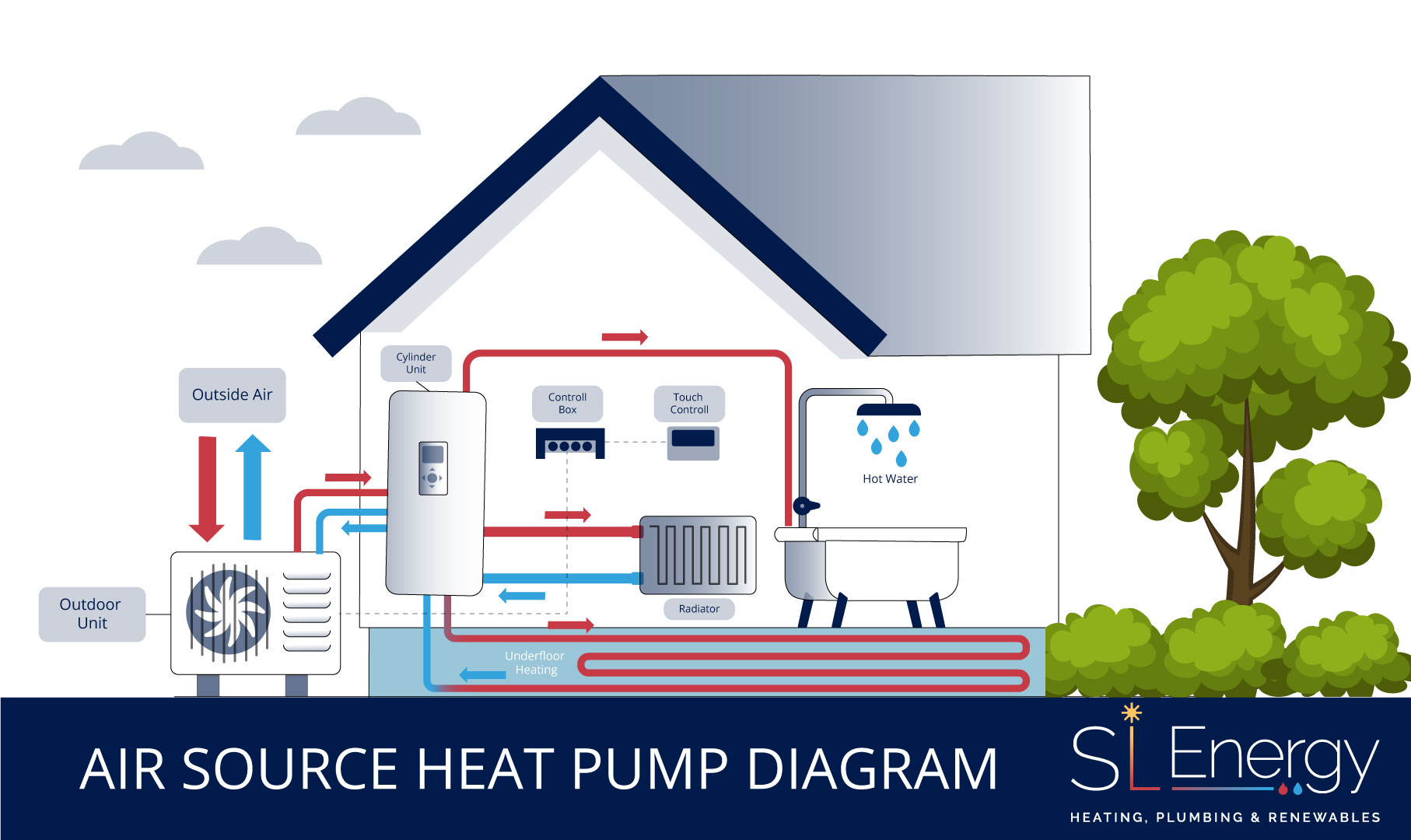
2. Why install an air-to-water heat pump in 2025?
- Decarbonization: reduction of emissions compared to oil/gas, especially if electricity is decarbonized.
- Savings: a SCOP of 3 means ~1 kWh electric → ~3 kWh heat delivered (variable depending on climate, emitters, regulation).
- Public subsidies: MaPrimeRénov’, CEE “Heating Boost”, eco-PTZ, VAT at 5.5% (subject to eligibility).
- Comfort: gentle heat, possible passive cooling on underfloor heating (if system and regulation are adapted, to be validated with the installer).
Context point — ADEME confirms the interest of heat pumps to limit fossil energy consumption and CO₂, provided there is a careful installation, precise sizing, and adequate regulation (water law). See ADEME’s public guide. Source.
3. Standards & rules 2025 (NF DTU 65.16, F-Gas, RGE)
3.1 NF DTU 65.16
NF DTU 65.16 governs the design and implementation of heat pump and thermodynamic water heater installations (on the primary design side: capture/sources, heat pump, hydraulic departure up to the buffer tank/bottle). It is the execution reference for professionals in new construction and renovation. Presentation • AFNOR Text.
3.2 F-Gas 2024/573 & refrigerant
Since 2024, Regulation (EU) 2024/573 strengthens the phase-down of HFCs (R410A, R32…) and directs the market towards fluids with low GWP such as R290 (propane) or R744 (CO₂). Requirements evolve regarding placing on the market, maintenance, and recovery of fluids. Official Journal Text • Ministry of Ecology • Professional Analysis.
3.3 Qualification & handling
In France, only qualified professionals may handle refrigerants and carry out the installation; and using an RGE-certified company is required to access public subsidies. Economie.gouv.
4. Financial aid 2025 (MaPrimeRénov’, CEE, eco-PTZ)
4.1 MaPrimeRénov’
MaPrimeRénov’ (ANAH) finances, depending on income profile and project, the installation of an air-to-water heat pump (including hybrid) via flat rates. The 2025 ANAH guide indicates indicative amounts per action (e.g., air-to-water heat pump) under eligibility conditions and RGE-certified company. User guide (PDF) • 2025 aid (PDF). Note: the large-scale renovation window was temporarily closed and reopens with adapted terms on September 30, 2025. Service-Public.fr.
4.2 CEE “Heating Boost”
The CEE bonus enhances the replacement of a fossil boiler with an air-to-water heat pump: the commitment must be made no later than 12/31/2025 and completion no later than 12/31/2026. Official fact sheet.
4.3 Eco-PTZ & 5.5% VAT
The zero-interest eco-loan can complement your financing plan, and eligible works benefit from a 5.5% VAT. See the summary sheet of heating aids as of 04/08/2025. Economie.gouv. Important — Eligibility rules are evolving (ceilings, work bundles, audit, etc.). Always check the most recent version of the schemes before signing.
5. Sizing: simple but reliable method
5.1 Heat loss calculation
The installer performs a room-by-room heat loss calculation (local climate, insulation, ventilation) to determine the thermal power at -7 °C or -10 °C depending on the zone. Avoid “oversized” heat pumps (short cycles, reduced efficiency) and those that are “just right” (frequent electric backup).
5.2 Supply temperature & water curve
A heat pump performs better at low temperature. If your radiators require 60–65 °C at -7 °C outside, consider emitter renovation (low-temperature radiators) or bivalent (boiler backup). The water law (heating curve) adjusts the supply temperature according to the weather to maximize the SCOP.
5.3 Buffer tank & hydraulics
Depending on the diagram, a buffer tank or a decoupling bottle stabilizes the flow, prevents short cycling, and facilitates defrosting. Careful adjustment of flows (valves, pumps, balancing) and protections (valves, expansion vessels).
| House (insulated area) | Heat pump power at -7 °C | Target supply temp | Achievable SCOP* |
|---|---|---|---|
| 80–100 m² RT2012 | 5–6 kW | 35–40 °C | 3.8–4.5 |
| 100–130 m² RT2005 | 6–8 kW | 40–45 °C | 3.2–4.0 |
| 120–160 m² renovated 90s house | 8–10 kW | 45–50 °C | 2.8–3.5 |
*Indicative assumptions, excluding DHW and depending on climate zone. Precise calculation remains the installer’s responsibility.
6. Emitters: low-temperature radiators, underfloor heating & DHW
Emitter compatibility determines the supply temperature:
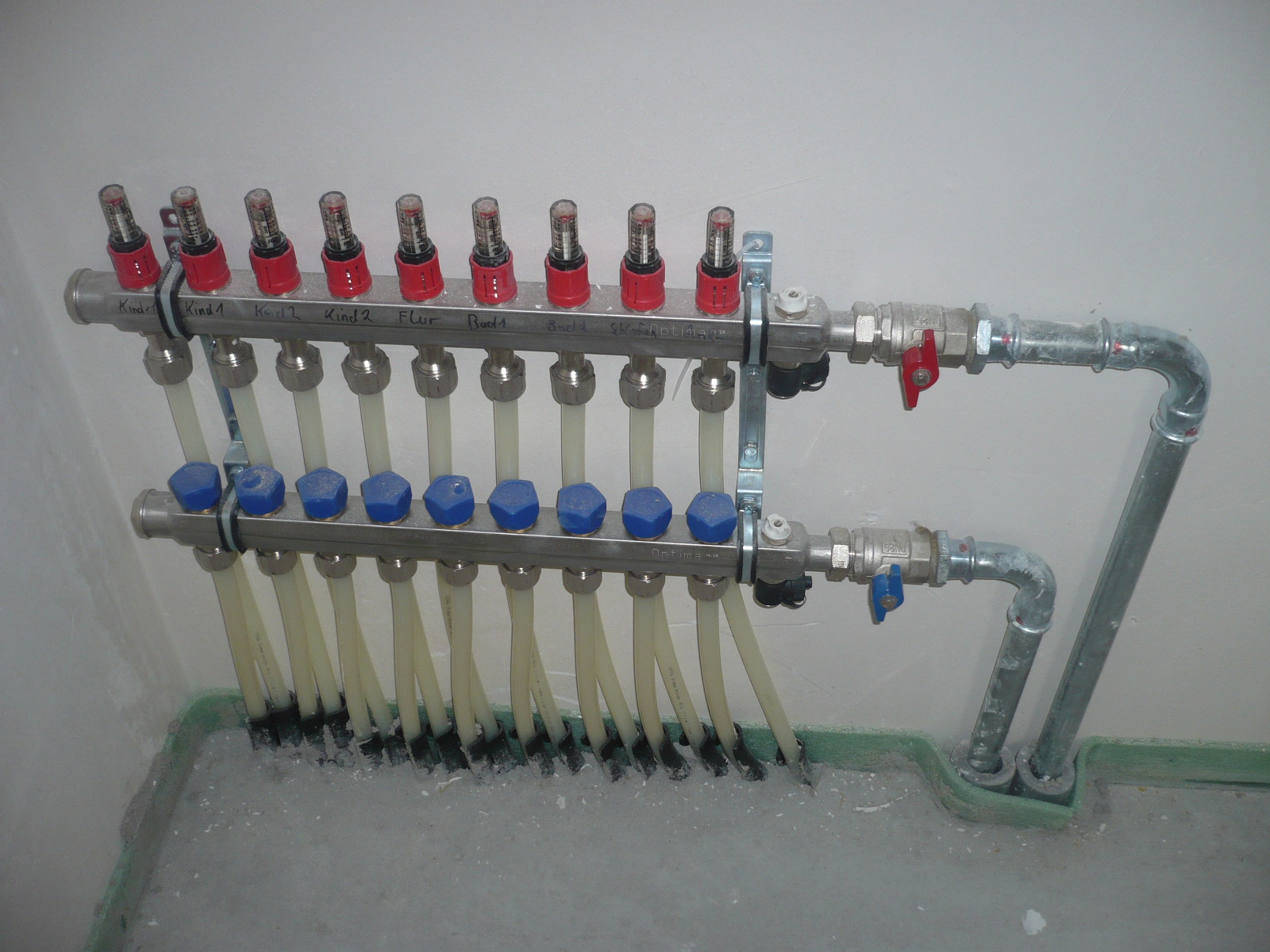
- Underfloor heating: ideal (supply 30–40 °C). Balancing via manifold (below) and room-by-room control.
- Low-temperature radiators: very suitable for renovation (supply 40–50 °C).
- Existing high-temperature radiators: case-by-case study (areas, oversizing, bivalent/hybrid).
- DHW: integrated production (tank) or dedicated (thermodynamic tank/backup boiler depending on case).
7. Placement & acoustics: don’t upset the neighbors
The outdoor unit should be positioned away from bedrooms, on an antivibration mount, at a distance from windows and property boundaries. Aim for a clear airflow (no enclosed corners), plan for defrost water drainage (freeze) and a snow guard if necessary. Regarding noise, pay attention to: decoupling of the base, fan orientation, acoustic casing if needed, and night mode settings.
Construction tip — A simple 90° rotation of the unit can reduce noise by several dB for the neighbor. Always request a installation plan with noise isolation.

8. Steps for a compliant installation (step by step)
- Technical visit: survey of surfaces, insulation, existing network, electrical panel, condensate drainage, outdoor/indoor placement.
- Study & quote: calculation note of heat losses, selected power, hydraulic diagram (with/without buffer), precise list of supplies and services (drilling if water-water, drilling, pulling refrigeration lines, commissioning).
- Preparation: isolated concrete support, passage of refrigerant/hydraulic connections, dedicated electrical network, protections (circuit breaker, differential).
- Installation: outdoor unit (wind alignment), indoor hydraulic module, DHW tank if integrated, hydraulic connections with bleeders, valves and filters.
- Refrigeration: vacuum pumping, leak test, charging with refrigerant (if necessary) by a certified professional. Forbidden for uncertified persons.
- Commissioning: water law parameter setting, balancing, defrost test, electrical current verification, safety instructions & F-Gas label.
- Acceptance: commissioning report, certificate of conformity, explanation to the client (uses, filters, summer/winter mode instructions), maintenance logbook.

9. Costs, savings & return on investment
The cost of an air-water heat pump varies greatly depending on power (5–12 kW in houses), brand, presence of a DHW tank, hydraulic and electrical work, acoustics and region. In 2025, the following (order of magnitude excluding subsidies) is observed:
- Equipment + installation €8,000 to €15,000 (heat pump only); €10,000 to €20,000 with DHW and network adaptations.
- Annual maintenance €150–300 (depending on contract and refrigerant).
- Savings vs fuel oil: often –40% to –60% on the heating bill, depending on insulation and usage.
The ROI depends on the energy price gap (kWh electricity vs gas/fuel oil), your actual SCOP and the net subsidies used (MaPrimeRénov’, CEE, eco-PTZ). Perform a personalized simulation and compare at least three quotes.
10. R32 vs R290: what to choose in 2025?
| Refrigerant | GWP | Advantages | Points of attention | Trend |
|---|---|---|---|---|
| R32 (HFC) | ~675 | Mature technology, wide availability, good efficiency. | Dependent on HFC phase-down (F-Gas 2024/573), future constraints on market placement. | Progressive transition towards lower GWP alternatives. |
| R290 (propane) | ~3 | Very low GWP, excellent low-temperature efficiency, future-proof regarding F-Gas. | Flammability (A3): secured design, strict compliance with manuals & distances, trained installers. | Strong growth of new installations in 2024–2026. |
Your choice will depend on the site constraints, the required starting temperature, the budget, and the local availability. In all cases, check the F-Gas compliance and favor manufacturers who clearly document R290 safety. References: F-Gas regulation (EU 2024/573) and ministry note. EUR-Lex • Ecologie.gouv.
11. Ten common mistakes to avoid
- Underestimating heat losses (or not calculating them) → incorrectly sized heat pump.
- Ignoring the water law and adjusting “by hand” → overconsumption.
- Forgetting hydraulics (buffer, balancing) → short cycles, noise, breakdowns.
- Poor placement (angle, reflection) → noise nuisances.
- Unmanaged condensates/defrosting → ice, puddles, disputes.
- Inappropriate electrical section → trips, overheating.
- Not planning maintenance (filters, leak checks if necessary).
- Omitting certificates (commissioning, F-Gas, RGE) → loss of subsidies.
- Hasty signatures without verifying SIREN numbers, insurances, reviews.
- Unclear quotes (no detail on materials/services) → budget overruns.
Need an expert eye on your heat pump quotes? Request a quick audit — contact us.
To better understand our approach and commitments, see About and Contact.
FAQ — Air-to-water heat pump installation (2025)
What is the price of an air-to-water heat pump installed in 2025?
Typically expect €10,000 to €20,000 installed (depending on power, DHW, hydraulic/electrical adaptations). Subsidies (MaPrimeRénov’, CEE, eco-PTZ) can reduce out-of-pocket costs subject to eligibility and certified installer.
My house has “classic” radiators: is it compatible?
Yes, if the required starting temperature remains reasonable (≤ 50 °C most of the time). Otherwise, consider low-temperature radiators, bivalent operation, or improving insulation.
R32 or R290 (propane): what do you recommend?
R290 has a very low GWP and better anticipates F-Gas evolution. It requires rigorous implementation (A3, flammable). R32 remains a mature option with wide availability. Decide with your installer based on your site, water law, and budget.
Can I install my heat pump myself?
No for the refrigeration part: it must be done by a certified professional (handling refrigerants). Without this, there are safety risks, breakdowns, and loss of subsidies.
What 2025 subsidies are available?
MaPrimeRénov’ (flat rate per action, conditions), CEE “Heating Boost” (commitment until 12/31/2025, completion 12/31/2026), eco-PTZ and 5.5% VAT. Refer to the official sheets and the ANAH 2025 guide.
What about external noise?
Choose a clear location, direct the airflow away from neighbors, use anti-vibration mounts and, if necessary, an acoustic cover. Set the night mode.
How much maintenance should be planned?
An annual maintenance (contract) ensures longevity: safety checks, filters, hydraulics, regulation updates. Leak checks may apply depending on the fluid charge and regulations.
Reliable sources
- ADEME — Heat pumps: practical guide
- Batirama — NF DTU 65.16 (summary)
- AFNOR — NF DTU 65.16 (reference)
- EUR-Lex — Regulation (EU) 2024/573 (F-Gas)
- Ministry of Ecological Transition — Refrigerant fluids
- Service-Public.fr — “Heating Boost” grant
- ANAH — MaPrimeRénov’: user guide (PDF)
- ANAH — Financial aid 2025 (PDF)
- Service-Public.fr — MaPrimeRénov’: reopening of the window 09/30/2025
- Economie.gouv — Aid for installing a heat pump (2025)
Last update: 09/07/2025 — Written by an SEO & energy consultant. This guide does not replace a thermal study or manufacturer’s instructions.