
Sommaire
Installing an air-to-water heat pump transforms the way a house is heated: it captures the calories from the outside air and converts them into heat for the hot water circuit. This file details, step by step, what the installation entails — from the technical choice to the hydraulic connection, including sizing and financial aids. The idea is not to replace your installer, but to give you the keys to ask the right questions, avoid pitfalls, and understand the trade-offs that influence performance and the energy bill.
In brief
🔧 Key steps: thermal study, choice of location, installation of the outdoor unit, hydraulic/electrical connections, commissioning and regulation.
📐 Sizing: the power must be adjusted to your actual losses — an oversized heat pump costs more without necessarily heating better.
💶 Costs and aids: price varies according to power and model, but subsidies exist — calculate profitability with current consumption.
🛠️ Maintenance: annual checks and defrosting, vigilance on the hydraulic network and regulation to preserve the COP.
Why choose an air-to-water heat pump?
An air-to-water heat pump is chosen to reduce dependence on fossil fuels and to benefit from a heating mode often more economical depending on the climate and the device’s performance. Unlike a boiler, the heat pump draws free energy (calories from the air) and delivers it via hot water to radiators, underfloor heating, or domestic hot water heaters. The actual gain depends on the coefficient of performance (COP) and the departure temperature required by your installation: the lower the system operates in temperature, the better the efficiency.
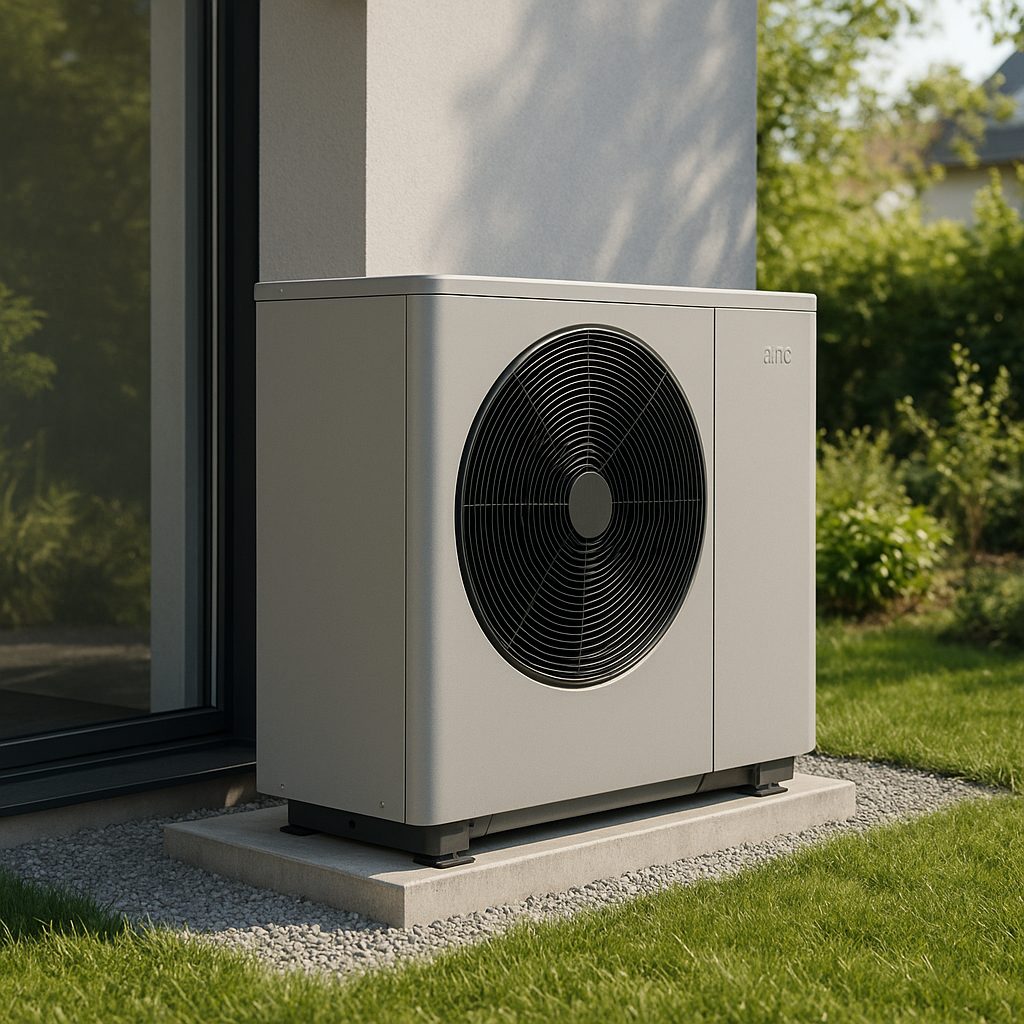
Advantages and limits
The main advantage is the reduced electrical consumption compared to direct thermal production. The heat pump can operate all year and adapt to domestic hot water production. However, at very low outdoor temperatures, efficiency drops and the heat pump may require electric backup or an auxiliary boiler. Another limitation: the noise of the outdoor unit, which requires positioning and acoustic insulation precautions if neighbors are close.
Principle and simplified operation
The air-to-water heat pump uses a refrigerant fluid that circulates in a closed circuit: evaporator, compressor, condenser, and expansion valve. The evaporator captures heat from the air and vaporizes the fluid; the compressor raises the pressure and temperature; the condenser transfers heat to the heating circuit water; finally, the expansion valve lowers the pressure to close the cycle. Technically, the hydraulic part resembles a conventional installation: a distribution circuit, a circulation pump, valves, and sometimes a buffer tank to smooth the cycles.
Detailed installation steps
1. Thermal study and sizing
First of all, involve a professional to carry out a thermal diagnosis or heat loss calculation. Sizing is not limited to the surface area: insulation, glazing, orientation, and usage strongly influence it. An undersized unit will struggle to maintain the temperature; an oversized unit will cycle on and off frequently, reducing its lifespan and seasonal efficiency.
2. Choice of location
The outdoor unit must be placed on a stable, clear, and accessible surface for maintenance. Prefer a location where air circulates freely and away from neighbors’ windows. The indoor unit (hydraulic module) should be located close to the connections to the tank, any backup boiler, and the electrical panel: this limits losses and facilitates connections.
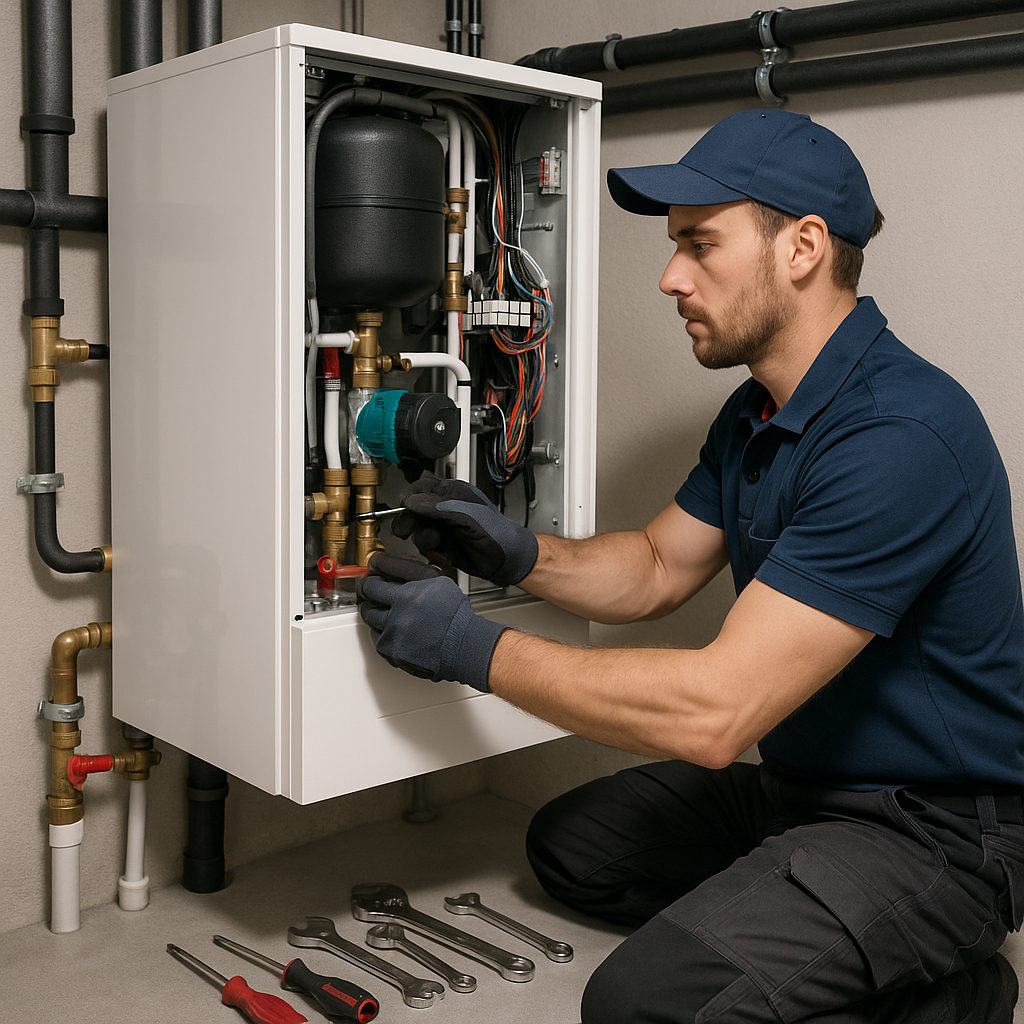
3. Hydraulic and electrical connections
The hydraulic assembly requires purging, proper fittings (welds, flanges, or crimp fittings depending on the material), and safety equipment: expansion vessel, filter, automatic purge, and safety groups for domestic hot water. On the electrical side, the heat pump requires a dedicated circuit breaker and a compliant grounding connection. Communication between the control system and sensors (temperature, sometimes pressure) must be tested to ensure optimal cycle management.
4. Commissioning and adjustments
Commissioning by a qualified professional is essential to validate refrigerant pressures, fluid level, defrosting, and mode programming. The control system must be adapted to the emitters: heating curve adjustment, temperature differential, weekly programming. Fine tuning will maximize the COP and avoid undesired operating modes.
Sizing: practical table
The table below provides a quick estimate to get an idea. It is not a definitive calculation but a useful commercial reference for discussions with an installer.
| Heated surface (m²) | Standard insulation | Indicative power (kW) | Remarks |
|---|---|---|---|
| Less than 80 | Good | 6 – 8 | Often suitable with underfloor heating or low-temperature radiators |
| 80 – 150 | Average | 8 – 12 | Check compatibility with existing radiators |
| 150 – 250 | Variable | 12 – 20+ | Buffer tank recommended to smooth cycles |
Costs, aids, and profitability
The installation cost of an air-to-water heat pump varies greatly depending on power, manufacturer, complexity of the hydraulic network, and the need for backup. Added to this is the cost of commissioning and any adaptation work (replacement of radiators, additional insulation).
- Purchase and installation price: wide range depending on power and options.
- Public aids and bonuses: there are aid schemes that can significantly reduce the out-of-pocket cost — check the eligibility conditions and RGE qualification requirements.
- Profitability calculation: simulate savings based on your current consumption and a realistic seasonal COP (SCOP), take into account the evolution of electricity and fossil fuel prices.
Maintenance and lifespan
Annual maintenance by a certified professional prevents breakdowns and preserves efficiency. Common operations: checking refrigerant pressures, inspecting the hydraulic circuit, cleaning the exchangers, and verifying proper defrost operation. Monitoring the water circuit pressure and limescale in hard water areas is also essential.
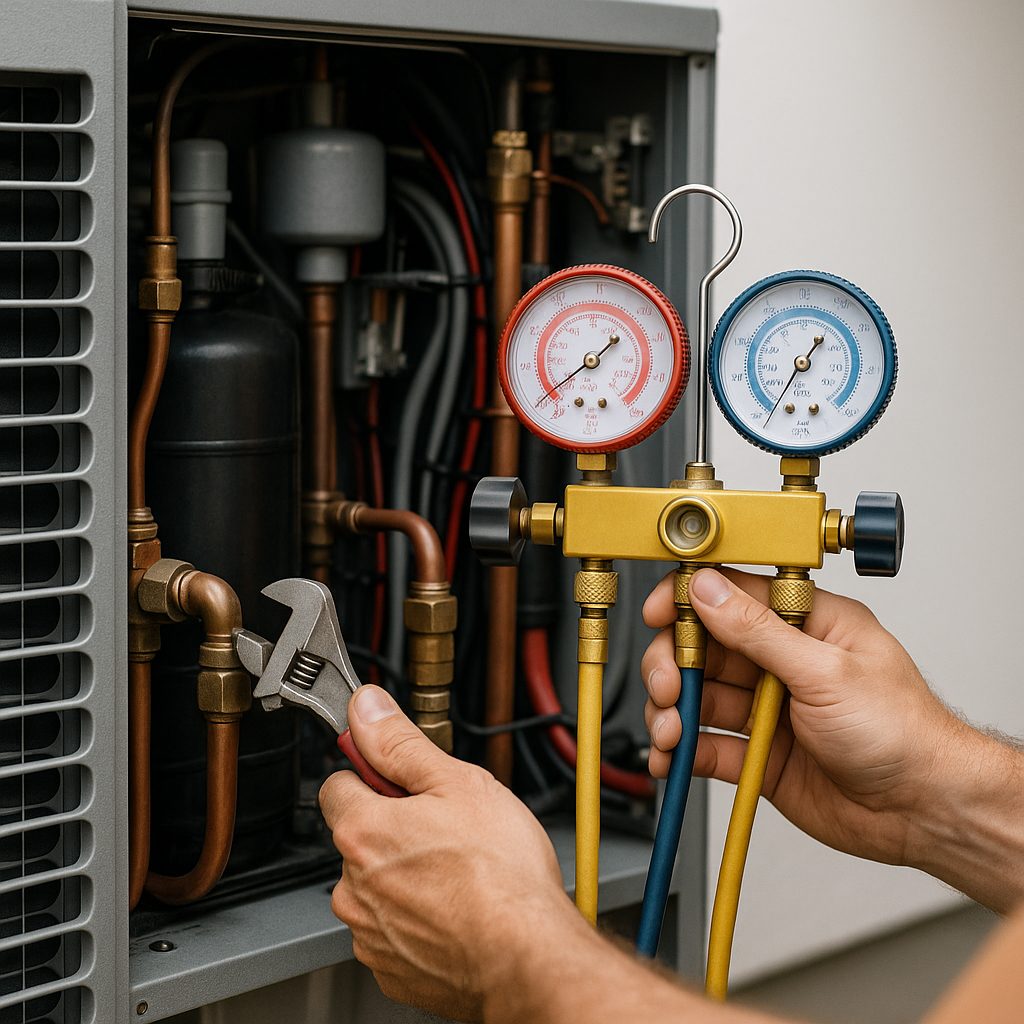
In practice, the lifespan of a well-maintained heat pump often ranges between 15 and 20 years. The electronic components and the compressor require the most attention; regular monitoring helps anticipate and limit repair costs.
Practical tips for a successful project
- Have a thermal study done rather than an approximate sizing.
- Prefer an RGE installer and request several detailed quotes.
- Consider the building insulation before increasing the heat pump’s power.
- Check the compatibility of emitters (radiators vs. underfloor heating).
- Request measurement of the SCOP and defrost tests in real cold conditions.
FAQ
Does an air-water heat pump work in very cold weather?
Yes, but its efficiency decreases when the outside temperature drops. However, modern models retain part of their efficiency down to low temperatures, and most are equipped with defrost options and electric backup or a boiler for very cold periods.
Can a gas boiler be replaced by a heat pump on existing radiators?
It is possible, but it depends on the required supply temperature of your radiators. Old radiators, designed for high-temperature supply, will provide lower comfort if fed by a heat pump without adaptation. Sometimes, replacing some radiators or adding a buffer tank and finer regulation is sufficient.
What maintenance should be planned?
Annual check for the refrigerant and hydraulic parts, cleaning of external exchangers, checking clearances and fixings, testing electrical safety. These actions ensure performance and longevity.