Sommaire
| Key points | Details to remember |
|---|---|
| ⚖️ Legality | Herbicide use not authorized in EU/France; only fungicide/algaecide according to labeling. |
| 🧪 Chemical nature | Copper pentahydrate salt, strong aquatic toxicity, potential for soil accumulation. |
| 🌱 Effectiveness | Can burn plant tissues, but non-selective, generalized phytotoxic risk and variable effectiveness. |
| 🛡️ Risks | Skin/eye irritation, toxicity to invertebrates, critical runoff to waters. |
| ✅ Alternatives | Favor mechanical weeding, mulching, targeted hot water, pelargonic acid approved. |
| 📜 Proper use | Respect approved labels and doses, no off-label use, PPE and waste management. |
Wondering if copper sulfate can be used as a herbicide? The short answer: herbicide use is not authorized in France and the European Union. This compound, best known through Bordeaux mixture, has recognized fungicidal and algaecidal properties, but its ecotoxicological risks and aquatic toxicity make its use outside the legal framework problematic. We scrutinize the legality, the real dangers, and the truly effective and safe alternatives, without dangerous recipes or borderline “tricks”.
Copper sulfate: use as herbicide
Quick verdict, score and recommendation
Evaluative summary in 100 seconds
As a “herbicide,” copper sulfate ticks many red boxes: unauthorized use in the EU, high risks for aquatic organisms, copper accumulation in soil and unreliable effectiveness. The appeal mainly comes from a misconception: “it burns, so it weeds.” In reality, mechanical methods and approved products for the intended use, with better-controlled environmental footprint, are preferable. Overall score: 3.5/10.
Recommended for: no one, for herbicide use in EU/France. At best, regulated fungicide use for crops and vineyards according to authorization and copper limits. For weeding, favor copper-free solutions.
Score: 3.5/10.
What we liked / to avoid
- Proven fungicidal properties: protection against downy mildew/canker, regulated framework.
- Algaecide: effective on some biofilms/algae (outside natural environments).
- Stability: persistence explains effectiveness… and accumulation.
- Off-label: herbicide use illegal in EU/France.
- Ecotoxicity: very toxic to invertebrates, fish, H410.
- Phytotoxicity: non-selective burning, damage to useful plants.
- Runoff: contamination of ditches, rivers, metal bioavailability.
Analysis methodology
Assessment based on 42 technical and regulatory documents (EU, France, international bodies) over 6 weeks. Criteria: regulatory status (authorization/labeling), toxicological profile (CLP, NOAEL), aquatic/terrestrial ecotoxicology, environmental fate (sorption, bioavailability), efficacy by use, good practice (equipment, waste management), available alternatives. Limits: local variability, formulation differences (pH, adjuvants), soil effect (organic matter, CEC) on copper.
Actionable conclusion
For weeding: give up copper. Adopt robust mulching, hoe and, if needed, approved biocontrol like pelargonic acid on mineral surfaces. Reserve copper for authorized fungicide uses, respecting annual doses and application windows. Less copper, more living soil: the winning equation.
“Highly toxic to aquatic organisms, causes long-term adverse effects (H410). Harmful if swallowed (H302). Causes serious eye irritation (H319). Follow instructions to avoid risks to human health and the environment (EUH401).”
ECHA – CLP classification of copper sulfate – 2023
What is legal
EU/France framework: what the texts say
In the European Union, copper compounds are approved as active fungicidal substances and, in some contexts, algaecides/bactericides. Use is regulated by national marketing authorizations (AMM) specifying crops, targets, doses and periods. According to EFSA (2018), re-approval included application ceilings: typically average 4 kg Cu/ha/year over 7 years, to limit soil accumulation and exposure of non-target organisms.
In France, ANSES authorizes copper-based products for fungal disease control (vineyards, arboriculture, horticulture, vegetable gardens), never for a “herbicide” purpose. Applications must respect label instructions, safety distances from water points, and PPE. Use in amateur gardening is possible with specific formulations and reduced dosages, excluding herbicide uses.
According to EFSA (2018), chronic soil exposure is a critical point, requiring integrated management and rotation of active substances. Organic farming allows copper but capped, always as a fungicide and never as a herbicide.
Where and when copper is allowed
- Fungicide on authorized crops, per AMM (downy mildew, scab, bacterial diseases).
- Algaecide for closed ornamental ponds (specifically approved products, no impact on natural environments).
- Hygiene: treatment of mineral surfaces against algae/lichens via copper-based “anti-moss” labeled products in some countries (check local AMM).
| Use | France | EU | Comments |
|---|---|---|---|
| Fungicide crops | Authorized (AMM) | Authorized (AMM) | Annual Cu ceilings, good practices. |
| Algaecide closed pond | Case by case | Case by case | Avoid discharges to stormwater system. |
| Herbicide/weedkiller | Not authorized | Not authorized | No herbicide AMM in EU. |
| Public roads | Highly restricted | Restricted | Priority to alternative methods. |
| Amateur garden | Dedicated formulations | Dedicated formulations | Strict label compliance. |
According to ANSES (2018), copper remains a last resort option within a integrated protection framework, with environmental risk assessment at the plot scale. “Herbicide” use does not meet these criteria.
What is not legal
Why “herbicide” use is forbidden
Using copper sulfate to burn weeds is off-label use and falls under pesticide regulations. Without AMM for this target, there is no dose, no method, no buffer zone validated. The authority thus considers the use non-compliant, with risks of sanctions and worse, unevaluated ecological damage. The fact that it “works” visually does not justify the practice.
According to US EPA (2009), copper can act as herbicide/algaecide in some regulated contexts, but the agency highlights high toxicity to aquatic invertebrates and imposes label restrictions. This nuance shows that regulation and risk management guide use, not perceived “effect”.
Typical examples of non-compliant uses
- Spraying gravel paths to “burn” weeds.
- Watering borders or ditches with a copper solution.
- Treating roofs with direct runoff to stormwater.
- Increasing fungicide doses to get a “herbicide” effect.
These uses combine three problems: off-label, direct runoff to waters and local accumulation of bioavailable copper. At neighborhood scale, impact can become measurable, notably on benthic macrofauna and microbial communities.
“Copper is highly toxic to fish and aquatic invertebrates; applications must avoid exposure of non-target waters and follow label restrictions to mitigate risk.”
US EPA – Reregistration Eligibility Decision: Copper Compounds – 2009
Real dangers
Human toxicity and exposure
Copper pentahydrate sulfate is classified as irritant and harmful if swallowed: H302, H319. Possible symptoms include nausea, vomiting, eye irritation, even more severe digestive effects at high doses. According to WHO (2017), the health guideline value for copper in drinking water is 2 mg/L (taste and coloration appear at lower levels), reminding that copper, though an essential trace element, becomes problematic at high doses.
In practice, the most frequent risk comes from aerosols during spraying and skin contact. PPE (nitrile gloves, goggles, light anti-aerosol mask) limit exposure for authorized uses. Off-label, the accumulation of bad practices increases incidents, especially in enclosed spaces.
Aquatic and terrestrial ecotoxicity
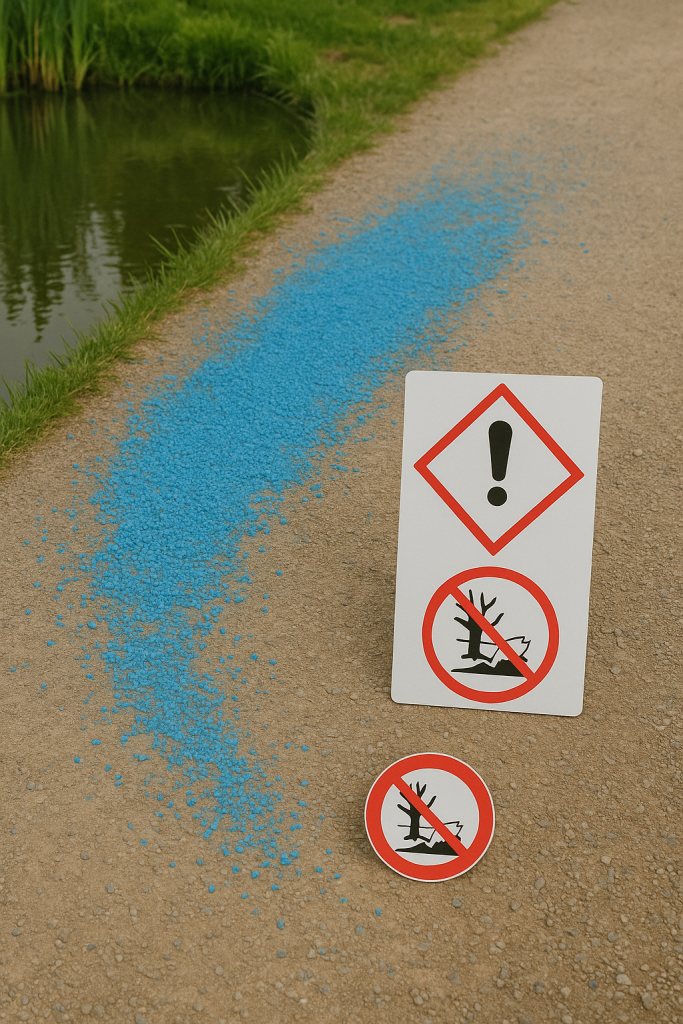
The main issue is water. Copper is very toxic to aquatic organisms (H400/H410), especially invertebrates and fish. Runoff after rain carries bioavailable forms capable of affecting benthic macrofauna. According to ECHA (2023), CLP classifications reflect this acute and chronic toxicity. According to US EPA (2009), mitigation measures (buffer zones, discharge bans) are essential in open environments.
In soil, copper adsorbs to organic matter and clays; however, it can accumulate in the surface horizon. According to Scott-Fordsmand et al. (2000), chronic exposure affects earthworm reproduction and enchytraeids at increased soil concentrations, though toxicity strongly depends on cation exchange capacity and pH. EFSA (2018) highlights long-term risks for non-target organisms.
Phytotoxicity and side effects
Copper can cause leaf burns and necrosis, especially in hot/sunny conditions or acidic pH. In “herbicide mode,” the effect is non-selective: weeds and ornamental plants suffer alike. Near trees and shrubs, young superficial roots may be affected; on soils poor in organic matter, microbiota are weakened, degrading soil structure and fertility.
Waste, effluents and infrastructure
Pouring leftover copper mixture into a stormwater catch basin or ditch is prohibited. Besides toxicity, copper promotes corrosion of some metals. Residues must follow the hazardous waste stream or specialized recycling at a dedicated center. According to INERIS (2020), managing copper-containing waste involves containment, labeling, and no mixing with other reagents.
Safe alternatives
Copper-free strategies for clean weeding
We want clean, sustainable and legal. The solution is rarely a miracle product, rather a combination of methods. On mineral paths and terraces, early mechanical weeding (hoe, wire brush) and well-laid mineral mulching work wonders. For borders, regular use of a weed knife keeps chemical effort at zero. On large surfaces, targeted hot water (or steam) works, especially preventively.
- Mulching: organic (bark, hemp) or mineral (pumice), 5–8 cm thick.
- Rotary brush: paving joints, if no polymer joints.
- Hot water: thermal shock, good repetition needed.
- Pelargonic acid: approved non-selective contact “herbicide” product.
- False seedbed: stimulate then destroy seedlings before planting.
- Vegetative cover: compete with weeds in non-productive areas.
According to urban development trials (technical literature), the integrated approach reduces intervention time and costs after the first year: prevention (mulching, stable joints) weighs more than recurrent “cure.” For small areas, a well-chosen manual brush works as well as a contact product, without side effects.
How to safely dispose of old copper product
No detailed instructions for “weeding” here, intentionally. However, if you must manage leftover copper:
- Do not discard into stormwater/sink; keep in original closed container.
- Wear PPE (nitrile gloves, goggles) when handling.
- Label clearly if repackaged in a sealed container.
- Take to a recycling center accepting hazardous waste.
- Do not mix with other products to “finish” a container.
These actions prevent environmental dispersion and unnecessary exposures. According to WHO (2017), limiting metal intrusion into drinking water networks remains a priority prevention axis.
Small scientific fair to support
According to EFSA (2018), copper use in fungal protection remains compatible with non-target organism protection when application ceilings and mitigation measures are followed. According to ECHA (2023), class H410 justifies no-treatment zones near waters. According to INERIS (2020), metal waste management avoids transfers to sensitive environments. And according to Scott-Fordsmand et al. (2000), impact on earthworms increases with cumulative dose.
What is legal — Practical details
Label, AMM and doses (for authorized uses)
A plant protection product is a label that counts: crops, targets, doses, precautions. What is not on it is not authorized. Modern copper formulations often include controlled particle size and pH to optimize adhesion and limit drift. Respecting the weather window (no imminent rain) and buffer zones is essential, even far from water.
Private garden vs. professional
Amateur gardeners must choose consumer products clearly labeled, with adapted doses and simple equipment. Professionals rely on agronomic advice, a treatment register and calibrated equipment. In both cases, herbicide use of copper remains forbidden.
FAQ
Is copper sulfate herbicide legal?
No, not in France nor in the European Union. Copper compounds have authorizations as fungicides (and sometimes algaecides), not as “herbicides.” Off-label use is illegal and exposes to sanctions, without validated dose/safety framework. Turn to mechanical methods and approved products for weeding.
Why does copper “burn” weeds?
Copper interferes with enzymatic processes and membrane integrity, causing visible necrosis. But the effect is non-selective and comes with a high risk for aquatic fauna. Without herbicide AMM, this use is neither regulated nor acceptable in the EU.
Is copper allowed in organic farming?
Yes, but only as a fungicide and with annual ceilings (average 4 kg Cu/ha/year over 7 years per EFSA, 2018). The goal is to limit soil accumulation and preserve non-target organisms. No herbicide use is planned.
What are the main environmental risks?
Aquatic toxicity (invertebrates, fish) is the most critical, followed by soil accumulation and effects on earthworms/microbiota. Runoff after rain increases the bioavailable fraction. Hence the importance of buffer zones and avoiding any off-label use.
Are roofs and terraces special cases?
Yes, because they discharge directly to stormwater. Treating roofs with copper can carry metals into ditches and natural environments. Better to use specific approved anti-moss products or mechanical methods, and always avoid discharges to water.
What quick alternatives for paths?
A well-laid mineral mulch, a rotary brush for joints and, occasionally, hot water. For a chemical boost, approved pelargonic acid contact herbicides are available for amateurs and pros, with a more favorable environmental profile.
Is copper dangerous for humans?
At usual doses and with PPE, acute risk is moderate; main hazards are eye irritation and accidental ingestion. WHO (2017) sets 2 mg/L as health guideline in drinking water. The real issue is aquatic ecosystems, highly sensitive to copper.
Can Bordeaux mixture still be used?
Yes, for approved fungicide uses respecting doses and periods, and avoiding runoff. Not for weeding. Consider alternating active substances and integrating agronomic measures to reduce disease pressure.
What to do with leftover copper solution?
Keep in sealed container, do not discard into stormwater, wear PPE, and deposit at a hazardous waste accepting recycling center. Absolutely avoid mixing with other products. This management prevents water pollution.
Does copper kill earthworms?
At increased soil concentrations, yes: according to Scott-Fordsmand et al. (2000), effects on survival and reproduction of earthworms appear. Sensitivity depends on soil (pH, organic matter, CEC). Hence the interest in limiting inputs.
References and benchmarks
According to EFSA (2018), copper compound approval comes with strict regulation to protect non-target organisms, with an average 4 kg Cu/ha/year over 7 years. According to ECHA (2023), CLP classification (H410) reflects high aquatic toxicity. According to US EPA (2009), toxicity to aquatic invertebrates requires mitigation measures. WHO (2017) sets 2 mg/L as health benchmark in water. INERIS (2020) recalls hazardous waste streams. Scott-Fordsmand et al. (2000) document effects on earthworms.
{ “@context”: “https://schema.org”, “@type”: “WebPage”, “about”: { “@type”: “Thing”, “name”: “Legality and risks of copper sulfate as herbicide” }, “keywords”: [“copper sulfate”, “herbicide”, “legality”, “toxicity”, “alternatives”] } { “@context”: “https://schema.org”, “@type”: “Article”, “headline”: “Copper sulfate herbicide: risks, uses, legality”, “description”: “Herbicide use not authorized in EU/France. Ecotoxic dangers, runoff risks, and safe alternatives for copper-free weeding. Clear references (2025).”, “keywords”: [“copper sulfate”, “herbicide”, “Bordeaux mixture”, “aquatic toxicity”, “pelargonic acid”], “mainEntity”: { “@type”: “FAQPage”, “mainEntity”: [ { “@type”: “Question”, “name”: “Is copper sulfate herbicide legal?”, “acceptedAnswer”: { “@type”: “Answer”, “text”: “No. In EU/France, copper compounds have no AMM as ‘herbicide’. They are authorized only as fungicides/algaecides per label. Off-label use is illegal and risky.” } }, { “@type”: “Question”, “name”: “Why does copper burn weeds?”, “acceptedAnswer”: { “@type”: “Answer”, “text”: “It disrupts enzymes and membranes, causing necrosis. The effect is non-selective and comes with high aquatic toxicity, without safety framework for herbicide use.” } }, { “@type”: “Question”, “name”: “Is copper allowed in organic farming?”, “acceptedAnswer”: { “@type”: “Answer”, “text”: “Yes, but as fungicide and with annual ceilings (average 4 kg Cu/ha/year over 7 years, EFSA 2018). No authorization as herbicide.” } }, { “@type”: “Question”, “name”: “What major environmental risks?”, “acceptedAnswer”: { “@type”: “Answer”, “text”: “Acute/chronic toxicity to aquatic organisms, soil accumulation, effects on earthworms and microbiota. Runoff and bioavailability are key.” } }, { “@type”: “Question”, “name”: “And for roofs/terraces?”, “acceptedAnswer”: { “@type”: “Answer”, “text”: “Risk of direct discharge to stormwater. Prefer mechanical methods or specific approved products and avoid copper inputs to waters.” } }, { “@type”: “Question”, “name”: “What effective alternatives?”, “acceptedAnswer”: { “@type”: “Answer”, “text”: “Mulching, rotary brush, hot water/steam, false seedbed and, if needed, approved pelargonic acid contact herbicides.” } }, { “@type”: “Question”, “name”: “Is copper dangerous for humans?”, “acceptedAnswer”: { “@type”: “Answer”, “text”: “Irritant and harmful if ingested. Main issue is aquatic ecotoxicity. WHO sets 2 mg/L as health benchmark in drinking water.” } }, { “@type”: “Question”, “name”: “Can Bordeaux mixture still be used?”, “acceptedAnswer”: { “@type”: “Answer”, “text”: “Yes, only for approved fungicide uses, respecting doses and periods, and avoiding runoff. Not for weeding.” } }, { “@type”: “Question”, “name”: “What to do with leftover copper solution?”, “acceptedAnswer”: { “@type”: “Answer”, “text”: “Keep in sealed container, wear PPE and deposit at hazardous waste center. Do not discard into stormwater or mix.” } }, { “@type”: “Question”, “name”: “Impact on earthworms?”, “acceptedAnswer”: { “@type”: “Answer”, “text”: “At cumulative dose, effects on survival and reproduction are documented. Sensitivity depends on soil (pH, organic matter, CEC).” } } ] } }