
Sommaire
| Key points | Details to remember |
|---|---|
| ⚖️ Legal framework | Only herbicides with Marketing Authorization (AMM) can be used; food vinegar has none. |
| 🧪 Active substance | Acetic acid burns leaves but is not approved for amateur use in France. |
| 🌱 Ecological risks | Local acidification, harm to soil microorganisms and danger to animals. |
| 🚫 Prohibited practices | Homemade mixtures (vinegar + salt or dish soap) = violation and high risks. |
| 🔄 Alternatives | Mechanical, thermal weeding, mulching, ground covers, products with appropriate AMM. |
| 💶 Penalties | Fines and penalties that can reach several thousand euros depending on the case. |
| 🧭 2025 in practice | Increased controls and reminders of the Labbé Law and EGAlim for individuals. |
Why white vinegar herbicide is banned
We’ve all heard the “miracle” tip of spraying white vinegar on weeds. Quick, cheap, easy to find: the temptation is real. But this DIY reflex is now under the legislator’s scrutiny. In France, the use of non-approved products as herbicides, even “natural” ones, falls under the Rural and Maritime Fishing Code. In 2025, the ban is clear both in public spaces and for individuals: a food product is not an authorized herbicide. Beyond the law, there is the agronomic reality: the effects of acetic acid on soil, beneficial fauna, and surfaces are not trivial. The goal here is simple: understand why it’s banned, what changes for you, and which legal and effective alternatives to adopt without breaking the law.
The 2025 law
Quick verdict and evaluative summary
The 2025 framework confirms the ban for individuals from using “homemade preparations” for weeding, including white vinegar. Reason? Lack of marketing authorization (AMM) as a phytopharmaceutical product, and insufficiently regulated risks for users and the environment. Summary score: 8.5/10 for regulatory clarity (it’s clear), 6/10 for education (some misconceptions remain). Recommended for: amateur gardeners, local authorities, green space managers who want to comply and avoid fines while keeping their outdoor spaces clean.
What to remember — strengths/weaknesses
- Clarity: a “food” product without AMM cannot be used as an herbicide.
- Protection: reduces unnecessary exposure to chemical burns and soil acidification.
- Regulation: obligation to use approved solutions or alternative methods.
- Barriers: persistence of “DIY” advice online, confusion around “natural” products.
- Impact: change of habits and initial cost to equip with mechanical or thermal methods.
Methodology of this analysis
We cross-referenced the Rural Code (articles L253-1 and following), communications from ANSES, and the scope of the Labbé Law and EGAlim (restrictions for individuals and local authorities). Technically, we compared the efficacy and risks of acetic acid with horticultural literature (seedling control, pH effects on soil microbiota) and feedback from local authorities that have adopted “zero pesticide” policies. Criteria: legal compliance, user safety, soil/water impact, real effectiveness, cost/time, feasibility. Limits: heterogeneity of situations (climate, soil type), and rapid changes in the list of products with AMM.
Why it’s banned in 2025
The rule is simple: in France, you can only weed with products that have an official authorization, or with non-chemical methods. Food vinegar has no AMM, and acetic acid is not approved for amateur herbicide use in France. Post-2019 laws (strengthened Labbé Law) have banned herbicide sales to individuals, except for biocontrol products, low-risk products, or listed basic substances. Vinegar does not fall into these categories for individual weeding. In 2025, controls are tightening: use and advice for “herbicide” use of vinegar are prohibited. Homemade mixtures (vinegar + salt + dish soap) accumulate violations and worsen environmental impact.
“A product is legally an herbicide only once it has received an AMM with specific uses, a label, dosages, and risk reduction measures. Vinegar sold for food does not meet any of these criteria.”
ANSES — Regulatory communication — 2022
Penalties and responsibilities
Advising or using a non-approved product as an herbicide exposes you to administrative and criminal fines. Amounts vary depending on the nature of the offense (marketing, possession, use), but for individuals, it can be a fine of several hundred euros, or more in case of repeat offenses or environmental damage. Local authorities and companies face much higher penalties. Beyond financial aspects, improper handling causing burns or eye splashes incurs civil liability.
Risks for soil / animals
What changes everything agronomically
Vinegar acts by contact: it dries aerial parts by destroying cell membranes. On paper, it’s “clean.” In reality, the product does not reach storage organs (rhizomes, deep roots); perennials regrow. Moreover, spraying abruptly acidifies the treated micro-zone. At low doses, acetate biodegrades quickly. At “herbicide” doses (often 8–20% in DIY), the pH shock is real, harming macrofauna (earthworms) and sensitive microorganisms.
According to Rousk et al. (2010), a rapid pH drop changes the bacteria/fungi balance and slows mineralization of organic matter. It’s subtle to the naked eye but affects soil resilience. Horticultural studies (Young, 2004; Webber & Shrefler, 2007) show effectiveness on young dicotyledons but at the cost of superficial burns, rapid reinfestations, and need for multiple treatments. In other words: you gain a few days but lose soil health.
“Applications of acetic acid at high concentrations are likely to damage soil fauna and non-target vegetation by drift. Short-term benefits do not outweigh collateral effects in an ecological garden.”
INRAE — Technical advice green spaces — 2021
Pets and beneficial fauna
A dog walking on a path freshly treated with 10–20% acetic acid can suffer paw irritations; a cat licking it may have digestive troubles. Bees are not the target, but spraying in sunlight increases volatility and risk of exposure to insects on the ground. Since the solution is corrosive, a simple wind gust exposes your eyes and respiratory tract. Safety data sheets classify high concentrations of acetic acid as corrosive, with risks of chemical burns.
Rinsing, runoff and surfaces
Weeding often involves paths, borders, terraces. On mineral soil, the acid attacks some materials (joints, metals), leaves stains, and accelerates corrosion. In rain, some runs off to drains or garden, causing a local acidity peak. Homemade mixtures with salt are worse: soil salinization is long-lasting and compromises plant life medium-term. What seems simple creates costly damage to fix.
| Effect | Likely consequence | Risk level |
|---|---|---|
| Local acidification | Reduced microbial activity, stress on superficial roots. | Medium to high depending on dose. |
| Skin/eye contact | Irritation to chemical burns in humans and animals. | High without PPE. |
| Wind drift | Damage to non-target vegetation, respiratory discomfort. | Medium in hot weather. |
| Runoff | Low pH to drains/garden, stress to local aquatic biota. | Low to medium. |
| Added salt | Salinization, nutrient blockages, plant mortality. | High and persistent. |
Horticultural literature shows acetic acid efficacy increases with concentration and plant youth (Young, 2004). This gain comes with more risks. This is where regulators decide: without AMM, label, or equipment, the equation is unacceptable for amateur use.
Legal alternatives
Goal: practical, safe, compliant
Good news: the range of reliable options has never been wider. Four categories stand out: mechanical, thermal methods, garden design (prevention), and approved products when available for the intended use. Your ideal strategy combines several approaches: prevention + a quick corrective action when a weed appears.
Mechanical and prevention, solid foundations
- Hoe/weed scraper: cuts seedlings before deep rooting, 2–3 times/year.
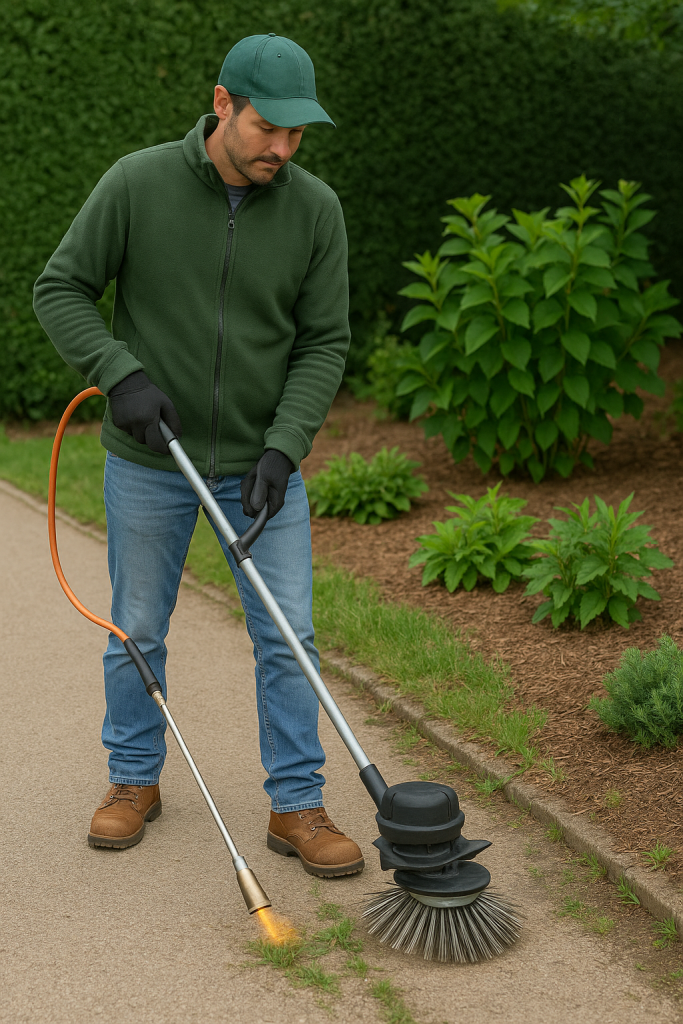
- Street brush: on paving/paths, removes young shoots and moss.
- Mulching: limits light and reduces weed emergence by 60–90%.
- Fabrics/wood chips: on new beds, durably cuts emergence.
- Ground covers: periwinkle, wild thyme, ivy… natural competition, aesthetic.
Thermal and hot water
Thermal by flame or infrared coagulates surface plant proteins. Properly adjusted, a short “heat blast” suffices. Advantages: zero chemicals, fast action. Disadvantages: gas/electricity consumption, caution in dry weather. Boiling water is an economical option for joints: pour at the base, it’s radical on seedlings, with no residual effect. A useful tip: plan a treatment 48–72h after rain, hydrated tissues are more sensitive to thermal shock.
Products with AMM: when relevant
Some contact herbicides based on pelargonic acid have AMM for specific uses (labeling “amateur” or “local authority” depending on case). These are sometimes useful substitution solutions on borders and mineral surfaces. Always check on E-phy (ANSES database) for AMM presence, conditions, dosages and protective equipment. Do not overload: these products are effective on young shoots and often require repeated treatments. They remain management strategies, not definitive eradication.
Quick comparison of alternatives
| Solution | 2025 Legality | Effectiveness | Remarks |
|---|---|---|---|
| Hoe/brush | Total | High on young shoots | Labor time, zero chemical risk. |
| Thermal/flame | Total | Good early on | Caution in drought, regrows on perennials. |
| Boiling water | Total | Good in joints | Simple, economical, no residual effect. |
| Mulching/ground covers | Total | Very good (preventive) | Initial investment, durable time savings. |
| Product with AMM | Yes (per label) | Good on seedlings | Read label, PPE, repeat as needed. |
| “Homemade” vinegar | Forbidden | Variable, regrowth | Risks to soil/fauna/equipment, fines. |
Practical tips to save time
- Act early: a weed at 2–4 leaf stage is removed in one move.
- Segment: 10 minutes per zone, weekly, rather than a monthly chore.
- Fill gaps: ground covers and mulch 5–7 cm thick.
- Tools: ergonomic long handle, rotary brush for joints.
- Weather: after rain (mechanical/thermal more effective), avoid strong wind.
“The best strategy remains preventive: cover the soil, densify plantings and intervene very early on emergence. This triptych sustainably reduces time spent weeding.”
Claire Jardin, Horticultural Engineer, 15 years supporting local authorities
FAQ
Why is it banned?
Because food vinegar has no AMM as an herbicide. French law requires only approved products or non-chemical methods. “Homemade recipes” create a responsibility gap (no label, no dose, no PPE) and risks for soil, user, and environment.
Is it dangerous?
At high concentration, yes. Acetic acid is corrosive: skin/eye burns, respiratory irritation, material damage. Environmentally, local acidification disrupts soil microbiota and can harm beneficial fauna. Salt mixtures worsen and persist in soil.
What if I use “strong” vinegar (10–20%)?
It’s even riskier and still illegal for amateur weeding. Burns are more severe, drift more dangerous, and perennials often regrow. The law makes no distinction: without herbicide AMM, use is forbidden.
Is vinegar at least “ecological”?
“Natural” is not synonymous with ecological. A strong acid applied in excess disrupts the soil ecosystem long-term. Mechanical methods, mulching, and thermal offer a much better overall balance for a living garden.
Quick alternatives on paved paths?
Mechanical brush for joints, boiling water on seedlings, then occasional thermal treatment. Complement with stabilized joint sand to limit future emergence. Effective routine, zero chemicals.
Can I use “biocontrol” products?
Yes if the AMM specifies your use. “Biocontrol” is not a buzzword: these are evaluated products with labels, doses, and equipment. Always check the E-phy sheet and strictly follow instructions.
Is vinegar + salt more effective?
Salt increases tissue dehydration but salinizes soil long-term; illegal and ecologically costly mixture. Absolutely avoid: you damage your soil for a long time.
How did local authorities manage before?
Most have switched to “zero pesticide”: mechanized brushing, thermal weeding, bed design, team training, communication to residents. The approach is sustainable and cities appreciate landscaping quality gains.
Is a pelargonic acid-based herbicide allowed?
Some products are, for defined uses, sometimes in “amateur” versions. A valid AMM, clear labeling, and respect for doses/PPE are required. Without these, do not use.
What about gravel paths?
Raking or brushing, then reloading clean gravel. An underlying geotextile greatly reduces emergence. For maintenance, boiling water is deadly on seedlings.
I have already used vinegar, what risk do I face?
If inspected, you can be fined. The simplest: stop immediately, eliminate homemade recipes, adopt compliant methods, and equip yourself with mechanical/thermal weeders.
How to check a product’s legality?
Search for it in the E-phy database (ANSES): active AMM, authorized use, dose, “amateur” or “professional” mention, PPE. Without a sheet or label: abstain.
“Respecting the regulatory framework protects the user, neighbors, and the environment. Non-chemical alternatives are now efficient enough to make risky ‘tricks’ unnecessary.”
Union of Landscape Companies — Technical note — 2023