
| Key points | Details to remember |
|---|---|
| 🌱 Definition | Acts on dicotyledons without destroying lawn grasses, thanks to physiological selectivity. |
| 🧪 How it works | Systemic herbicides (post-emergence) of the auxinic type (e.g. 2,4-D, MCPA, dicamba) which disrupt the growth of weeds. |
| 🏆 Best uses | Spring and autumn, in mild weather (12–25 °C), on plants at the rosette stage. |
| 📏 Dosage | Follow the authorization: generally 50–100 ml/100 m² in 5–10 L of water (typical example). |
| 🧰 Method | Apply post-emergence, on dry lawn, with no rain forecast for 6–8 h, low wind, using a fine cone spray nozzle. |
| ⚠️ Safety | Avoid drift/vaporization, respect untreated zones, re-entry intervals, keep animals away until drying. |
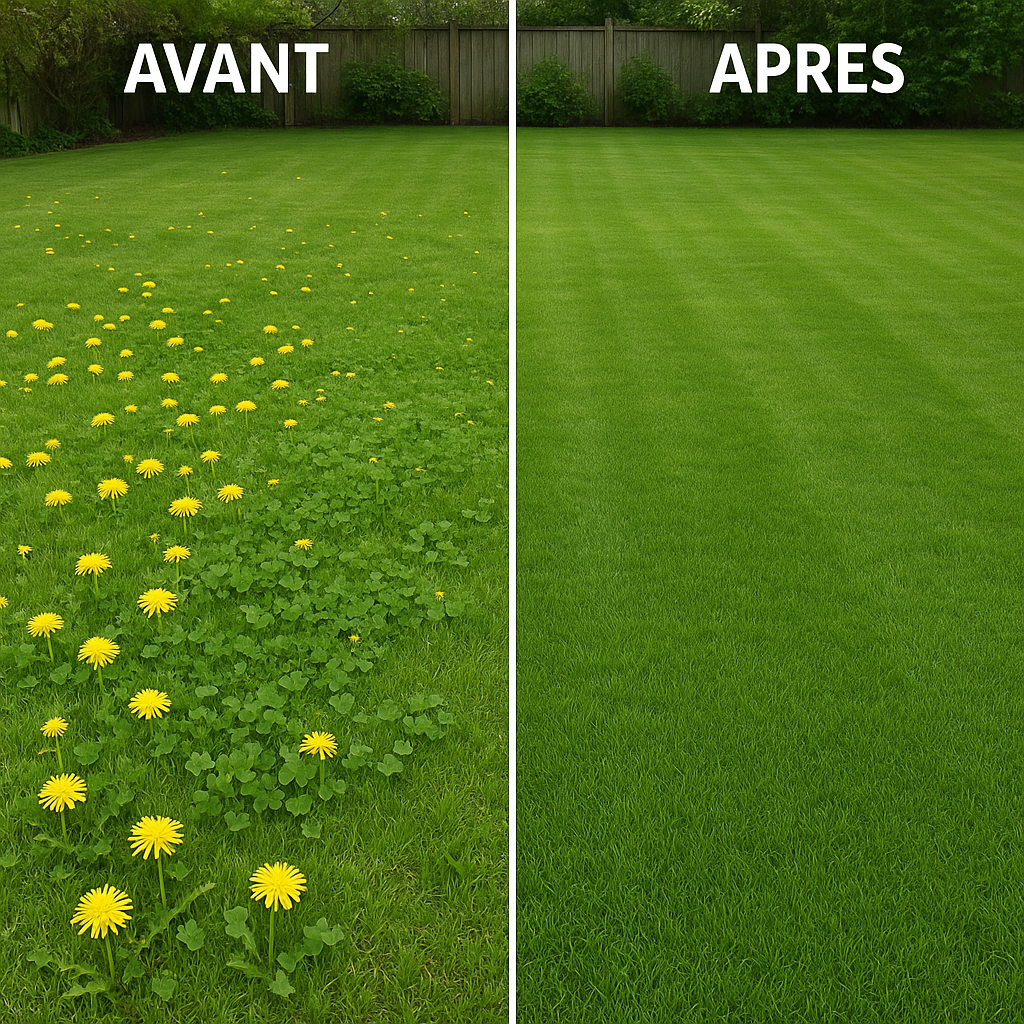
| 📈 Results | Wilting in 3–7 days, yellowing in 10–14 days, full effectiveness in 2–3 weeks. |
Want to eliminate clover, dandelion, and plantain without ruining your lawn? A selective lawn herbicide targets broadleaf weeds while preserving grasses. This 2025 guide provides how it works, a proven top 5, doses per area, and precautions that make the difference between a lawn that greens up… and a patchy turf. We get straight to the point, with practical advice and a clear FAQ.
2025 Selective Herbicides Comparison
How a selective herbicide works
Mode of action: synthetic auxins and absorption
Most lawn products use synthetic auxins (the “auxinic” family) such as 2,4-D, MCPA, dicamba, or fluroxypyr. These molecules mimic the plant hormone auxin and disrupt the growth of dicotyledons (broadleaf plants: dandelion, clover, plantain, thistle), causing twisting, necrosis, and progressive death. Lawn grasses metabolize these substances better, hence the selectivity. The product acts mainly post-emergence through the leaves (systemic), then migrates to the roots.
What changes everything: the physiological state of the weeds. On a young, growing rosette, internal translocation is maximal and the herbicide hits its mark. On stressed plants (drought, cold), absorption decreases and the response becomes uneven.
According to Petrov et al. (2021), the efficacy of auxinics increases when the target plant is at the 2–6 leaf stage, with mild temperatures. According to EFSA (2023), 2,4-D has an acceptable risk profile under authorized use conditions, provided doses and drift reduction measures are respected.
Post-emergence vs pre-emergence: why it matters
Selective lawn herbicides are mainly post-emergence foliar products. Pre-emergence (germination barrier) products exist for green space maintenance but are rarely available to amateurs depending on the country and are not “selective” in the general public sense. In practice: treat the leaves, avoid saturating the soil, let dry, and do not mow just before or just after.
According to Derr (2012), targeting the rosette stage of dicotyledons increases mortality rates while reducing repetitions. Patton et al. (2019) highlight that water stress reduces translocation, with efficacy drops exceeding 30%.
Key efficacy parameters
- Temperature: target 12–25 °C, avoid heat > 28 °C.
- Humidity: slightly wet leaves to the point of dripping = less effective.
- Rain: rain-free window 6–8 h (according to label), ideally 12 h.
- Wind: low, to limit drift and protect flowers.
- Water volume: 5–10 L/100 m² for uniform coverage.
“On lawns, timing often beats dose. Treating at rosette stage, in mild weather and no wind, weighs as much as choosing the best formulation. Many failures come from applying on stressed weeds.”
Dr Aaron J. Patton, Turfgrass Professor, Purdue University — Turfgrass Science — 2019
TOP 5 effective products
Quick verdict and recommended profiles
Here is a top 5 based on the diversity of the dicotyledon spectrum, selectivity on grasses, lawn tolerance, practicality (formulation, dose/100 m²), and regulatory framework. The names below describe common active ingredient families in lawn maintenance. Check your country: availability and authorizations (registration) may vary, especially for amateurs.
- Best overall: “triple auxinic” formulation (2,4-D + dicamba + MCPA/Mecoprop-P) — very broad spectrum on clover, dandelion, plantain, ground ivy.
- Best on perennial dicots: fluroxypyr + triclopyr — strong on ground ivy, buttercups, potentilla.
- Gentle selective option: fluroxypyr solo — good selectivity/efficacy balance on young rosettes.
- Budget/regular maintenance: 2,4-D + MCPA — classic, effective on young dandelion/clover stages.
- Pro/green spaces use: low-dose sulfonylureas (e.g. tribenuron-methyl in authorized programs) — micro-doses, precision required.
| Typical formulation | Active ingredients | Strong targets | Dose/100 m² | Window |
|---|---|---|---|---|
| Triple auxinic | 2,4-D + dicamba + MCPA/Mecoprop-P | Clover, dandelion, plantain, ground ivy | 50–100 ml (according to label) | Spring/Autumn (12–25 °C) |
| Fluroxypyr + triclopyr | Fluroxypyr, triclopyr | Ground ivy, buttercup, potentilla | 40–80 ml | Active post-emergence |
| Fluroxypyr solo | Fluroxypyr | Young dandelion, plantain, chickweed | 30–60 ml | 2–6 leaf stage |
| Classic bi-auxinic | 2,4-D + MCPA | Dandelion, sow thistle, young thistle | 50–80 ml | Mild spring |
| Sulfonylurea (pro) | Tribenuron-methyl (targeted registration) | Fine rosettes, annual dicots | 0.1–0.3 g | Short window, pro |
According to Bingham et al. (2016), fluroxypyr shows excellent systemic activity on perennial dicotyledons at low doses. Roberts et al. (2010) remind that dicamba is prone to drift and volatility in hot conditions, hence the importance of early treatment and low wind.
Selection methodology (transparency)
- Sources: labels/registrations, scientific journals (Weed Technology, Pest Management Science), university guides (turfgrass), EFSA/EPA sheets.
- Weighted criteria: spectrum (30%), selectivity/grass fit (25%), lawn tolerance (20%), practicality (15%), safety/regulation data (10%).
- Limits: presence/absence depending on country, possible substance withdrawal, variability by grass species (fescues, ryegrass, bluegrass).
Application tips to maximize effectiveness
- Mowing: mow 2–3 days before, wait 3–4 days after.
- Water: 5–10 L/100 m², fine mist, well-covered leaves, no dripping.
- Weather: 12–25 °C, wind < 10 km/h, no rain 6–8 h.
- Repeat: if tough perennials, second pass after 3–4 weeks.
- Overseeding: wait 2–3 weeks after treatment before reseeding.
“The most sustainable programs combine occasional chemical correction and cultural strategy: moderate fertilization, appropriate cutting height, and lawn densification reduce dicotyledon pressure.”
Dr John C. Stier, Vice-Provost and Turfgrass Researcher, University of Tennessee — 2020
Doses by surface area
Quick calculation without hassle
Labels often express dose in ml/100 m² with a recommended water volume. Typical example for a “triple auxinic”: 60 ml in 6–8 L water/100 m². To adjust, multiply proportionally. The goal: uniformly cover the surface, not increase concentration.
| Surface | Product dose | Water volume |
|---|---|---|
| 50 m² | 30 ml | 3–4 L |
| 100 m² | 60 ml | 6–8 L |
| 200 m² | 120 ml | 12–16 L |
| 500 m² | 300 ml | 30–40 L |
| 1000 m² | 600 ml | 60–80 L |
Practical tip: mark your 100 m² reference (10 × 10 m) and adjust your walking speed/pressure to empty the sprayer exactly on this surface. It’s the best guarantee of a realistic dosage.
Special cases: young lawns, fragile areas
On recent sowings (< 3 months), many formulations are not recommended. Wait for 2–3 regular mowings. On stressed areas (yellowing, drought), delay application and rehydrate the lawn a few days before. On fine fescue lawns, prefer fluroxypyr or “gentle” formulations at low doses within the authorized range.
According to Patton et al. (2019), applications on drought-stressed lawns can cause visual phytotoxicity; keeping a safety margin on dose/conditions avoids these mottlings.
5-step action plan
- Identify the weeds (clover, dandelion, plantain, ground ivy…).
- Choose the appropriate active ingredient family (triple auxinic, fluroxypyr…).
- Schedule a favorable weather window (12–25 °C, no wind/rain).
- Apply the dose/100 m² with a fine nozzle, uniform coverage.
- Monitor for 7–21 days and repeat if necessary.
“In integrated management, the label dose is sufficient. Overdosing does not speed mortality but increases risk of drift, phytotoxicity, and costs.”
European Weed Research Society (EWRS) — Good practice recommendations — 2021
Risks & precautions
Safety for people and animals
Equip yourself: nitrile gloves, goggles, long pants. Keep dogs and cats away until the treated foliage is fully dry. According to US EPA (2012) on auxinics, skin exposure during properly conducted domestic use is low. Veterinary studies report herbicide traces in dog urine after playing on treated lawns; a re-entry interval after drying greatly reduces this risk (Reif et al., 1995).
Avoid contact with vegetable gardens, flower beds, and sensitive plants (roses, tomatoes, vines): auxinics are very active on ornamental dicots. When in doubt, use drift barriers.
Drift, volatility, and weather
Droplet drift is the main vector of damage to sensitive plants. Dicamba, in particular, can be volatile in high heat. Roberts et al. (2010) recommend treatments in cool weather, anti-drift nozzles, and moderate pressure. Avoid completely on days forecasted > 28 °C.
Regulation and special use
Depending on the country, sale/use of selective herbicides to amateurs is regulated. In France, the Labbé law limits the availability of non-biocontrol plant protection products to amateurs; some selective herbicides remain reserved for professionals. Check current registrations and respect buffer zones and hazard warnings. Always read the label; it is the legal reference.
Resistance and sustainable strategies
Repeated use of the same active ingredient family can select for resistance. Alternate modes of action (e.g. fluroxypyr vs dicamba/2,4-D), combine with cultural practices: densification, cutting height 6–8 cm, balanced fertilization. According to Moss et al. (2019), diversification reduces selection risk and maintains efficacy over time.
“The first barrier against lawn weeds is density. A well-fed, reasonably irrigated, and higher-mowed lawn leaves little space for opportunistic dicotyledons.”
Dr Mike Richardson, Professor of Horticulture, University of Arkansas — Turfgrass Research — 2020
FAQ
What is the best selective herbicide?
For a broad spectrum in regular maintenance, a triple auxinic formulation (2,4-D + dicamba + MCPA/Mecoprop-P) gives excellent results on clover, dandelions, and plantain. For ground ivy/potentilla, aim for fluroxypyr + triclopyr. Always adapt to the weed stage and lawn type.
Danger to animals?
The risk is reduced if you keep dogs/cats away until complete drying. Avoid application on licking/bathing areas. Store products and sprayer out of reach. Respect doses and the re-entry interval: it is your best safety lever.
When to apply for good results?
Spring and early autumn, in mild weather (12–25 °C), no wind or rain expected for 6–8 h. Treating at the rosette stage is crucial. Avoid heatwaves, frost, or marked drought periods.
Can I treat a young lawn?
Wait at least 2–3 regular mowings (often 8–12 weeks) to ensure selectivity. On young lawns, prefer targeted manual control and strengthening the lawn (watering, gentle fertilization) before any treatment.
Should I mow before or after?
Mow 2–3 days before to improve access to target leaves. After treatment, leave 3–4 days without mowing to favor absorption/translocation. Immediate watering is to be avoided unless otherwise stated.
What if rain comes earlier?
If rain falls before the “non-leaching rain” window indicated (often 6–8 h), efficacy may decrease. Wait for favorable conditions to return and reapply if necessary, partially if needed, depending on observed response.
Do selective herbicides kill white clover?
Yes, most auxinic formulations control white clover well, especially in active growth. If deeply rooted, a second pass after 3–4 weeks improves control, combined with lawn densification.
Can I overseed after treatment?
Wait 2–3 weeks depending on the product before overseeding. Foliar/soil residues can impact establishment. Light scarification, then sowing and regular watering help fill the “holes” left by eliminated dicots.
Are “herbicide + fertilizer” products worth it?
The combo can be convenient but not always optimal. Nutrition and weed control do not always share ideal windows. Better to have a program where nitrogen dose and weed correction are adjusted separately.
Is there a truly selective “natural” alternative?
Fatty acids (e.g. pelargonic acid) are mostly non-selective and contact-only — useful on paths, not in the middle of lawns. For a “gentle” approach, rely on cultural prevention, spot manual weeding, and low-dose auxinic formulations when authorized.
Why did my treatment hardly work?
Often, the timing or weather conditions were unsuitable: weeds too old, drought, quick rain, wind. Also check the dose/100 m², spray quality, and chosen active family. A targeted second pass usually corrects the course.
How long to see results?
Deformations/wilting in 3–7 days, yellowing in 10–14 days, and full effect within 2–3 weeks. Deep perennials may require a second intervention.
Selective references (safety and efficacy) — EFSA (2023) 2,4-D Peer Review; US EPA (2012) Auxinic Herbicides; Bingham et al. (2016) fluroxypyr, Pest Management Science; Roberts et al. (2010) dicamba volatility, Weed Technology; Derr (2012) rosette timing, Virginia Tech Extension; Patton et al. (2019) water stress, Purdue Turfgrass; EWRS (2021) good practices; Moss et al. (2019) resistance.
{ “@context”: “https://schema.org”, “@type”: “WebPage”, “about”: { “@type”: “Thing”, “name”: “2025 Comparison of Selective Lawn Herbicides” }, “keywords”: [ “selective lawn herbicide”, “anti-dicotyledons”, “fluroxypyr”, “dicamba”, “2,4-D” ] } { “@context”: “https://schema.org”, “@type”: “Article”, “headline”: “2025 Selective Herbicides Comparison”, “description”: “2025 guide to selective lawn herbicides: how they work, top 5, doses per area, precautions, application tips, plus a clear FAQ.”, “keywords”: [ “selective lawn herbicide”, “anti-dicotyledons”, “post-emergence”, “fluroxypyr”, “dicamba”, “2,4-D”, “triclopyr”, “MCPA”, “rosette”, “lawn” ], “mainEntity”: { “@type”: “FAQPage”, “mainEntity”: [ { “@type”: “Question”, “name”: “What is the best selective herbicide?”, “acceptedAnswer”: { “@type”: “Answer”, “text”: “For a broad spectrum, a triple auxinic formulation (2,4-D + dicamba + MCPA/Mecoprop-P) is a safe bet. For ground ivy/potentilla, prefer fluroxypyr + triclopyr.” } }, { “@type”: “Question”, “name”: “Danger to animals?”, “acceptedAnswer”: { “@type”: “Answer”, “text”: “Keep dogs and cats away until complete drying. Respect doses and re-entry interval.” } }, { “@type”: “Question”, “name”: “When to apply?”, “acceptedAnswer”: { “@type”: “Answer”, “text”: “In spring and early autumn, at 12–25 °C, no wind or rain for 6–8 h.” } }, { “@type”: “Question”, “name”: “Treat young lawn?”, “acceptedAnswer”: { “@type”: “Answer”, “text”: “Wait 2–3 regular mowings (8–12 weeks).” } }, { “@type”: “Question”, “name”: “Mow before/after?”, “acceptedAnswer”: { “@type”: “Answer”, “text”: “Mow 2–3 days before, then wait 3–4 days after treatment.” } }, { “@type”: “Question”, “name”: “Rain after application?”, “acceptedAnswer”: { “@type”: “Answer”, “text”: “If rain falls before 6–8 h, efficacy reduced: reschedule application.” } }, { “@type”: “Question”, “name”: “Eliminate white clover?”, “acceptedAnswer”: { “@type”: “Answer”, “text”: “Most auxinics control it well in active growth.” } }, { “@type”: “Question”, “name”: “Overseed after treatment?”, “acceptedAnswer”: { “@type”: “Answer”, “text”: “Wait 2–3 weeks, lightly scarify then irrigate.” } }, { “@type”: “Question”, “name”: “2-in-1 fertilizer + herbicide products?”, “acceptedAnswer”: { “@type”: “Answer”, “text”: “Convenient but not optimal: better to manage nutrition and weed control separately.” } }, { “@type”: “Question”, “name”: “Why did my treatment barely work?”, “acceptedAnswer”: { “@type”: “Answer”, “text”: “Often weather issues (rain/wind), lawn stress, or insufficient coverage.” } }, { “@type”: “Question”, “name”: “Time to see results?”, “acceptedAnswer”: { “@type”: “Answer”, “text”: “3–7 days for deformities, 10–14 days for yellowing, 2–3 weeks for maximum effect.” } } ] } }