Sommaire
Observation Tower: Top 10 Models 2026
The observation tower has moved beyond being just a simple Montessori piece of furniture to become a true everyday equipment in many kitchens and bathrooms. However, it is essential to choose a model that is truly stable, suitable for the child’s age, and consistent with the available space. In 2026, the range has expanded to include foldable, adjustable, multifunctional versions, and compact formats. It turns out that a good purchase is not only about design: platform height, guardrails, base depth, and ease of maintenance make all the difference in use.
🔎 The best observation towers of 2026 are not necessarily the most expensive: in practice, the most relevant models are often priced between 80 and 180 €, with a real difference in stability, adjustable height, and quality of finishes.
📏 The most underestimated criterion remains compatibility with the countertop: a kitchen around 90 cm does not require the same adjustment as a lower sink. A platform adjustable on 2 to 3 levels is often more durable.
🛡️ An observation tower is not a completely self-service piece of furniture: key points are the wide base, side barriers, a non-slip surface, and adult supervision, especially before 3 years old.
🏠 For small living spaces, foldable or multifunctional models have real appeal, but they require more careful control of the locking system and hinges.
Why does an observation tower appeal so much to parents in 2026?
An observation tower allows the child to participate in daily tasks at adult height while remaining safer than with a classic stool. In 2026, its success is based on three very concrete expectations: autonomy, participation, and reduction of risky situations in the kitchen or bathroom.
The principle is simple: the child climbs onto a platform surrounded by guardrails to reach a countertop, sink, or high table without being carried. This elevation changes the experience. The child can wash vegetables, watch meal preparation, brush their teeth at the sink, or participate in a craft activity. It is precisely this link between domestic use and learning that explains the lasting success of the observation tower, often also called a learning tower or Montessori tower.
E-commerce competitors mainly highlight autonomy, but the real benefit goes further. A good tower avoids the very common sequence of a stool that is too low, the child leaning over, then the adult holding them with one hand while cooking with the other. According to Public Health France on everyday life accidents, falls remain a major cause of domestic accidents among young children. A tower does not eliminate this risk, but it can better manage the situation than an improvised stool.
In practice, urban apartment dwellers often look for compact or foldable formats, while families with open kitchens prefer wider, heavier models, generally more reassuring for everyday use. The right question is therefore not just “which tower is the best?”, but “which observation tower suits my child, my kitchen, and my lifestyle?”.
What Age for an Observation Tower and Up to What Weight?
Most children start using an observation tower when they can stand steadily and climb with assistance, often around 18 months, sometimes a little earlier or later depending on their motor skills. Usage can continue until 4 to 6 years, depending on the adjustable height and the maximum load indicated by the manufacturer.
This is one of the major blind spots in the current SERP: many sellers talk about autonomy, but very few specify the motor prerequisites. Yet the age displayed on a product sheet is not enough. Above all, the child must be able to stand without wobbling, understand the instruction to stay within the structure, and tolerate simple frustration, for example waiting before descending alone. For some children, this happens around 15-18 months; for others, closer to 2 years.
The duration of use then depends on the adjustable platform and the supported load. Manufacturers often announce capacities between 50 and 100 kg for the structure, sometimes more on very robust models. In reality, the limiting factor is not only the maximum weight but the comfort of use: when the child becomes too tall and the barriers come too low, the practical interest decreases.
A childcare sales agent observes that many product returns are not about quality but poor timing of purchase: the family buys too early, then finds that the child does not yet understand the instructions for climbing up and down. In practice, the smoothest uses often begin when the child already wants to imitate adult gestures several times a day.
It is also necessary to distinguish uses. A tower used occasionally for hand washing does not impose the same requirements as a 20 to 30 minute use in the kitchen during meal preparation. For those seeking a durable purchase, models with 2 or 3 platform levels are generally the most consistent.
Top 10 Best Observation Tower Models in 2026
The ranking below favors concrete criteria: stability, height adjustment, perceived quality, versatility, footprint, and price coherence. It is based on models and ranges visible at French retailers in early 2026. Since exact references, colors, and availability can change quickly, it remains useful to check the manufacturer’s sheet at the time of purchase.
| Rank | Model / range | Profile | Strengths | Observed price |
|---|---|---|---|---|
| 1 | Maxi-Cosi Toucan 3-in-1 | Convertible / multifunctional | Transforms into a seat, wide range of use, refined finish | Around 150 to 220 € |
| 2 | KiddyMoon adjustable learning tower | Adjustable | Adjustable platform, simple lines, good price/use balance | 90 to 140 € |
| 3 | Busy Kids 3-in-1 / 5-in-1 | Multifunctional | Versatility, useful in small living spaces, playful approach | 100 to 185 € |
| 4 | Vertbaudet Montessori learning tower | Family | Easy distribution, home-style design, simple daily use | 80 to 130 € |
| 5 | Orchestra Léa | Entry / mid-range | Affordable pricing, classic wooden structure | 60 to 100 € |
| 6 | Monloove adjustable height | Adjustable | Focus on adaptability to the child’s height | 100 to 160 € |
| 7 | Pimpampoum Montessori learning tower | Specialist | Selection focused on educational use, formats designed for the home | 90 to 150 € |
| 8 | Autour de Bébé – learning tower selection | General public | Brand choices, simple benchmarks for a first purchase | 70 to 150 € |
| 9 | Learning tower kit for adjustable chair | Space-saving | Low footprint, relevant if the chair is already compatible | 50 to 90 € |
| 10 | Compact foldable tower | Small space | Easier storage, occasional use in apartments | 80 to 140 € |
The first takeaway from this top 10 is clear: there is no universal “best model.” The Maxi-Cosi Toucan 3-in-1 appeals to families who want to amortize the purchase over multiple uses. Models like KiddyMoon or Monloove appeal more to those looking for an adjustable learning tower without multiplying secondary functions. Finally, offers like Busy Kids or certain foldable formats address a very concrete constraint: not leaving a bulky piece of furniture in the middle of the kitchen all day.
There is another way to read this ranking: by level of requirement. If the priority is pure stability, a simple, more massive, less “convertible” model is often better. If the priority is saving space, a foldable system can be relevant, provided the locking mechanism is checked at each use. And if the budget is tight, entry-level versions remain interesting but require increased attention to wood thickness, joint rigidity, and non-slip pads.
How to choose a learning tower truly suited to your home?
To choose a learning tower well, you must first cross-check four criteria: worktop height, available space, child’s age, and frequency of use. A tower that is very versatile on paper can become disappointing if it is too wide, too low, or difficult to move daily.
The first check concerns the height. In France, a kitchen worktop is often around 90 cm, whereas a sink can be lower. If the platform is too low, the child stands on tiptoes; too high, they lose comfort and safety. Adjustable height models are therefore more relevant than they seem, especially if the tower moves from the kitchen to the bathroom.
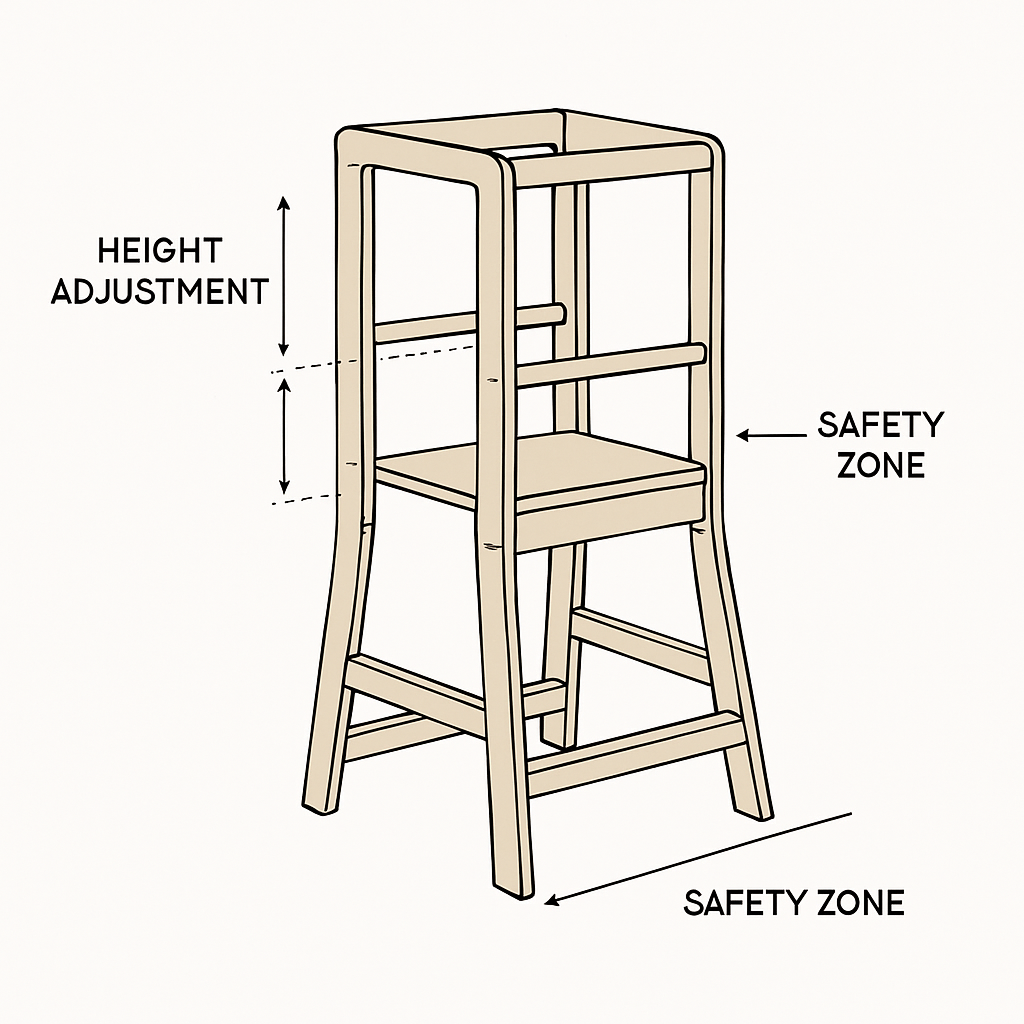
Next comes the bulkiness. A wide base improves stability but can hinder passage in a small kitchen. In an apartment, the depth of the base deserves almost as much attention as the price. A tower that has to be moved ten times a day ends up being used less. Conversely, in a house with an open kitchen, a wider and heavier model will often be better accepted because it stays in place and provides visual reassurance.
The choice also depends on the lifestyle. For daily use at mealtimes, favor a model that is easy to clean, with smooth surfaces and easily accessible corners. For more occasional use, for example only at the sink, a compact version may suffice. Finally, regarding the material, wood remains dominant for its rigidity and appearance, but the quality of the varnishes and the absence of sharp edges must be checked.
- Small space: foldable tower or kit compatible with an existing adjustable chair.
- Intensive kitchen use: heavier structure, wide base, adjustable platform.
- Tight budget: simple model, without table/chair function, but with real guardrails.
- Two children of different ages: quick height adjustment and well-sized access step.
Observation tower or step stool: which solution is safer?
The observation tower is generally safer than a step stool or a stool for a young child because it partially surrounds the body and limits lateral shifts. However, it remains a piece of furniture for supervised use: without supervision, especially before age 3, the risk does not disappear.
The step stool has an obvious advantage: it takes up less space and often costs between 15 and 40 €. But it serves a different purpose. It is especially suitable when the child is already more autonomous, understands instructions, and only needs a small height boost for the sink or toilet. In the kitchen, its lack of guardrails makes it more delicate for long or dynamic activities, such as mixing dough or watching a pan.
The observation tower, on the other hand, better frames the torso and provides a firmer support under the feet. This is particularly useful between 18 months and 4 years, a period when the child wants to participate without always having sufficient postural control. However, some very lightweight or poorly assembled towers can become less reassuring than a good anti-slip step stool. Therefore, the actual structure must be examined, not just the marketing promise “Montessori.”
A family who moved into an apartment with a narrow kitchen in 2022 reports having quickly abandoned a stool that was nonetheless considered practical because the child kept turning around to see the parent behind them. Switching to a more enveloping tower mainly changed one thing: the adult could cook while keeping the child nearby, with fewer catching gestures.
| Criterion | Observation tower | Step stool / stool |
|---|---|---|
| Lateral safety | Good if complete guardrails | Low to medium |
| Bulkiness | High | Low |
| Relevant age | Often 18 months to 4-6 years | Rather already autonomous child |
| Kitchen use | Very suitable | More limited |
| Price | Often 60 to 220 € | Often 15 to 40 € |
What safety points should be checked before buying?
Before buying an observation tower, five points must be checked: stability of the base, height and closure of the guardrails, non-slip surface, quality of the assemblies and, for a foldable model, reliable locking. These concrete details distinguish a useful piece of furniture from a quickly disappointing purchase.
Stability first depends on geometry. A base wider than the top platform limits tipping. Non-slip pads help on tile or parquet, but they do not compensate for a structure that is too narrow. Next, the guardrails must be observed: a simple rear frame is not always enough if the child moves a lot. Enveloping sides, without large lateral gaps, are often preferable for younger children.
Foldable models require particular vigilance. Their main advantage, storage, also creates their main weakness: hinges, latches, and flex points. Before any use, it is necessary to check that the system is properly locked. In case of doubt about a product for children, RappelConso, the official French platform, allows checking for the existence of a product recall. It is also useful to consult the general recommendations of the DGCCRF on consumer goods safety.
The material and finishes also matter. Wood that is too soft or poorly varnished will age quickly if the tower stays near a sink. Screws must be well countersunk, edges smoothed, and the platform easy to clean. For families sensitive to material composition, the ADEME recommends paying attention to healthier furniture, especially regarding indoor air emissions. This is not a minor detail: an observation tower is often used in closed rooms and at the child’s face height.
- Check the maximum load indicated by the manufacturer.
- Check the tightening of screws after assembly and regularly thereafter.
- Avoid use near a hot plate or accessible sharp objects.
- Do not let the child climb up and down without clear reference points if motor skills are still unstable.
- Test the tower on the actual floor of the house, not just in theory.
Should you choose a foldable, adjustable, or multifunction observation tower?
The right format depends less on current trends than on how the tower will be used each week. An adjustable version is often the best rational choice, as it follows the child’s growth and remains relevant longer. A foldable version is mainly suitable when every square meter counts. A multifunction version makes sense if the transformation into a table, chair, or activity space is actually used at home.
Adjustable models remain the most balanced. Their benefit is concrete: with 2 or 3 platform levels, they better accommodate changes in size and use. The extra cost generally remains reasonable compared to a fixed tower, often around 20 to 50 € depending on the ranges. For a one-time purchase over several years, this is often the best additional expense.
Foldable models follow a different logic. They are not systematically less stable, but they introduce more points to check. They are therefore more suitable for families who store the tower after use than for those who want a fixed station in the kitchen. As for 3-in-1 or 5-in-1 versions, they attract by their versatility, but one must honestly ask if the secondary function will really be used. Otherwise, the parent mainly pays for a promise of modularity.
The best observation tower is not the one that does the most things, but the one that truly simplifies family life without creating unnecessary extra vigilance.
FAQ about the observation tower
Can an observation tower be left accessible all day?
It is better to avoid this until the child clearly masters climbing up, climbing down, and safety instructions. In many families, the tower remains accessible only during supervised activity times, especially before 3 years old. The kitchen contains too many hot or sharp objects for full free access.
Is an observation tower useful in the bathroom?
Yes, often as much as in the kitchen. It is used for hand washing, tooth brushing, or hair styling in front of a sink located much higher than the child. However, one must be even more vigilant about the risk of wet floors and check the grip of the pads.
What is the difference between a Montessori tower and an observation tower?
In commerce, the two terms almost always refer to the same type of furniture. The term “Montessori” mainly refers to a philosophy of autonomy and an environment adapted to the child. In practice, it is the design and safety of the product that matter more than the marketing label.
How much space should be planned around the furniture?
Space must be planned to climb up, climb down, and rotate the tower without hitting a drawer, a handle, or a table. In the kitchen, a free zone of at least 60 to 80 cm in front of the furniture significantly improves usability. This margin varies depending on the depth of the base and the room’s traffic flow.
Is a wooden observation tower necessarily better than one made of another material?
Wood remains appreciated for its rigidity, warm appearance, and longevity, but it all depends on the quality of manufacture. Poorly finished or too light wood can be less convincing than a well-designed structure made of another material. One must look at the joints, the finishes, and the overall stability.
Can you make an observation tower yourself?
Yes, a DIY project is possible, but it requires real skills in assembly and safety. The slightest error in the center of gravity, guardrails, or panel thickness can create a risk. For a young child, homemade construction only makes sense if it is designed with the same level of rigor as commercial furniture.