Sommaire
DAACT: Completion Declaration Guide
The end of a construction site is not only marked when the workers leave the premises. For a new house, an extension, a subdivision, or certain authorized works, the DAACT marks the administrative closure of the file at the town hall and triggers the possible compliance inspection. It is a document often underestimated, although it can carry significant weight in case of resale, dispute, or regularization request. It follows that a truly practical guide must go beyond the definition: understanding when to submit the DAACT, how to fill it out, which annexes to attach, and what to do if the town hall contests it saves valuable time.
📌 The DAACT is the declaration certifying the completion and conformity of the works. It concerns works carried out with an urban planning authorization: building permit, development permit, or, in some cases, prior declaration.
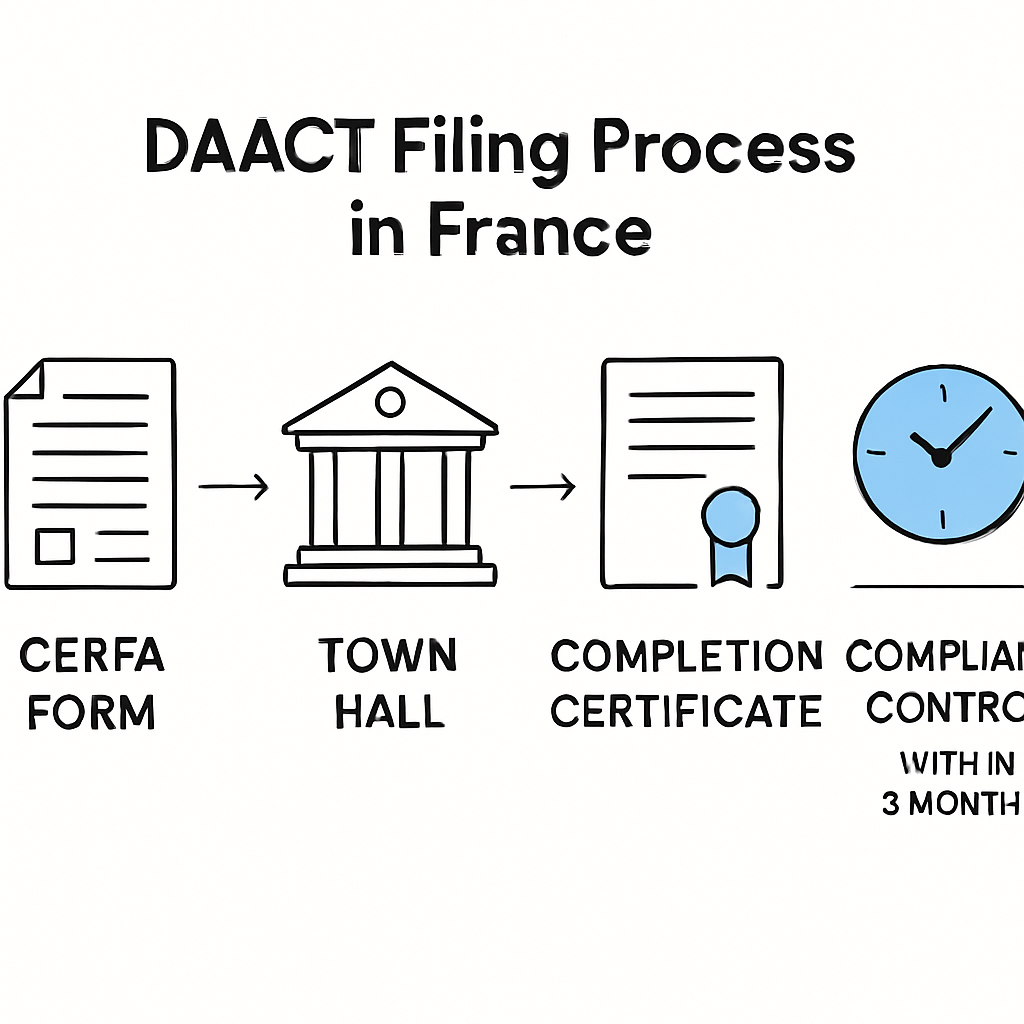
⏱️ The key point to remember: there is no general 30-day deadline to submit the DAACT. In practice, it is submitted as soon as the works are completed in the urban planning sense, which triggers a control period of 3 months, extended to 5 months in certain situations.
📄 The form used is the Cerfa DAACT accessible on Service-Public.fr. Depending on the project, it may be supplemented by additional certificates: accessibility, environmental regulations, acoustics, seismic protection, or specific rules.
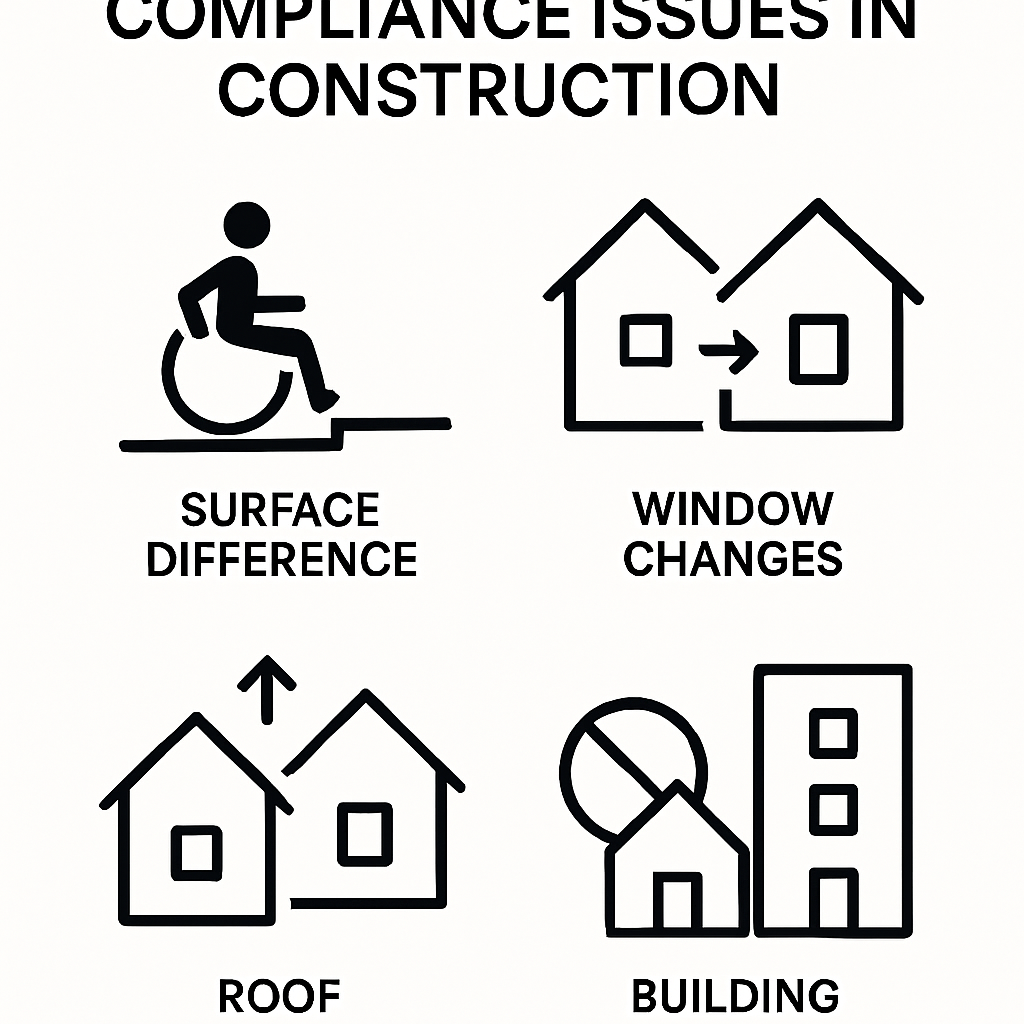
⚠️ The most frequent blockages do not come from the form itself, but from a non-compliance between the completed works and the authorization: surface area, location, openings, roof, materials, parking, or exterior arrangements.
What is the DAACT and what is it for?
The DAACT serves to inform the town hall that the authorized works are completed and conform to the granted authorization. Its submission starts the period during which the municipality can inspect the site and, if necessary, contest the conformity of the completed project.
The declaration certifying the completion and conformity of the works is a document provided for by the Urban Planning Code, notably within articles R.462-1 to R.462-10. It is not a simple end-of-site letter. By signing the DAACT, the declarant certifies under their responsibility that the works have been carried out in accordance with the building permit, development permit, or prior declaration obtained.
Practically, the DAACT serves two functions. First, it indicates that the project is sufficiently advanced to be considered completed in the administrative sense. Second, it opens the possible inspection phase by the town hall. This is an important point: the municipality does not automatically “approve” the project with an immediate stamp. However, after submission, it has a legal period to verify conformity and, if necessary, request documents, conduct a visit, or note discrepancies.
This logic has very practical effects. During a sale, refinancing, rental, or cadastral regularization, the question of urban planning conformity often arises. A properly submitted and uncontested DAACT within the deadlines secures the property’s documentary situation, even if it does not replace all other technical or notarial checks.
Is the DAACT mandatory for your project?
The DAACT is generally required when the work has been carried out with a planning permission: building permit, development permit, and certain files submitted by prior declaration. If your project generated a file at the town hall, you must check if a completion declaration is expected.
In practice, the DAACT primarily concerns projects authorized by building permits: single-family house, building, large independent garage, significant elevation or extension subject to a permit. It also concerns projects subject to development permits, for example a subdivision or certain more structural developments. Finally, it may apply to works submitted by prior declaration, which is sometimes forgotten by individuals.
The best approach is to start from the authorization obtained. If a receipt of submission or an order exists, you must check what the town hall expects upon completion. This approach avoids the common mistake of thinking that the DAACT only concerns new constructions. An extension of 25 to 40 m² in an urban area with a permit, a facade change modifying openings, or a subdivision development may also require a completion declaration.
Some concrete cases help clarify:
- New single-family house: almost systematic DAACT, with possible annexes depending on the nature of the project.
- Extension: DAACT if the work was subject to a permit or prior declaration with end-of-work formalities.
- Subdivision: DAACT often linked to the development permit, sometimes in phases.
- Establishment open to the public (ERP): increased vigilance, with additional controls and certificates.
- Work carried out in phases: completion can be declared by phase in certain authorized setups.
| Your project | Common authorization | DAACT | Points of vigilance |
|---|---|---|---|
| New house | Building permit | Yes | RE2020, location, facades, parking |
| Significant extension | Building permit | Yes | Created area, openings, height, footprint |
| Small extension or exterior modification | Prior declaration | To be verified depending on the file | Exterior appearance, joinery, roofing |
| Subdivision | Development permit | Yes | Roads, networks, common areas, phases |
| ERP or protected site | Permit / specific authorization | Yes, with enhanced control | Accessibility, safety, protected area |
In the field, an officer in charge of processing observes that many individuals submit a DAACT for the main house but forget the visible elements added during construction, such as a relocated window, a modified roof slope, or an unplanned low wall. It is often these apparent discrepancies that trigger regularization requests.
How to correctly fill out and submit a DAACT without errors?
To submit a DAACT, you must use the dedicated Cerfa form, provide the relevant authorization, precisely identify the land, and declare the actual completion of the works. Depending on the municipality, submission can be done at the town hall, by registered mail, or online if a digital portal is available.
The first step is to use the correct form. The DAACT reference published by the administration is accessible on the official Cerfa form page on Service-Public.fr. This is a more sensitive point than it seems, as many online sources still cite older versions. It is better to start with the official, up-to-date form at the time of submission, especially if the project has spanned several months.
Next, the declaration must be completed meticulously: identity of the holder, authorization references, exact address, nature of the works, and completion date. The latter must not be chosen arbitrarily. In urban planning, completion means that the authorized works are actually finished and usable according to their intended purpose. A “nearly finished” house with missing structural elements does not necessarily constitute an acceptable completion.
Submission is made at the town hall of the municipality where the project is located, either physically, by postal mail, or via online procedure if the municipality has opened a digital service. Since the evolution of digital urban planning procedures, more and more cities offer an online portal, but the methods vary widely. In Lyon, Toulouse, or Nantes, digital procedures are generally better structured than in small municipalities; elsewhere, paper submission remains common. There is another way to secure proof of submission: systematically keep the receipt, acknowledgment of receipt, or electronic confirmation.
The number of copies and the exact list of documents may vary depending on the submission method and the municipality. However, the principle remains stable: the declaration can be accompanied by additional certificates when the project is subject to them. This is notably the case for accessibility, certain energy or environmental performance requirements, acoustics in relevant operations, or specific rules such as seismic standards. The reference page on Service-Public.fr about the DAACT details the most common cases.
A simple checklist limits omissions:
- Up-to-date Cerfa form correctly filled out and signed;
- Reference of the initial or amended authorization;
- Actual completion date;
- Additional certificates if the project is subject to them;
- Proof of submission kept;
- Copy of the permit and authorized plans for comparison in case of inspection.
When should the DAACT be filed and what are the control deadlines?
The DAACT is filed when the work is actually completed. There is no general 30-day deadline applicable in all cases. After filing, the town hall usually has 3 months to contest compliance, a period extended to 5 months in certain cases.
On this point, many web pages still cause confusion. The most reliable message is as follows: the DAACT must be filed upon completion of the work, and not within an alleged standard 30-day period applicable to all projects. This clarification is essential because poor advice on the schedule can weaken the subsequent handling of the file. In practice, the declaration must be filed as soon as the site reaches a level of completion consistent with the authorization obtained.
Once the DAACT is registered, the town hall can carry out a inspection, that is, a compliance check. The standard legal deadline is 3 months. It is extended to 5 months in several specific cases, notably when the project is located in an area with enhanced control or when specific regulations require a more thorough examination. This is typically the case for files in heritage sites, near historical monuments, for certain ERP (public access buildings), or for operations whose technical rules require targeted certifications.
The starting point of the deadline deserves to be properly understood. In administrative practice, what matters is the actual filing of a DAACT usable by the town hall. If the file is incomplete on a crucial point, the situation can become complicated and delay the review of the file by the urban planning department. That is why the best strategy is not to file quickly, but to file complete and coherent.
In practice, residents who sell just after the end of the construction often discover the importance of chronology. One family recounts that between the actual completion of the work and the signing of the preliminary contract, the absence of proof of DAACT filing forced the notary to request additional documents, extending the timeline by several weeks.
Which non-compliances most often block a DAACT?
The most frequent non-compliances concern visible discrepancies between the authorized project and the executed project: created surface area larger, different placement, relocated windows, modified roof, changed materials, height exceeded, or missing parking spaces. Depending on the discrepancy, it is necessary to regularize by a modification or bring the work back into compliance.
Compliance is not limited to the “spirit of the project.” In urban planning, the town hall compares the executed work to the authorized documents. An extension planned at 30 m² and built at 34 m², a facade with three openings instead of two, a coating in a color not authorized in a municipality with precise regulations, or a placement shifted by 50 centimeters to 1 meter can be enough to reveal a non-compliance. This may sometimes seem minor to the owner, but the administrative analysis is based on plans and prescriptions.
The most sensitive discrepancies often concern volume, exterior appearance, and integration into the site. In a village subject to strict architectural rules, a change of roofing or joinery will be more scrutinized than in a standard suburban area. Conversely, in a recent subdivision near Bordeaux or Montpellier, it is often the question of fences, heights, or parking spaces that comes up during the inspection.
In case of non-compliance, not everything is blocked in the same way. If the discrepancy can be regularized, a modification permit or an appropriate procedure can sometimes correct the situation. If the discrepancy violates the local urban plan or a non-derogable rule, a material compliance correction may become necessary. That is why it is risky to sign the DAACT hoping that “it will pass” without checking the plans of the initial file.
The DAACT is not a mere end-of-paper formality; it is the moment when the actual construction site meets the authorized file. The earlier the discrepancy is addressed, the simpler the regularization remains.
What happens after submitting the DAACT?
After submission, two scenarios dominate. Either the town hall does not detect any anomaly within the applicable timeframe, or it initiates an inspection and reports a non-compliance. In the first case, the file becomes much easier to present during a sale or an additional administrative request. In the second, the nature of the grievance must be precisely analyzed: missing document, simple documentary inconsistency, or actual urban planning violation.
The municipality may request an on-site visit, compare the final state to the authorized plans, or examine the attached technical certificates. For those wishing to secure their situation, it may be useful to request a certificate of non-contestation of compliance when conditions are met. This document is not always essential, but it can reassure a buyer, a bank, or a notary in a resale context.
Moreover, the absence of reaction from the town hall within the legal timeframe does not magically erase all possible issues around the property. However, it improves the clarity of the file. In transactions, this clarity weighs heavily. A property located in Rennes, Lille, or Aix-en-Provence with a permit, plans, submitted DAACT, proof of submission, and no contestation within deadlines will generally be easier to document than a property whose construction completion remains unclear.
The case of sales deserves to be highlighted. A missing DAACT does not automatically block the sale, but it often raises questions. The notary may request clarifications, the buyer may negotiate, and the insurer or financier may want to understand the administrative situation. Regarding recent projects, it is therefore better to treat the declaration of completion as a full closing step, on the same level as the reception of works or the collection of final invoices.
Special cases: phased works, ERP, protected sector, and sale of the property
Some files require a more detailed reading. Projects carried out in phases can sometimes lead to partial declarations of completion, if the administrative setup allows it and if each phase has sufficient autonomy. This situation appears in development operations, programs of several buildings, or long construction sites where delivery is sequenced. It is then necessary to review the granted authorization and, if needed, consult the town hall before submission.
For an ERP (Establishment Receiving the Public), vigilance increases by a notch. Urban compliance is only part of the issue. Accessibility, safety, and other applicable rules may require specific certificates. The same reasoning applies in a protected sector or near a historical monument: architectural prescriptions are often more detailed there, and the control period may be extended.
In the case of a sale after works, the DAACT takes on a very concrete dimension. A clean file generally includes the initial authorization, any modifications, the plans, the DAACT, proof of submission, and, if possible, the document confirming the absence of contestation within the deadline. Otherwise, the seller must be ready to explain any discrepancies and provide available certificates. This preparation reduces the risk of blockage to a few days instead of several weeks.
According to the official Service-Public.fr fact sheet updated by the administration, annexes and modalities vary depending on the nature of the operation. On its side, the Urban Planning Code on Légifrance governs the general mechanisms of control and compliance. These two sources are the safest bases for verifying a point before submission.
FAQ on the DAACT
Who must sign the DAACT?
In principle, it is the holder of the urban planning authorization or their authorized representative who signs. In a project carried out by an SCI, a proxy, or a delegated project manager, it is necessary to verify that the signatory has the proper authority to commit the file.
Can a DAACT be submitted online?
Yes, if the municipality has a digital portal for urban planning authorizations. This is not uniform across the territory: some cities accept it systematically, others still require a paper or mixed submission depending on the type of file.
What to do if the town hall does not respond after submission?
If the town hall does not contest within the 3 or 5 month deadline applicable, the situation becomes more secure for the declarant. It may be advisable to request a certificate of non-contestation, particularly useful in case of sale or refinancing.
Can a DAACT be submitted if some finishing touches are missing?
It all depends on the nature of the finishing touches. Minor details may sometimes not prevent completion, but if essential elements of the authorization are not completed, the DAACT is premature. The criterion is not aesthetic, it is functional and regulatory.
Does the DAACT replace the acceptance of work with the contractors?
No. The acceptance of work pertains to contractual relations with contractors, whereas the DAACT concerns urban planning and compliance with the authorized file. The two steps may be close in time, but they do not have the same purpose or effects.
Is a DAACT required for a simple prior declaration?
One should not answer automatically. Some operations authorized by prior declaration do indeed involve a formal end-of-site procedure; other situations are simpler. The safest approach is to start from the file accepted by the town hall and check the local procedure to follow.