
Sommaire
Choosing a saltwater pool changes the maintenance routine more than one might think: the water feels softer, the smell of chlorine fades, but the chemical balance and equipment require regular attention. This guide is for those who want to understand exactly what to test, when to act, and how to extend the life of the electrolyzer and equipment without getting lost in vague advice. You will find concrete actions, a maintenance schedule, numerical benchmarks, and immediately applicable solutions.
In brief
🔎 Weekly checks: measure the pH and oxygenation/chlorine, check turbidity, and clean a pre-filter if necessary.
🛠️ Key equipment: the electrolyzer converts salt into active chlorine; monitor its cells and scale buildup, and respect the expected lifespan.
📅 Seasonal ritual: increased filtration during peak season, occasional shock treatment if the water turns green, and adapted winterizing to protect the electrolyzer.
⚠️ Target parameters: pH ~7.2–7.6, free chlorine equivalent to 0.5–2 mg/L (active salt via electrolysis), and salt level according to manufacturer (~3–4 g/L).
Why a saltwater pool changes the game
One might think a saltwater pool is “chlorine-free”: in reality, the pool salt serves as the raw material. The electrolyzer converts salt into hypochlorite, so the disinfectant is produced continuously on demand. This system reduces handling of hydrochloric acid or granules but involves more technical monitoring: cells to descale, stabilized water parameters, and salt management. In other words, you trade a chemical chore for regular technical maintenance.
The role of the electrolyzer
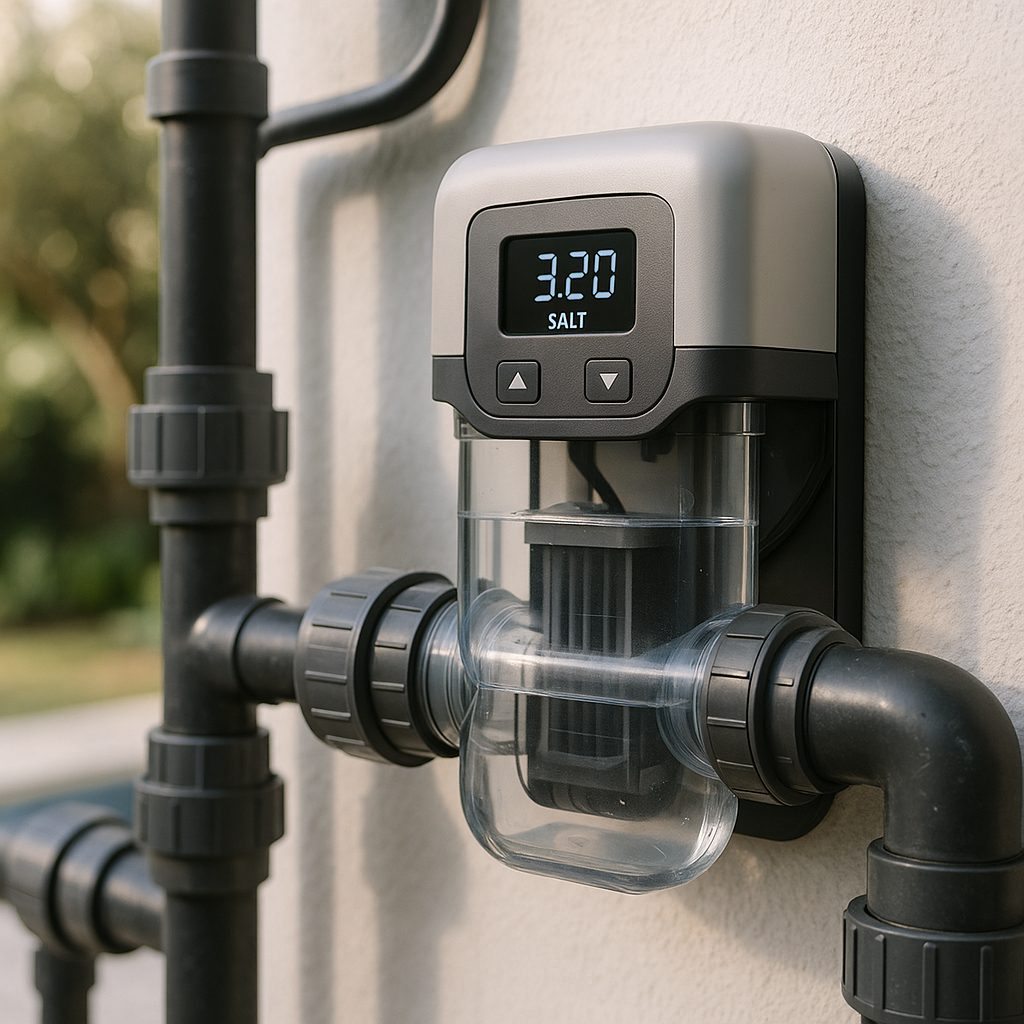
The electrolyzer is the heart of the system. It polarizes a saline solution to release active chlorine that disinfects the water. The cells made of metal plates get clogged with scale and organic residues: a clogged cell produces less chlorine, salt consumption remains constant but its transformation is compromised. Proper maintenance of the electrolyzer ensures stable chlorine production and avoids premature replacement costs.
Four simple checks to do every week
The weekly frequency is an effective compromise: neither too lax nor paranoid. These quick checks take 10 minutes and prevent most incidents.
- pH: test and adjust. Bromine and chlorine are more effective within a precise range.
- Free chlorine level (or equivalent produced by electrolysis): confirm disinfection.
- Turbidity and presence of algae: clear water is often a sign of a controlled system.
- Filtration: observe the pressure on the pressure gauge and perform a backwash if the pressure increases by 0.3–0.5 bar above normal.
Recommended equipment for these checks
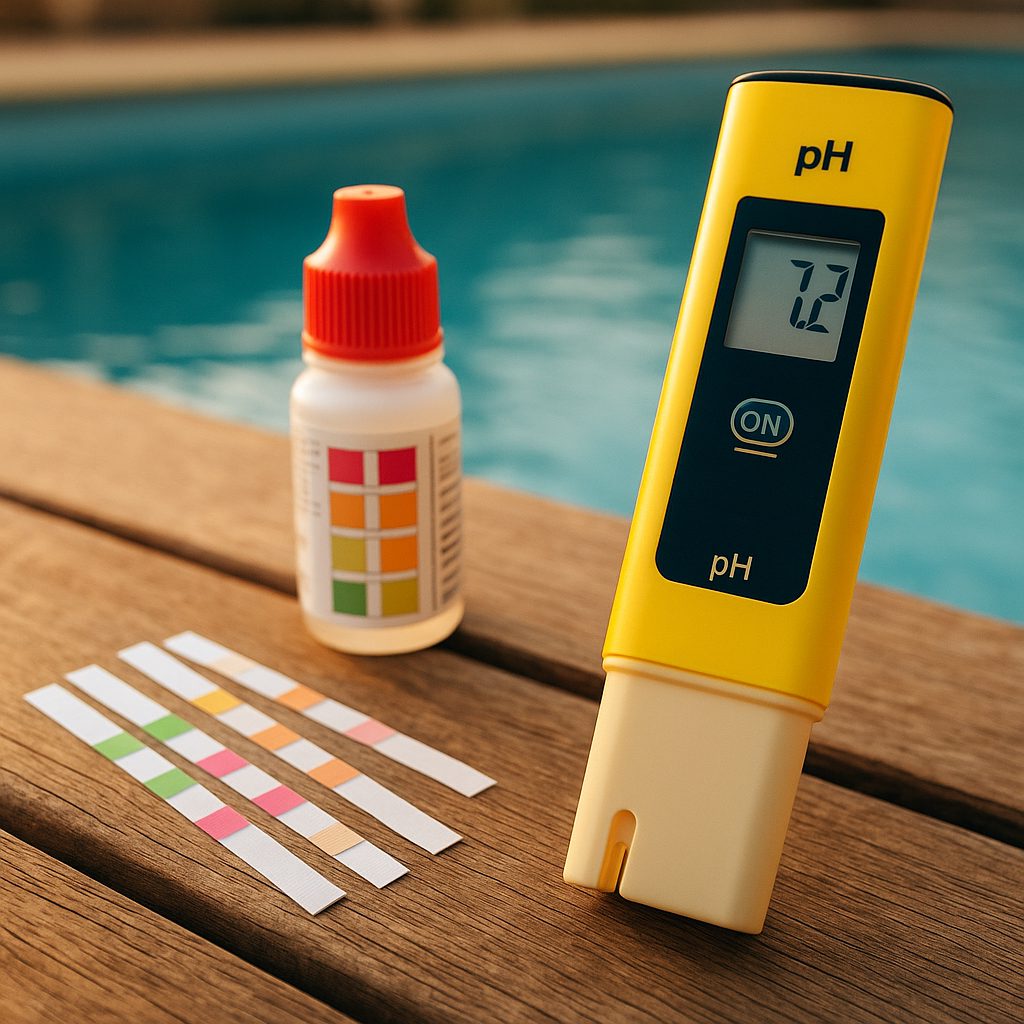
A strip test kit for quick monitoring, a photometer for more precision, and an electronic pH meter threshold if you want to ensure reliable measurements. These tools reduce approximations and avoid unnecessary chemical additions.
Table of target parameters and corrective actions
| Parameter | Target value | Action if out of range |
|---|---|---|
| pH | 7.2 – 7.6 | Lower pH with pH-lowering acid (if >7.6); raise with alkalizing agent (if <7.2) |
| Salt level | According to manufacturer, generally 3–4 g/L | Add pure salt or dilute the water if too high |
| Free chlorine (equivalent) | 0.5 – 2 mg/L | Adjust electrolyzer production; shock treatment if algae proliferation |
| Alkalinity (TAC) | 80 – 120 mg/L | Adjust with baking soda or acid to stabilize pH |
Maintenance of filtration and cell
Filtration works continuously: an efficient pump and a clean filter limit the organic load that the electrolyzer must treat. In saltwater pools, the cell is a wear part; monitor chlorine production and the appearance of the plates.
Filter cleaning
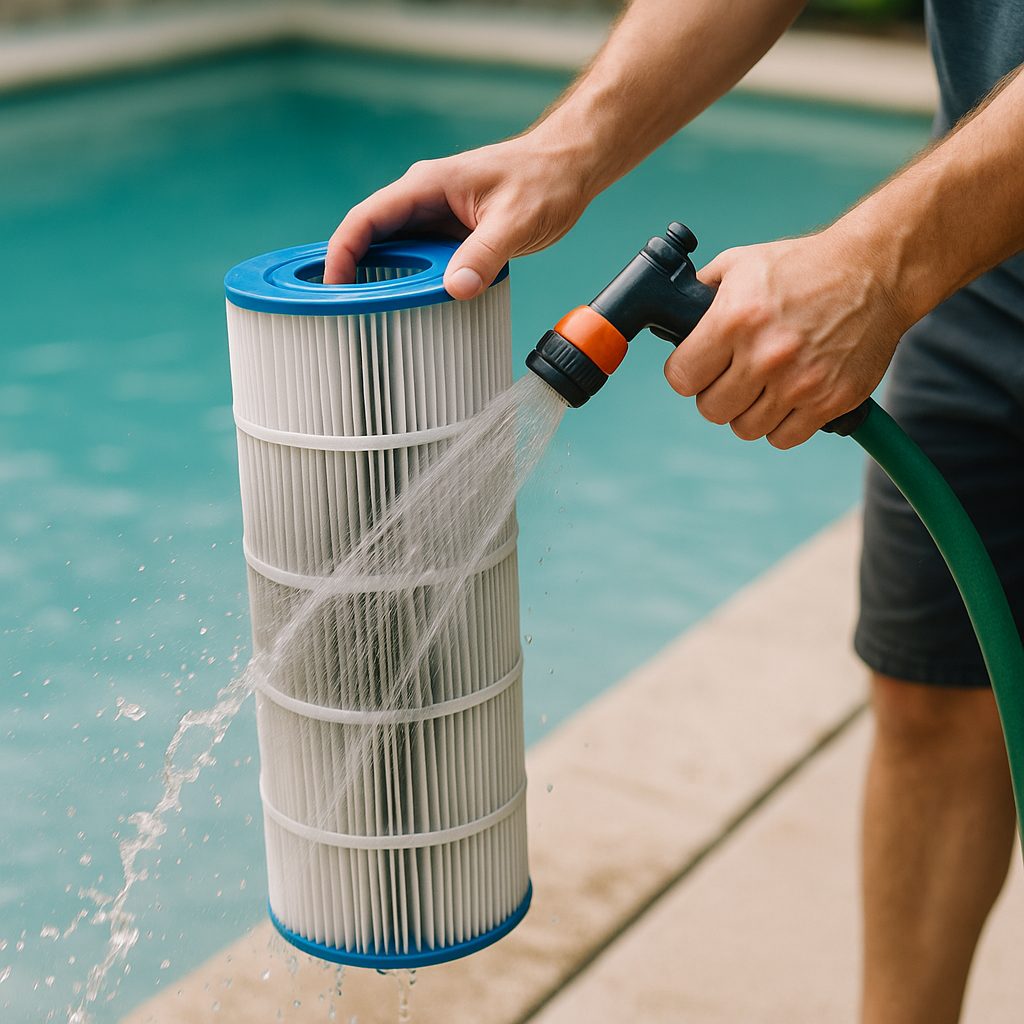
Backwash every 1–4 weeks depending on use, and more thorough cleaning (filter disinfection) at the start and end of the season. For cartridge filters, remove the cartridge, rinse it, and spray a degreaser if necessary. A clogged cartridge increases turbidity and chlorine demand.
Maintenance of the electrolysis cell
Visually inspect the cell every 1–3 months: whitish deposits indicate limescale. Descaling is done with a specific diluted acid solution according to the manufacturer’s manual — never use metal tools that damage the plates. Note the amperage and production: a significant drop often signals clogging or an end-of-life cell.
Shock and occasional treatment
If the water turns green or the organic load exceeds the electrolyzer’s production, a shock treatment is necessary. You can temporarily increase production (if the equipment allows), but sometimes chemical shock or a salt-compatible algaecide is required. Always test after 24–48 hours and do not neglect high-speed filtration during treatment.
Winterizing: protecting the electrolyzer and structure
Putting the pool into winter mode is not just a cosmetic gesture: it is about preventing freezing, corrosion, and deposits. For a saltwater pool, partial draining of the electrolyzer or bypassing according to manufacturer instructions, lowering the water level if required, adding a non-aggressive winterizing product, and a tight cover extend the system’s lifespan.
Common Problems and Quick Solutions
- Insufficient chlorine production: check the salt level, unseal the cell, descale, measure voltage/amperage.
- Unstable pH: correct alkalinity before pH to stabilize in the long term.
- Cloudy water: increase filtration, clean the filter, use clarifier if necessary.
- Equipment corrosion: rinse parts with fresh water, check the anodes and maintain an appropriate salt level.
Some Expert Tips
Controlling the production of an electrolyzer is like listening to an engine: knowing the normal “note” prevents surprises. Keep a simple notebook: cleaning dates, production settings, salt levels, and chemical interventions. This helps anticipate cell wear and optimize filtration times according to sunlight and usage.
FAQ
How often should salt be added?
Salt evaporates very little: you will mostly replace it after partial drainings, significant splashes, or diluting rains. Measure the salt level every month and adjust if the value is outside the manufacturer’s recommendations for the electrolyzer.
Can I use any salt?
Prefer salt specially intended for pools, 99% pure and without additives. Sea salt or iodized salt contain impurities that clog cells faster and can promote corrosion.
How long does an electrolyzer cell last?
The duration varies greatly depending on salt quality, maintenance, and water hardness: on average 3–7 years. Regular maintenance and gentle descaling extend its life; hard water and poor maintenance reduce it quickly.
What to do in case of green water?
Increase filtration, perform a shock compatible with the salt system, brush the walls, and check pH and alkalinity. Avoid approximate dosages: it is better to test then act accordingly.
Practical Resources: Maintenance Schedule
- Weekly: test pH, chlorine, visual observation, clean skimmer.
- Monthly: measure salt level, inspect cell, wash filter if needed.
- Quarterly: check anode, electrical control, advanced filter cleaning.
- Seasonal: winterizing/recommissioning with particular attention to the electrolyzer.
Tip: Never adjust pH before stabilizing TAC (alkalinity): you will waste time and your pH will oscillate faster.