
Sommaire
Thermal solar panels convert sunlight into useful heat for the home: domestic hot water, supplementary heating, or even swimming pools. It is not electricity but a controlled heat transfer — a technology as old as the idea of exposing a container to the sun, but now precise, reliable, and cost-effective if installed correctly. This article explains, step by step, how the collectors work, the differences between technologies, and why a thermal solar project can change a home’s energy bill.
In Brief
☀️ Key principle: panels capture solar energy to heat a fluid that circulates to a tank; the energy is stored and released as needed.
🔧 Main types: flat plate collectors (versatile), vacuum tubes (better efficiency in cold), and direct circulation or antifreeze systems depending on the climate.
💶 Economy and efficiency: significant reduction in hot water bills (often 50–70% depending on surface and climate); payback varies 5–15 years depending on subsidies and usage.
🧰 To plan for: roof integration, adapted solar tank, regulation, simple annual maintenance and checking the heat transfer fluid.
What is the basic principle?
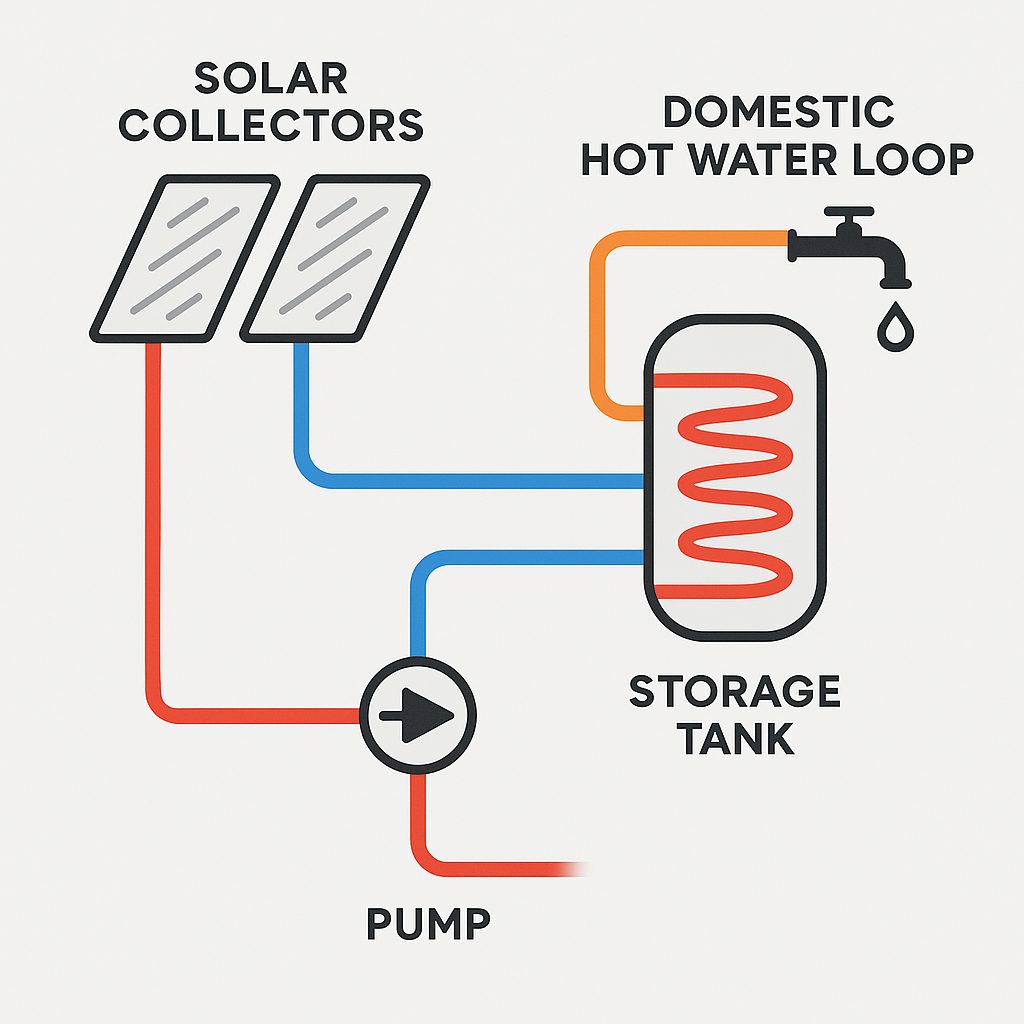
A simple idea builds a complete system: a collector absorbs photons and converts them into heat; this heat is transferred to a fluid, then stored in a tank. The scheme is straightforward but each step hides technical choices: absorption materials, insulation, nature of the fluid (water or antifreeze mixture), type of exchanger, and control. One might think performance depends mainly on exposed surface area, but the quality of the collector, orientation, inclination, and regulation also play a crucial role.
Components of a thermal solar system
1. The collector
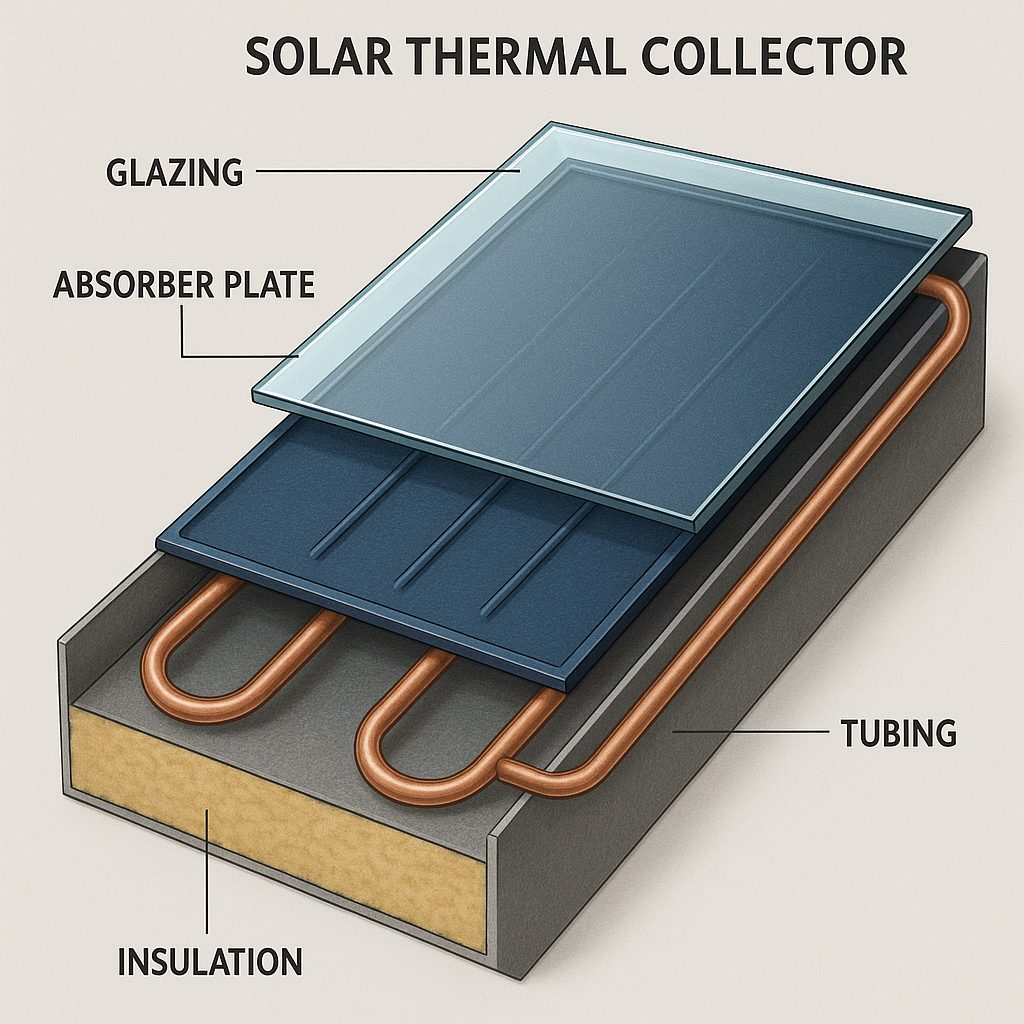
The collector is the heart: it absorbs radiation and transfers it to the fluid. Two main families dominate:
- Flat plate collectors: black metal plate protected by glass, excellent versatility, controlled cost. Ideal for domestic hot water and supplementary heating.
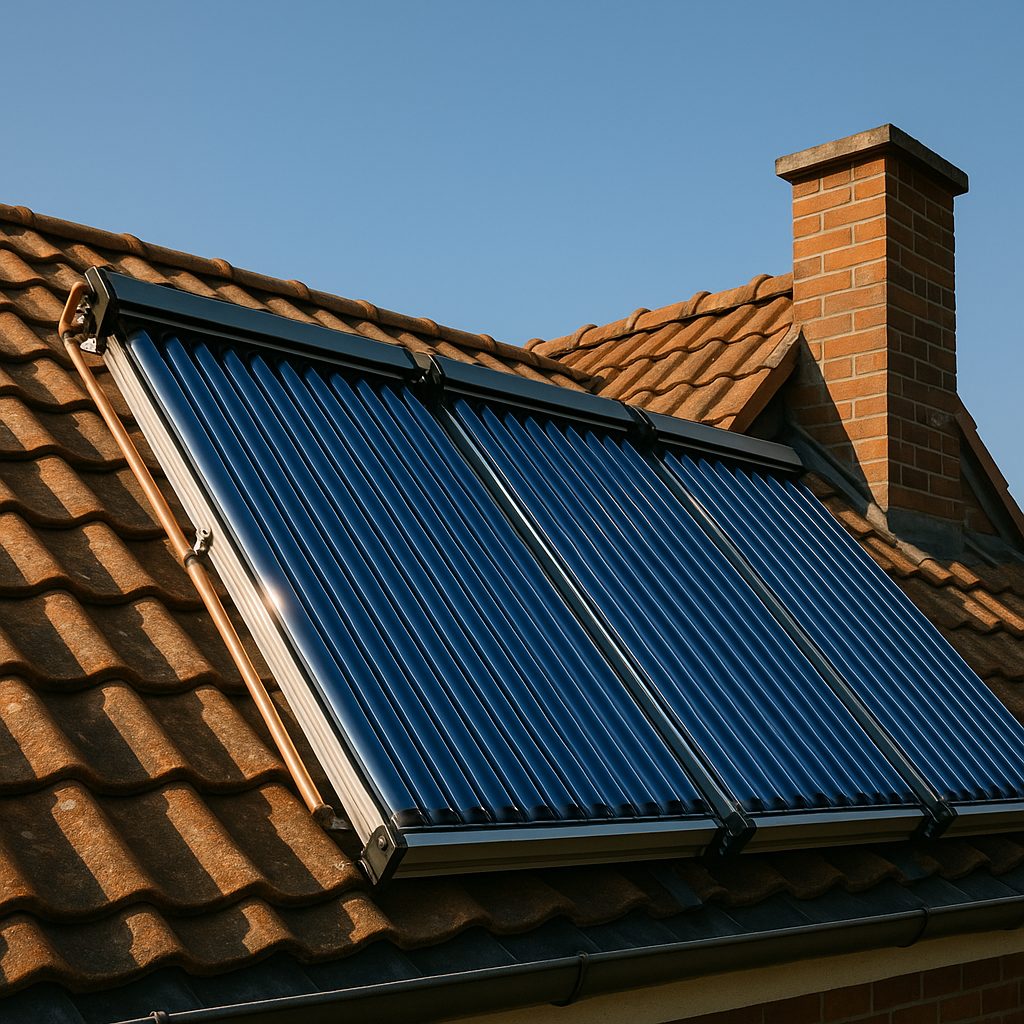
- Vacuum tubes: each tube is a mini insulated capsule, better performance in winter or snowy climates, higher price but superior efficiency per m².
2. The heat transfer fluid
Often a water/glycol mixture in frost-prone areas, it circulates via a pump. In very simple and temperate systems, water can circulate directly (direct circulation), but antifreeze fluid is preferred as soon as there is a risk of freezing. The choice of fluid influences maintenance, corrosion, and thermal efficiency.
3. The Storage Tank
The solar tank allows for storing the available energy. There are specific tanks with triple exchangers (solar + electric backup + boiler) to optimize heat distribution. The capacity depends on consumption: a household of 3 people will generally aim for 200–300 L for domestic hot water with a proportionate collector surface area.
4. Regulation and the Pump
The regulation compares the temperature of the collector and the tank and controls the pump. It prevents unnecessary circulation at night, limits overheating, and maximizes efficiency. Good regulation will extend the lifespan of the fluid and the circuit.
Types of Collectors: Quick Comparison
| Type | Principle | Typical Efficiency | Common Use |
|---|---|---|---|
| Flat Plate Collector | Absorption on black plate + glass | 50–70% (depending on exposure) | DHW, supplementary heating |
| Vacuum Tubes | Vacuum confinement and insulation, reduced losses | 60–85% | Cold climates, roofs with limited surface area |
| Integrated Collector | Integrated into the roof (thermal solar tiles) | Variable | Aesthetic, renovation |
Efficiency: What to Expect?
The efficiency of a thermal solar panel is measured by the amount of useful energy produced per m² of collector and depends heavily on sunlight, angle, shading, and ambient temperature. In practice, for domestic hot water, a well-sized installation is estimated to cover on average 50 to 70% of annual DHW needs in temperate regions. In the north or in mountainous areas, vacuum tubes retain an advantage.
Sizing and Choice
Sizing is based on two factors: hot water consumption and local climate. First, the necessary collector surface area (in m²) is calculated, then the tank capacity. For example, a household of 4 people might aim for 6–8 m² of flat collectors with a 300 L tank to achieve a comfortable solar contribution. Costs vary depending on complexity, but subsidies and tax credits improve profitability.
Installation: Steps and Best Practices
- Site evaluation: shading, inclination, and orientation (30°–45° and due south ideal).
- Choice of collector type adapted to the climate and roof.
- Mechanical installation and hydraulic connections to the tank.
- Setup of regulation, pump, and anti-corrosion devices.
- Pressure test and circuit filling, then commissioning and adjustments.
A poorly oriented or unbalanced installation ruins the economic potential of the project. Experienced craftsmen will calibrate the installation to limit losses and optimize lifespan.
Maintenance and Durability
Maintenance of a thermal solar system is reasonably light: annual check of the heat transfer fluid (antifreeze and anti-corrosion), verification of tightness, air purge of the circuit, and occasional cleaning of the glass in case of persistent dirt. Collectors often have a lifespan of 20 to 30 years; the pump and regulation may require more frequent replacements.
Advantages and Limits
- Advantages: almost zero operating cost, emission reduction, tangible return on investment with subsidies.
- Limits: intermittent production (need for a tank), requires a sunny location, efficiency decreases in low sunlight.
Practical cases and figures
For a single-family house in a temperate climate, installing 6 m² of collectors can generate the equivalent of 1,500 to 2,500 kWh thermal per year — enough to cover a large part of the domestic hot water (DHW). By replacing part of the heating, the carbon savings become significant. The cost/savings ratio then depends on local subsidies and usage: a household that consumes a lot of hot water will recover its investment more quickly.
Quick comparison with photovoltaics
Photovoltaic panels convert radiation into electricity, often favored for versatile energy production. Thermal panels remain more efficient on a given surface area for producing heat. If the main objective is hot water, solar thermal offers better direct efficiency. For electrical production or for resale/self-consumption, photovoltaics remain the right choice. In some projects, both technologies coexist to maximize energy autonomy.
Choosing an installer and warranties
Favor a certified installer (RGE qualifications in France): this ensures compliance, safety, and access to subsidies. Ask for references, expected production records, and a detailed offer. Warranties on the collectors, on the tank, and on labor vary: read carefully the performance clauses and maintenance conditions.
Regulations and subsidies
Financial aids evolve; it is necessary to check local and national schemes (grants, energy bonuses, reduced VAT). These aids can bring the payback period to attractive levels. Note that some aids require installation by a certified professional.
Common mistakes to avoid
- Oversizing to “plan for the future”: a collector that is too large can cause overheating and reduce the lifespan of the fluid.
- Ignoring orientation: a poorly oriented panel produces much less.
- Choosing solely based on price without checking the quality of the exchanger or the regulation.
Technical resources
To go deeper, consult technical datasheets on collectors, feedback from local installations, and sizing guides. Online comparators and calculators help estimate surface area and production according to location.
On site, a point often neglected concerns installation details: compatibility between tank and collectors, integration capacity on the roof, and choice of antifreeze protections. For these elements, technical manuals and thermal studies are essential to avoid disappointments.
According to the technical datasheets, the performance of different collectors varies greatly depending on the design: selective coating, insulation, or tubular construction modify the efficiency curve according to the outside temperature.
FAQ
Do thermal panels work when it is cold?
Absolutely: production depends on radiation, not just temperature. Vacuum tubes perform particularly well in cold and sunny weather because their thermal losses are low.
Can solar thermal be combined with an existing boiler?
Yes: solar covers part of the needs and the boiler takes over in case of deficit. Systems with tanks and exchangers are designed to switch cleanly between sources.
What surface area of panels for a family of 4?
As a general rule, 6–8 m² of flat collectors with a 200–300 L tank cover a large part of the hot water needs of a household of 4 people in a temperate climate.
What maintenance should be planned?
Annual fluid check, verification of fastenings and regulation, occasional cleaning of the glass if necessary. The operation is simple and inexpensive compared to the energy savings.
{
“@context”: “https://schema.org”,
“@type”: “FAQPage”,
“mainEntity”: [
{
“@type”: “Question”,
“name”: “Do thermal panels work when it is cold?”,
“acceptedAnswer”: {
“@type”: “Answer”,
“text”: “Production depends on radiation: vacuum tubes maintain good efficiency in cold and sunny weather thanks to their insulation.”
}
},
{
“@type”: “Question”,
“name”: “Can solar thermal and existing boiler be combined?”,
“acceptedAnswer”: {
“@type”: “Answer”,
“text”: “Yes, solar can preheat the water and the boiler takes over if necessary via a tank with a heat exchanger.”
}
},
{
“@type”: “Question”,
“name”: “What panel surface area for a family of 4?”,
“acceptedAnswer”: {
“@type”: “Answer”,
“text”: “About 6 to 8 m² of flat plate collectors with a 200–300 L tank cover a large part of the hot water needs in a temperate climate.”
}
}
]
}
{
“@context”: “https://schema.org”,
“@type”: “WebPage”,
“about”: {
“@type”: “Thing”,
“name”: “Solar thermal panels”
},
“keywords”: [“solar thermal panels”, “flat plate collector”, “solar water heater”, “efficiency”, “installation”]
}