Sommaire
In a kennel, a shelter, a boarding facility, or even a care area, the floor is the most “used” element of the establishment: repeated traffic, humidity, cleaning water, droppings, hair… If the surface retains water or becomes slippery, the risk increases for everyone: animals (stress, falls, injuries), staff (slips, fatigue), and visitors if the space is open to the public. The goal is therefore twofold: secure walking and simplify hygiene, day after day.
Why the floor is a key lever for safety and hygiene
A wet floor is rarely “neutral”: it promotes loss of grip, but also the appearance of hard-to-clean areas (corners, puddles, deposits). That is why, in fall prevention, it is recommended to act on organization, maintenance, traffic flow, and floor quality (clearing pathways, removing obstacles, scheduling inspections, etc.).
In animal spaces, the other constraint is moisture management: the faster a surface dries, the healthier and more comfortable it remains. Hygiene protocols also emphasize the importance of the sequence “cleaning → rinsing → disinfection (if necessary) → drying,” with real attention paid to drying (scraping, ventilation, airflow), because damp environments promote microbial growth.
Openwork floor: a logical choice when you want to drain and avoid stagnation
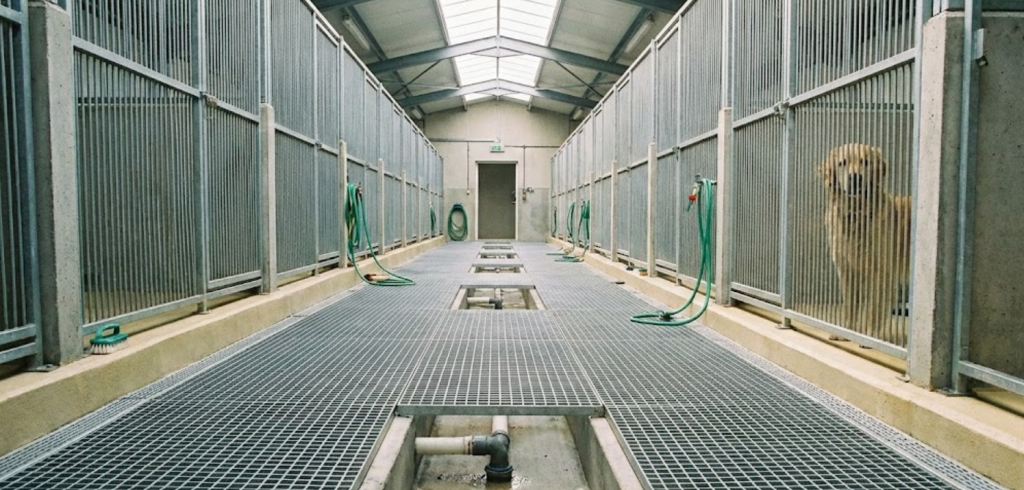
When trying to limit water stagnation, one solution is to favor openwork and resistant surfaces. The benefit is simple: water and residues drain more easily, the surface remains more walkable, and cleaning is often faster. Following this logic, the metal grating is presented as a floor suitable for animal spaces, with a focus on walking safety and maintenance.
Selection criteria to check before ordering
To avoid mistakes (discomfort, trapped objects, complicated cleaning), rely on concrete criteria:
- Material & treatment: hot-dip galvanized steel is often cited for its durability and corrosion resistance.
- Mesh: a 19×19 mesh is frequently recommended for public passages or small animals, while 30×30 can promote maximum drainage depending on the use.
- Load & rigidity: size according to the site reality (cart traffic, handling, care area). The most useful “mental custom” is to allow a margin.
- Fixings: a high-performance floor poorly fixed remains a risk (movement, noise, snag points). Also consider joints and transition zones.
- Public areas: if visitors are welcomed, accessibility and walking comfort should guide the chosen mesh.
Maintenance: what makes the difference over time
An “easy” floor is not a “no maintenance” floor. The goal is rather to make maintenance faster and more reliable. For galvanized steel installations, it is advised to schedule regular rinsing, disinfection compatible with the material, and visual inspection of fixings.
And above all: formalize your protocol. A professional resource like this hygiene strategy for canine accommodation (SNPCC) reminds of the importance of posted procedures, correct product dilution, respect for steps (pre-cleaning, cleaning, rinsing, disinfection, drying), and combating moisture by concrete means (scraping, ventilation).
“Floor & circulation” checklist in 60 seconds
- Are the traffic paths clear and clearly identified?
- Are there areas where water stagnates (drinkers, washing, entrances)?
- Does the chosen floor drain water quickly?
- Is the mesh adapted to the size of the animals and walking comfort?
- Does the protocol provide for drying (squeegee/ventilation) after cleaning?
By combining a more draining floor, reliable fixings, and a clear maintenance protocol, you improve safety, animal comfort, and the perceived quality of your establishment. And this is often where the difference lies between a space “that deteriorates” and a space “that remains clean and walkable” over time.