
Sommaire
| Key points | Details to remember |
|---|---|
| 🛠️ Problem | Identify the exact source of the squeaking or rubbing |
| 🧴 Lubrication | Choose the right product according to the type of hinge |
| Adjust the screws and the alignment of the door leaf | |
| 🔩 Replacement | Install new or reinforced hinges |
| 🧘 Silence | Opt for specially designed anti-squeak hinges |
| ⚖️ Comparison | Weigh cost, difficulty and effectiveness of each solution |
A bedroom door that complains at every opening is more than just a nuisance: it is a reminder that the house lives, moves, wears out. When rubbing turns into squeaking, there is no need to fear that the whole house will wake up: several methods, sometimes very simple, can bring calm and smoothness back to your door. I suggest reviewing five solutions, from the quickest gesture to the most technical option, so that your doors slide and close without protest.
Why your door squeaks or rubs
Before diving into the different strategies, it is important to understand what is happening. Squeaking often arises from a contact point without lubrication, where metal rubs against metal. Rubbing can result from misalignment of the door leaf or a frame that has shifted due to humidity or settling. In short, we do not act blindly: we start by inspecting hinges and pins, note the precise area of noise or contact, then define the origin of the problem.
Detecting the origin
- Observe the door open at 45°: locate the rubbing point by touch.
- Listen quietly: sharp squeaking or dull crackling indicate the type of contact.
- Check the squareness of the frame: a meter or carpenter’s square reveals slight misalignment.
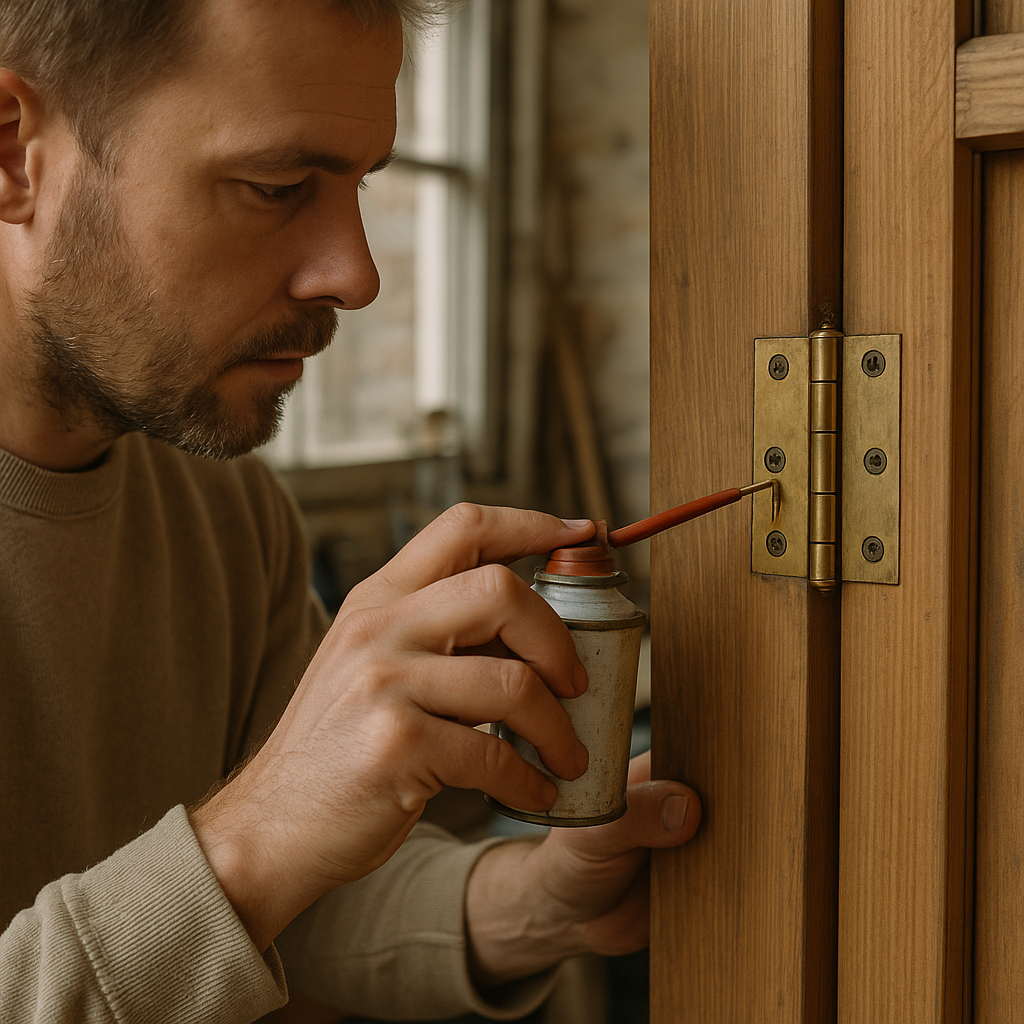
Solution 1: classic lubrication
One might think that a simple drop of oil is enough to solve everything, but in reality, the choice of product is crucial. Between universal oil, silicone, dry graphite or WD-40, each fluid has its advantages and limits depending on the nature of the hinge and the environment (dust, humidity, etc.).
Products and application tips
- Vaseline oil: excellent for indoor domestic hinges, it does not slip and resists dust.
- Silicone spray: recommended if you fear dirt accumulation; leaves a dry and waterproof film.
- Graphite powder: ideal for continuous use without stains, but less effective on heavily oxidized metal.
Solution 2: hinge adjustment
If the door rubs on the floor or against the frame, it is often a positioning problem. Adjusting the alignment is then more effective than repeated lubrication. Using an Allen key or screwdriver, adjust the verticality and depth of the door leaf so that it returns to its original place.
Step-by-step
- Slightly unscrew the upper hinge to be able to move the door leaf.
- Lift or lower the door by a few millimeters until the gap is uniform along the entire height.
- Gradually tighten the screws, checking each time that the rubbing has disappeared.
Solution 3: replacement of pins or hinges
When pins are damaged, bent or too worn, they lose their pivot role and cause noises and deformations. Replacing the entire part guarantees a nearly new result, provided you choose the right size and a robust material (brass, stainless steel or galvanized steel).
Types of hinges to favor
- Roller hinges: smoother but more expensive, suitable for heavy doors.
- Adjustable friction hinges: allow adjusting the tension of the door leaf and prevent slamming.
- Concealed pins: for an aesthetic finish, but require precise templates during installation.
Solution 4: frame adjustment
Moving walls, settling floors… your door frame can deform over the years. In this case, it is not the hinge that needs changing, but the entire frame. Warped parts are repaired, gaps filled with putty or the sub-frame redone. This solution is more involved but definitively eliminates any source of misalignment.
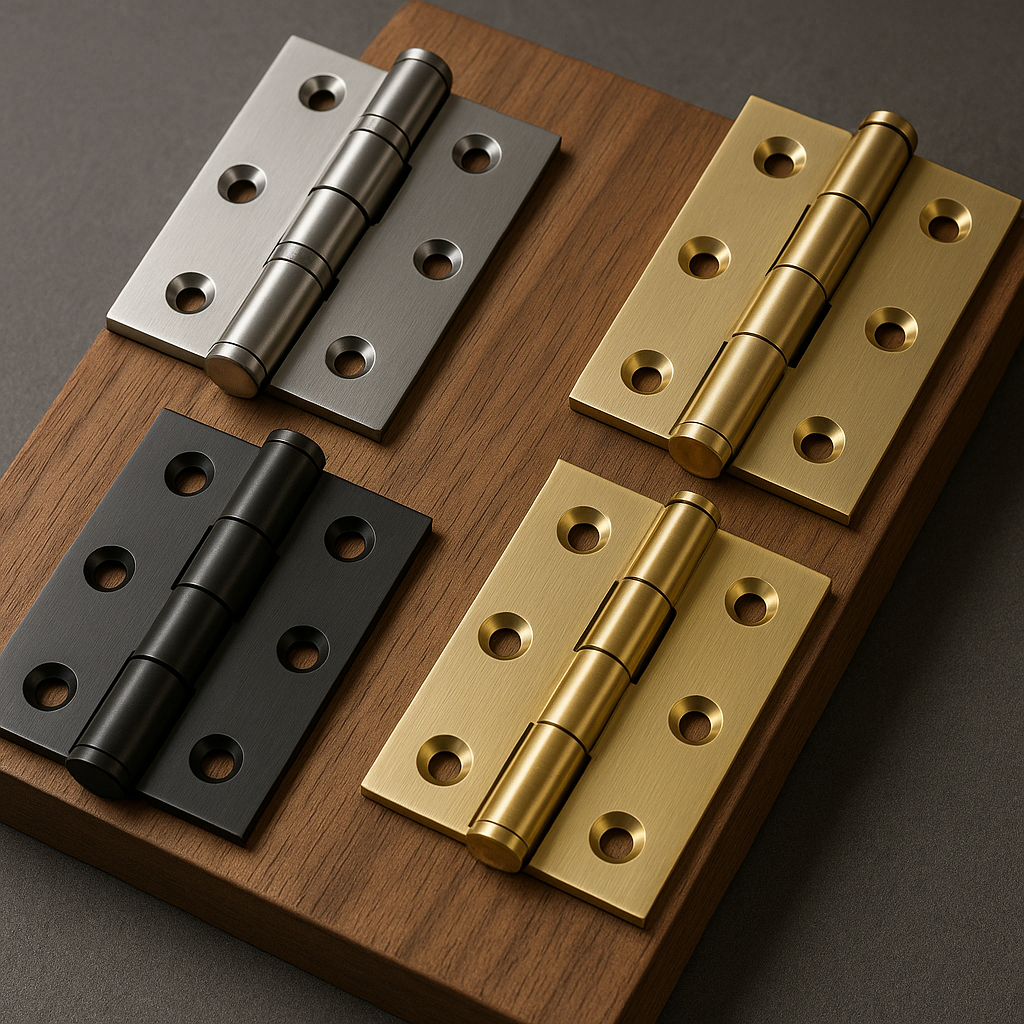
Solution 5: opt for specialized silent hinges
For several years, manufacturers have offered mechanisms integrating an internal damper to reduce friction. They act like a small hydraulic piston or offer ultra-smooth ball bearing rotation. Suitable for all interior doors, their installation does not differ from classic hinges.
| Solution | Advantages | Disadvantages |
|---|---|---|
| Lubrication | Fast, economical | Regular maintenance |
| Adjustment | No replacement, precise | Tools required, patience |
| Replacement | Durable, like new | Cost, disassembly |
| Frame adjustment | Long-lasting solution | Carpentry work |
| Silent hinges | Modern design, anti-squeak | Higher price |
FAQ
How do I know if I need adjustment or replacement?
Observe the condition of the screws and the shape of the pins: if the metal is deformed or the holes are oval, it is better to replace. If the door deviates slightly but everything remains solid, a simple adjustment is enough.
Which lubricant is the most durable?
Silicone spray leaves a dry film that attracts little dust, making it the most durable choice for indoor use.
Can I use WD-40 as a permanent lubricant?
WD-40 is primarily a penetrating oil and cleaner. It is suitable for loosening an oxidized mechanism, then a specific lubricant (graphite or thick oil) should be preferred for long-term maintenance.
Is it difficult to install silent hinges?
The principle remains the same as a classic hinge. However, be careful with the provided template and door leaf alignment, as any misalignment can cancel the “silent” effect.