
Sommaire
Lifting pumps play a key role whenever it is necessary to raise wastewater or rainwater located below the discharge level. Whether to protect a flood-prone basement, ensure the drainage of a car wash station, or manage rainwater in a flood zone, these devices come in several technologies adapted to each context. Far from being simple motors, they often integrate detection, cutting, and corrosion protection systems. In this guide, we review their operating principle, existing types, their most common applications, and best practices for choosing and maintaining them properly.
In brief
📌 Principle: a submerged or external pump raises water located below the drainage level to a discharge point located higher up.
⚙️ Types: there are submersible, semi-submersible, cutting (macerator), or turbine models, each having advantages depending on the nature of the effluents.
💧 Applications: from domestic lifting (basements, kitchens) to industrial uses (stations, processes). Annual maintenance and verification of pumping capacity are crucial to avoid breakdowns.
How does a lifting pump work?
At the heart of the device is an electric motor that drives a hydraulic element—turbine, propeller, or screw—to create a vacuum and suck in water. The pump is often installed in a tank called a lifting pit or collector. When a float or level sensor detects a certain volume of water, it automatically activates the motor. A non-return valve ensures that the pumped fluid does not flow back into the tank after stopping.
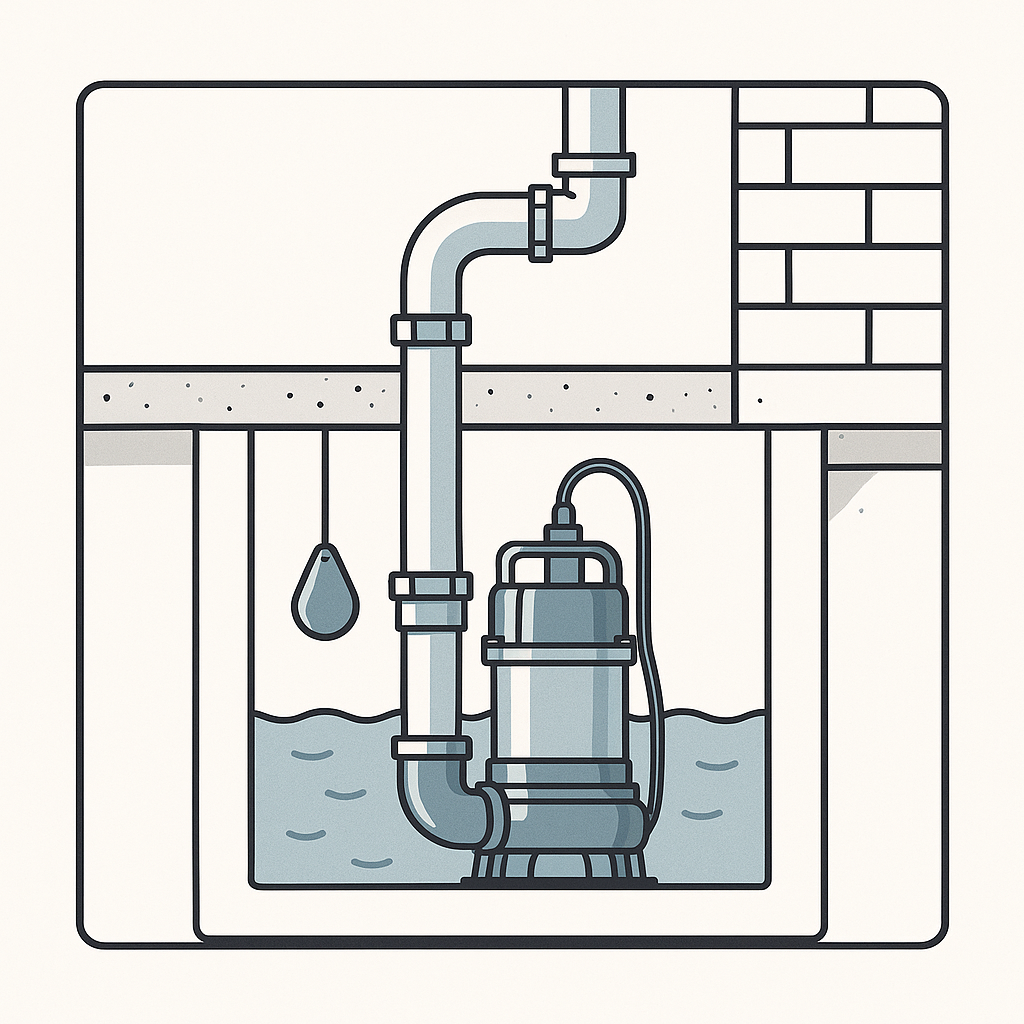
In practice, the total manometric height (HMT) determines the pressure needed to overcome the water column and pressure loss in the pipes. As long as the desired flow rate (expressed in liters per hour or m³/h) remains compatible with the curve provided by the manufacturer, the pump will operate without strain, preserving its longevity.
Main components
- Electric motor: asynchronous or induction, with integrated thermal protection.
- Hydraulic body: vortex turbine, blade wheel, or Archimedes screw.
- Float/sensor: triggers the pumping cycle.
- Non-return valve: prevents backflow and limits the number of starts.
Types of lifting pumps
There are mainly two large families: submersible models immersed in the tank, and external models, called inline lifting. Each offers specific advantages depending on the environment and the nature of the liquid to be treated.
| Type | Advantages | Disadvantages |
|---|---|---|
| Submersible | Silent, compact, optimal protection against corrosion | Difficult maintenance, limited access |
| External | Accessible, quick assembly/disassembly | Noisier, risk of freezing outdoors |
| Chopper | Cuts solids, prevents blockages | Higher electrical consumption |
| Self-priming | Instant priming, ideal for sumps | Requires a minimum water level |
Submersible vs. external pumps
The submersible pump naturally fits in sealed pits: less noise pollution and protected wiring. The external option will please technicians who need quick access for inspection or replacement, especially in agricultural or industrial environments where downtime must be minimized.
Applications and uses
Uses range from simple wastewater lifting in a single-family home to large volume treatment plants in industry. Here are some common scenarios:
- Domestic: flooded basements, basement kitchens, toilets installed below street level.
- Collective: buildings, underground parking lots, urban stormwater networks.
- Industrial: treatment plants, washing workshops, agri-food processes.
- Agricultural: soil drainage, livestock effluent storage.
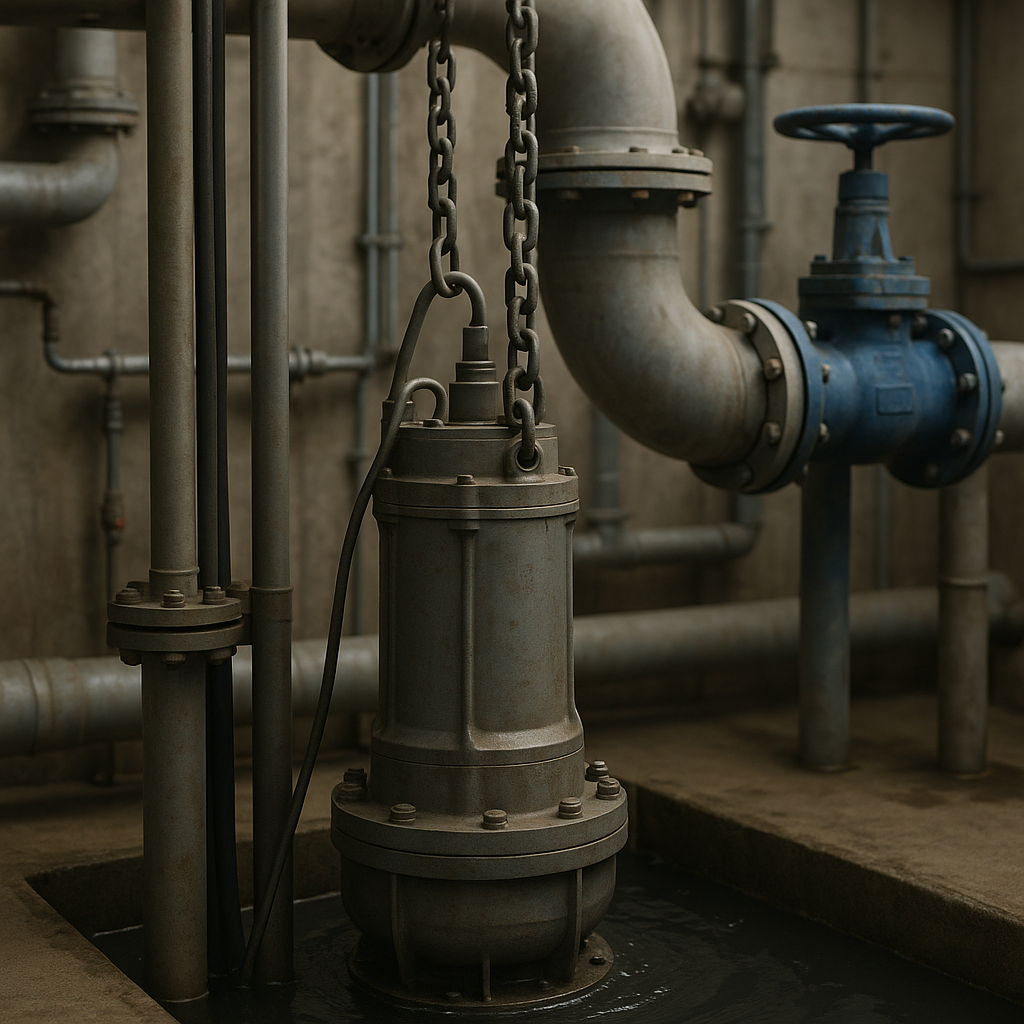
In each case, it is essential to adapt the material composition (stainless steel, cast iron, reinforced plastic) to the nature of the effluents (clear water, loaded, corrosive). A poor choice can lead to premature wear or even breakage within a few weeks.
Installation and maintenance
Installation always starts with sizing the lifting tank: volume adapted to flow rate and pumping frequency. An inspection chamber facilitates maintenance: sludge cleaning, float checks, check valve verification. A simple maintenance plan is broken down as follows:
- Quarterly visual inspection of cables and connections.
- Biannual cleaning of the pump body and tank.
- Functional testing of sensors and floats every 6 months.
- Replacement of mechanical seal or rotor every 2 years depending on use.
Key installation steps
- Dig the pit and pour a concrete base to stabilize the tank.
- Position the pump and connect the discharge pipe.
- Install the automatic control system (panel with level relay).
- Perform a dry run test then a real situation test for 24 hours.
Selection criteria and sizing
To select a pump, three main parameters are considered:
- Flow rate (Q) in l/h or m³/h: amount of water to be pumped.
- Total Manometric Head (HMT) in meters: elevation + pressure losses.
- Power of the motor in kilowatts or horsepower (HP) to ensure good starting.
A lack of margin on the HMT will force the pump, leading to a risk of overheating. Conversely, oversizing makes the installation costly and energy-consuming.
A concrete example: to lift 1,200 l/h at 5 m of HMT, one would choose a 0.75 kW pump offering an operating point close to its ideal curve.
Maintenance and Troubleshooting
In case of a breakdown, the first step is to check the power supply and the circuit breaker. Next, check the condition of the floats: winding or clogging can prevent the pump from starting. Here are some common diagnostics:
- Machine blocked by debris: disassembly and cleaning of the hydraulic body.
- Maintenance of the mechanical seal if there are leaks under the base plate.
- Replacement of the starting capacitor for single-phase motors.
Frequently Asked Questions
What is the difference between a lifting pump and a drainage pump?
The lifting pump raises effluents to a higher point, while the drainage pump transfers water to an equivalent or lower level. The uses and hydraulic design therefore differ significantly.
How to choose the right size for a lifting pit?
The volume is calculated by adding the flow rate of the pump(s) and the recommended start frequency (generally 10 to 20 cycles/hour). A 20% margin is added to absorb consumption variations.
What is the average annual maintenance cost?
Expect between €100 and €200 excluding parts for professional maintenance including visits, cleaning, and testing of safety components.
Can you install a lifting pump yourself?
An experienced DIYer can carry out the installation, but the intervention of a plumber-electrician guarantees compliance with current electrical and sanitary standards.
{
“@context”: “https://schema.org”,
“@type”: “WebPage”,
“about”: {
“@type”: “Thing”,
“name”: “Lifting Pumps”
},
“keywords”: [“lifting pump”, “submersible”, “HMT”, “flow rate”, “maintenance”]
}