
Sommaire
For several years, the Agapanthus – better known in French as Agapanthe or lily of the Nile – has established itself as one of the most spectacular perennials in our gardens and on our balconies. Its umbels of blue, purple, or white flowers emerge in the heart of summer and instantly transform spaces into true Mediterranean paintings.
But behind this beauty lies a great diversity of species and cultivars, very specific cultivation requirements, and horticultural novelties that never cease to surprise enthusiasts. This comprehensive guide invites you to dive into the heart of this fascinating plant to understand its history, learn about its varieties, master its cultivation, and discover the combinations that highlight it.
Our verdict at a glance ⭐
| Pros | Cons |
|---|---|
| Spectacular summer bloom Easy to maintain Wide range of colors Suitable for pots and open ground |
Frost sensitive depending on variety Time before first bloom Rot in poorly drained soil Pests to watch out for |
Overall rating: 8/10 ⭐
Recommended for: beginner gardeners, perennial enthusiasts, lovers of Mediterranean gardens
Definition and classification of Agapanthus
The word “Agapanthus” is the French adaptation of the botanical Latin Agapanthus, itself derived from the Greek agápē (love) and anthos (flower). It is sometimes called “blue tuberose” or “Nile lily”, although the plant has no connection to the African river: all agapanthuses are native to South Africa where they naturally grow in pastures and forest edges.
The genus Agapanthus belongs to the family of Amaryllidaceae and constitutes a subfamily on its own. Botanists now agree to distinguish six to seven main species, to which more than six hundred horticultural cultivars are added. This diversity allows for plants of varying sizes (from 30 cm to over 1.5 m tall) and colors ranging from pure white to almost black violet.
Agapanthuses are divided into two main groups: species with evergreen foliage, such as A. praecox, which keep their leaves in winter and are adapted to mild climates, and species with deciduous foliage, such as A. campanulatus, which disappear in winter before regrowing in spring.
Other species like A. africanus, A. inapertus, or A. orientalis have intermediate characteristics. The taxonomy of the genus has evolved over the centuries: in the 18th century, the naturalist Charles Louis L’Héritier de Brutelle created the genus Agapanthus by reclassifying plants previously placed in the genus Crinum.
More recently, specialist Wim Snoeijer revised the classification and precisely described the species, their distribution, and naming confusions. Today, the scientific community recognizes the ornamental and genetic value of these wild species, which form the basis of contemporary hybrids.
Comparative Table of Main Species
| Species | Height | Foliage | Hardiness | Particularity |
|---|---|---|---|---|
| A. praecox (syn. A. africanus) | 60 – 100 cm | Evergreen | −5 °C | Most cultivated species, summer blooming with bright blue or white flowers |
| A. campanulatus | 50 – 80 cm | Deciduous | −10 °C | Loose umbels and bell-shaped blue or lilac flowers |
| A. inapertus | 1.20 – 1.50 m | Deciduous | −7 °C | Hanging dark blue flowers, very graphic |
| A. orientalis | 80 – 150 cm | Evergreen | −5 °C | Dense umbels of light blue to violet flowers |
| A. africanus subsp. pendulus | 40 – 70 cm | Deciduous | −8 °C | Light blue drooping flowers, suitable for rock gardens |
Botanical Characteristics and Life Cycle
The Agapanthus is a perennial plant with a fleshy base formed of short, thick rhizomes that store water and nutrient reserves. At the base, long ribbon-like leaves develop, measuring 30 to 80 cm in length and a few centimeters wide, ranging from bluish-green to dark green.
In evergreen species, these leaves remain throughout the year and form a dense clump. In deciduous species, they dry up and disappear in autumn before regrowing in spring.
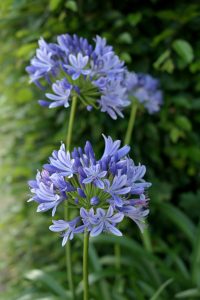
In the heart of summer, a hollow stem called a scape emerges from the leaf rosettes and rises up to 1.50 m depending on the varieties. This stem bears at its top an umbel composed of 20 to 100 tubular flowers. The petals, fused at the base, unfold like a trumpet and can take shades ranging from pure white to azure blue, from lavender to very dark purple.
Flowering generally extends from June to September. Some recent varieties like ‘Bridal Veil’ even promise continuous flower spikes for three months.
After flowering, each flower can produce a capsule filled with shiny black seeds. However, propagation by sowing remains unpredictable because hybrids do not faithfully reproduce the traits of the parent plant.
Division of clumps is therefore the most used method: it is done in autumn or spring by gently separating the rhizomes and replanting the divisions in fresh, well-drained soil.
Physiologically, the Agapanthus is a heliophilous plant that needs a lot of light to flower. It goes dormant in winter and poorly tolerates prolonged frosts, especially for evergreen varieties. Deciduous species, like A. campanulatus, are hardier and can withstand temperatures close to −10 °C with good mulching.
The genus Agapanthus includes only six or seven botanical species but more than 600 cultivars, offering an almost infinite palette of colors and shapes for gardeners.
Growing Agapanthus: cultivation and care
Although it originates from southern Africa, the agapanthus is an easy plant to grow in our latitudes provided certain rules are respected. It appreciates exposure in full sun or bright partial shade and requires a light, well-drained soil rich in organic matter.
In open ground, choose a location sheltered from cold winds and prepare the soil by incorporating mature compost and sand if your soil is heavy. Plant the seedlings in spring or autumn by burying the collar slightly above ground level and spacing the clumps 40 to 60 cm apart depending on the variety.
Water regularly during the first year to encourage rooting, then reduce watering: an agapanthus tolerates slight water stress better than excess moisture, which could cause its rhizomes to rot.
Pot culture: the solution for balconies
In pots, prefer a terracotta container with a minimum diameter of 30 cm with drainage holes. Agapanthuses like to be a bit cramped: a pot that is too large delays flowering.
Prepare a substrate of equal parts potting soil, compost, and coarse sand. Add a drainage layer at the bottom (clay pellets or gravel) to prevent water stagnation.
During the growing period, water regularly without leaving stagnant water in the saucer. Apply an organic fertilizer or one for bulbous plants every three weeks.
Bring the pots indoors to a bright, frost-free location as soon as temperatures drop below 0 °C. Reduce watering in winter to encourage vegetative rest.
Repot every 3 or 4 years in spring when the roots completely fill the pot. Dividing clumps in pots is done by breaking the rhizomes with a clean knife.
Propagation and simplified maintenance
Divide the clumps after four to five years to regenerate the plant and restart flowering. Cut the wilted inflorescences to encourage the production of new stems. Remove yellowed leaves as they appear.
A mulch of gravel or wood chips limits watering and protects the collar from frost. In cold regions, deciduous agapanthuses can remain in the ground with good mulching, while the evergreen ones are better dug up and overwintered in pots.
Finally, be patient: the first flowering may sometimes appear only one to two years after planting, but it more than rewards the wait with majestic umbels.
Advantages and disadvantages
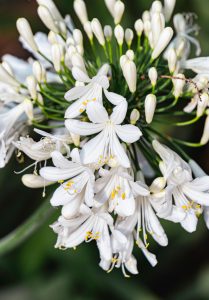
The agapanthus is primarily attractive due to its elegant silhouette and spectacular flowering. Its slender stems crowned with umbels evoke the bouquets of Mediterranean gardens and bring an exotic touch to flower beds as well as terraces. The color palette, from the purest white to almost black violet through a whole range of blues, allows for harmonious compositions.
Moreover, this perennial is relatively undemanding: a sunny exposure, well-drained soil, and some regular watering are enough to ensure its longevity. It easily pairs with other ornamental plants and can even be grown in pots to flower balconies and patios. Its cut flowers last a long time in a vase and enhance summer bouquets.
However, some disadvantages must be taken into account. Evergreen varieties are sensitive to frost and need to be protected or overwintered in cold regions. Excess water or heavy soil can cause rhizome rot: the plant dislikes wet winters.
The sap contains irritating compounds; it can cause skin reactions in sensitive people, hence the importance of wearing gloves when handling. Agapanthuses sometimes take time to flower after planting, especially if the pot is too large. Finally, they attract some pests such as slugs, snails, and scale insects, which must be monitored.
Examples and garden associations
Thanks to their graphic form, agapanthuses fit well both in contemporary gardens and traditional flower beds. They are perfect as borders along terraces, in rows along a path, or in isolated clumps in a lawn.
In a Mediterranean spirit, pair them with aromatic plants such as lavender, rosemary, or thyme: their bluish blooms complement each other and their hardiness is similar. For an exotic atmosphere, combine them with grasses like Stipa tenuissima, Miscanthus, or Pennisetum, with Yuccas or dwarf palms; the contrasting foliage and varying heights create rhythm and movement.
In a perennial bed, agapanthus pairs wonderfully with gauras, sages, perennial geraniums, and English roses. In a pot, plant it with trailing annual flowers (lobelias, bacopas) that will dress the base without competing with the flower stalk.
For an elegant pairing, plant white agapanthus next to pastel-shaded roses; their spherical inflorescences contrast with the flat flowers of the roses and brighten the beds. Dark-flowered varieties (‘Black Buddhist’, ‘Midnight Star’) stand out against a background of gray or silver foliage such as wormwood or sea cineraria.
Whatever combinations you choose, be sure to group your agapanthus in numbers to create a mass effect and achieve maximum visual impact.
Diseases, pests, and solutions
Agapanthus is generally not very susceptible to diseases. Most problems arise from unsuitable cultivation: poorly drained soil promotes root and collar rot, while a pot that is too large or excess nitrogen fertilizer can lead to lush foliage at the expense of flowering.
Leaf spots may appear in case of persistent moisture. Remove affected leaves and improve ventilation. The most common pests are slugs and snails that nibble on young shoots. Install physical barriers (ashes, wood chips) or use beer traps to keep them away.
Mealybugs can also appear on the leaves. Treat with a cotton swab soaked in household alcohol or diluted black soap and isolate contaminated plants. Finally, aphids appreciate the flower stalks: a spray of water and the presence of beneficial insects (ladybugs, hoverflies) are generally enough to get rid of them.
As a preventive measure, adopt good cultural practices: space the plants sufficiently to promote air circulation, water at the base without wetting the foliage, weed around the clumps, and avoid excess nitrogen which attracts insects. In humid regions, plant your agapanthus on an overhang or mound to ensure quick drainage. Regular monitoring and responsiveness to the first symptoms guarantee vigorous and flowering plants.
Varieties and New Releases
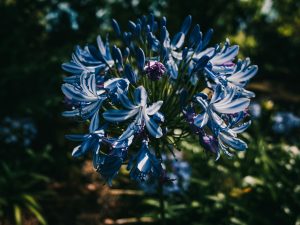
Horticultural selection has produced a multitude of agapanthus varieties that differ in size, flower color, umbel shape, and hardiness. Among the reliable choices are the blue cultivars ‘Blue Giant’ and ‘Bressingham Blue’, with large umbels borne on stems over one meter tall, and the very popular ‘Midnight Star’, whose midnight blue flowers contrast with dark green foliage. White varieties such as ‘Albus’, ‘Giant White’, or ‘Silver Baby’ bring brightness and elegance to flower beds.
In recent years, nurseries have developed cultivars with innovative characteristics. The company De Vroomen presented in 2024 the Agapanthus ‘Black Buddhist’, a compact variety with violet flowers so dark they appear black when bathed in sunlight. It reaches about 80 cm in height and blooms from July to September with little care.
Meanwhile, the firm Monrovia announced for 2025 ‘Bridal Veil’, a dwarf agapanthus with very abundant white flowering: its sturdy stems, measuring only 30 cm, bear a multitude of flowers making it an ideal choice for borders and summer floral pots.
The Californian nursery San Marcos Growers offers ‘Grey Ghost’, a dwarf cultivar with gray-green foliage streaked with white and white umbels, as well as ‘Periwinkle Days’, a hybrid with large blue-violet umbels borne on stems about 90 cm tall. These varieties clearly show the diversity offered by the genus and allow you to choose a plant suited to every garden style.
When choosing your variety, take into account hardiness and height to integrate it harmoniously. Dwarf varieties are perfect for planters or the front of flower beds. Larger species are better suited as a backdrop or when planted alone. Feel free to visit specialized nurseries or botanical gardens to discover new varieties and select the one that best matches your climate and preferences.
Tools and resources for growing Agapanthus
To maximize your chances, equip yourself with the right tools and suitable equipment. A spade or a fork-spade is essential for preparing the soil and dividing clumps. A bulb planter makes it easier to place young plants in the ground. A well-sharpened pruning shear is used to cut faded flower stalks and damaged leaves.
In pots, provide sturdy containers with several drainage holes, as well as a saucer to catch excess water. A mineral mulch (gravel, pumice) keeps the substrate cool and limits weeds. Finally, a balanced fertilizer (type 10-10-10) or an organic amendment (compost, composted manure) enriches the soil and supports flowering.
Regarding documentation, several resources allow you to deepen your knowledge. The guide Agapanthus: A Revision of the Genus by Wim Snoeijer is a reference for understanding the botany and diversity of species. The National Horticultural Society of France (SNHF) publishes technical sheets and offers training on ornamental perennials.
Specialized nursery websites (Monrovia, San Marcos Growers, De Vroomen) present their varieties with detailed cultivation advice. Finally, gardening magazines (Garden Center, Greenhouse Management) publish annual “New Varieties” guides that allow you to discover trends and innovations. Take advantage of these resources to choose your plants, plan your plantings, and share your experiences with other enthusiasts.