
Sommaire
| Key Points | Details to Remember |
|---|---|
| 🌸 Definition | Selection of trees with remarkable flowering adapted to the French climate |
| ✅ Advantages | Resilience, long-lasting flowering, limited maintenance |
| ⚖️ Criteria | Exposure, soil type, hardiness |
| 🛠️ Maintenance | Pruning, watering, light fertilization |
| 🏡 Applications | Paths, flowering hedges, isolated in massifs |
| 🌿 Results | Aesthetic effect guaranteed in spring |
| 🛒 Accessibility | Availability in specialized nurseries |
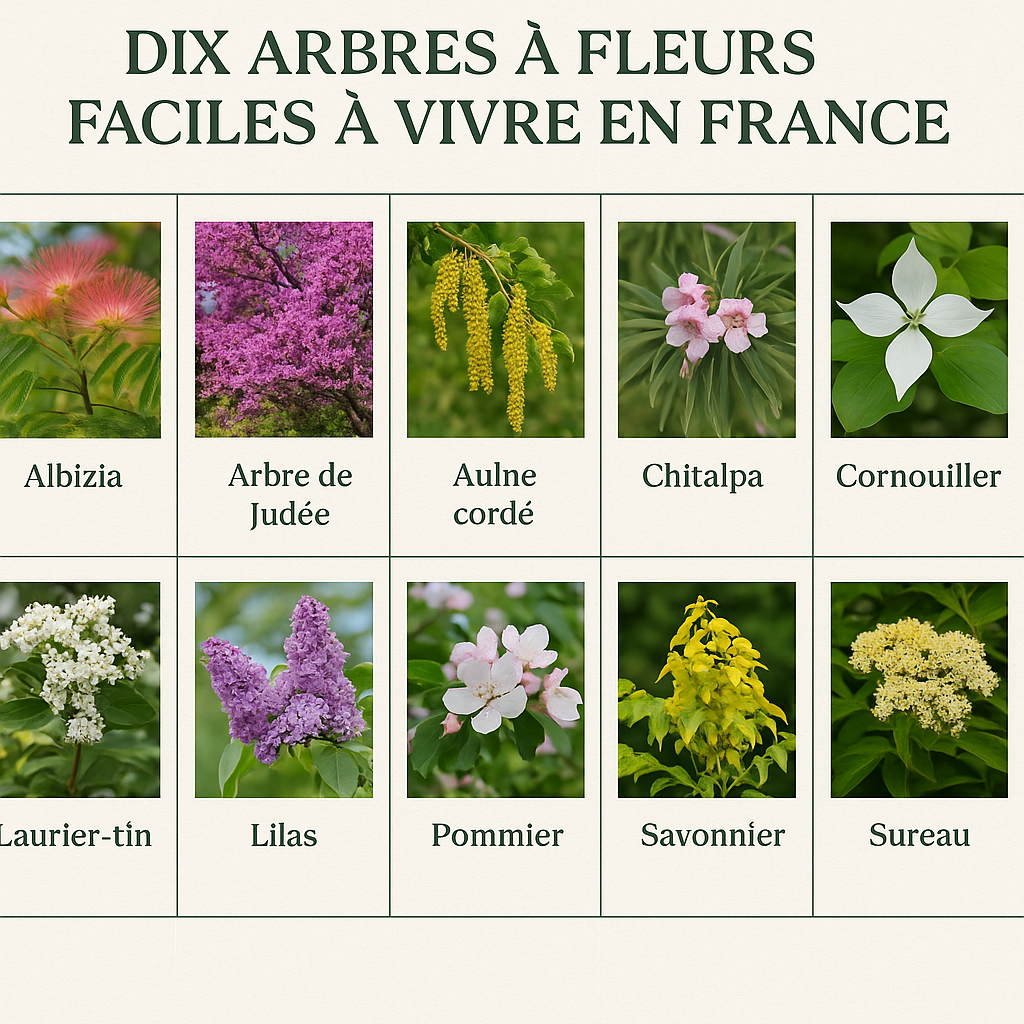
Planting a flowering tree in your garden is the promise of awakening the senses as soon as the first beautiful days arrive. Without yielding to the whims of demanding species, there are robust varieties that offer a floral spectacle without requiring daily maintenance. This article offers a ranking of the ten easiest-to-grow flowering trees in France, accompanied by expert advice to successfully complete your project from A to Z.
Comparison of the 10 Essential Flowering Trees
| Species | Height | Flowering | Hardiness | Exposure |
|---|---|---|---|---|
| Prunus serrulata ‘Kanzan’ | 5 – 8 m | April – May (pink) | -15 °C | full sun |
| Magnolia stellata | 3 – 4 m | March – April (white) | -20 °C | partial shade |
| Malus ‘Evereste’ | 4 – 6 m | April (pink) | -20 °C | full sun |
| Cornus kousa | 5 – 7 m | May – June (white) | -25 °C | partial shade |
| Lagerstroemia indica | 4 – 6 m | July – September (pink) | -12 °C | full sun |
| Cercis siliquastrum | 4 – 8 m | April – May (bright pink) | -15 °C | full sun |
| Prunus subhirtella ‘Pendula’ | 5 – 7 m | February – March (pale pink) | -15 °C | partial shade |
| Pyrus calleryana ‘Chanticleer’ | 6 – 8 m | April (white) | -18 °C | full sun |
| Amelanchier lamarckii | 4 – 7 m | April (white) | -25 °C | partial shade |
| Albizia julibrissin | 6 – 8 m | June – August (pink) | -10 °C | full sun |
Criteria for Choosing Your Flowering Tree Well
Exposure and Climate
The sun is a primary factor: most of the presented varieties thrive in full sun, but some, like Magnolia stellata or Cornus kousa, tolerate partial shade. Conversely, Albizia julibrissin prefers the warmest regions and fears late frosts. Take into account the orientation of your garden and the shade cast by surrounding buildings.
Soil Type and Drainage
Well-drained, light soil rich in humus is ideal. Malus and Pyrus are content with clay-sandy soils, while Prunus and Amelanchier prefer fresh, slightly acidic potting soil. If your soil is too heavy, adding coarse sand or compost helps lighten the mixture and prevent root suffocation.
Spacing and Growth
Each species occupies a different volume at maturity. For a small space, favor Magnolia stellata or Prunus subhirtella ‘Pendula’, whose silhouette is more compact. This avoids imposing drastic pruning in the future. In a mass planting or isolated, a Lagerstroemia or an Albizia will reach their full size and offer a true summer spectacle.
Step-by-step Planting Tips
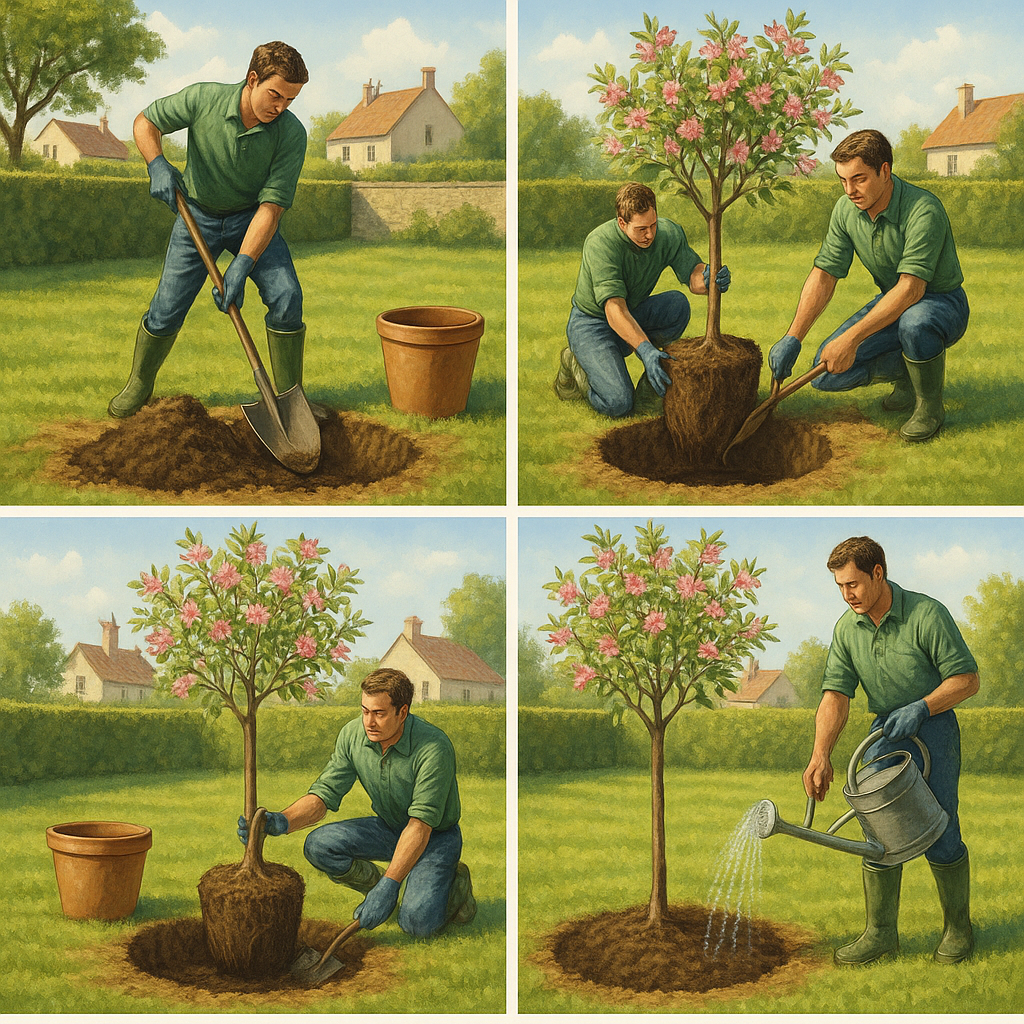
- Dig a hole two to three times the volume of the root ball, to loosen the surrounding soil.
- Amend the soil with mature compost or planting soil, without excess to avoid burning the roots.
- Position the tree so that the collar is at ground level. Avoid burying it.
- Water generously at planting, then regularly during the first year without water stagnation.
- Mulch the base with straw or bark to retain moisture and limit weeds.
Minimal Maintenance for Optimal Blooming
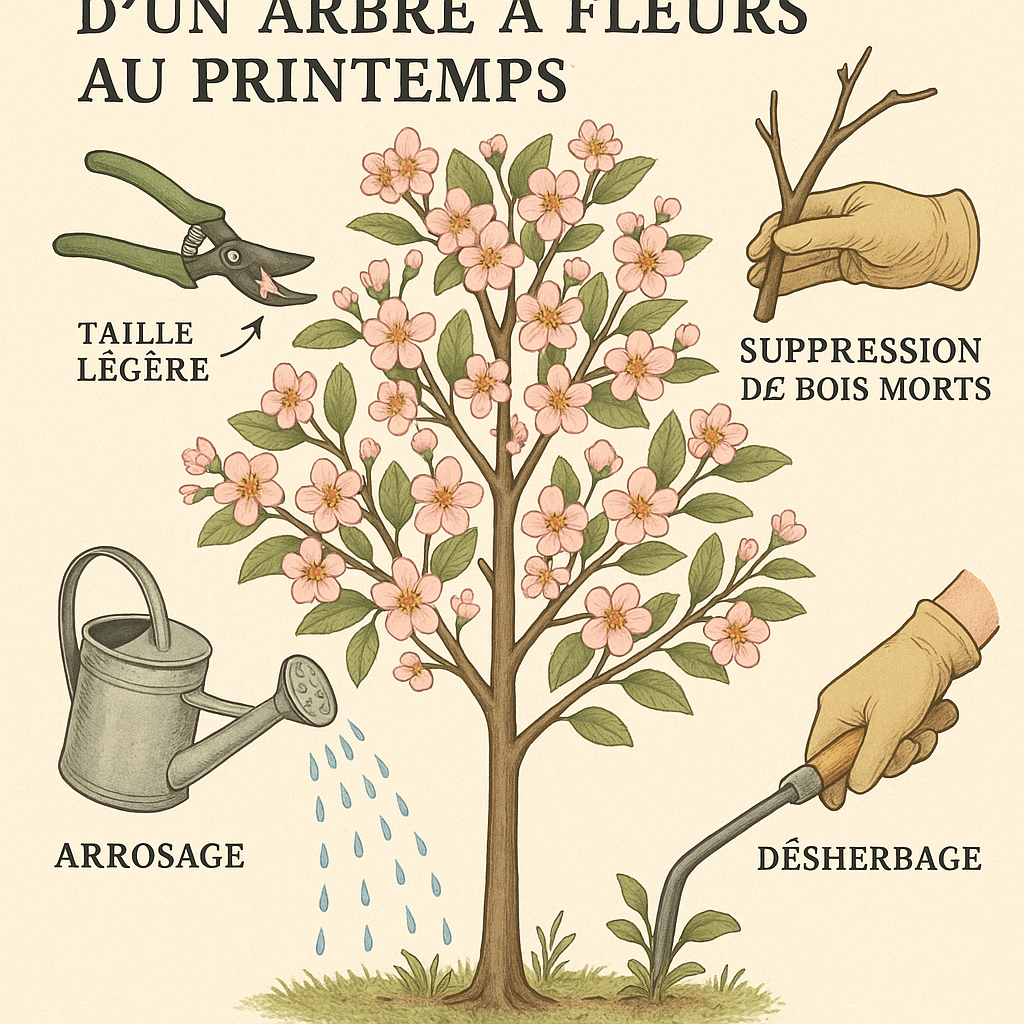
The absence of overly drastic pruning is a major advantage. For most species, a cleaning pruning at the end of winter suffices: removal of dead wood and light thinning of inner branches. Albizia and Lagerstroemia may require a more marked intervention to maintain a nice shape. An application of roasted horn meal or dehydrated manure in spring stimulates flowering.
FAQ
Which tree blooms the longest?
Lagerstroemia indica, or crepe myrtle, offers generous flowering from July to September in the warmest zones.
Which tree tolerates drought?
Albizia julibrissin tolerates longer drought periods thanks to its deep root system, provided it is planted in light soil.
What exposure is best for a flowering prunus?
A Prunus serrulata thrives ideally in full sun, with at least 6 hours of daily sunlight.
How to protect the tree in winter?
Install a stake and thick mulch around the trunk to limit damage caused by frost and freeze-thaw cycles.
{
“@context”: “https://schema.org”,
“@type”: “WebPage”,
“about”: {
“@type”: “Thing”,
“name”: “easy-to-grow flowering trees in France”
},
“keywords”: [“flowering trees”, “blooming”, “maintenance”, “planting”, “hardiness”]
}
{
“@context”: “https://schema.org”,
“@type”: “FAQPage”,
“mainEntity”: [
{
“@type”: “Question”,
“name”: “Which tree blooms the longest?”,
“acceptedAnswer”: {
“@type”: “Answer”,
“text”: “The Lagerstroemia indica offers a generous flowering from July to September in the warmest areas.”
}
},
{
“@type”: “Question”,
“name”: “Which tree tolerates drought?”,
“acceptedAnswer”: {
“@type”: “Answer”,
“text”: “Albizia julibrissin tolerates longer periods of drought thanks to its deep root system.”
}
},
{
“@type”: “Question”,
“name”: “What exposure does a flowering cherry tree need?”,
“acceptedAnswer”: {
“@type”: “Answer”,
“text”: “A Prunus serrulata thrives ideally in full sun, with at least 6 hours of daily sunlight.”
}
},
{
“@type”: “Question”,
“name”: “How to protect the tree in winter?”,
“acceptedAnswer”: {
“@type”: “Answer”,
“text”: “Install a stake and thick mulch around the trunk to limit damage caused by frost and freeze-thaw cycles.”
}
}
]
}