
The kilogram seems obvious: a kilo of apples, a kilo of flour, a kilo of carry-on luggage. Yet, the history of the kilogram is a scientific epic spanning over two centuries, intertwining the French Revolution, platinum cylinders carefully kept under glass, ultra-sensitive scales, and the Planck constant. Today, the unit of mass is no longer linked to an object but to a fundamental property of nature, while remaining perfectly identical for everyday use.
Sommaire
Quick summary: the history of the kilogram in brief
Quick verdict: the history of the kilogram is an excellent thread to tell the rise of modern measurement science. Note: 9/10, recommended for teachers, museum guides, science communicators, students, and curious minds who want to understand where the “kilo” comes from.
In three major stages, the unit of mass has changed nature:
- 1795-1799: birth of the French metric system, the kilogram is defined as the mass of a cubic decimeter of water at a precise temperature.
- 1889-2019: the “international prototype of the kilogram” (IPK), a platinum-iridium cylinder kept in Sèvres, becomes the world reference.
- Since 2019: the kilogram is defined from an exact numerical value of the Planck constant, measured using the Kibble balance and other advanced metrology techniques.
For the general public, a kilogram remains the same amount of mass. The change lies in the national metrology laboratories, which can now “manufacture” the kilogram from constants of nature, without relying on a single object locked under glass.
Our verdict ⭐
| Pros | Cons |
|---|---|
| Clear narrative in three major periods (water, platinum-iridium prototype, Planck constant). Excellent scientific mediation support for guided tours, classes, or exhibitions. Good balance between history and modern physics of the International System of Units. Detailed FAQ covering common public questions. | Quantum concepts sometimes abstract for very beginner audiences. Few ready-to-use exercises or activities for teachers. Few concrete numerical examples on the impact of the 2019 redefinition. Requires a minimum scientific context to be fully appreciated. |
Rating: 9/10 | Recommended for: teachers, science communicators, museum guides, students, science history enthusiasts.
Strengths and weaknesses of the kilogram definitions
Each major definition of the kilogram met the needs of its time. Here is a comparative table to clearly visualize the evolutions:
| Period | Reference | Nature | Strengths / limits |
|---|---|---|---|
| 1799-1889 | Mass of one liter of water | Natural reference (water) | Simple to explain, but very difficult to reproduce with the necessary precision (temperature, purity, local gravity). |
| 1889-2019 | International platinum-iridium prototype | Unique material object | Excellent stability initially, but sensitive to tiny surface variations and impossible to reproduce exactly elsewhere. |
| Since 2019 | Planck constant (h) | Universal constant | Abstract definition but perfectly reproducible, independent of any artifact, compatible with very high precision measurements. |
The strengths of the new definition can be summarized as:
- Temporal stability: a fundamental constant does not “age” like a metal object.
- Worldwide reproducibility: any equipped national metrology laboratory can, in principle, realize the kilogram with the same method.
- Coherence with other SI units: mass is linked to the second and the meter via the constants h and c.
The limitations mainly concern pedagogy: explaining a metal cylinder is simple, explaining the Planck constant and an electromagnetic balance requires more imagery and patience.
How this history is reconstructed: sources and method
Telling the history of the kilogram is not just lining up dates. The following narrative relies on a methodology quite close to that of a guide or science communicator:
- Primary sources: texts from the Revolution, decisions of the General Conference on Weights and Measures (CGPM), SI Brochure, documents from the BIPM and national bodies like the LNE.
- Recognized syntheses: popular science articles (National Geographic, metrology associations), history of science textbooks.
- Scientific coherence: priority to sources agreeing on key dates (1799, 1889, 2019) and description of standards.
- International perspective: the kilogram is a global unit, not just French, although the Paris region is its cradle.
- Accessibility: choice of analogies and scales understandable by a non-specialist audience.
Assumed limitations: the most technical details (uncertainty calculations, full quantum models) are deliberately simplified to keep a smooth narrative usable in guided tours or classes.
“One can read the history of the kilogram as the gradual transition from a world of local measurements and unique objects to a world of universal units, anchored in the laws of physics rather than a fragile artifact.” Synthesis inspired by BIPM and LNE documents, 2019
From local units to the French metric system
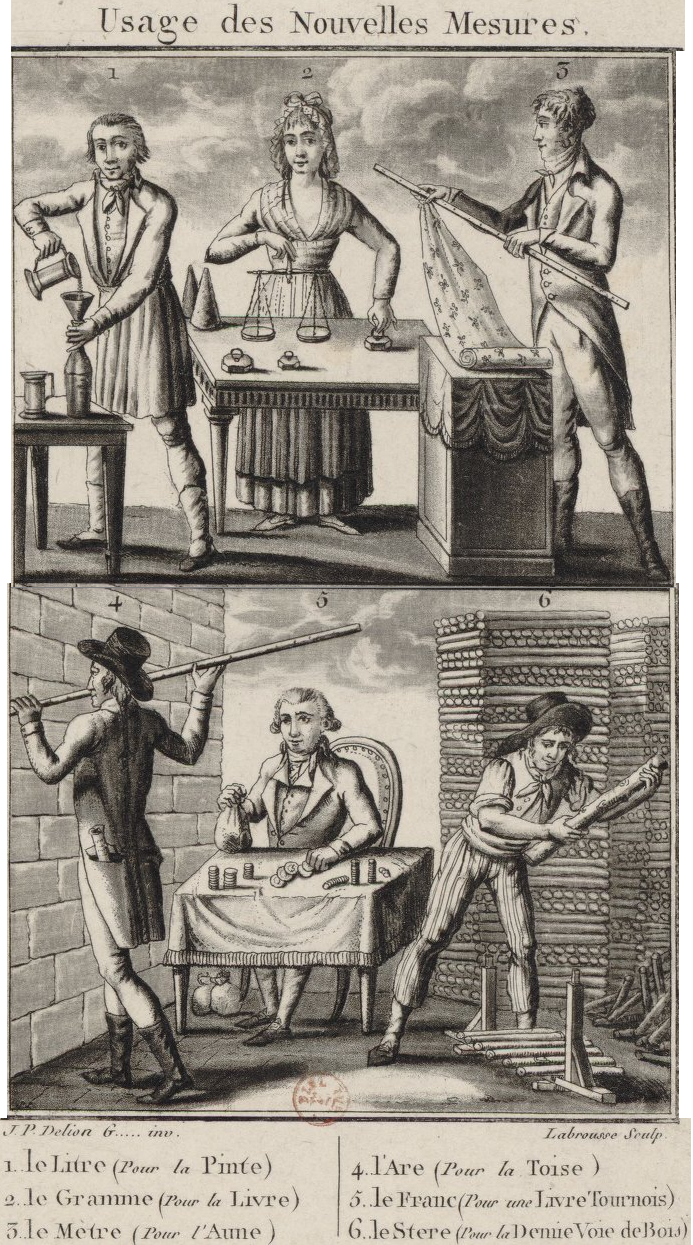
Before the Revolution, the French territory was covered by hundreds of different mass units: Paris pound, Lyon pound, setier, boisseau… The same “kilo” of grain could thus weigh more or less depending on the city or market. This cacophony complicated trade, taxation, and scientific exchanges.
From 1790, the revolutionaries entrusted a commission of scholars (Condorcet, Lagrange, Laplace, Monge, Lavoisier…) with the mission to invent a universal measurement system. The idea: a decimal base and units derived from natural phenomena, independent of kings and cities. This is the birth of the French metric system, which would gradually become the International System of Units (SI).
On April 7, 1795, the law ratified the new units: the meter for length, the gram and the kilogram for mass, the liter for volume, etc. The link between kilogram and liter would be at the heart of the first definition.
The Archives kilogram: when water was the standard
To fix the new unit of mass, the scholars chose an easy-to-visualize natural reference: water. The kilogram was defined as the mass of a cubic decimeter of water (one liter) at the temperature of its maximum density, near 4 °C.
Practically, a metal cylinder — the “Archives kilogram” — was made whose mass was adjusted to correspond to this liter of water. This cylinder was deposited at the Archives of the Republic, alongside the meter standard, with the solemn mission to serve “for all time and all peoples.”
Scientifically, the idea was elegant, but quickly met limits seen by metrologists:
- Temperature: maintaining water exactly at the reference temperature is very difficult.
- Purity: water composition (salts, dissolved gases) slightly affects its density.
- Local gravity: gravity varies by location, complicating fine comparisons between regions.
For commercial needs, these imperfections were negligible. But in high-precision laboratories, they became a real problem. A more stable and easily transportable mass standard was needed.
Useful note for mediation: this is where one can link to the liter definition and its evolution — a good complement to discuss when explaining volumes and conversions in a teaching kitchen or tasting workshop, referring if needed to resources detailing the liter definition and its history or ml to cl conversion tables.
From the Archives kilogram to the international prototype
In 1875, the Meter Convention created the International Bureau of Weights and Measures (BIPM), located at the Pavillon de Breteuil in Sèvres, Hauts-de-Seine. The goal: to have an international body responsible for maintaining and comparing measurement standards.
The kilogram then changed nature. In 1889, the first General Conference on Weights and Measures (CGPM) adopted a new standard: the international prototype of the kilogram (IPK), a platinum-iridium cylinder (90 % Pt, 10 % Ir) 39.17 mm tall and in diameter.
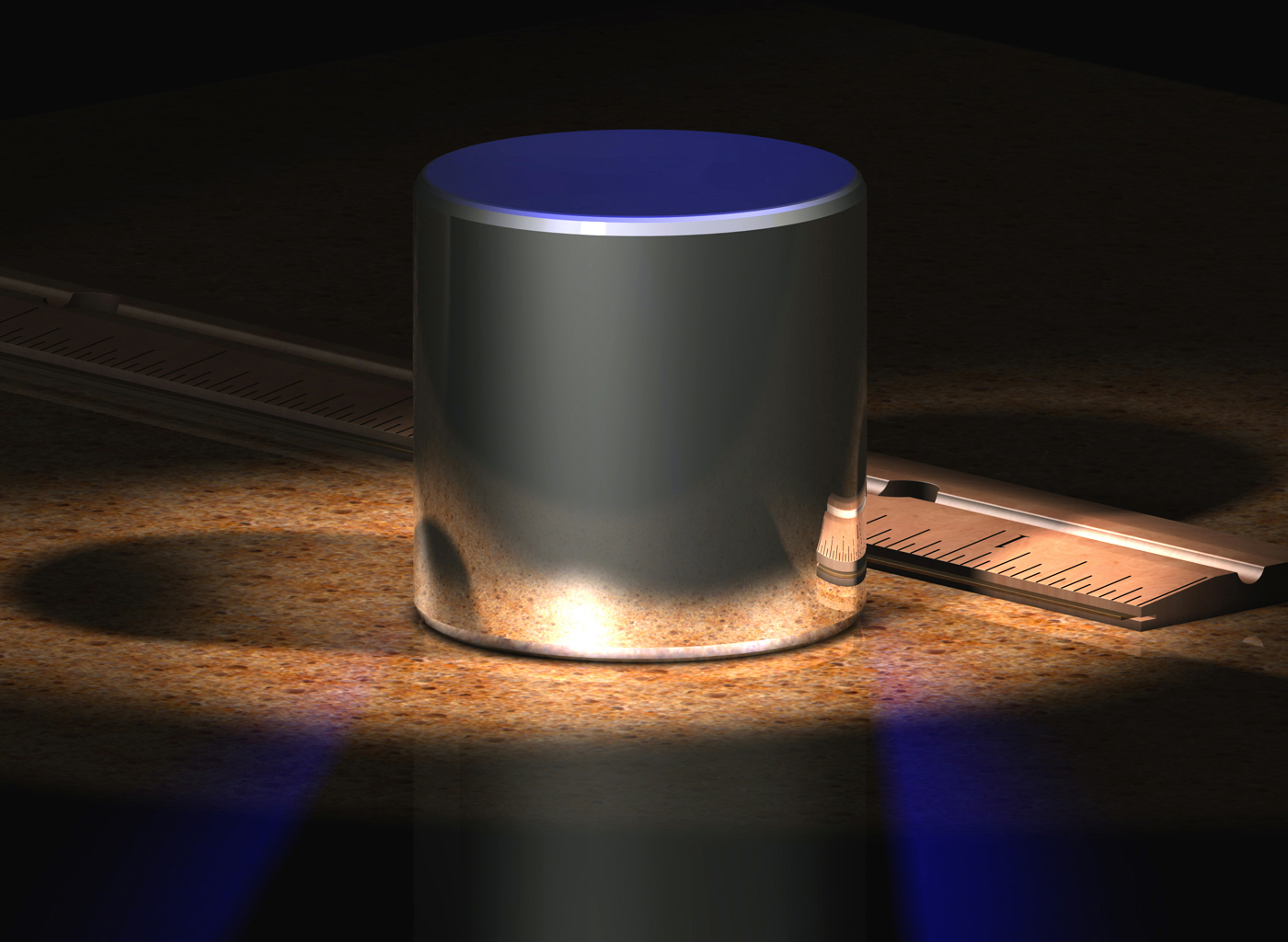
Around this international standard, a family of official copies was made and distributed to the signatory countries. Regularly, these copies return to Sèvres to be compared with the original cylinder, like watches being reset.

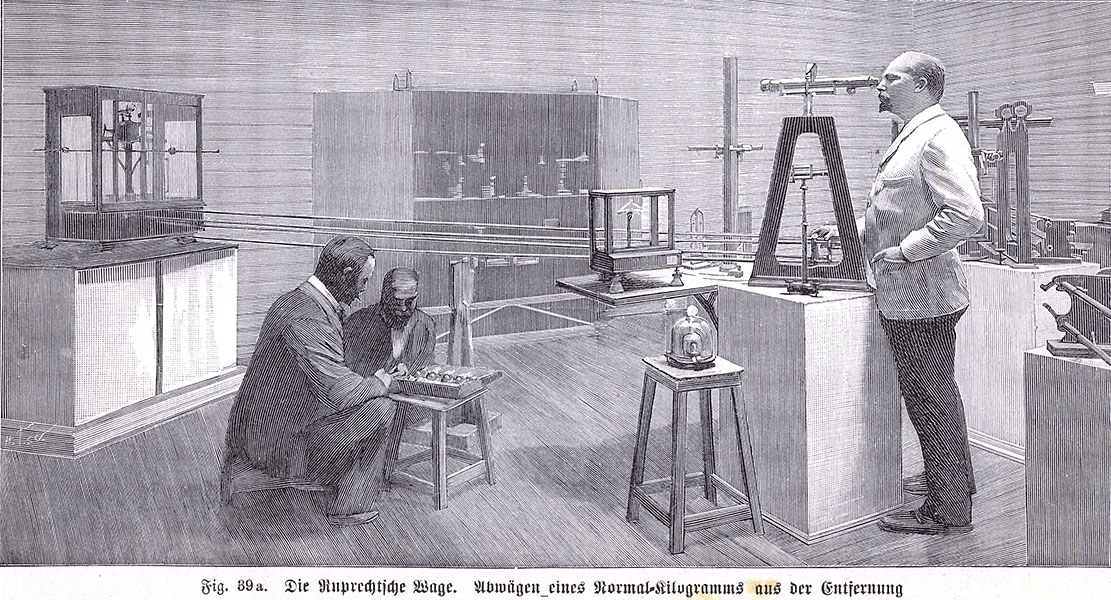
“Such a carefully designed artifact remains a physical object: it can lose a few atoms on its surface, gain others, or be slightly altered by successive cleanings. When the standard moves, the entire unit moves with it.” Metrology comment inspired by BIPM work on the IPK
The long crisis of the platinum-iridium standard
For nearly a century, the international prototype of the kilogram perfectly fulfilled its role. But as weighing instruments gained precision, tiny discrepancies between the IPK and its copies appeared, on the order of a few tens of micrograms, less than the mass of a grain of sand.
These variations are negligible for daily life but problematic for fundamental research, pharmaceutical industry, aeronautics, and nanotechnology metrology. How to compare experiments conducted decades apart if the unit of mass itself drifts slightly?
Metrologists then asked a radical question: can the kilogram be detached from any material object and linked to a constant of nature, as was done for the second (cesium frequency) or the meter (speed of light)?
This marked the start of a vast international program that would culminate, more than a century later, in the 2019 redefinition.
From the watt balance to the Kibble balance
To anchor the kilogram in fundamental constants, a bridge was needed between mass, energy, and electricity. This bridge is an amazing machine: the Kibble balance (formerly “watt balance”).
The principle is as follows: instead of comparing an unknown mass to a reference weight, the Kibble balance compares it to a perfectly measurable electrical power (thanks notably to the Josephson effect and the quantum Hall effect). By combining these quantum effects, one can trace back to the Planck constant (h), which links energy and frequency.


In the 2000s-2010s, several laboratories (NIST in the USA, NRC in Canada, LNE in France, etc.) made increasingly consistent Planck measurements thanks to these balances, reaching uncertainties below 50 parts per billion. These results paved the way for a new kilogram definition based on a fixed number.
“The Kibble balance is less a ‘balance’ in the usual sense than a huge quantum physics setup disguised as a weighing instrument. It transforms mass into voltage and current, then, via constants of nature, into a pure number.” Educational explanation inspired by NIST presentations, 2017
The 2019 redefinition: a kilogram anchored in the Planck constant
In November 2018, the 26th CGPM adopted a historic resolution: from May 20, 2019, the kilogram is no longer defined by a platinum-iridium cylinder but by the exact value of the Planck constant:
h = 6.626 070 15 × 10−34 J·s (exact).
The official definition can be summarized as: the kilogram is the SI unit of mass, defined by fixing the numerical value of h to 6.626 070 15 × 10−34, expressed in kg·m2·s−1, with the meter and second themselves defined from the speed of light and the cesium atom frequency.
In other words, h was not “measured” with infinite precision: its value was chosen by convention and the kilogram deduced from it. The Kibble balances and other quantum experiments now serve to realize the kilogram practically, verifying that all measurements remain consistent with this definition.
What the new kilogram definition changes (or not)
In daily life, nothing has changed: your recipes, luggage, or supermarket labels still use the same kilogram. “Classic” scales continue to be calibrated in chains, from national standards which themselves are linked to the new definition by very high precision experiments.
What changes deeply is the philosophy of measurement:
- Independence from a unique object: if the old IPK were lost or damaged, there was no plan B. Today, any equipped laboratory can, in principle, reconstruct the unit relying on constants.
- Scalability: as devices improve, the kilogram can be realized with ever lower uncertainties without changing the definition itself.
- Truly universal unit: the link with h, c, and the cesium frequency makes the SI a system firmly anchored in quantum physics and relativity.
For a guide or teacher, a good tip is to keep concrete images: the glass dome of Sèvres, the ultra-sensitive balance, then the modern “recipe” where the dome is replaced by a constant of nature. Occasionally, one can mention volume-mass conversions (mL, cL, L) to show how the kilogram remains linked to water and the liter in many practical uses, for example when handling ml to cl conversion tables in cooking or oenology.
FAQ: common questions about the history of the kilogram
Why was the kilogram invented during the French Revolution?
The Revolution sought to unify an extremely fragmented measurement landscape. The kilogram, like the meter or liter, is part of a coherent decimal system designed to facilitate trade, taxation, and scientific exchanges, relying on natural phenomena rather than local customs.
Does the Archives kilogram still exist?
Yes, the “Archives kilogram” is still preserved, but it no longer has a normative role. It testifies to the first generation of standards, when mass was defined by a volume of water rather than a metal alloy or a constant of nature.
Where is the kilogram standard today?
The international prototype in platinum-iridium is still at the BIPM in Sèvres, under glass, but it is no longer the “official standard.” Mass units are now linked to the Planck constant via Kibble balances and other devices in several national metrology laboratories.
Did the 2019 redefinition change the mass of a kilogram?
For practical uses, no: the numerical value of the kilogram was preserved within measurement uncertainties. The redefinition only changed the way the unit is linked to physical reality, without modifying the mass of a bag of flour or a liter of water from the user’s perspective.
Why was the Planck constant chosen to define the kilogram?
The Planck constant links energy and frequency in quantum mechanics. It naturally appears in ultra-precise electrical experiments, such as those conducted with Kibble balances. By fixing it, one obtains a mass definition compatible with the entire International System of Units, without relying on a material object.
Can the international prototype of the kilogram be seen on a visit?
The Pavillon de Breteuil is not a museum open permanently to the public. Exceptional visits are sometimes organized, but most of the time, visitors discover the kilogram through replicas, photographs, models, or temporary exhibitions in science and technology museums.
Which other countries participated in the kilogram redefinition?
The redefinition is the result of international cooperation: national metrology laboratories from Europe, America, Asia, and Oceania made Planck measurements and standard comparisons. The CGPM, which now includes almost all world states, finally ratified the new definition by unanimous vote in 2018.
Is the kilogram the only unit recently redefined?
No. In 2019, four base units were simultaneously redefined: the kilogram (Planck constant), the ampere (elementary charge), the kelvin (Boltzmann constant), and the mole (Avogadro constant). The goal is to have a unit system entirely based on fundamental constants.
Why is “kilo” still sometimes used in everyday life?
The word “kilo” is a familiar abbreviation for “kilogram,” like “meter” for “m” or “liter” for “L.” It has been part of everyday vocabulary for over 200 years. From the SI perspective, the official unit is still the kilogram, but common usage has kept this very practical diminutive.
What link remains between kilogram, liter, and gram?
Historically, the kilogram was born as the mass of a liter of water. Today, the official definition no longer depends on water or the liter, but in practice, this approximate correspondence is still used for everyday liquids (1 L of water ≈ 1 kg). Conversions between grams and milliliters remain very useful in cooking, cosmetics, or oenology.
How to tell this story to a non-scientific audience?
An effective strategy is to structure the narrative in three images: the bottle of water (Archives kilogram), the glass dome (international prototype), and the futuristic laboratory machine (Kibble balance). For a tourist route or guided visit, these images can be linked to the Île-de-France architecture, science museums, and visitors’ everyday uses.
What we liked ✅ / liked less ⚠️
✅ What works very well
- Clear chronological progression (Ancien Régime → Revolution → IPK → Planck constant).
- Constant links between history and everyday uses (cooking, luggage, supermarket labels).
- Highlighting the role of institutions (CGPM, BIPM, LNE, national metrology laboratories).
- Explanations on the Kibble balance and the 2019 redefinition, accessible without formulas.
- Rich FAQ anticipating main questions from visitors or students.
- Comparative table of different kilogram definitions over time.
- Clearly presented methodology and sources, useful for educational use.
⚠️ Pedagogical improvement suggestions
- Add even more concrete examples (market scenes, classroom weighings, simple experiments).
- Offer additional visual analogies for quantum concepts.
- Emphasize industrial stakes more (microelectronics, pharmacy, aeronautics).
- Complement with visual supports (diagrams, timelines, infographics).
- Provide activity ideas for teachers (workshops, hands-on, quizzes).
- Link more to other SI units (second, meter, kelvin, ampere) for a global vision.
- Plan reading levels (beginner, intermediate, advanced) to adapt to all audiences.
Conclusion: from a liter of water to constants of nature
In just over two centuries, the kilogram has evolved from a liter of water to a platinum-iridium cylinder, then to a fundamental constant of nature. This evolution tells both the history of modern measurement science and that of a world seeking universal, stable, and reproducible units everywhere.
For the general public, nothing has changed: a kilo of apples remains a kilo of apples. But for metrology laboratories, industries, and space agencies, the 2019 redefinition opens the way to ever finer measurements, consistent with the entire International System of Units. It is this dual story – both very concrete and deeply abstract – that makes the kilogram an ideal subject for science communication.
💡 The information presented in this article is provided for educational purposes. External links are given for further reading and do not influence the content, which is independently written.
For further exploration, one can place this story within the broader framework of the French metric system, showing how the meter, liter, gram, and kilogram shaped our way of counting, trading, and observing the world.