
Quick definition: A litre is a unit of volume equivalent to a cubic decimetre (a cube 10 cm on a side), created during the French Revolution in 1795. It corresponds to the mass of one kilogram of pure water at 4°C. This universal measure revolutionized commerce, science and daily life by unifying the fragmented measurement systems of the premodern world.
Sommaire
You pour a litre of milk into your glass every morning without thinking about it. Yet behind this familiar unit lies a fascinating history: that of the revolutionary French metric system that unified the world’s measurements. The litre did not always exist under its current name, and its definition has even changed over time. Between historical anecdotes, little-known details and scientific curiosities, this article immerses you in the fascinating world of a measure that transformed how we measure the world.
🏛️ The revolutionary origin of the litre: when France reinvented measurements
Before the French Revolution, France was a true chaos of measurements. Imagine: more than seven hundred different units coexisted across the territory, varying from one town to another, even from one guild to another. A pint in Bordeaux was not the same as a pint in Paris. This confusion made commercial exchanges impossible and arithmetic calculations a nightmare. Peasants, merchants and scholars were lost in this labyrinth of measurements.
In 1790, faced with this disorder, the National Constituent Assembly decided to create a unified and logical system of units. It was a decisive turning point: for the first time, humanity dreamed of a universal measure, independent of regions, traditions and local whims. The choice of reference was bold and scientific. The revolutionaries decided to turn to nature itself. What better reference than an immutable element? They chose a quarter of the Earth’s meridian — the arc of the meridian linking Dunkirk to Barcelona — and set the metre as the ten-millionth part of that distance.
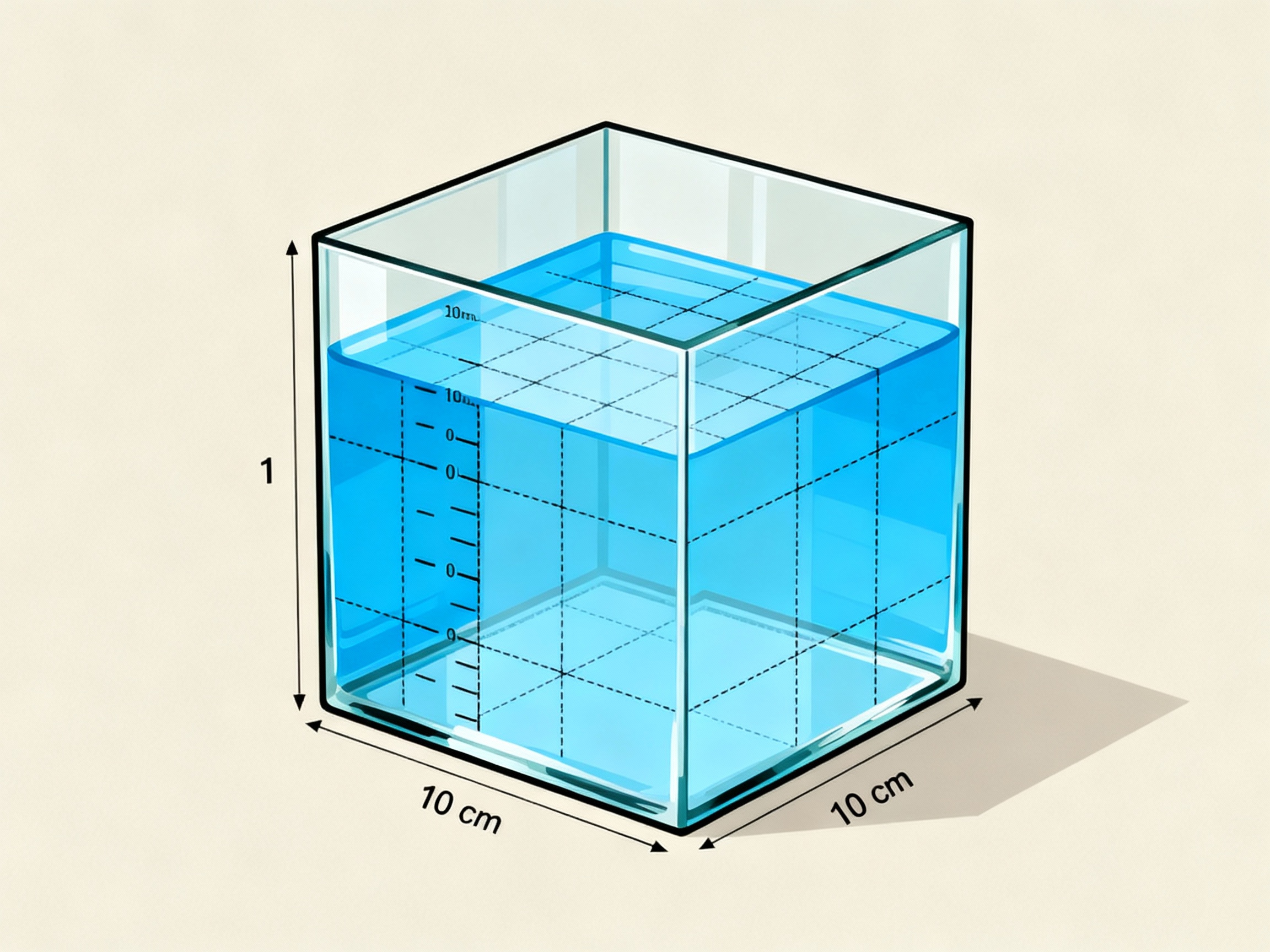
Once the metre was defined, logic required creating derived units. The litre then emerged as an obvious choice: it corresponds to the volume of a cube whose side measures one decimetre — exactly one tenth of a metre. At the same time the kilogram was born, defined as the mass of a litre of pure water at its maximum density. This triple alliance between length, volume and mass created a coherence never seen before.
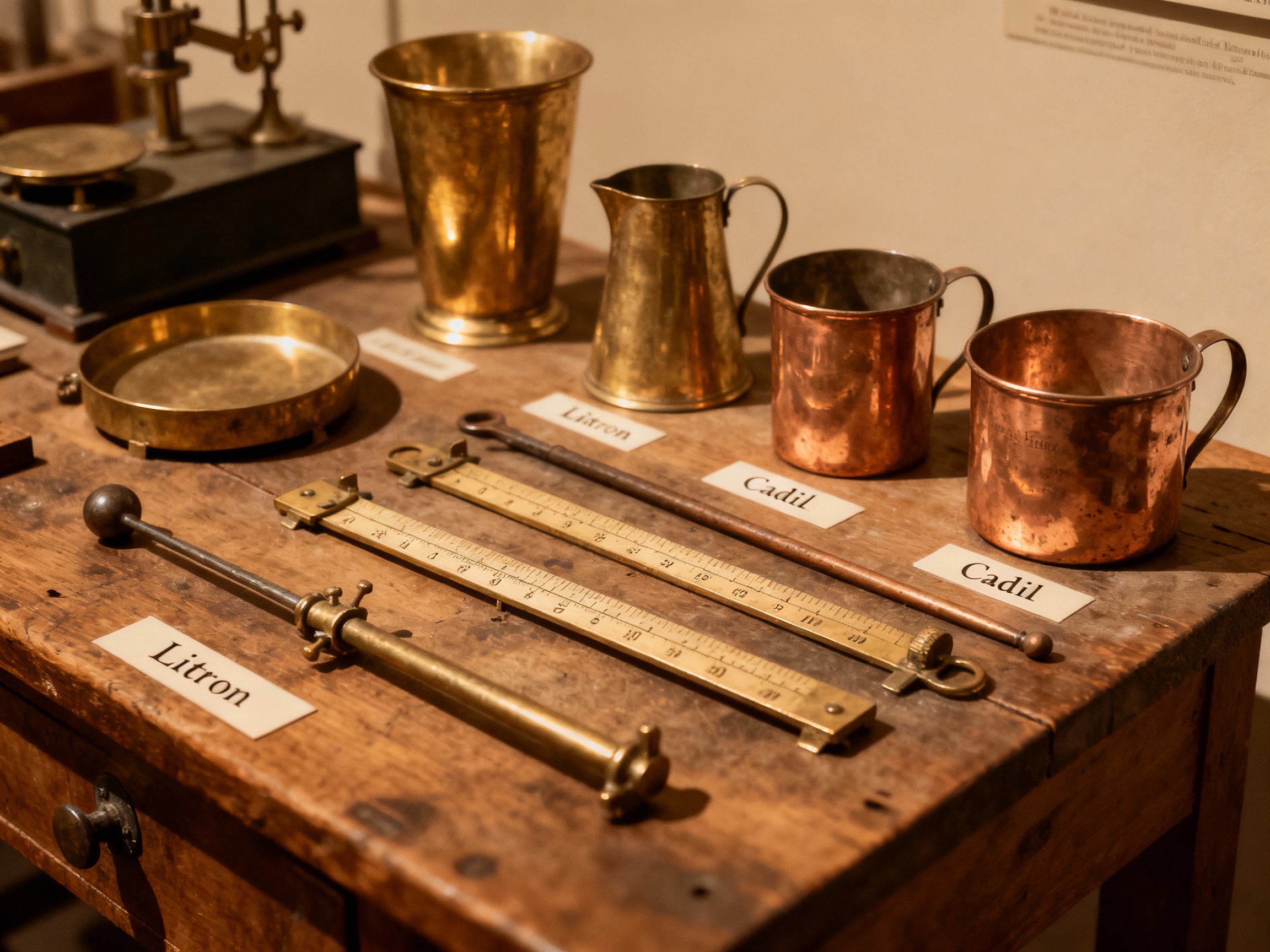
The law of 18 Germinal, Year III (7 April 1795) formalized this metric system. The name chosen for this new unit of volume, ” litre “, derives from an older term, the litron, a preexisting French measure equivalent to about 79 centilitres. It was a nod to the past, a way to respect history while embracing the future. Before becoming definitively ” litre “, this unit bore amusing provisional names: first “pinte”, then “cadil”. By the way, if you visit the Musée des arts et métiers in Paris, you can admire an original cadil standard, a tangible relic of this transition period.
📏 Decoding: how the litre was defined scientifically
The beauty of the metric system lies in its ruthless logic. One litre equals exactly 1 cubic decimetre — that is, the volume of a cube 10 centimetres on each side. This definition seems simple, but it hides remarkable sophistication. It establishes an inseparable link between units of length (the metre) and units of volume. Here’s why: 1 metre = 10 decimetres, so 1 cubic metre = 1000 cubic decimetres = 1000 litres. Conversions then become child’s play, based on powers of 10.
However, over time, scientists updated this definition. In 1901, the International Bureau of Weights and Measures (BIPM), created in 1875 to harmonize measurements worldwide, redefined the litre as ” the volume occupied by the mass of 1 kilogram of pure water, at its maximum density and under normal atmospheric pressure “. This definition relies on a fascinating characteristic of water: unlike most liquids, water reaches its maximum density not at 0°C but at about 3.98°C (rounded to 4°C in practice).
Here’s an interesting anecdote: at that precise temperature, 1 kilogram of pure water occupies exactly 1.000028 litres — a difference of only 28 millionths from the cubic decimetre. Scientists thought they had found perfection. Alas, subsequent measurements, particularly those of 1960, confirmed this slight divergence. In 1964, the BIPM chose to simplify radically by declaring: a litre is a special name given to the cubic decimetre, period. The definition returned to its pure geometric roots, abandoning the subtleties of water physics.
⚗️ Anecdotes and curiosities: well-kept secrets of the litre
The litre had a tumultuous childhood. Before obtaining its definitive name in 1795, it was provisionally called “pinte”, then more curiously “cadil”. Imagine the heated debates in the Parisian salons of the Convention, where scholars and politicians argued fiercely: what name should be given to this new unit? The choice of ” litre ” ultimately prevailed, and fortunately so, because it evokes antiquity (the Greek term “lítra” referred to an ancient measure of capacity).
Here is an often-forgotten anecdote: the litre was indispensable to the unification of three fundamental concepts. The relationship between the litre, the kilogram and the metre creates a remarkable synergy. One litre of pure water at 4°C weighs exactly 1 kilogram. One cubic metre contains exactly 1000 litres. This cohesion was not accidental — it resulted from a deliberate design by the revolutionaries. They understood that the universality of measurements relied on a rigorous conceptual architecture. Water, a common and constant substance, became the bridge between the physical world and the mathematical world.
In terms of precision, the revolutionary metric system represented a quantum leap for its time. Before 1795, measuring 150 millilitres of syrup was an achievement worthy of an alchemist. After the adoption of the decimal metric system, it became a routine operation for any grocer. Trade was facilitated, science progressed faster, and recipes became finally reproducible. Marie-Antoine Cadet, a cook at the Élysée in the 19th century, reportedly said that the metric system revolutionized French gastronomy more than any other culinary invention.
🏷️ The mystery of the symbol L: why a capital so rare?
A curious typographical exception surrounds the litre. As a rule, unit symbols are lowercase (m for metre, s for second, kg for kilogram). But the litre? It’s the uppercase L that dominates. Why this oddity?
The reason is almost comical: the lowercase symbol “l” (letter l) tragically confuses with the digit “1” in many typefaces. Imagine the disasters: a bottle label reading “1l” could be read as “11”. Medical errors could occur in pharmacies if a pharmacist confuses “5l” (five litres) and “51”. In 1979, the Sixteenth General Conference on Weights and Measures (CGPM) officially recognized this problem and approved the use of uppercase “L” as an acceptable symbol for the litre — an extraordinary exception to the typographic protocol of the International System.
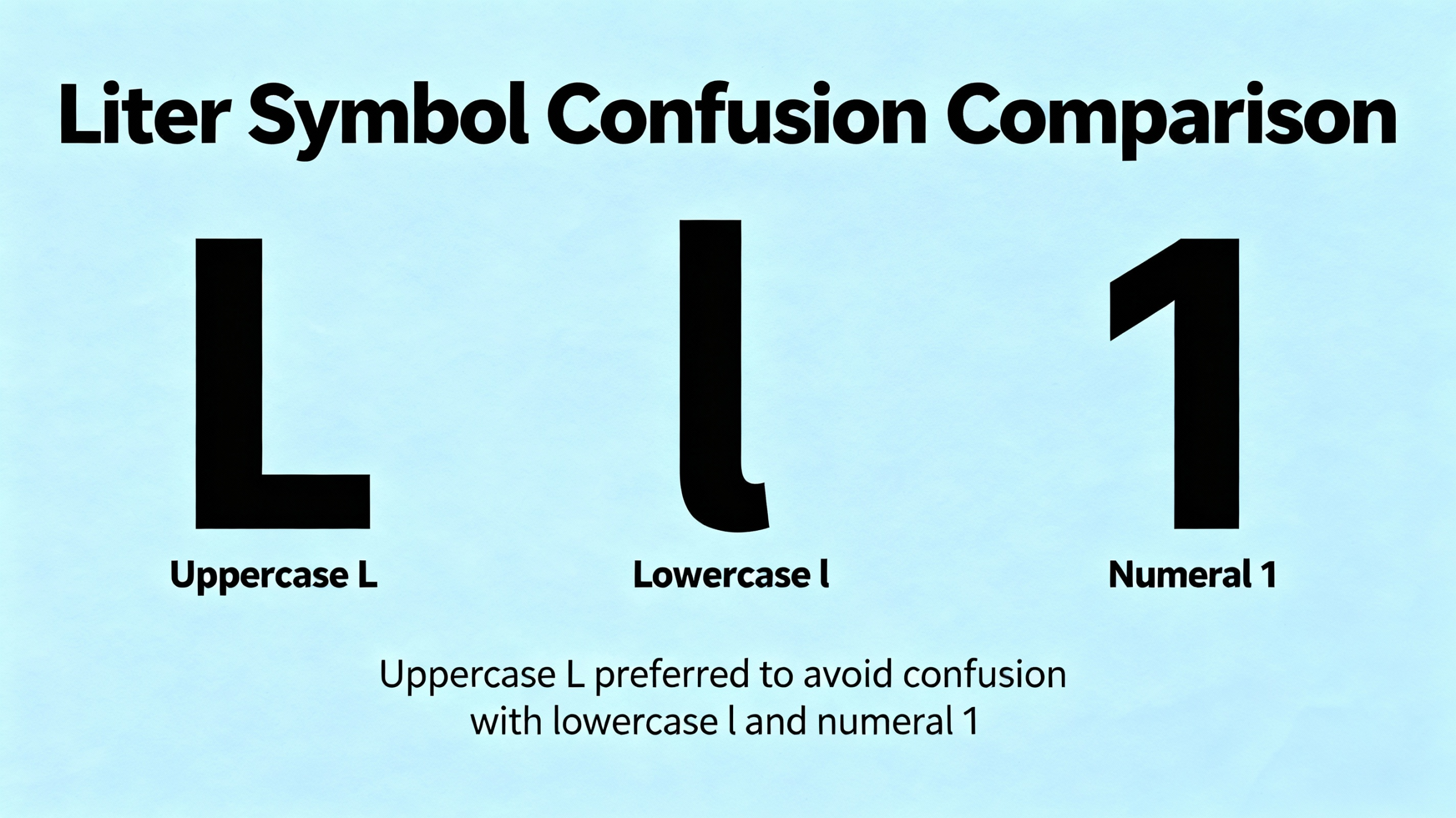
Technically, both symbols “l” and “L” remain officially accepted, but “L” is progressively imposing itself everywhere. On milk bottles, wine labels, medical prescriptions — you see almost exclusively “L”. It’s a fascinating example of how empirical practice overrides theory when practical stakes are involved. The BIPM itself recommends that, in the future, a single symbol be chosen to avoid confusion: likely “L”.
💧 The water symphony: 1 litre = 1 kilogram at 4°C
Let’s dive into a remarkable physical phenomenon that intimately links the litre to water. Unlike almost all other liquids, water has a strange characteristic: its density is not maximal at its freezing point (0°C) but at about 3.98°C. At this temperature, one kilogram of pure water occupies precisely one litre. It’s an extraordinary coincidence — or rather, a deliberate choice by the revolutionaries who created the metric system based on this property.
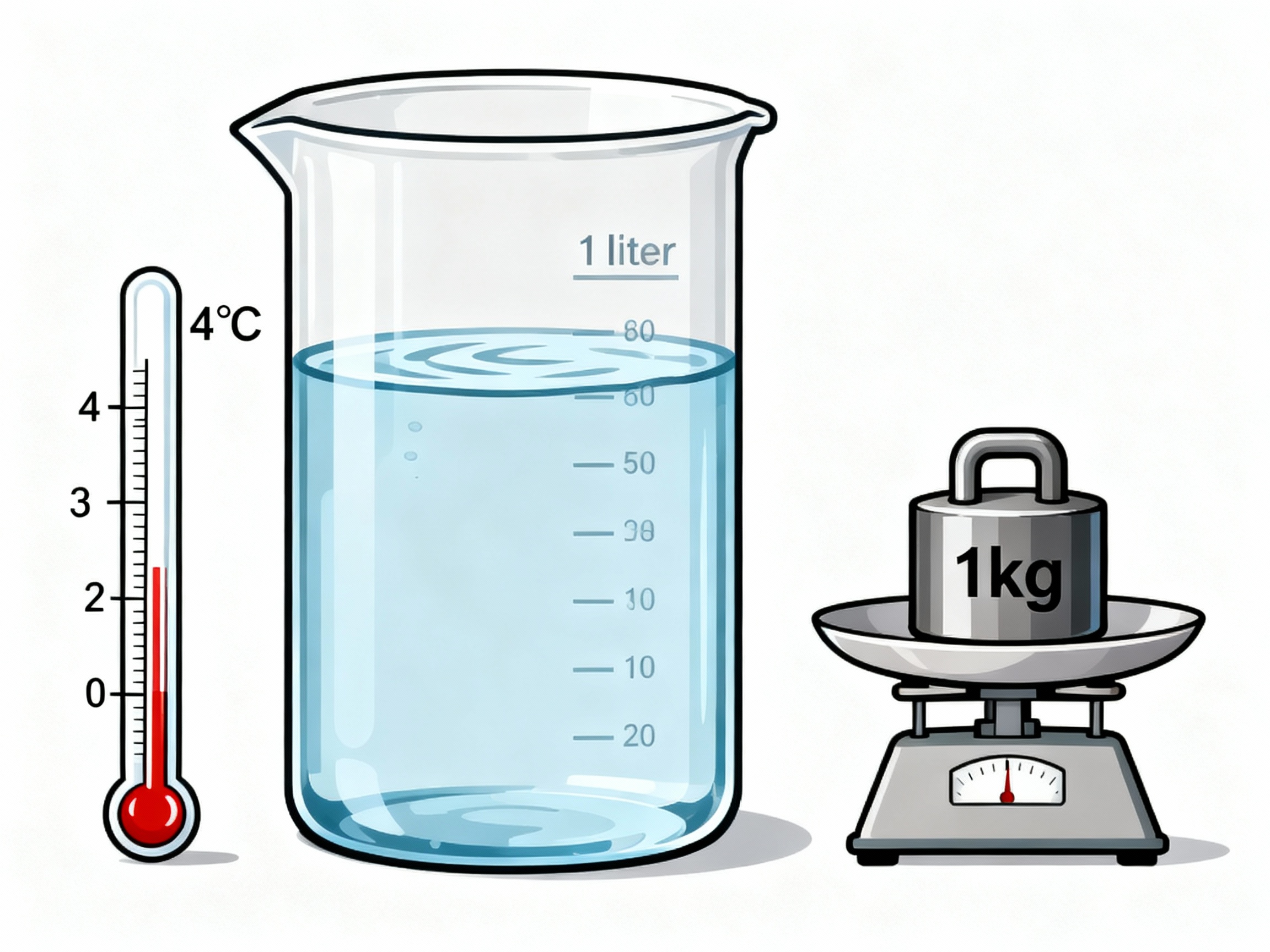
This relation between mass and volume creates a conceptual elegance rarely found. Chemists, biologists and scholars appreciated this organic link. It removed complex conversions and allowed direct intuition: if I know the volume of water, I know its mass. This clarity was exactly what the revolutionaries sought. Not only was the system logical, but it was also rooted in physical reality.
Curiously, this mathematical beauty concealed a persistent imprecision. In 1901, scientists discovered that 1 kilogram of water at 4°C actually occupied 1.000028 litres, not exactly 1 litre. This microscopic difference — 28 millionths — seemed negligible for everyday applications but troubled precision chemists. It’s a classic example in science: the perpetual quest for ever greater accuracy. In 1964, by abandoning the water-based definition and replacing it with a purely geometric one (the cubic decimetre), the BIPM ultimately solved this problem — by eliminating it rather than fixing it, which is less poetic but infinitely more pragmatic.
🌍 From the litron to the litre: the evolution of old French measures
Before the metric system, the measurement of volume in France was an area dominated by chaos. The litron, a medieval unit of reference, equalled about 0.79 modern litres. Above it were the boisseau (12.695 litres), the minot (38.086 litres), the mine (76.172 litres), the setier (152.343 litres) and finally the muid (1828 litres) — the major units used in the trade of grains and liquids.
What made things even more complicated was that each town had its own variants. The boisseau of Paris (about 13 litres) differed from the boisseau of Bordeaux (78.808 litres) — a difference by a factor of 6! A Bordeaux merchant and a Paris merchant literally did not speak the same measurement language. Contemporary archives reveal endless disputes between towns about standardizing measurements, disputes that no agreement could permanently resolve.
There were even variations within the same categories. A minot of oats did not contain the same quantity as a minot of wheat — 6 boisseaux for oats versus 3 for wheat. The unit of measurement depended on what was being measured! That seems absurd in the 21st century, but it was the medieval and pre-revolutionary reality. The metric system, by imposing a single unit independent of the product measured, represented a philosophical as well as practical break.
📚 The metric system: far beyond the simple litre
The litre was never isolated. It fits into the global architecture of the metric system, created in 1795 and made compulsory in France from 1840. This system is based on the conviction that all physical phenomena — length, mass, volume, temperature — should be interconnected and expressible in terms of a small number of fundamental units.
The French metric system (ancestor of today’s International System of Units, or SI) derives everything from the metre. From this single unit, one logically extracts:
- The litre: volume of a cubic decimetre (10 cm × 10 cm × 10 cm)
- The gram: mass of a cubic centimetre of water at 4°C
- The kilogram: mass of a litre of water at 4°C (1000 grams)
- The are: area of a square 10 metres on a side
- The franc: decimal currency reflecting the ratios of metric units
This coherence was revolutionary. For the first time in history, a civilization abandoned fragmentary customs and embraced a unified mathematical architecture. The British and Americans would resist this system for a long time — the United States never officially adopted the metric system despite its obvious advantages. But France, and gradually the rest of the world, recognized the genius of the project. To delve deeper into this history, discover our complete guide to the French metric system and its global impact.
🔬 The litre in modern science and commerce
Today, the litre is omnipresent. You encounter it at the petrol station (where fuels are sold in litres), in laboratory chemistry, in cooking, in pharmacy, in craft brewing, and wherever liquid volume must be measured accurately. Technically the litre does not belong to the International System of Units (SI), but its use is so universal that the BIPM officially accepts it and recommends its use with the SI. It’s a practical recognition of its indispensability.
In pharmacy and high-precision chemistry, however, the BIPM recommends not using the litre for measurements requiring extreme accuracy, preferring the cubic metre or the cubic centimetre. This reflects a scientific subtlety: although the litre is today defined as exactly one cubic decimetre, the history of its successive redefinitions leaves traces in terms of metrologically critical precision.
Let’s also mention a curiosity: the litre naturally divides into multiples and submultiples based on base 10. A millilitre (ml) = 1/1000 of a litre. A centilitre (cl) = 1/100 of a litre. A decilitre (dl) = 1/10 of a litre. Conversely, a kilolitre (kl) = 1000 litres. This decimal modularity makes conversions trivial and reinforces the usefulness of the litre. To master practical litre conversions, consult our conversion table from ML to CL detailed with ready-to-use examples.
❓ Frequently Asked Questions: doubts many keep secret
Q: Why wasn’t the litre simply named “cubic decimetre”?
A: The revolutionaries chose a new name for psychological and practical reasons. ” Cubic decimetre” is awkward to pronounce and unintuitive. ” Litre” is short, sonorous and easy to remember. Paradoxically, using an old term (litron) for a new scientific reality likely facilitated public acceptance of the revolutionary metric system.
Q: Why exactly a cubic decimetre? Why not a cubic centimetre?
A: A cubic decimetre represents a volume convenient to handle in daily life — neither too small nor too large. A millilitre (cubic centimetre) would be too modest for a base unit; a cubic metre would be too large for most common uses. The cubic decimetre finds the ideal practical balance.
Q: Does water really weigh exactly 1 kg per litre?
A: Yes for pure water at 4°C and normal atmospheric pressure. For tap or seawater, there are slight variations due to dissolved minerals. But for common practical applications, you can safely approximate that 1 litre of water ≈ 1 kilogram.
Q: Are there other ancient units that survived like the litre?
A: Yes, notably the minute and the second for time (inherited from the Babylonians who used base 60), and the degree for angles. These ancient units coexist with the modern SI because they meet practical needs too deep to be abandoned.
Q: Is the BIPM likely to redefine the litre again?
A: Unlikely in the coming decades. The current definition (exactly 1 cubic decimetre) is simple, stable and sufficiently precise for any non-extreme application. Redefinition would create unnecessary confusion.
Q: Why didn’t the British and Americans adopt the metric system?
A: It’s a complex historical question. Great Britain dominated maritime trade in the 19th century and imposed its own measures (gallon, pint, etc.). The United States, newly independent, also rooted itself in the British system. Cultural and commercial inertia proved stronger than scientific logic.
Q: What was the old litron and its value in modern litres?
A: The litron was a preexisting French measure equal to about 0.79 modern litres. Its name inspired the creation of the modern litre of the metric system in 1795.
Q: Is the litre a unit of the International System (SI)?
A: Technically no, the litre is not part of the SI. However, its use is so universal that the BIPM officially accepts it and recommends its use with the SI as a commonly used unit.
Q: When exactly was the litre officially defined?
A: The litre was officially defined by the law of 18 Germinal, Year III (7 April 1795) as the volume of a cube 10 centimetres on a side, i.e. a cubic decimetre. This definition was redefined in 1901 and again in 1964 by the BIPM to its current form.
Q: How many litres are there in a cubic metre?
A: There are exactly 1000 litres in a cubic metre, because 1 cubic metre equals 1000 cubic decimetres, and 1 litre = 1 cubic decimetre.
Q: Why were there more than 700 units of measurement in France before 1795?
A: Measurements varied from region to region, from town to town and even from guild to guild. Each local group had its own standards, which made trade extremely complex and mathematical calculations laborious.
✨ Conclusion: a litre to unify the world
The litre embodies a pivotal moment in human history: when societies chose to favor universal rationality over local tradition. Beneath the appearance of a simple unit of volume lies a scientific manifesto, a political philosophy, and remarkable social engineering.
Since 1795, the litre has become the French ambassador of the metric system across the world. It accompanied explorers, scholars, merchants and exiles. It established itself gradually — not by force, but by intrinsic efficiency. Today, the litre is so natural that we use it without thinking, often unaware that it is the fruit of a revolution.
Next time you pour a litre of milk or fill your car with 50 litres of petrol, take a moment to appreciate this invisible unit that makes your daily life fluid and measurable. Behind it stand the shadows of the revolutionary surveyors who measured the Earth’s meridian, the scholars of 1795 who debated the optimal name, and the 1901 BIPM scientists who corrected the imprecisions of water at 4°C. The litre is a collective conquest of scientific common sense.
🔗 Deepen your knowledge
- Millilitre-centilitre conversion table for your recipes and daily calculations
- Complete history of the French metric system and its global impact
- History of the kilogram and its close relationship with the litre