
Sommaire
/* Css In Brief */
.en-bref {
max-width: 640px;
margin: 2em auto;
padding: 1.5em 1.8em;
background: #f7f9f9;
border: 1px solid #10b58b;
border-left: 6px solid #10b58b;
border-radius: 12px;
box-shadow: 0 8px 24px rgba(251, 191, 36, 0.15);
font-family: ‘Inter’, ‘Segoe UI’, sans-serif;
color: #3a2d0d;
text-align: left;
}
.en-bref .enbref-header {
font-size: 1.15em;
font-weight: 700;
color: #d97706;
margin-bottom: 0.6em;
display: flex;
align-items: center;
gap: 0.5em;
}
.en-bref p {
font-size: 1em;
line-height: 1.65;
margin: 10px;
}
.en-bref strong {
color: #1c1917;
}
Installing an electric fence for animals requires both method and discernment: it’s not just about stretching a wire, it’s about designing a system that respects the animals’ behavior, meets the terrain constraints, and guarantees lasting safety. In this article, I describe step-by-step how to choose the energizer, position the wires, install the posts, manage the power supply (mains, battery, solar), and maintain the whole system to avoid breakdowns and unnecessary risks. You will also find tips to adapt the fence to different species and an essential safety section to prevent accidents and disputes.
In Brief
⚡ Equipment Choice: opt for an energizer suited to the type of animals and the length of the layout — milli-joules and output capacity determine effectiveness.
🧭 Planning: map the perimeter, identify power sources and obstacle areas, plan gates and tension zones.
🛠️ Implementation: install insulating posts, wire correctly (ground + conductor), test the voltage with a dedicated voltmeter, and secure the installation.
🔒 Safety and Maintenance: regular checks of insulators, cleaning of conductors, and verification of grounding reduce incidents and ensure longevity.
Why choose an electric fence?
The electric fence is appealing because it combines efficiency, low cost, and minimal visual impact. Unlike a heavy physical barrier, it deters without injuring when properly sized: the shock the animal receives is a brief but memorable stimulus. For farmers, the main advantage lies in modularity — it is easy to resize a route for pasture rotation — and in the possibility of installing a temporary system for seasonal needs. However, be careful: a poorly designed fence can be ineffective (vegetation in contact, bad connection) or dangerous — hence the importance of a precise specification before any installation.
Assessing the need according to the species
Cattle and sheep
Cattle tolerate boundaries better but have inertia when pushing; therefore, a sufficient voltage level is needed to be deterrent. For sheep, the wires must be closer to the ground and more visible because sheep tend to slip through. An energizer capable of delivering between 2,000 and 5,000 volts with a good grounding system, adapted to the perimeter length, is often chosen.
Horses
Horses are curious and reactive: the system must provide a strong but brief pulse. The wires should be at chest height, and using visible tapes prevents accidental collisions. Prefer robust insulators and variable height around workshops and waterers to account for sprints.
Dogs and poultry
For dogs, a low electric fence, often combined with a conductor wire near the ground, is enough to prevent escapes. Poultry require tighter mesh or wires close to the ground to block snakes and foxes; sometimes a peripheral electrified fence combined with a predator-proof net is the most reliable solution.
Necessary equipment
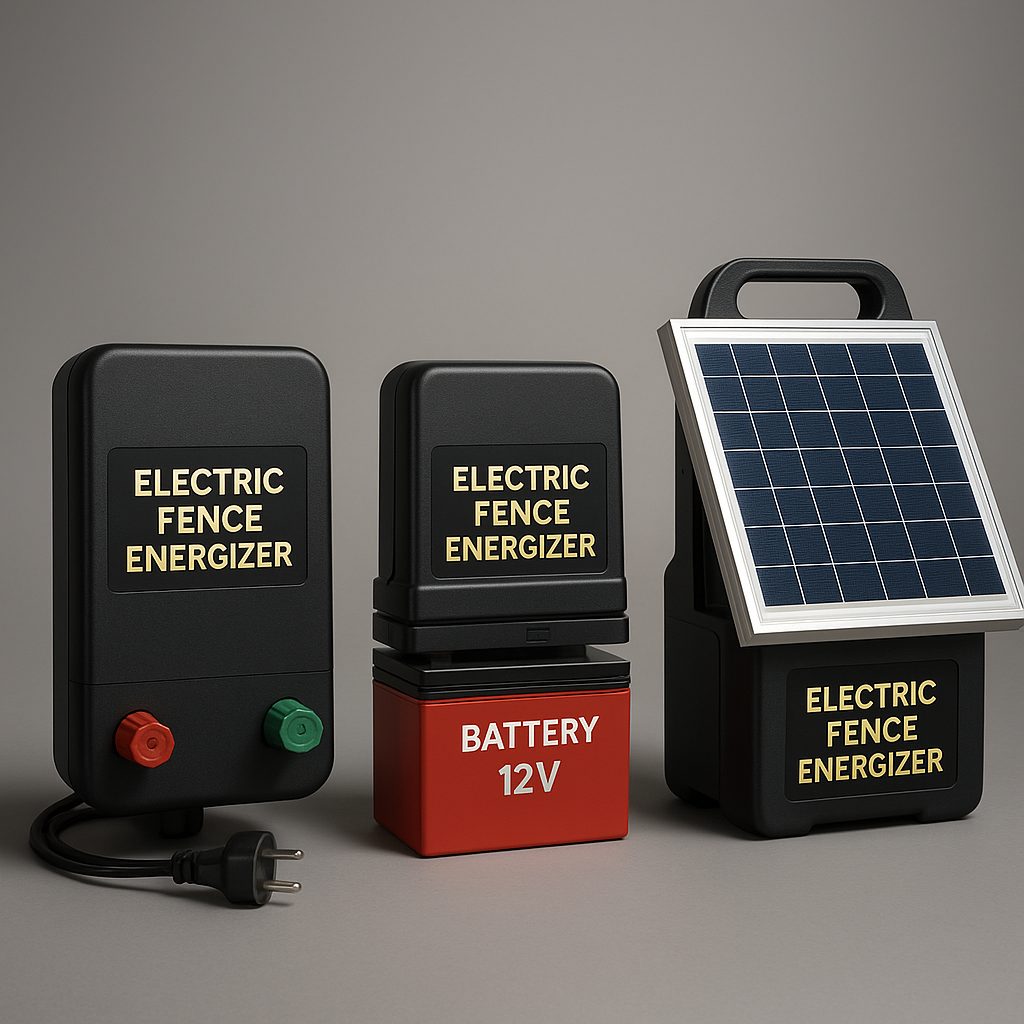
- Energizer (mains, battery, or solar): power measured in joules and adaptability to length.
- Conductors: coated steel wire, conductive tape, versatile cable depending on visibility and resistance.
- Posts: insulators for wires, metal stakes for anchor points.
- Accessories: insulators, connectors, ground clamps, fence voltmeter, grounding kit.
- Tools: shovel, sledgehammer, level, wire tensioner, insulating gloves, and safety glasses.
Installation steps
1 — Plan the layout
Start by marking the route with temporary stakes or ground paint. Identify wet areas, trees, passage points, and public zones where regulations require warning devices. Think ahead: gates, areas where you will need to move the fence for pasture rotation.
2 — Choose the location of the energizer and the grounding rod
The energizer must be placed in a dry, accessible location protected from animals. The grounding rod is crucial: several grounding rods spaced 3 to 5 meters apart, driven deep and connected together, ensure good dissipation. If the soil is very dry, you will need to multiply the rods or install a deeper grounding system.
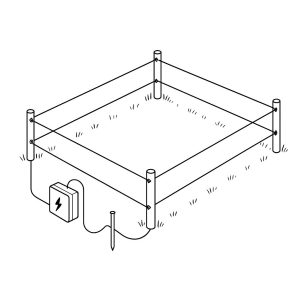
3 — Installing the stakes and insulators
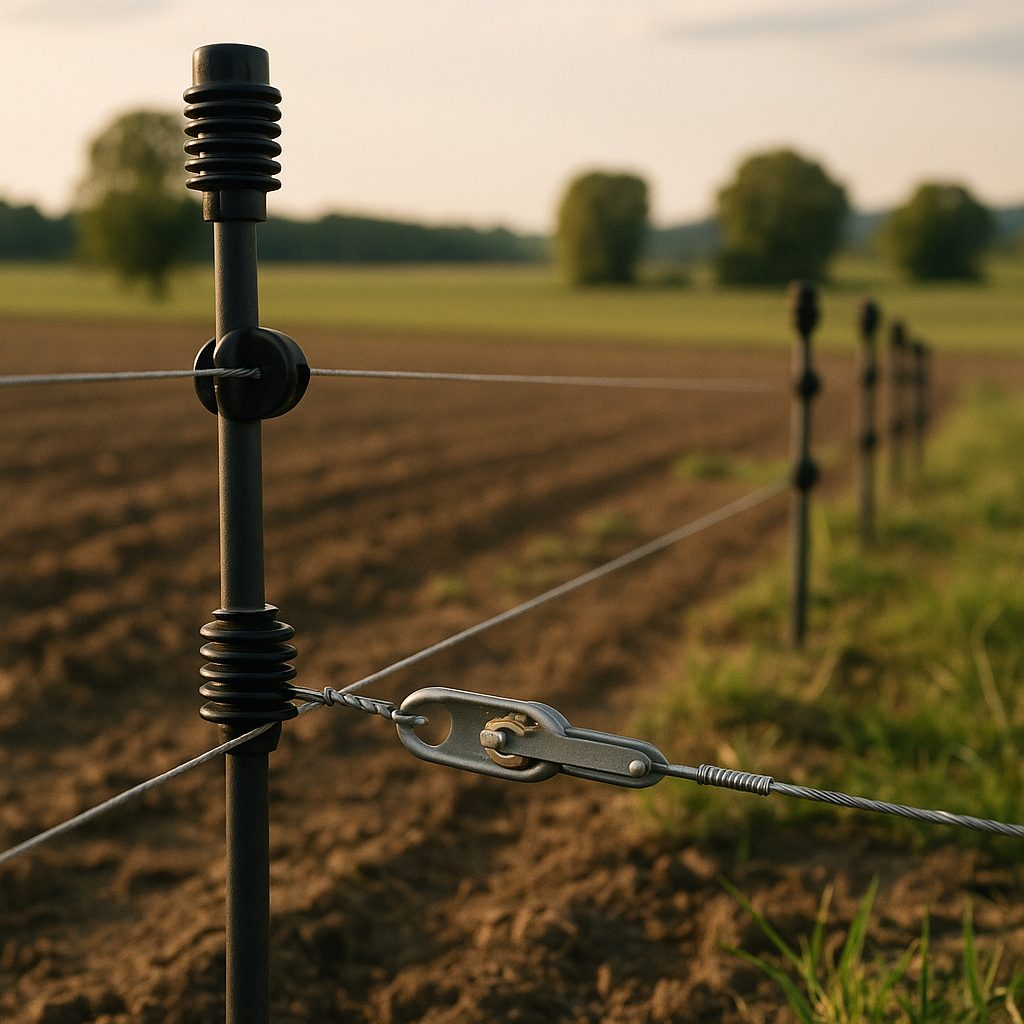
Attach the stakes at the intervals recommended by the manufacturer (generally 3 to 10 meters depending on the type of conductor). The insulators must prevent any electrical contact with the stake or the guy wires. For better visibility, use reflective tapes or add flags at regular intervals, especially where the wire is thin.
4 — Wiring: conductor and grounding
Install the conductor by tightening it just enough so it does not sag but without over-tensioning, which could break the insulators. The conductor must be connected to the energizer according to the manufacturer’s instructions. The grounding is connected to the device’s earth pole; test the earth resistance if possible: a high value means poor dissipation and loss of efficiency.
5 — Powering up and testing
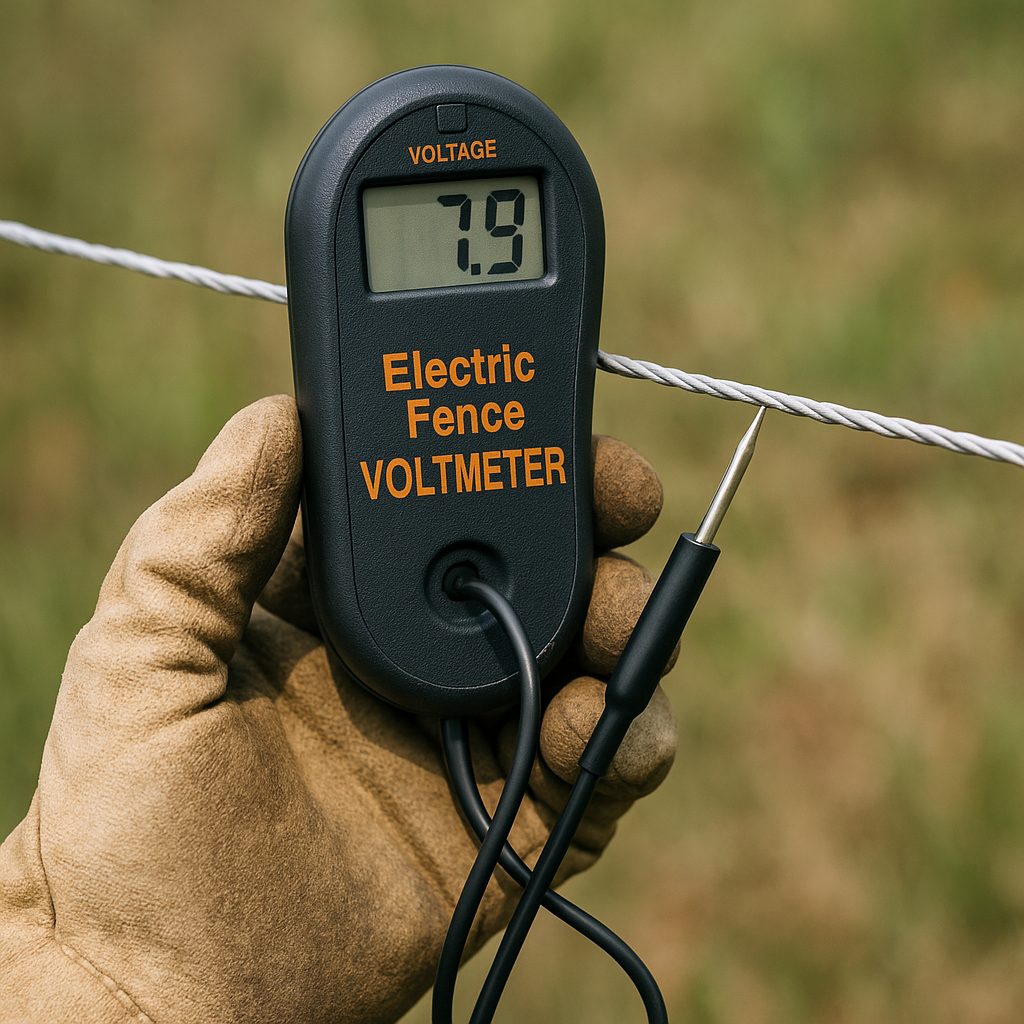
Before activating, check all connections, isolate the work area, and ensure that no person or animal is within reach. Use a specific fence voltage tester to check the voltage at various points around the perimeter. A significant voltage drop indicates contact (vegetation, branch) or a current leak that must be found and corrected.
Safety: rules and best practices
Safety must be the central focus: warning signs at the entrance, compliance with local standards, and distancing from existing electrical installations. Avoid installing an electric fence near overhead lines. For areas accessible to the public, display visible and compliant signs. In case of an incident involving a person, immediately cut the power and have the device checked by a professional.
Practical tips to minimize risks
- Install warning signs every X meters according to local regulations.
- Cut power during maintenance work or if children are nearby.
- Maintain a cleared strip under the wire (regular weeding) to limit current loss.
- Never connect two energizers without precautions: check compatibility and polarity.
Quick comparison of power sources
| Source | Advantage | Limit | Ideal for |
|---|---|---|---|
| Grid (220V) | Constant power, low maintenance | Needs a nearby outlet, risk of freezing | Long fixed fences |
| Battery (12V) | Mobility, independence from the grid | Limited autonomy, needs recharging | Temporary plots, pasture rotation |
| Solar | Ecological autonomy, isolated installation | Depends on sun, initial cost | Isolated sites without electrical access |
Maintenance and common troubleshooting
A simple maintenance schedule prevents many breakdowns: check the voltage every week at first then every 2-4 weeks depending on the season, clean the insulators, replace frayed wires and tighten connections. If the voltage drops, proceed by elimination: test the ground, inspect vegetation in contact, isolate sections to locate the leak. Always have a fence multimeter and a quick repair kit on hand.
Warning signs
- Significant voltage drop without apparent cause
- Presence of corrosion on connections
- Voltage fluctuations during heavy rain
Costs and budget
The cost varies greatly depending on length, number of wires, and type of energizer. For a small plot (less than one hectare), a basic kit (portable energizer, some stakes, 200 m of conductive tape) can remain affordable. For long fences or professional installations, plan a higher budget for a more powerful energizer, reinforced grounding, and durable materials. Also consider recurring costs: battery replacement, solar panels, or repairs after storms.
FAQ
- Can an electric fence hurt an animal?
- No, if it is properly set: the pulse is brief and designed to deter without causing injury. Excessive voltages or non-compliant devices increase the risk, hence the importance of buying certified equipment.
- How many wires are needed to contain sheep?
- For sheep, generally 2 to 4 closely spaced wires are recommended, including one near the ground, to prevent passage and ensure vertical deterrence.
- Can you install the fence yourself?
- Yes, with good preparation and by following safety instructions. For complex or very long installations, a professional’s intervention ensures compliance and warranty.
Quick resources: checklist before installation
- Trace the perimeter and mark obstacles
- Choose an energizer suited to the length and species
- Plan grounding with several stakes
- Install warning signs if the area is accessible
- Perform a complete voltage test before commissioning
Practical conclusion
Installing an electric fence for animals is not a trivial operation, but it is accessible with a clear method: analyze the need, choose the right equipment, secure the grounding, and plan a maintenance schedule. This system offers a flexible and economical solution to contain and protect animals, provided it is designed respecting safety rules and the behavior of the species concerned. If you hesitate about power or configuration, have your project evaluated to avoid costly mistakes.
{
“@context”: “https://schema.org”,
“@type”: “FAQPage”,
“mainEntity”: [
{
“@type”: “Question”,
“name”: “Can an electric fence hurt an animal?”,
“acceptedAnswer”: {
“@type”: “Answer”,
“text”: “No, if it is properly set: the pulse is brief and designed to deter without causing injury. Excessive voltages or non-compliant devices increase the risk.”
}
},
{
“@type”: “Question”,
“name”: “How many wires are needed to contain sheep?”,
“acceptedAnswer”: {
“@type”: “Answer”,
“text”: “For sheep, generally 2 to 4 closely spaced wires are recommended, including one near the ground, to prevent passage and ensure vertical deterrence.”
}
},
{
“@type”: “Question”,
“name”: “Can you install the fence yourself?”,
“acceptedAnswer”: {
“@type”: “Answer”,
“text”: “Yes, with good preparation and by following safety instructions. For complex or very long installations, a professional’s intervention ensures compliance and warranty.”
}
}
]
}
{
“@context”: “https://schema.org”,
“@type”: “WebPage”,
“about”: {
“@type”: “Thing”,
“name”: “electric fence for animals”
},
“keywords”: [
“electric fence”,
“energizer”,
“animal safety”,
“fence installation”
]
}