Sommaire
Ice Maker: Top 10 Models 2026
An ice maker is no longer a gadget reserved for bars: in just a few minutes, it can produce a first batch where a freezer often takes several hours. In 2026, the range expands further, with compact models for the kitchen, faster devices for parties, and semi-professional versions designed for large volumes. It turns out that a good purchase is not only about price but also about the actual production rate, noise, maintenance, and the type of ice produced.
Product sheets almost all highlight the kilograms per day, but many say little about the reservoir autonomy, ease of cleaning, or the real benefit of an auto-cleaning function. This is precisely where the difference lies between a practical device for everyday use and a machine that ends up in the cupboard after two summers.
This 2026 comparison gathers the 10 most relevant models for domestic or semi-professional use, with a simple reading method: who each machine suits, what it does well, its limits, and the criteria to check before buying.
🧊 A domestic ice maker generally produces between 9 and 15 kg of ice per 24 hours, with a first cycle of 6 to 15 minutes depending on ambient temperature, the water used, and the size of the ice cubes.
⚙️ The criteria that really change usage are the water reservoir, noise level, presence of auto-cleaning, integrated storage, and the type of ice: hollow, solid, or so-called “bullet” ice.
💶 In 2026, the majority of serious consumer models are priced between <strong€90 and €220. Beyond that, you often enter the semi-professional range, with better production rates, a more robust chassis, and sometimes a more stable water supply.
🔧 To last, an ice maker must be descaled, emptied after prolonged use, and used with water low in limescale. Maintenance weighs almost as much as the technical specifications in long-term satisfaction.
Top 10 Best Ice Makers in 2026
The 2026 market remains dominated by compact reservoir models, without water inlet, designed for home, office, or seasonal rentals. The selection below favors easy-to-use devices, with consistent production for their size, useful daily functions, and regular availability on the French market.
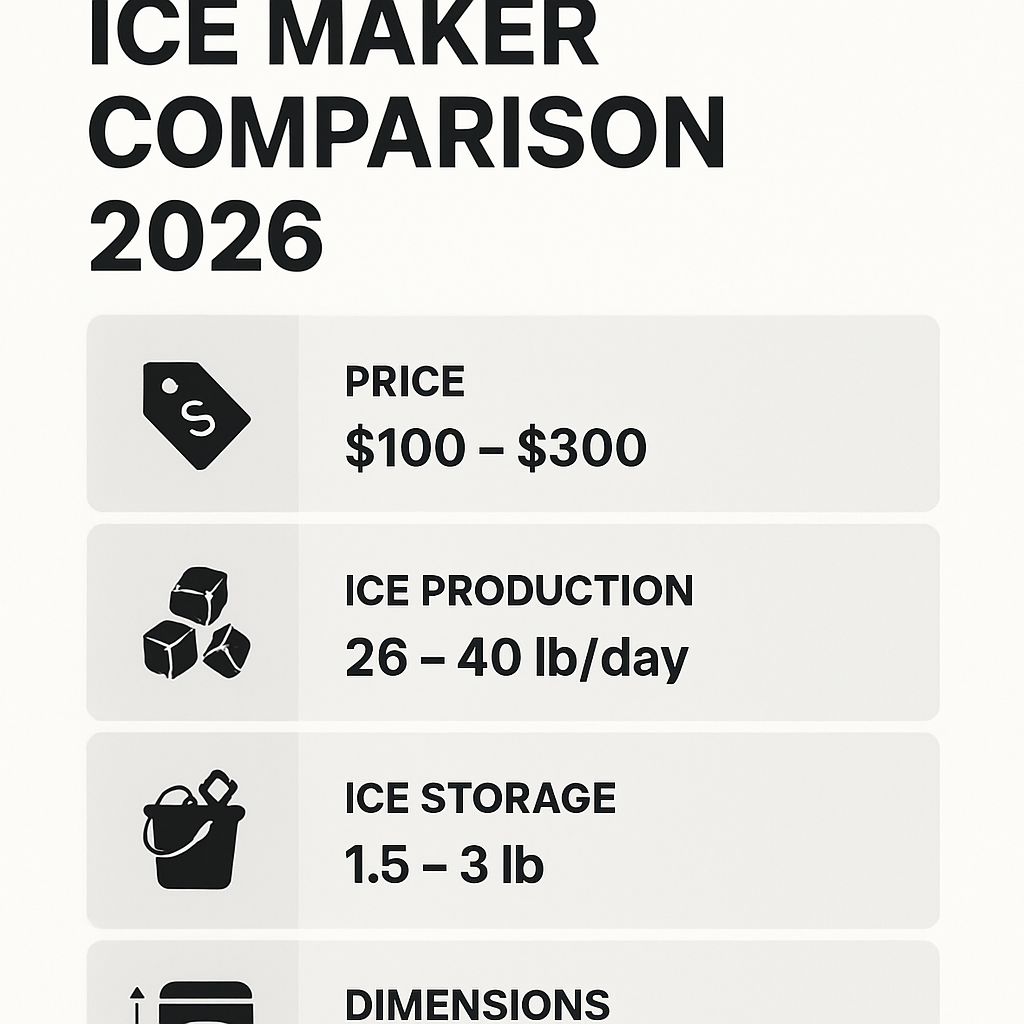
Between €90 and €220: this is the most competitive price range for a domestic ice maker in France in early 2026. Below this threshold, differences often appear in noise, finish, and production consistency when the room temperature exceeds 25 °C.
| Model | Usage profile | Indicative output | Main advantage | Observed price 2026 |
|---|---|---|---|---|
| Klarstein Icefestival | Home, family kitchen | approx. 12 kg/24 h | Balanced size, simple use | around €130 to €170 |
| H.Koenig KB12 | Small spaces, occasional use | approx. 12 kg/24 h | Compact, quick handling | around €100 to €140 |
| Duronic ICM12 | Office, studio, rental | approx. 12 kg/24 h | Short cycle, practical size | around €100 to €130 |
| Princess 283069 | Regular family use | approx. 10 to 12 kg/24 h | Good price/functions balance | around €110 to €150 |
| Winkel KW12 | Occasional use | approx. 12 kg/24 h | Affordable, wide distribution | around €90 to €130 |
| Essentielb EMG 2 | Home, reassuring store purchase | approx. 10 to 12 kg/24 h | After-sales service and in-store availability | around €110 to €160 |
| Crownful Ice Maker | Parties, mobile use | approx. 12 kg/24 h | Frequent self-cleaning in the range | around €100 to €150 |
| Klarstein Icemeister | Intensive home use | approx. 15 kg/24 h | More comfortable output | around €160 to €220 |
| Proline MIG compact series | Small budget | approx. 9 to 12 kg/24 h | Entry-level easy to find | around €80 to €120 |
| Vevor semi-pro counter | High demand, office, event | approx. 15 to 20 kg/24 h | Increased capacity | around €180 to €260 |
1. Klarstein Icefestival, the most balanced choice
This model appeals to those who want a simple ice maker to place on a countertop, without getting lost in complex settings. Its output places it in the heart of the domestic market, with enough capacity for aperitifs, summer meals, or a small gathering. Its main interest lies in its balance between compactness, clear controls, and realistic output.
It is well suited for a family or household that uses ice cubes several times a week. However, to continuously serve a large number of guests, one must anticipate: the “per 24 h” figures remain theoretical and do not mean that the internal bin can store large volumes constantly.
2. H.Koenig KB12, the compact that gets straight to the point
In small dwellings, size matters almost as much as speed. The KB12 precisely targets this need: limited footprint, quick start-up, and operation without special installation. For those who want to produce ice cubes without monopolizing the freezer, it is a relevant entry in the segment.
Its limitation is typical for this category: storage remains modest. It is therefore mainly useful when ice cubes are consumed as they are produced, rather than preparing a very large party all at once.
3. Duronic ICM12, interesting for office or short-term rental
The Duronic ICM12 is often noticed by users looking for a device easy to explain to others. In a seasonal rental, shared office, or secondary kitchen, this simplicity is a real advantage: few buttons, little ambiguity, quick start.
The point to watch remains water quality. In a hard water area, this type of machine requires regular maintenance to avoid circuit clogging and performance drop after a few months.
4. Princess 283069, the good family compromise
The strength of this model is less about “doing more” than “doing well enough” in all areas. It is aimed at regular but not intensive use, with production compatible with the needs of a family table or a few guests. The pricing position generally remains reasonable compared to the competition.
For a durable purchase, it is especially important to check the ease of access to the reservoir and internal surfaces. An ice maker that is pleasant to clean is often the one that continues to be really used after the first season.
5. Winkel KW12, a consistent entry-level option
This type of model exists to meet a simple demand: to have ice cubes quickly without increasing the budget. In practice, it is observed that this kind of machine often appeals to households who want to test the concept before investing more. For occasional use, this makes perfect sense.
However, it is necessary to keep realistic expectations regarding noise, external finish, and the quality of the storage bin. At a tight price, compromises are often more noticeable in user comfort than in the announced production.
How to choose an ice maker without making a mistake?
To choose an ice maker well, you should primarily look at the actual output, the time of the first cycle, the reservoir capacity, the noise, and the ease of maintenance. For home use, a model of 10 to 15 kg/24 h is generally sufficient, provided that the internal storage is consistent with the usage.
The first trap is to only look at the “kg per day” figure. This number is useful, but it corresponds to a theoretical maximum capacity, measured under good conditions. In practice, room temperature, starting water, and the frequency of opening the lid influence the result. A machine advertised at 12 kg/24 h will not give the same impression in a kitchen at 21 °C and in a conservatory at 29 °C in summer.
The second decisive criterion is the time of the first cycle. For aperitif use, this is often more important than daily production. A device capable of producing its first ice cubes in 6 to 8 minutes will be perceived as significantly more practical than a slightly larger but slower starting model. This is especially true when starting the machine at the last minute.
Next comes the actual autonomy. A machine with a reservoir of about 1.2 to 2.2 liters covers the majority of domestic uses, but not all. If the reservoir is small and the storage bin limited, the machine will need to be monitored more often. Conversely, a slightly larger device becomes relevant as soon as several people consume cold drinks for several hours.
The noise level also deserves to be taken seriously. Manufacturers rarely communicate uniformly on this point, yet it changes the experience in a studio, an open kitchen, or an office. In practice, users tolerate a device that runs occasionally well, but much less a machine that ventilates loudly and restarts often throughout the evening.
Finally, maintenance must be considered even before purchase. According to the legal guarantee of conformity recalled by Service-Public.fr, the seller remains responsible for defects of conformity, but wear due to lack of maintenance does not fall under the same logic. On an ice maker, stagnant water, limescale, and mineral residues are the three most frequent causes of performance decline in the medium term.
- For 1 to 2 people: aim for about 9 to 12 kg/24 h, with a compact format.
- For a family: aim for 12 to 15 kg/24 h, comfortable reservoir, simple cleaning.
- For frequent parties: prioritize output, effective ventilation, and a slightly larger bin.
- For office or rental: choose simple controls, obvious maintenance, and a stable machine for long sessions.
An agent who regularly equips seasonal rentals observes that “unexplained” breakdowns often come from a trivial point: the machine is left wet for several days after use. It is observed in the field that simply completely emptying and drying the bin significantly extends reliability on compact models.
Should You Buy an Ice Maker or Stick to Freezer Trays?
An ice maker becomes interesting as soon as the needs are frequent, quick, or greater than a few trays. For occasional use, freezer trays remain more economical. For summer meals, guests, or daily drinks, the machine provides a real time and comfort gain.
The classic ice tray has an undeniable advantage: it consumes almost nothing extra if the freezer is already running, and it requires no additional appliance on the countertop. For rare consumption, it is still the most rational solution. But it quickly reaches its limits as soon as continuous production, last-minute ice availability, or a large quantity in a short time frame is needed.
Conversely, an ice maker truly changes usage when services need to be chained. It becomes interesting in open kitchens, during barbecues, in a conservatory, in a second home, or in a small professional space. It also avoids occupying space in the freezer, which matters when it is already full.
Regarding electrical consumption, usage should be considered. According to the recommendations of the ADEME on energy savings at home, small appliances should be chosen based on their actual frequency of use. An ice maker is not necessarily energy-intensive if used occasionally and then turned off, but it makes little sense if it runs for a long time for a very low need.
A good ice maker is not the one that promises the most on its sheet, but the one whose pace, noise, and maintenance remain bearable after the tenth use.
What Technical Criteria Really Make a Difference?
The operation of a countertop ice maker is based on a simple principle: water is pumped to a refrigerated system, ice forms around rods or in a mold, then is detached and falls into a bin. This mechanism seems basic, but several parameters strongly affect the result: ambient temperature, cooling speed, air circulation, and water quality.
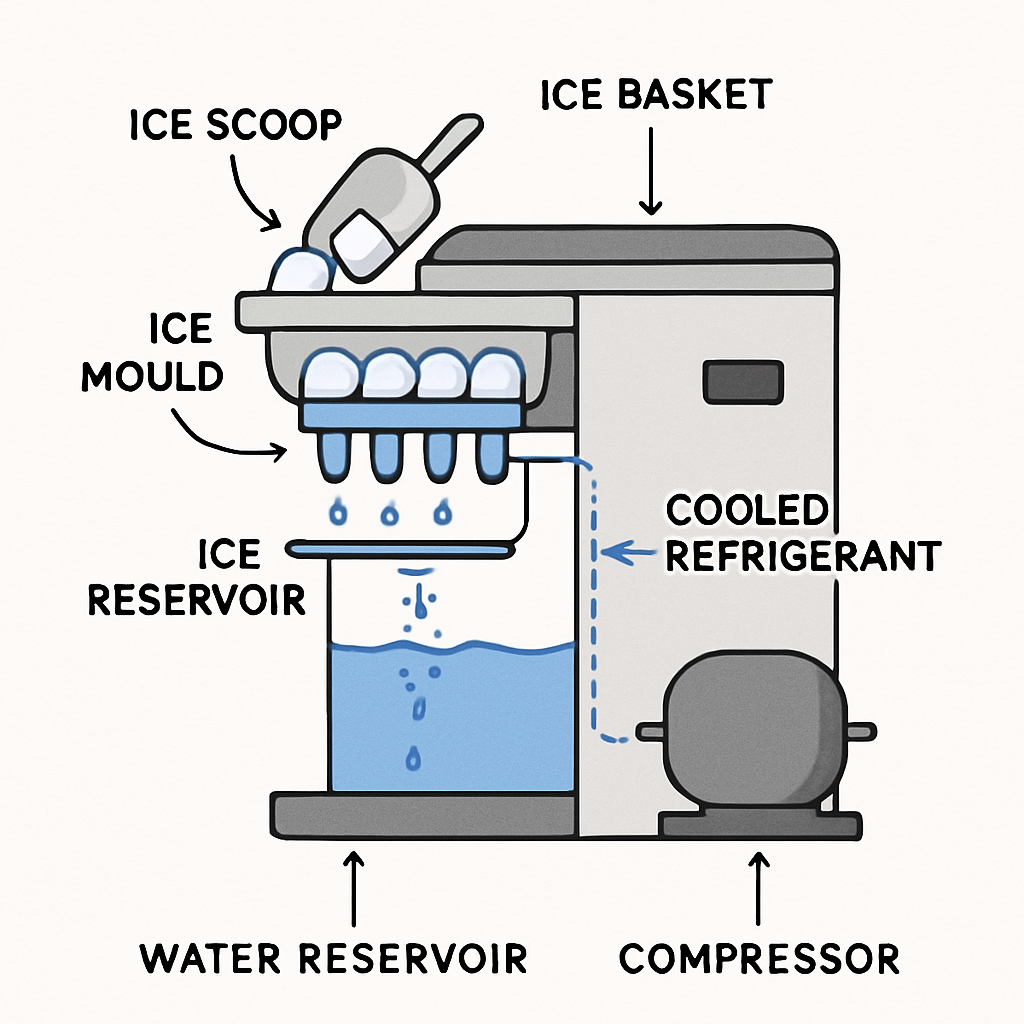
The type of ice is another often overlooked point. Many domestic models produce hollow or “bullet” shaped ice cubes, appreciated because they come out quickly. They are very suitable for sodas, flavored waters, or cocktails served quickly, but often melt faster than solid ice cubes. For a glass of spirits or longer preservation in a bucket, denser ice cubes remain preferable.
Water quality also has a direct impact. According to public resources on drinking water available via Data.gouv.fr, water hardness and composition vary greatly depending on the area. In a limestone zone, using filtered water or tap water left to settle can reduce scaling and improve the transparency of the ice cubes. This does not turn an entry-level device into a premium machine, but it significantly improves cycle consistency.
Regarding storage, an essential point must be recalled: the built-in bin temporarily stores the ice cubes, but it does not replace a freezer. Ice cubes can stick together, partially melt, then be recycled by the machine depending on the model. If the goal is to build a reserve for later, it is better to quickly transfer the production into a bag or box in the freezer.
How much does an ice maker cost and how much does it consume?
For a reliable domestic ice maker, you generally need to budget €100 to €180. Semi-professional models tend to range between €180 and €300 and up. Consumption depends on usage time, but the actual cost is mainly related to frequency of use and room temperature.
In the home segment, serious entry-level models start around €80 to €100. At this level, you often get the essentials: fast production, two ice cube sizes on some devices, simple controls. Moving up to €140 to €220 generally brings better finishing, a more stable chassis, better noise control, and a less tedious maintenance experience. This is often where the most satisfying purchases are made over time.
Electric consumption is not always displayed in a comparable way from one manufacturer to another. So you have to be wary of too quick readings. A machine used for an hour or two for an evening will not have the same impact as a device that stays plugged in for a long time in a warm room. According to the ADEME, reasonable use of small appliances primarily involves complete shutdown when not needed and avoiding devices that remain unnecessarily active.
There are also modest but real hidden costs: possible filters, descaling products, filtered water if local water is hard, and especially time spent cleaning the machine. Over several seasons, a slightly more expensive model that is easy to drain and dry can become more cost-effective than a cheap device whose maintenance discourages the user.
Maintenance, hygiene, and lifespan: points not to overlook
An ice maker works with water, cold, and temporary storage phases: it is exactly the type of device that can age poorly if closed while damp. The first reflex is to empty residual water after prolonged use, especially if the machine will not be restarted for several days. This simple habit limits odors, deposits, and biofilm formation.
Descaling depends greatly on the geographical area. A family often recounts the same scenario after a summer of heavy use: ice cubes become smaller, the cycle lengthens, and the machine seems “tired,” whereas it has mainly accumulated limescale. In practice, light but regular maintenance works better than heavy cleaning done late. It is better to intervene every few weeks of intensive use than to let limescale settle.
For hygiene, two things must be distinguished: daily cleaning and deep cleaning. The first consists of rinsing, drying, and wiping accessible parts. The second involves descaling adapted to the material and a complete rinse before putting back into service. Auto-cleaning functions are useful, but they do not replace manual draining, inspection of the tray, or drying.
The lifespan of a domestic ice maker finally depends on three very concrete factors: frequency of use, water quality, and ventilation management. A machine stuck to a wall, used in a very warm room and never dried will logically age faster than a device stored properly between periods of use.
What is each type of ice maker best suited for?
Not all ice makers meet the same needs. The core market corresponds to countertop models for the home: they are suitable for everyday kitchen use, summer lunches, and small gatherings. This is the category to prioritize if you want a portable device, plugged in occasionally and then stored away.
Larger versions, close to semi-professional, make sense in a guesthouse, a break room, a busy office, or for repeated events. They take up more space but prevent service interruptions. They also better withstand periods of sustained use, provided they have proper ventilation.
For camping or very mobile use, it is better to be cautious. A compact ice maker remains portable, but it is not necessarily designed for vibrations, precarious connections, or high temperatures under a canopy. In this case, the question is no longer just production, but electrical stability and the possibility of on-site cleaning.
- Home: 10 to 12 kg/24 h is often sufficient.
- Family and receptions: aim for 12 to 15 kg/24 h with a decent bin.
- Office or guesthouse: priority to ease of use and maintenance.
- Small professional use: better to choose a semi-pro model or a true professional machine depending on the flow.
FAQ about the ice maker
Is a water supply needed for an ice maker?
No, most domestic models operate with a manual reservoir. The water supply mainly concerns certain built-in or professional machines designed for a higher continuous flow.
Can ice cubes be left in the machine?
Not for long if the device is not refrigerated like a freezer. The ice cubes eventually partially melt, then stick together. To preserve production, it is better to transfer them quickly to the cold.
What type of ice cubes is most practical for drinks?
Hollow or “bullet” type ice cubes are very common in domestic use because they come out quickly. For sodas, cold waters, and quick cocktails, they are more than sufficient. For slower melting, denser ice cubes remain better.
Does an ice maker make a lot of noise?
The noise varies depending on the fan, compressor, and chassis quality. In a closed kitchen, it is not very disturbing. In a studio or open living area, a poorly soundproofed model can become tiring, especially during repeated restarts.
Does filtered water improve the ice cubes?
Yes, especially in limestone areas. Water with fewer minerals reduces scaling and often improves the appearance of the ice cubes. It can also limit residual odors in the reservoir after several close uses.
What is the best time to buy an ice maker?
Promotions often appear before summer and sometimes at the end of the season. Between May and July, the selection is wider but prices rise quickly on popular models. Outside heat peaks, prices can be a bit more flexible.