
Sommaire
TL;DR : An air-to-air heat pump (reversible air conditioning) must be powered via a dedicated circuit protected by a 30 mA residual current device (now Type F required/recommended for single-phase inverter), then a circuit breaker rated according to the current of the outdoor unit and the cable cross-section (2.5/4/6 mm² depending on the case). Comply with NF C 15-100, voltage drop ≤ 5%, and the manufacturer’s instructions. Electrical work = qualified electrician.
1. Air-to-air heat pump: principle & terminology
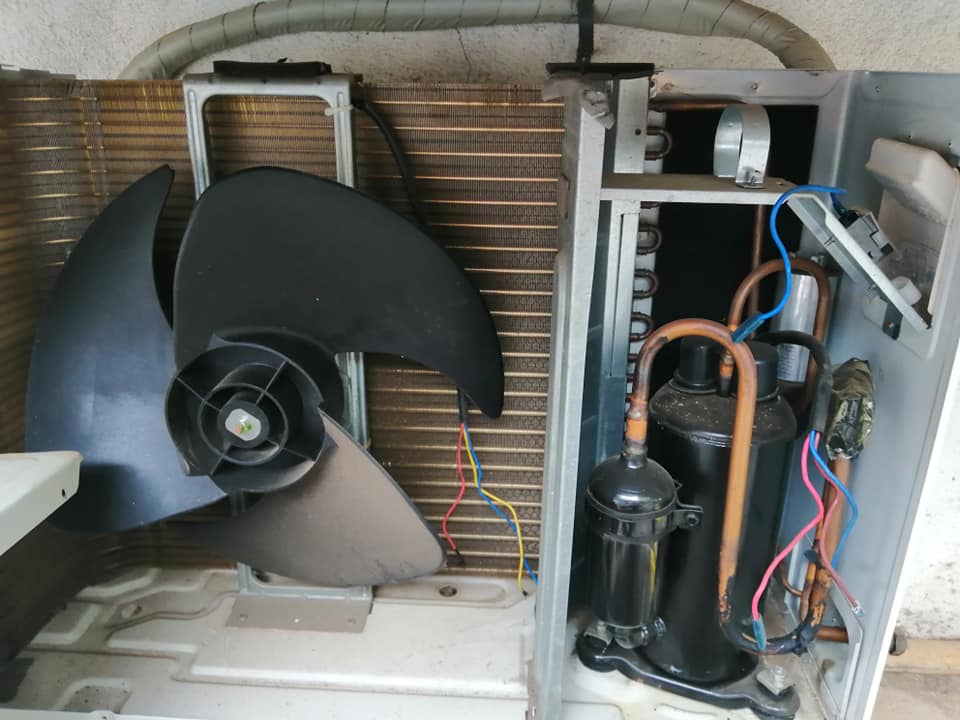
An air-to-air heat pump (reversible air conditioning) extracts heat from the outside air via the outdoor unit (evaporator/condenser + inverter compressor) and transfers it to the indoor air via the indoor unit(s) (wall-mounted, console, cassette). On the electrical side, the outdoor unit concentrates most of the load currents (compressor, fan) while the indoor unit mainly powers the control electronics and the fan.
2. Standards 2025: NF C 15-100, Type F, voltage drop
In 2024, the NF C 15-100 standard was restructured into the NF C 15-100-X series with an overlap period until 08/23/2025. For single-phase inverter heat pumps/air conditioners, manufacturers and normative guides specify the use of a 30 mA Type F RCD at the head of the dedicated circuit (required by version 15-100-1 according to several manufacturers/guides; some organizations indicate it as highly recommended: check the version applicable to your project). References: Legrand, ABB, Hager, Promotelec.
- Dedicated circuit: obligation for a specialized circuit for air conditioning (NF C 15-100). Ref. Legrand, Promotelec.
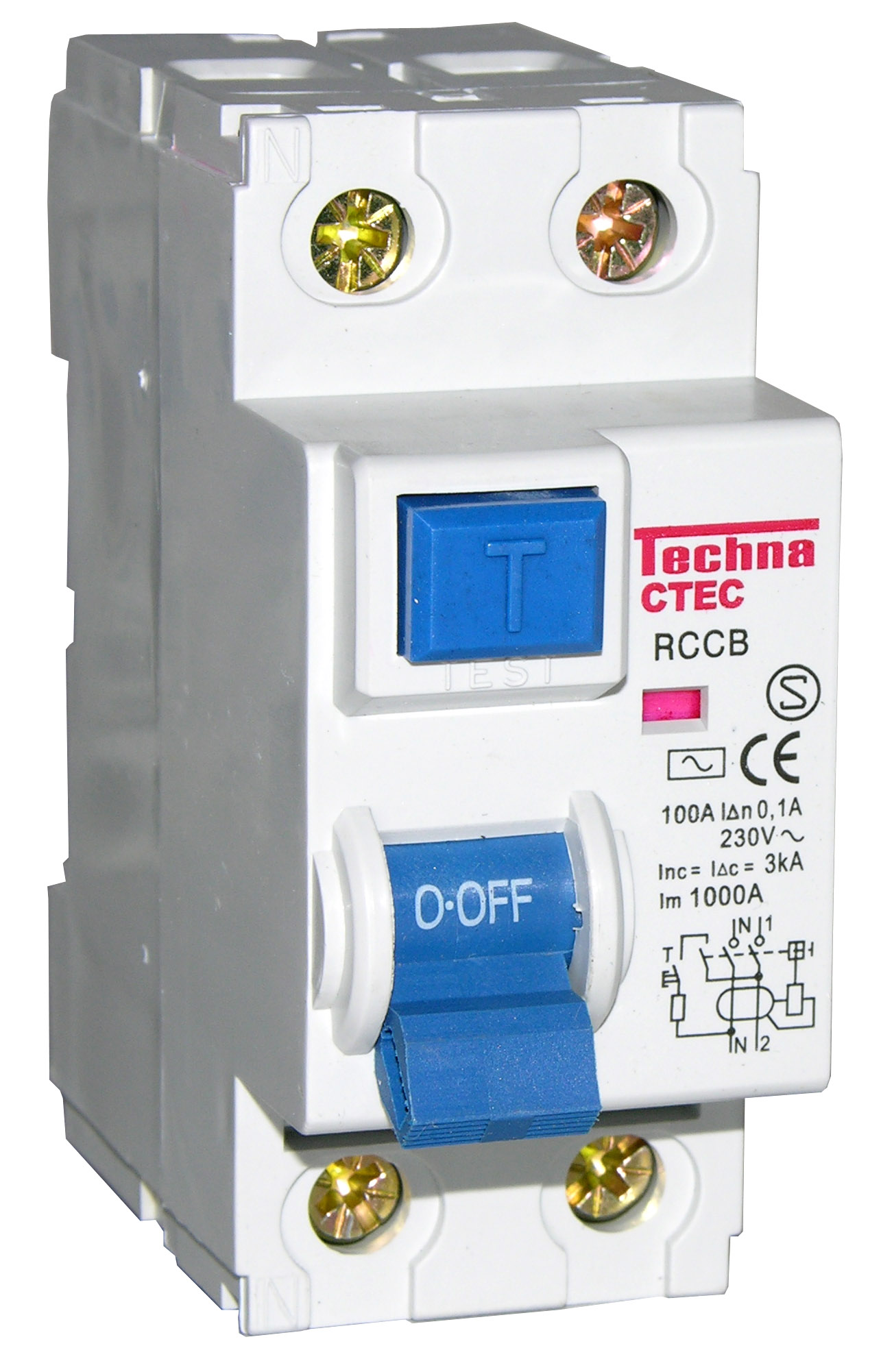
- Residual current device: 30 mA Type F (or at least Type A if prescribed by the manufacturer) sized to the upstream current (40/63 A). See Promotelec datasheet and Legrand.
- Voltage drop: ≤ 3% (lighting), ≤ 5% other uses (including air conditioning). Ref. Promotelec, Schneider Electric.
- Instructions: strict compliance with installation manuals (cables, MCB/RCD, interconnection). Ex. Daikin, Mitsubishi Electric.
3. Wiring diagrams (single-line & multi-line)
3.1 Single-line — standard mono-split (outdoor unit power supply)
Origin ENEDIS
   │
Main circuit breaker (DB)
   │
Main panel
   │
30 mA residual current device  40/63 A
   │
16 A or 20 A branch circuit breaker (curve C/D according to manual)
   │
3G2.5 mm² cable (according to current and length)
   │
Switch-disconnector (local cut-off, suitable IP)
   │
Outdoor unit (OU)
   └─── Interconnection cable to IU (e.g. 3G1.5 to 4G1.5 mm² depending on manufacturer)
            └─ Indoor unit (IU)
3.2 Multi-line — terminal block details (typical logic, to be confirmed by manual)
[Panel]
 L ──────────────────────────┐
 N ──────────────────────────┼─> to OU (main power supply)
 PE──────────────────────────┘

[OU - terminal block]
 L_IN  N_IN  PE   |  S1 S2 S3 (bus/control) → to IU
  │     │    │    |   └────────── IU (terminal block L/N/PE + S1/S2/S3 if required)
  │     │    │    |  (Some models power the IU via the OU)
  └─────┴────┴────┘

Option: multiple UIs (multi-split) on a dedicated control bus (mandatory labeling).

4. Circuit breakers, residual current devices & disconnect switches
4.1 Residual current device (RCD) 30 mA
- Type F 30 mA at the head of the HVAC/heat pump circuit (single-phase inverter): required by version 15-100-1 according to several manufacturer guides and strongly recommended by Promotelec/Hager. See ABB, Legrand, Hager, Promotelec.
- Rating: 40 A or 63 A depending on downstream load (sum of ratings and operating conditions).
- Coordination: avoid nuisance tripping (harmonics/variations); Type F has increased immunity.
4.2 Miniature circuit breaker (MCB)
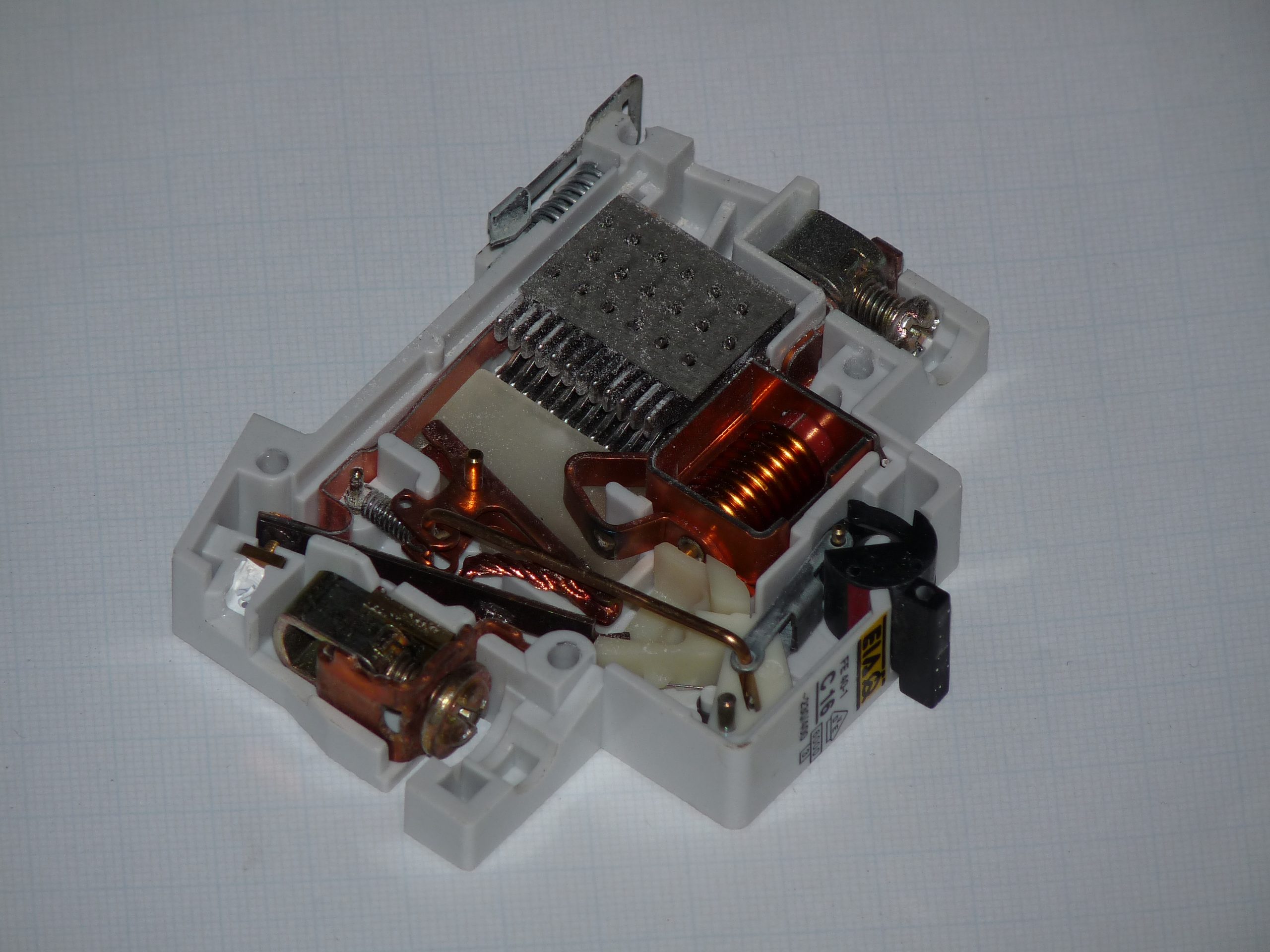
- Curve: curve C is most often suitable (soft start by inverter). Curve D possible if required by manual or for high inrush currents (rare on modern inverters). See general advice: curve guide.
- Rating: 16/20/25/32 A depending on the device’s IB (nameplate/manual) and conductor size/length.
- Dedicated circuit: 1 breaker = 1 specialized circuit (NF C 15-100).
4.3 Proximity disconnect switch
Provide a proximity disconnect (lockable disconnect switch) next to the outdoor unit for maintenance (IP rating suitable for exposure). Many manufacturer manuals require this. E.g., Daikin.
5. Cable sizes & voltage drop calculation
The cable size is determined according to: current IB (nameplate), length, installation method, temperature, and voltage drop constraint (≤ 5% for this type of use). Ref. Promotelec.
| Current (IB) | Circuit breaker (curve C/D) | Min. cross-section | Typical max. length* | Common use |
|---|---|---|---|---|
| ≤ 10 A | 16 A | 3G1.5 mm² | up to ~30 m | Small splits 2–2.5 kW (per manual) |
| 10–16 A | 20 A | 3G2.5 mm² | ~25–30 m | Single split 2.5–3.5 kW |
| 16–25 A | 25 A | 3G4 mm² | ~30–40 m | Powerful single split / small multi |
| 25–32 A | 32 A | 3G6 mm² | ~30–50 m | Multi-split 3–5 UIs |
*Approximate lengths to respect a voltage drop ≤ 5% (230 V) in residential use, to be confirmed by calculation and manuals. Always prioritize manufacturer documentation and NF C 15-100.
5.1 Simplified voltage drop calculation
Assumptions:
- Single-split heat pump: IB = 12 A, copper cable 3G2.5 mm², one-way length = 18 m (36 m round trip)
- Copper resistivity ρ ≈ 22.5 mΩ·mm²/m
ΔU ≈ (2 × L × ρ × I) / S  = (2 × 18 × 0.0225 × 12) / 2.5  ≈ 3.888 V
ΔU% rate = 3.888 / 230 × 100 ≈ 1.69 %  → OK (≤ 5 %)
5.2 Interconnection cable UE ↔ UI
Depending on the brands, the UI is powered by the UE via a 3 to 5 conductor cable (power + communication), often minimum 1.5 mm². Respect the color/coding (e.g., S1/S2/S3). Some systems require a separate power supply for the UI → provide a second dedicated circuit according to the manual. E.g. Daikin, Mitsubishi Electric.
6. Numerical Examples (mono-split & multi-split)
6.1 Mono-split 3.5 kW (inverter)
- Outdoor Unit nameplate: Pelec 0.9 kW; Imax 12 A; 230 V ~ 50 Hz.
- Protection: 30 mA Type F RCD (40 A), 20 A circuit breaker (curve C unless otherwise specified).
- Conductors: 3G2.5 mm² up to ~25–30 m (check voltage drop). Outdoor-Indoor interconnection: 4G1.5 mm² (example brand), marking S1-S2-S3 + PE.
- Disconnection: IP55 switch-disconnector near the outdoor unit.
6.2 Multi-split 4 Indoor Units
- Outdoor Unit Imax: 24 A (example datasheet).
- Protection: 30 mA Type F RCD (63 A), 32 A circuit breaker (curve C/D according to manual).
- Conductors: 3G6 mm² if notable length (≥ 25–30 m); otherwise 3G4 mm² possible depending on voltage drop. Communication bus to 4 indoor units via 4×1.5 mm² (depending on brand), topology star or daisy-chain according to manual.
- Accessories: Type 2 surge arrester recommended if stormy area and panel far away, according to study. (See NF C 15-100 / manufacturers guides).
Reminder — The circuit breaker rating must satisfy IB ≤ In ≤ Iz, where IB = load current, In = circuit breaker rating, Iz = allowable cable current (function of section/mounting method). Always follow the manufacturer’s instructions.
7. Common Mistakes to Avoid
- No dedicated circuit: connecting an air conditioner to an existing socket circuit is non-compliant and dangerous.
- Wrong RCD type: Type AC at the head of a single-phase inverter → nuisance tripping or inadequate protection. Prefer Type F (or at least Type A if prescribed by the manufacturer).
- Confusion of Indoor/Outdoor terminals: S1/S2/S3 inversions, mixing power/control → electronic board failures.
- Insufficient conductor size: overheating, voltage drops > 5%, performance losses and risks.
- Absence of switch-disconnector near the outdoor unit: dangerous maintenance.
- Inappropriate curve: circuit breaker too “soft” or too sensitive at startup → tripping.
- Neglected grounding: PE continuity, tightening, marking; beware of external conduits and penetrations.
8. Tools, Consumables & Site Checklist
- Tools: crimping pliers, terminals, cable cutter, insulated screwdrivers, tester (insulation/continuity measurement), labeler, level.
- Consumables: ICTA/UV conduit, U-1000 R2V cable or suitable, cable glands, trunking, clamps, marking S1/S2/S3, Wago terminals.
- Protection & compliance: 30 mA Type F RCD, curve C/D circuit breaker, IP55 switch-disconnector, surge arrester (according to study), certification cards.
- Checklist: single-line diagram, circuit marking, voltage drop calculation, terminal tightening torque, functional test, client instructions.
9. 2025 Trends (Type F, inverters, surge arresters)
The rise of inverter compressors and power electronics encourages the adoption of Type F RCDs for robustness against complex residual currents. The 2024 revision of NF C 15-100 has formalized many updates (series 15-100-X) with final overlap in 2025. Surge arresters at the panel head are increasingly installed in storm-prone areas or isolated houses to improve the service continuity of heat pumps and home electronics (consult your manufacturer guides and the standard for Type 1/2/3 selection).
Also read: our 2025 Air-to-Water Heat Pump Installation Guide and About Us.

FAQ — Diagram and wiring of an air-to-air heat pump
What type of differential for a heat pump/AC in 2025?
Type F 30 mA at the head of the dedicated circuit is now required or explicitly recommended for single-phase inverter equipment (AC, heat pump, pool pump), according to manufacturer guides and the NF C 15-100-1 standard. Otherwise, follow the manual (Type A at minimum if prescribed). Sources: Legrand, ABB, Hager, Promotelec.
C or D curve for the circuit breaker?
The C curve is sufficient in most cases (inverter = soft start). Choose D curve only if the manual or site experience requires it (significant inrush current, powerful multi-split).
What cable size for a 3.5 kW single-split?
Often 3G2.5 mm² with a 20 A circuit breaker (to be confirmed by the nameplate and voltage drop calculation). The interconnection between outdoor and indoor units is generally 1.5 mm² (3 to 5 conductors depending on S1/S2/S3 markers…).
Is a disconnect switch near the outdoor unit necessary?
Yes, it is strongly recommended (and often required by manuals) to ensure a secure local disconnection during maintenance.
Can the indoor and outdoor units be powered on the same circuit?
In most systems, the outdoor unit powers the indoor unit via the interconnection cable: a single dedicated circuit is sufficient. Some models require a separate power supply for the indoor unit — follow the brand’s manual.
Should I plan for a surge protector?
In storm-prone areas, overhead networks, or sensitive equipment, adding a Type 2 surge protector at the panel is often relevant. Decision case by case according to risk assessment and NF C 15-100.
Reliable sources
- Legrand — 2024 revision of NF C 15-100 (overlap period)
- Legrand — NF C 15-100: professional guide
- ABB — NF C 15-100 normative guide (Type F required for single-phase inverter)
- Hager — NF C 15-100 standard (Type F RCD recommended for inverters)
- Promotelec — Choosing RCDs (Type F for AC/heat pump)
- Promotelec — Voltage drop calculation (3%/5%)
- Schneider Electric — Voltage drop limits
- Daikin — R32 split installation manual (wiring examples)
- Mitsubishi Electric — MSZ-GS: Installation Manual
- Promotelec — NF C 15-100 (general reminder)
{
“@context”: “https://schema.org”,
“@graph”: [
{
“@type”: “Article”,
“headline”: “Diagram and wiring of an air-to-air heat pump: connections, circuit breakers, cable sections (2025 Guide)”,
“description”: “Single-line and multi-line diagrams for air-to-air heat pumps, choice of 30 mA Type F differential, circuit breaker ratings, cable sections and voltage drop calculation according to NF C 15-100, numerical examples and mistakes to avoid.”,
“inLanguage”: “fr”,
“author”: {
“@type”: “Person”,
“name”: “SEO Article Writer”
},
“publisher”: {
“@type”: “Organization”,
“name”: “https://www.pcsm-idf.fr”,
“logo”: {
“@type”: “ImageObject”,
“url”: “https://upload.wikimedia.org/wikipedia/commons/5/5d/DAIKIN_AIR_CONDITIONER_OUTDOOR_UNIT_%2823%29.jpg”,
“width”: 1600,
“height”: 960
}
},
“image”: [
“https://upload.wikimedia.org/wikipedia/commons/5/5d/DAIKIN_AIR_CONDITIONER_OUTDOOR_UNIT_%2823%29.jpg”,
“https://upload.wikimedia.org/wikipedia/commons/d/d8/Inside_of_split_type_ac_outdoor_unit.jpg”,
“https://upload.wikimedia.org/wikipedia/commons/2/2c/Main_distribution_board_under_construction.JPG”,
“https://upload.wikimedia.org/wikipedia/commons/9/9a/Residual_current_device_2pole.jpg”,
“https://upload.wikimedia.org/wikipedia/commons/0/06/EIA_FE_40-1.JPG”
],
“datePublished”: “2025-09-07”,
“dateModified”: “2025-09-07”,
“mainEntityOfPage”: {
“@type”: “WebPage”,
“@id”: “https://www.pcsm-idf.fr/blog/schema-cablage-pac-air-air”
}
},
{
“@type”: “FAQPage”,
“mainEntity”: [
{
“@type”: “Question”,
“name”: “What type of differential for a heat pump/AC in 2025?”,
“acceptedAnswer”: {
“@type”: “Answer”,
“text”: “A 30 mA Type F RCD is required or explicitly recommended at the head of circuits supplying single-phase variable speed equipment (air conditioning, heat pumps, pumps), according to manufacturer guides and the NF C 15-100-1 series. Otherwise, follow the manual (Type A at minimum if prescribed).”
}
},
{
“@type”: “Question”,
“name”: “Curve C or D for the circuit breaker?”,
“acceptedAnswer”: {
“@type”: “Answer”,
“text”: “Curve C is generally sufficient with inverter compressors. Use curve D only if the manufacturer’s manual requires it or if significant inrush currents are observed.”
}
},
{
“@type”: “Question”,
“name”: “What cable section for a 3.5 kW single-split?”,
“acceptedAnswer”: {
“@type”: “Answer”,
“text”: “Often 3G2.5 mm² with a 20 A circuit breaker, but this must be confirmed with the nameplate, cable length (voltage drop ≤ 5%), and the manufacturer’s manual.”
}
},
{
“@type”: “Question”,
“name”: “Is a switch-disconnector needed near the outdoor unit?”,
“acceptedAnswer”: {
“@type”: “Answer”,
“text”: “Yes, a local disconnection is strongly recommended and often required by manuals to secure maintenance operations.”
}
},
{
“@type”: “Question”,
“name”: “Can the indoor and outdoor units be powered on the same circuit?”,
“acceptedAnswer”: {
“@type”: “Answer”,
“text”: “Most often, the outdoor unit powers the indoor unit via an interconnection cable (power + control). However, some models require a separate supply for the indoor unit: refer to the manual.”
}
},
{
“@type”: “Question”,
“name”: “Should I plan for a surge arrester?”,
“acceptedAnswer”: {
“@type”: “Answer”,
“text”: “In storm-prone areas, with overhead networks or to protect sensitive electronics, a Type 2 surge arrester at the panel is relevant. Decision to be made after study according to NF C 15-100.”
}
}
]
}
]
}