Sommaire
1) Close and let the freezer cool back down to -18 °C. 2) Inspect: smell, texture, ice crystals. 3) Sort: keep if still hard & with crystals, cook immediately if partially thawed, throw away if warm/smelly. 4) Prevent: alarm thermometer, connected sensor, clean door seal.
Temperature memo: -18 °C (safe freezing) | 4–60 °C = danger zone (bacteria) | ≥63 °C = core cooking.
Our verdict ⭐
| Pros | Cons |
|---|---|
| Simple decision grid, concrete steps, anti-waste, prevention | Sometimes degraded quality, very sensitive fish, irrecoverable ice creams, limited refreezing |
Rating: 8/10 | Recommended for: households, students, busy families.
| Key points | Details to remember |
|---|---|
| ❄️ Definition | Understand what a prolonged opening of the freezer means for the internal temperature. |
| ⏳ Critical delay | Assess if 12 hours caused a partial or total thawing. |
| 🧪 Health risk | Identify high-risk foods (meats, fish, prepared dishes). |
| 🥫 Save or throw away | Decide based on appearance, texture, presence of ice crystals and packaging. |
| 🍽️ Reuse | Use recoverable products in cooking: cooking, soups, compotes. |
| 🛠️ Prevention | Set up an alarm thermometer and an organization to avoid recurrence. |
Your freezer was left ajar for 12 hours: panic, questions, then a simple but crucial question — what to keep, what to throw away, and what can be hoped to save? This guide takes a step-by-step, practical and factual approach. It explains the physical mechanisms involved, details a quick inspection, then offers a clear decision grid for each food category. Finally, you will find tips to save what can be saved and prevention advice.
What happens when a freezer is left ajar for 12 hours
An ajar freezer loses its insulation: the ambient air, warmer and more humid, enters and melts the surface ice. The internal temperature gradually rises until it reaches room temperature if the door remains open too long. Over a period of 12 hours — a relatively long duration — several scenarios are possible depending on the appliance’s power, the amount of food, and the previous frequency of opening:
- If the compartment was full, the frozen mass slows the temperature rise: a partial thaw is more likely than a total melt.
- A partially filled freezer will warm up faster and may lose critical degrees beyond the safety threshold.
- The presence of a layer of frost can mask superficial thawing: one believes it is still frozen while the interior has already started to defrost.
Step 1 — Immediate visual and sensory inspection
Open, look, smell
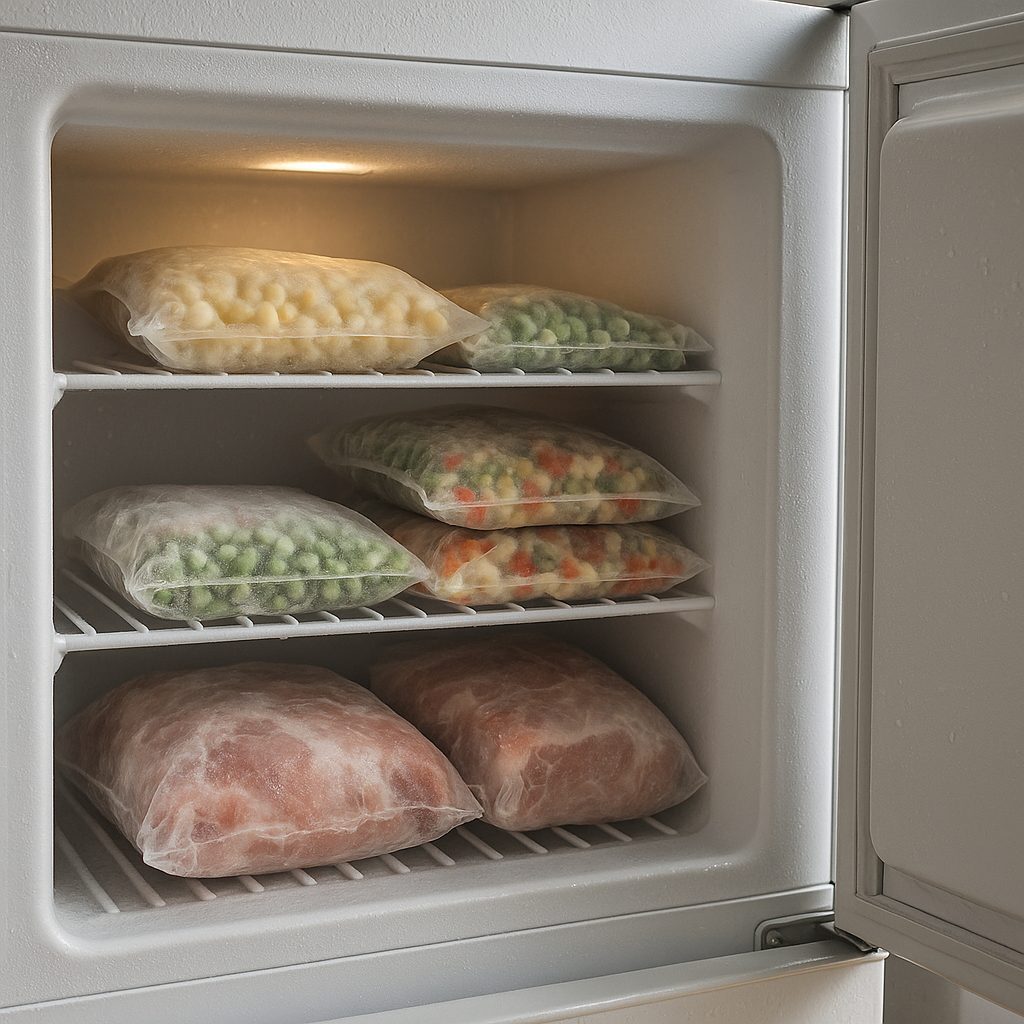
Start by opening the freezer and taking a first impression: smell the air. A sour or sweetish odor signals spoilage. Look at the packaging: if they are wet, sticky, or have stains, safety is compromised. Quickly touch some products (through the packaging) to check the temperature: cold and firm = freezing maintained; warm, soft or soggy = advanced thawing.
Check for ice crystals
Ice crystals indicate that the food has retained part of the freezing at -18 °C regime; often, if crystals remain, the bacterial risk is much lower and the product can be refrozen after cooking or sometimes directly. Conversely, a smooth and wet surface means complete melting — a warning sign.
Step 2 — Categorize: keep, throw away or try to save
The decision is based on three elements: the felt temperature, the appearance (presence of water, color, odor) and the nature of the food. Here is a practical chart covering the main food categories.
| Type of food | Recommended action | Reason |
|---|---|---|
| Raw meat (beef, pork, poultry) | Throw away if soft or warm; keep if still icy | High bacteriological sensitivity; insufficient cooling = proliferation (Salmonella, Listeria). |
| Fish and seafood | Throw away if altered odor or soft texture | Risks of rapid spoilage and toxins; safety priority. |
| Cooked dishes (sauces, stews) | Cook immediately if partially melted; otherwise throw away | Cooking through destroys most pathogens; quality sometimes degraded. |
| Frozen vegetables | Save: often usable after cooking | Texture altered, but low health risk. |
| Frozen fruits | Save for smoothies, compotes, jams | Low health risk; texture loss. |
| Ice creams and frozen desserts | Throw away if completely melted and refrozen | Texture ruined and risk of micro-crystals. |
| Breads and pastries | Keep or refrigerate: generally low risk | Low bacterial risk, limited quality loss. |
Simple rules for on-site decision making
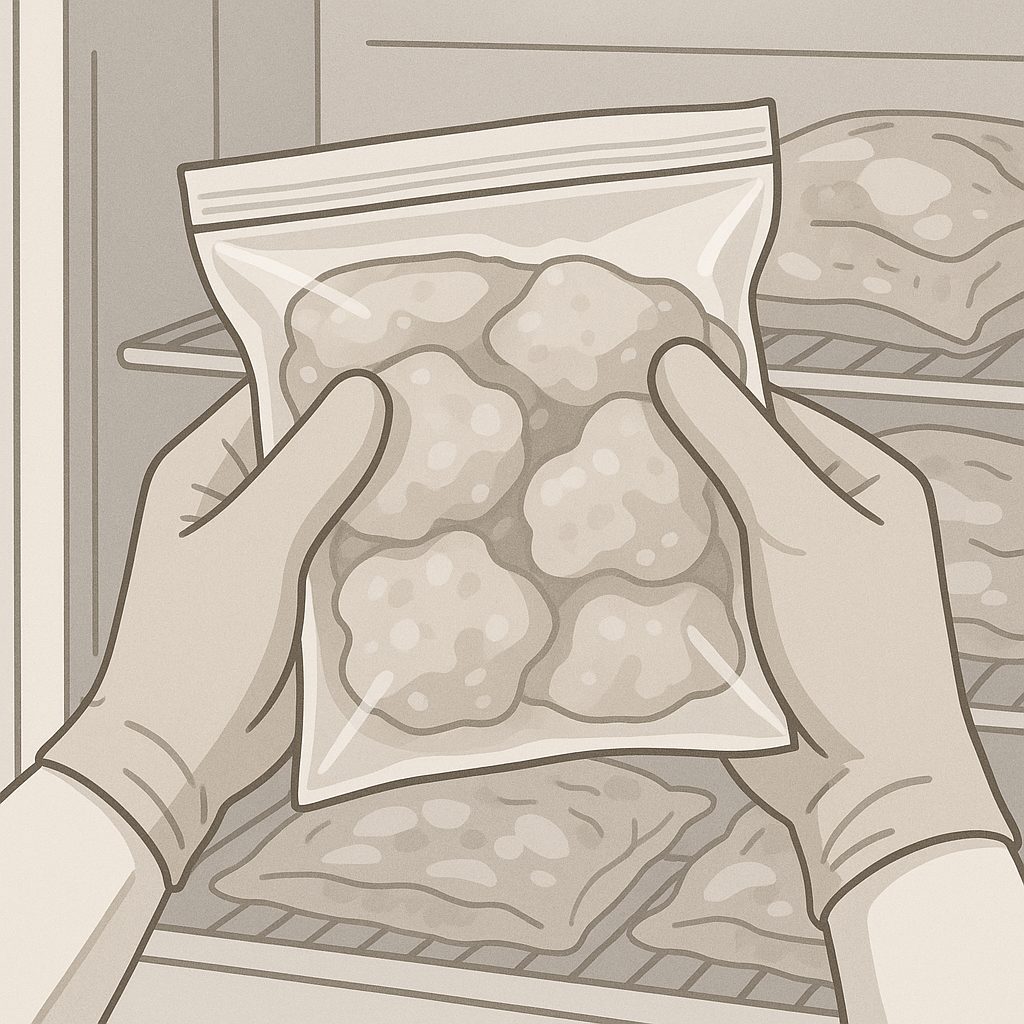
- If the food is still hard in the center and shows crystals ⇒ generally safe.
- If the packaging has leaked liquid contaminating other products ⇒ discard items in contact (avoid cross-contamination).
- Vacuum-packed products: if the vacuum is intact and the product still very cold, you can often save it.
- Any product that smells bad, has an altered color or an abnormal texture: discard.
Practical tips to save what can be saved
When there is a chance to save, you must act quickly and smartly. The idea is to minimize the time during which food remains at dangerous temperature and to use culinary techniques to reduce risks.
Immediate cooking
If a prepared dish or meat has partially thawed but remains cold, cook it thoroughly as soon as possible: a long cooking at high temperature destroys most pathogens. Then consume quickly or keep in the refrigerator for a short time (24–48 h depending on the dish).
Controlled cooling then freezing
For products that still have crystals, you can let them cool then refreeze, but the quality (texture) may degrade. This choice is acceptable for soups, stews, cooked vegetables. Avoid for dishes based on cream or delicate sauces.
Culinary transformation
Transforming into soup, puree, compote or smoothie is often the best option to recover fruits and vegetables. Fragile proteins (fish) benefit less from this strategy.
Prevention: reduce the risk of incidents in the future
Some simple habits greatly reduce the likelihood of finding the door ajar for 12 hours:
- Install an internal thermometer with alarm or a connected sensor.
- Organize the freezer by zones and label contents to avoid long searching.
- Regularly check the door seal tightness and replace if damaged.
- Do not overload the door with heavy containers and store the most used products towards the front.
- Plan a simple inventory (a sheet on the door) to know what is inside.
What we liked ✅ / liked less ⚠️
✅ Liked
- Clear steps and immediately applicable
- Readable decision tables
- FAQ useful in emergency situations
- Concrete prevention (alarm, sensor)
- Anti-waste (soups, compotes)
- Temperature reminders (-18 °C, 4–60 °C)
- High-risk foods clearly identified
⚠️ Liked less
- Fish very poorly tolerant to temperature rise
- Ice creams and frozen desserts often unrecoverable
- Refreezing possible but limited (loss of texture)
- Requires careful sensory evaluation
- Risk of cross-contamination in case of leaks
- Sometimes complete cleaning needed
- Organoleptic quality variable after saving
Methodology
Recommendations based on key temperatures (-18 °C freezing, 4–60 °C danger zone, ≥63 °C core cooking), the nature of foods (meats, fish, plants, desserts), sensory indicators (smell/color/texture) and the presence of ice crystals. Approach aligned with good domestic cooking practices and HACCP principles (cleaning).
Conclusion
In case of freezer ajar for 12 h, base your decision on temperature, crystals and type of food. Cook immediately what can be cooked, discard suspicious products (warm meats/fish), and prevent recurrence (thermometer/alarm, organization by zones, clean seal). Anti-waste: favor soups, stews, compotes to save texture and budget.
Also to read
- freezer temperature -18 °C — why and how to check it (probe, alarm).
- defrost meat safely — refrigerator, microwave, cold water.
- home anti-waste — turning leftovers into useful recipes.
- freezer alarm thermometer — comparison of connected sensors.
- cross-contamination — cleaning and disinfecting safely.
💡 General information: does not replace professional advice. This guide targets domestic food safety. Possible affiliate links. Data updated on 2025-11-03.
FAQ
The most common questions, clearly answered to help you make the right decision on the spot.
Can partially thawed meat be refrozen?
If the meat is still cold and has crystals, it can be refrozen after cooking or sometimes raw if the core remains frozen. If it is soft, warm, or gives off an odor, it must be thrown away.
How long after thawing is a cooked dish still safe to eat?
After cooking, consume or refrigerate the dish within two hours if the ambient temperature is high; if you cook it immediately after thawing, it can be kept 24–48 hours in the refrigerator depending on its composition.
Do vegetables pose a health risk after thawing?
The risk is low; the main loss concerns texture. Cooking or turning them into puree solves most quality issues.
What about ice cream?
Ice cream that has completely melted and then been refrozen loses its creaminess and may develop micro-crystals; from a health perspective, it is rarely dangerous, but the taste quality is often ruined.
Should I throw away everything that has been in contact with thawing liquid?
Yes, throw away or clean carefully the contaminated items (or surfaces): the liquid can carry harmful bacteria and contaminate other foods.
What immediate action should I take if I find the freezer door ajar?
Stop opening the door, quickly assess the situation (smell, temperature, crystals), remove risky products for decision, then organize cooking or refrigeration as appropriate.