Sommaire
Children’s Ice Rink Accident: The 2026 Prevention Guide to Protect the Youngest
A child’s fall on the ice lasts a second, but a children’s ice rink accident can leave much longer-lasting consequences when a skate passes over the hand, fingers, or face. Recent incidents in Villeneuve-sur-Lot, Belfort, or near Perpignan have reminded us of a reality often underestimated: at the ice rink, the danger is not only slipping but also speed, the density of skaters, and the lack of appropriate equipment. It follows that the real question is not just “how to avoid falling,” but “how to prevent a fall from turning into a surgical emergency.”
For those who want to supervise a family outing without improvising, this guide brings together points that research results rarely cover comprehensively: concrete prevention, first aid steps, useful equipment, insurance procedures, and liabilities. The goal is simple: know what to prepare before stepping onto the ice, what to watch for during the session, and what to do immediately if an accident occurs.
🧤 Serious injuries observed during a children’s ice rink accident often occur after a fall, then the passage of an adult skate over the hand. Thick gloves, a less crowded time slot, and a safe distance significantly reduce this risk.
⛑️ In case of a deep cut or severed finger, you must apply pressure, call 15 or 112, protect the injured part, and keep any fragment in a watertight bag cooled indirectly, never in direct contact with the ice.
📄 After the accident, the important elements are photos, the name of the ice rink, the time, the contact details of witnesses, and the insurance declaration. In practice, insurers often require a declaration within about 5 working days.
Why do serious ice rink accidents happen to children?
The most serious accidents rarely occur because of the ice alone. The typical scenario combines fall, hand placed on the ground, proximity of a faster skater, and lack of appropriate protection. The denser the rink, the harder it is for the child to get up before another skate passes by.
The mechanics are unfortunately quite consistent in the reported cases. In Villeneuve-sur-Lot, at the end of December 2025, a 4-year-old child was seriously injured in the hand after a fall on a temporary ice rink installed during the holidays. In Belfort, early 2024, another 7-year-old child suffered a similar serious injury. Near Pia, in the Pyrénées-Orientales, a 9-year-old child was also the victim of a severe accident. These named examples show a common point: the injury is not related to “poor skating technique” in the sporting sense, but to a temporal collision between a fall and the passage of a blade.
The most underestimated factor remains the crowd. On a recreational ice rink, especially during winter holidays or Christmas events, the space available per skater quickly decreases. An adult moving at low speed already needs a few meters to go around an unexpected obstacle. A child, on the other hand, falls lower, gets up more slowly, and often has the reflex to put their hands in front, which directly exposes the fingers. In practice, this risk also increases when levels are mixed: beginners in the center, fast teenagers on the periphery, supervisors focused on another child.
It is observed on the ground that families first think about the cold, then balance, and only lastly about the risk of cuts. Yet a simple wool glove mainly protects against cold and somewhat against abrasion, not against a moving blade. Moreover, a tired, intimidated, or overdressed child may lose mobility. The real challenge is therefore to combine protection, supervision, and choosing the right moment, rather than relying solely on the general caution of other skaters.
How to prevent a child ice rink accident even before stepping onto the ice?
To reduce the risk, action must be taken before the session: choose a quiet time slot, equip the child with thick gloves and a helmet, check the level of the rink, set simple rules, and stay within immediate reach. The most effective prevention starts at the edge of the ice, not after the first fall.
The first lever is the choice of time slot. A session early in the morning, outside peak times, is generally safer than an afternoon slot during holidays or just before closing. On a temporary rink, danger increases when the rink hosts families, fast teenagers, and inexperienced adults all at once. A family often recounts that they accepted “the slot with the most atmosphere” before realizing the child had almost no space to learn. Regarding safety, a slightly less busy rink is better than a crowded one.
The second lever is equipment. Gloves are essential, not as an absolute guarantee, but as the first barrier against cuts and friction burns on the ice. The helmet protects against backward or lateral impacts, very common among beginners. Close-fitting clothing, without long scarves or dangling accessories, also limits snagging. Finally, skates tightened well around the ankle improve stability; a skate that is too loose promotes lateral falls.
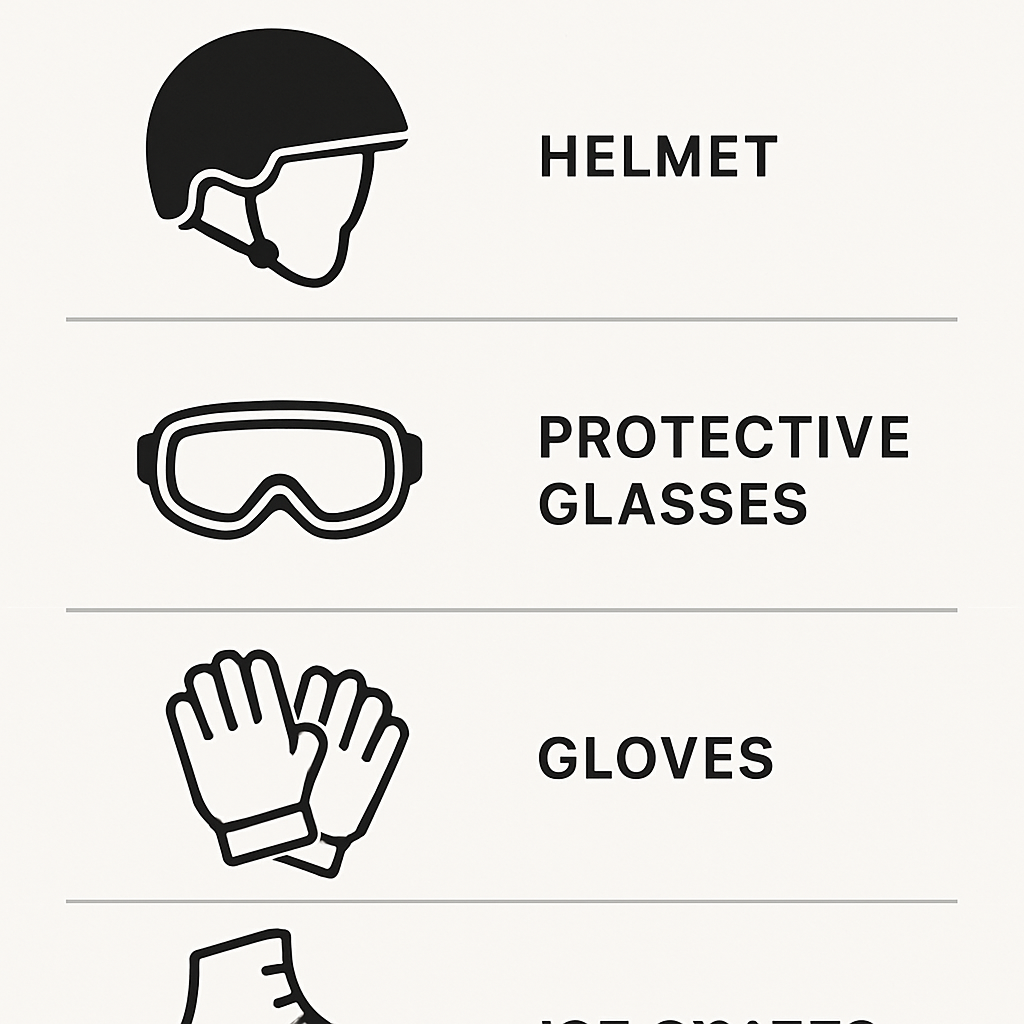
Before stepping onto the ice, some clear rules make a difference:
- Never kneel or sit in the middle of the rink to catch your breath.
- Get up by moving towards the edge if possible, to get out of others’ path.
- Keep hands closed or close to the body when balance is lost, as much as the child can manage.
- Avoid the fast perimeter if the rink is not separated between beginners and advanced skaters.
- Give up if the child is scared, crying, shivering, or unable to follow instructions anymore.
An attendant notes that, during the smoothest family sessions, the accompanying adult does not skate “for themselves”: they stay slightly behind, scan the traffic with their eyes, and create a safety space around the child. This role is especially useful for children under 6 to 8 years old, depending on their motor skills. Conversely, filming the scene or skating next to a second child distracts attention at the wrong moment.
It is observed on site that near-miss incidents almost always share the same warning signs: very crowded rink, tired child, gloves too thin, adult more than a few meters away. An ice rink attendant observes that the first minutes are decisive: if the child is already sliding uncontrollably near the edge, it’s better to get out and try again later.
Which equipment really reduces the risk of cuts and falls?
There is another way to think beyond a simple list of items: distinguish what protects against falling, what protects against cold, and what can limit cuts. Many comfortable pieces of equipment reassure, but few are truly useful at the critical moment. For those who want a simple base, the table below helps prioritize.
| Equipment | Main Use | Priority Level | Practical Note |
|---|---|---|---|
| Helmet | Reduces risk of head trauma | Very high | Particularly useful for beginners and young children |
| Thick gloves | Protect against cold, abrasion, and partially against cuts | Very high | Prefer a fitted model that covers the fingers well |
| Well-tightened skates | Improve control and stability | Very high | The heel should not float |
| Flexible pants | Freedom of movement and light protection | High | Avoid clothes that are too long and drag |
| Wrist guards | Limit certain fall injuries | Variable | Can help beginners, less common in recreational ice rinks |
| Long scarf / shoulder bag | No protection | To avoid | Risk of snagging and hindrance |
Cut-resistant gloves are sometimes mentioned after serious accidents. They can provide additional protection, but they do not replace supervision or managing the flow on the ice. On the other hand, gloves that are too thin or wet quickly lose their effectiveness. In practice, a sturdy glove that covers the hand well is better than mittens that are imprecise and prevent the child from properly grabbing the railing.
For helmets, the logic is similar to that of cycling or rollerblading: you don’t expect to need it, but you often regret its absence after a crash. It is not always mandatory in recreational ice rinks, yet it is a coherent choice for a beginner child, especially under 10 years old. According to the Ministry of Sports, personal protective equipment is part of preventing injuries related to sports and leisure activities; at the ice rink, this principle remains very concrete.
What to do immediately in case of a deep cut or severed finger?
In case of a serious injury, you must remove the child from the rink, compress the wound with a clean cloth or compress, call 15 or 112, then keep any severed part in a clean, waterproof bag cooled indirectly. Never place the finger directly on ice or in water.
The first priority is to secure the area and stop the bleeding. On an ice rink, the child may be in shock, cry little, or on the contrary struggle. They must be removed from traffic, immediately ask for help from the staff, then apply local compression with a sterile compress if available, or failing that a clean cloth. If the bleeding goes through the first dressing, add another on top without removing the first, so as not to restart the hemorrhage.
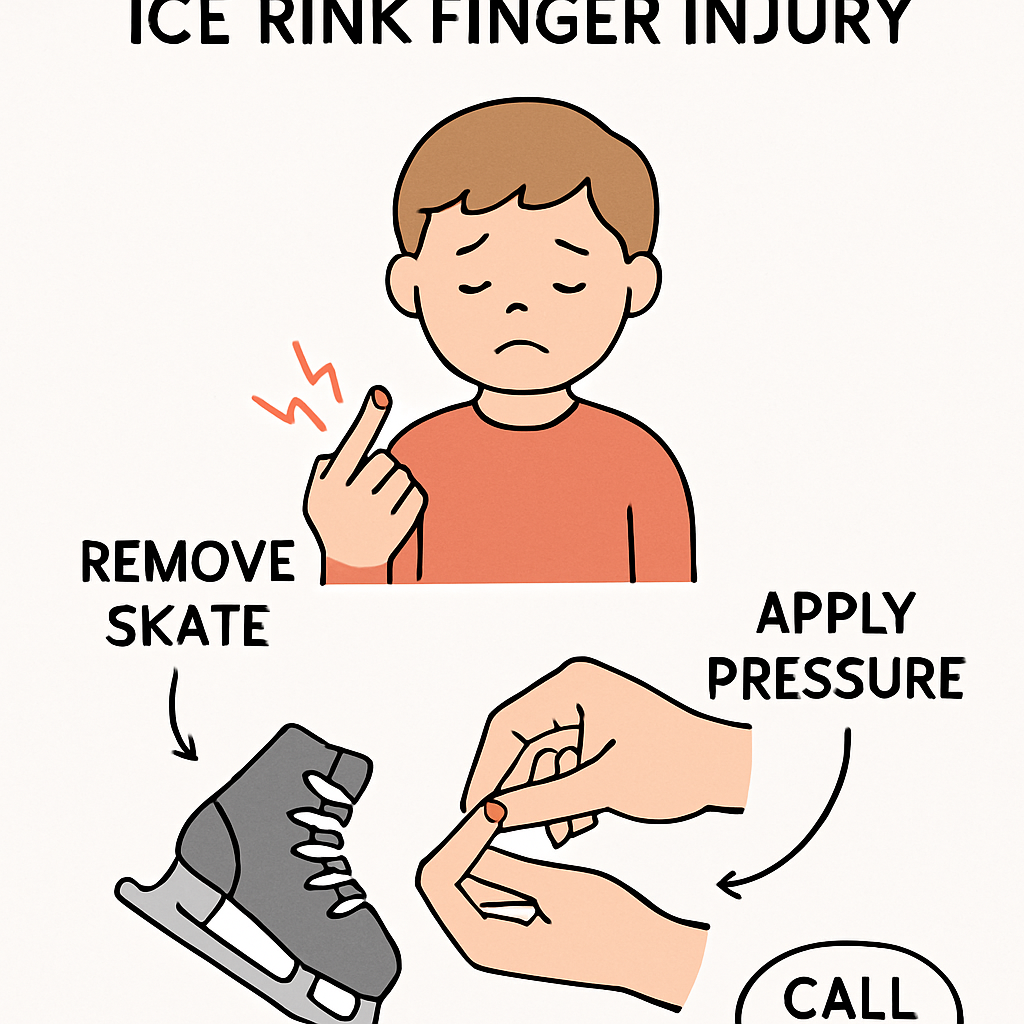
The second reflex is to alert. In France, the emergency numbers to know are 15 and 112, recalled by the Ministry of the Interior. For a hand injury with partial or total finger amputation, you must not “wait to see” if it bleeds less. Referral to an emergency department, or even to a hand surgery center, may be necessary very quickly. The site of Health Insurance reminds that an emergency affects functional prognosis or requires rapid care; this is typically the case here.
If a part of the finger has been severed, it must be properly protected. The generally recommended procedure is to wrap it in a clean compress, place it in a waterproof bag or container, then put this bag in a second container with cold, without direct contact with the ice. This nuance is important: cold helps preservation, but direct contact can further damage the tissues. Do not clean aggressively, rub, or soak in water.
In practice, parents sometimes hesitate between “going immediately to the hospital” and “waiting for the staff’s advice.” The correct order is rather as follows: first actions, alert, then transport according to received instructions. A family arriving in 2022 in a town equipped with a seasonal ice rink recounts that they had never imagined that removing a glove for a few seconds to “dry the hands” could expose the fingers so much during a fall. This type of detail seems trivial before the accident, but weighs heavily afterwards.
Who is responsible after an ice rink accident and what steps should be taken?
After an accident, you need to think about the child’s health, then about the evidence. Responsibility may lie with a third party, the operator, or a combination of circumstances. It is important to keep photos, witnesses, medical certificates, entry tickets, and to promptly report the claim to the liability insurance.
Responsibility is not automatic. If another skater collides with or injures the child, their civil liability may be sought depending on the circumstances. If the organization of the rink is questionable — overcrowding, lack of clear separation of skill levels, lack of information, defective equipment, insufficient supervision — the responsibility of the operator or organizer may also be discussed. In some cases, several factors coexist, which explains why families sometimes try to identify the skater involved, as reported after certain recent accidents.
Practically, you should gather as soon as possible:
- the exact or approximate time of the accident;
- the name and address of the ice rink;
- photos of the location, if the child’s condition allows after care;
- the contact details of witnesses;
- the entry ticket or proof of purchase;
- the initial medical certificate and hospital reports.
The website economie.gouv.fr recalls the principles of liability insurance, useful when damage is caused to others or suffered under certain contractual configurations. It is also relevant to check coverage via home insurance, extracurricular insurance, or any possible personal accident guarantee. As a general rule, a prompt declaration is preferable; many contracts allow a period of about 5 working days, but it is always necessary to reread the specific conditions.
If the identity of the person involved is unknown, the rink staff must be notified immediately to record the incident. It may be useful to ask if there is an accident register, agents present, or a video surveillance system. A police report or complaint may be considered if the circumstances justify it, especially in cases of obvious flight, dangerous behavior, or serious disagreement about the facts. The goal is not to automatically “litigate,” but to document an event whose medical and financial consequences can last for months.
When should you give up the session or take a child off the ice?
The best prevention is sometimes a very simple decision: stop. A child does not need to “last the entire session” to successfully finish their outing. There are several concrete warning signs that justify immediately leaving the ice, even if the atmosphere seems festive and everyone else continues skating.
The signs that should make you give up include:
- crowded rink with fast skaters continuously overtaking;
- visible fatigue, trembling legs, repeated falls;
- wet or removed gloves;
- poorly fitted skates causing pain or instability;
- panicked child who crouches or crawls after each loss of balance;
- no beginner space or overwhelmed staff.
A real estate agent has nothing to do with an ice rink, but a field agent in leisure safety often observes the same logic: serious accidents happen less when everything is going wrong than when “it still seems fine” for a few minutes too long. This is especially true at the end of a session, when fatigue sets in and parental attention decreases. About 30 to 45 minutes on the ice can already represent a sufficient duration for a young beginner; beyond that, the quality of support often deteriorates.
For those who want to extend the activity without increasing risk, it is better to alternate with a break off the ice, drink, check the hands, tighten the skates, and only resume if the child regains calm. This logic of micro-breaks works better than a long continuous session. Moreover, prevention often resembles other practical daily guides: like getting rid of gnats with a real action plan, effectiveness comes less from a “miracle gesture” than from a series of good reflexes applied at the right time.
2026 Checklist: good reflexes before, during, and after the ice rink
To make this guide immediately useful, here is an operational summary to keep before an outing.
Before the session
- Choose a less busy time slot, if possible outside holiday peaks.
- Plan for a helmet, thick gloves, flexible pants, and fitted clothing.
- Check the tightness of the skates and the actual size.
- Explain to the child how to get up by moving aside and avoid placing hands far forward.
During the session
- Stay within immediate reach of the child, especially during the first 10 minutes.
- Avoid fast zones and tight crossings.
- Leave the ice as soon as the child is tired, crying, or removes their gloves.
- Do not hesitate to shorten the session after several close falls.
In case of accident
- Remove the child from traffic.
- Compress the wound with a clean support.
- Call 15 or 112.
- Keep any severed part in a watertight container cooled indirectly.
After the accident
- Take photos and note witnesses.
- Request an intervention report if the rink has one.
- Report the claim quickly to the insurance.
- Keep all medical documents and expenses incurred.
FAQ about child ice rink accidents
Are gloves really essential at the ice rink?
Yes, especially for a child. They do not eliminate the risk of cuts from blades, but they protect against cold, abrasions, and add a useful barrier when the hand touches the ice. A thick, well-fitted glove is preferable to a simple decorative model.
Is a helmet mandatory for a child at the ice rink?
Not always, it depends on the rink’s rules. However, for a beginner or a young child, a helmet is strongly recommended because backward falls are frequent. Below about 10 years old, the benefit-to-comfort ratio is generally favorable.
Should you take a 3 or 4-year-old child to a public ice rink?
This can be done, but only if the rink, the schedule, and the supervision are appropriate. At this age, coordination is still limited and falling with hand support is very common. A short session, during a quiet time slot, with immediate exit at the first sign of fear, is often the best option.
What should you do if the other skater left without leaving their contact details?
You must immediately notify the staff, note any witnesses, and ask if there are any recordings. The quicker the response, the easier it is to document the facts. At the same time, your insurance claim should not wait for the certain identification of the person involved.
Can the ice rink refuse to provide information about the accident?
They can control their communication, but they must at least manage the event on site and, depending on their organization, record the incident. On your side, request written confirmation of the location, time, and the possible existence of an internal report. These are useful elements for the insurer and, if necessary, for any legal follow-up.
Does a small finger cut also require a consultation?
If the cut is superficial and the bleeding stops quickly, monitoring may be sufficient. However, if the wound is deep, located near a joint, accompanied by loss of sensation or persistent bleeding, a prompt medical opinion is preferable. The hand contains delicate structures and functional sequelae can be disproportionate compared to the size of the wound.