
Sommaire
1 % (w/v) = 10 g/L. For 5 L: grams of a.i. = 10 × 5 = 50 g.
Volume of concentrated product (mL) = (desired g / concentration in g/L) × 1000.
Example at 1 % with 360 g/L: 50/360 × 1000 ≈ 139 mL; with 480 g/L: 50/480 × 1000 ≈ 104 mL.
Our verdict ⭐
| Pros | Cons |
|---|---|
| Clear calculation method • ready-to-use tables • PPE reminders • error reduction | Technical units sometimes confusing • regulations vary by region • precise dosing requires proper equipment • risks if instructions ignored |
Rating: 4.4/5 | Recommended for: operators, communities, experienced gardeners who respect the label and regulations.
| Key points | Details to remember |
|---|---|
| 🌱 Definition | Glyphosate is the active ingredient of a systemic herbicide used to control undesired plants. |
| 🧪 Concentration | g/L and % (w/v) are useful units to convert a recommendation into a volume of product to pour. |
| 🔢 Practical calculation | Formula: ml product = (desired g / concentration g/L) × 1000 |
| ⚖️ Equivalences | Examples for formulations 360 g/L and 480 g/L at 0.5–2 % for 5 L. |
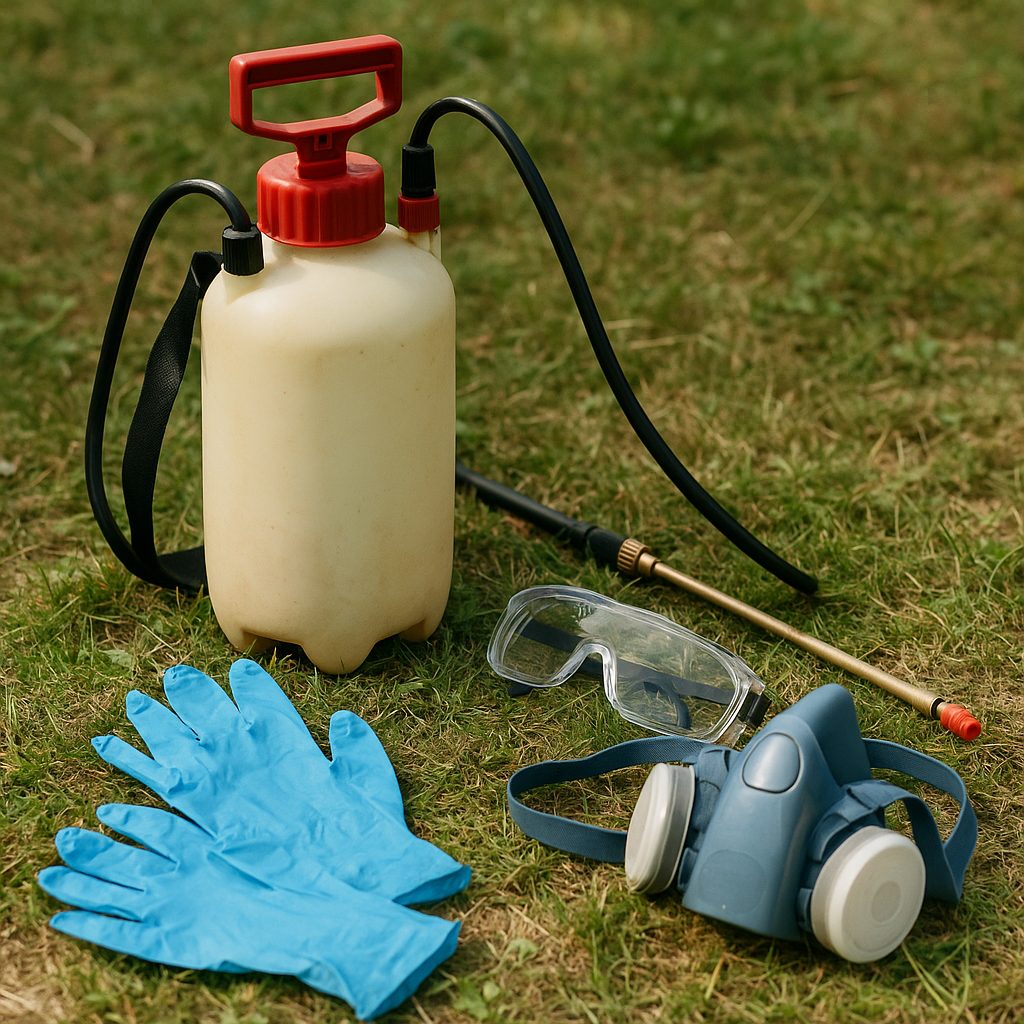
| 🛠️ Equipment | Scale or measuring device, gloves, goggles, calibrated sprayer: check condition before use. |
| ⚠️ Precautions | Follow the product sheet, avoid runoff and drift, dispose of leftovers properly. |
Preparing a glyphosate solution for 5 liters of water first involves understanding the units and formulations. You often encounter figures in g/L (grams of active ingredient per liter) or mass percentages. This guide explains how to convert a recommendation (e.g.: “1 % active ingredient“) into the actual volume of concentrate to measure, with numerical examples, conversion tables, and practical safety instructions. The idea is not to prescribe a precise use for all situations—each product has its label—but to provide you with the tools to do the calculation properly and avoid dosage errors.
Understanding units: % (w/v) vs g/L
In the context of liquid herbicides, 1 % (w/v) means 1 gram of active ingredient per 100 milliliters of solution, thus 10 g/L. Manufacturers often indicate the concentration of the commercial product in g/L (for example 360 g/L or 480 g/L). This number represents the amount of active ingredient in one liter of concentrated product. To convert a target into the amount of product to pour, just apply a simple rule of three.
Basic formula
Short and reusable procedure:
- Define the desired concentration in g/L (e.g.: 1 % = 10 g/L).
- Multiply by the final volume (here 5 L) to get the grams of active ingredient needed.
- Divide this amount by the product concentration (g/L) to get the volume of concentrated product in liters, then convert to milliliters.
Example formula: ml product = (desired g / product concentration in g/L) × 1000
Numerical examples — applied calculations
To make this concrete, let’s take two common formulations: 360 g/L and 480 g/L. We calculate the volumes needed to obtain solutions at 0.5 %, 1 %, and 2 % in 5 L of water.
| Target | g a.i. for 5 L | Volume for 360 g/L product (mL) | Volume for 480 g/L product (mL) |
|---|---|---|---|
| 0.5 % (5 g/L) | 25 g | 25 / 360 × 1000 ≈ 69 mL | 25 / 480 × 1000 ≈ 52 mL |
| 1 % (10 g/L) | 50 g | 50 / 360 × 1000 ≈ 139 mL | 50 / 480 × 1000 ≈ 104 mL |
| 2 % (20 g/L) | 100 g | 100 / 360 × 1000 ≈ 278 mL | 100 / 480 × 1000 ≈ 208 mL |
These results show that the strength of the concentrate radically changes the volume to measure. For a 1 % solution in 5 L, you pour about 140 mL of a 360 g/L product or 104 mL of a 480 g/L product. Even a small difference in formulation = a big difference in milliliters to dose.
Practical steps to prepare 5 L of solution
Here is a simple protocol designed to reduce errors and limit exposure:
- Read the product label: always follow the precise recommendation of the manufacturer — this is the legal and safety rule.
- Equip personal protective equipment: nitrile gloves, sealed goggles, long clothing, and if possible, respiratory mask according to the label.
- Partially fill the sprayer (about half with clean water).
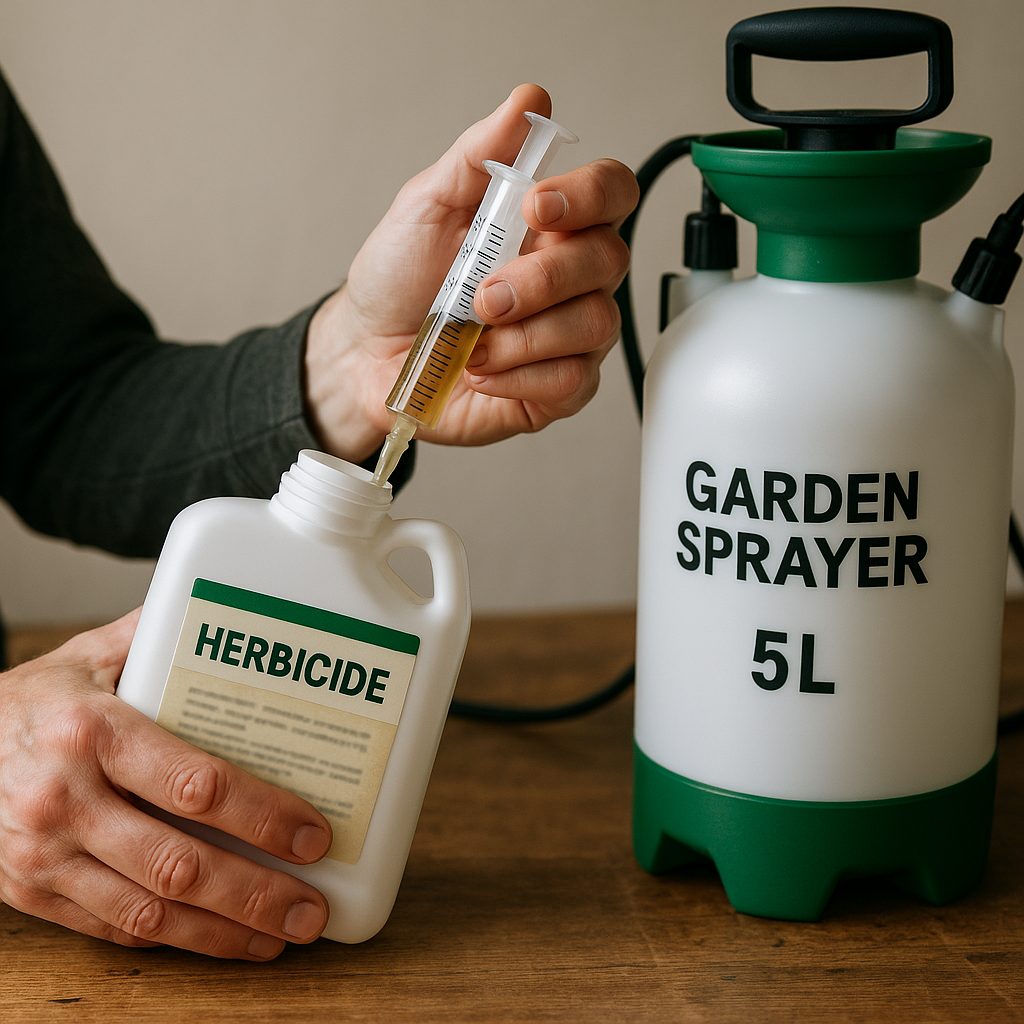
- Measure the volume of concentrated product with a graduated container or a clean, dry graduated syringe, then add it to the water. Never pour water into the concentrated product.
- Mix gently, then top up with water to 5 L.
- Label the container immediately if the preparation is not used right away.
Measurement tips
Using an opaque measuring cup can distort graduations if poorly positioned. Prefer a graduated syringe for small volumes: it limits error and splashing. Rinse instruments carefully after use in a designated area, and never reintroduce rinse water into a drinking water source.
Quick equivalences and conversions
To save time in the field, memorize some benchmarks or keep a small table. Remember that:
- 1 % = 10 g/L → for 5 L = 50 g of a.i.
- If product = C g/L, ml to pour for 5 L = (50 × desired percentage %) / C × 1000 (formula adapted as needed).
- Common errors: confusing % v/v and % w/v, forgetting to convert liters to milliliters, mixing up commercial concentration.
Risks, storage, and disposal
Using glyphosate requires careful reading of the technical sheet and label. Avoid:
- drift to neighboring crops or ornamental plants; spray in calm weather;
- mixing in an improper container or storing unlabeled leftovers;
- discharging residues into sewers or water bodies: packaging and leftovers must be disposed of according to local regulations.
In case of skin exposure, remove contaminated clothing and rinse thoroughly. If inhalation or ingestion is suspected, consult a poison control center or a health professional specifying the product label.
Quick summary table
| Purpose | Calculation | Example for 5 L (360 g/L product) |
|---|---|---|
| 1 % a.i. | 10 g/L × 5 L = 50 g → 50 / 360 ×1000 | ≈ 139 mL |
| 0.5 % a.i. | 5 g/L × 5 L = 25 g → 25 / 360 ×1000 | ≈ 69 mL |
| 2 % a.i. | 20 g/L × 5 L = 100 g → 100 / 360 ×1000 | ≈ 278 mL |
What we liked ✅ / liked less ⚠️
✅ Liked
- Universal formula simple to reuse
- 360/480 g/L examples very concrete
- Safety focus and PPE reminders
- Tables scannable in the field
- %↔g/L conversion clarified
- Useful measurement tips (syringe, graduations)
- Stepwise structure to reduce errors
⚠️ Liked less
- Units “w/v” can be confusing
- Regulations differ by country/community
- Overdosing to avoid: follow the label
- A table for other concentrations could help
- No embedded calculator (QR/tool)
- A photo not sufficiently captioned (added below)
- An example of 240 g/L would be useful
Methodology
Conversions based on unit definitions (% w/v, g/L) and use of the rule of three. The examples at 360 and 480 g/L are calculated from targets of 0.5 %, 1 %, and 2 % for a final volume of 5 L.
Best practices retained: respect the product label, PPE, safe dilution (water then product), avoiding runoff, and managing residues according to local regulations.
Conclusion
To prepare 5 L of glyphosate solution without error, first convert the % (w/v) into g/L, calculate the grams of a.i., then convert into milliliters according to the commercial concentration (g/L). Follow the manufacturer’s label, wear PPE, and apply in calm weather. The precision of dosage determines efficacy and limits risks.
FAQ
How to convert a recommendation in % to mL of concentrated product?
Convert the % to g/L (1 % = 10 g/L), multiply by 5 to get grams for 5 L, then divide by the commercial concentration (g/L) and multiply by 1000 to get milliliters.
Can the solution be prepared in advance and stored?
It is better to prepare the needed amount for the day. Some products lose effectiveness after storage; moreover, storing a diluted solution increases accident risks. If storage is necessary, follow the product label.
What to do if I overdosed by mistake?
Stop application, clean the equipment, and consult the product sheet for recommendations. For treated surfaces or sensitive areas, rinse with water if the label allows and notify concerned persons.
How to choose between 360 g/L and 480 g/L formulations?
The choice depends on the recommendation for the crop or targeted situation, ease of transport and storage, and preference for measuring smaller volumes (a more concentrated product reduces transport volume). Always comply with the label.
🔎 General information. Strictly respect the label, local authorizations, and PPE/PPF. Application may be regulated or prohibited depending on zones/uses. If in doubt, consult a licensed professional. Update: 2025-10-30.