
Sommaire
How to Sleep Without Mosquitoes in Summer: Practical Guide to Protect Your Bedroom
| 📌 | Goal: minimize the entry of mosquitoes into the bedroom and block those that remain. |
| 🛏️ | Priority: protect the bed, as it is the area where stillness favors bites. |
| 🌬️ | Useful reflex: air out at the right time then close before the most active period in the evening. |
| 🪟 | Key equipment: a well-installed window mosquito net remains the most consistent barrier. |
| 🔎 | Quick routine: inspect corners, curtains, under the bed, and around openings every evening. |
| 👶 | Sensitive case: for a baby or child, physical protections should be prioritized. |
In summer, sometimes just a window left open for ten minutes at the wrong time can turn the bedroom into a hunting ground for MOSQUITOES. The problem is not only discomfort: a night broken by buzzing, awakenings, and bites has a direct effect on recovery. The good news is that the situation can be significantly improved with a simple, realistic, and repeatable method, without turning your room into a bunker. Here are the gestures that really matter, the most useful equipment, and the mistakes that often cancel out all efforts.
Why is the bedroom so sensitive to mosquitoes in summer?
The bedroom concentrates three factors favorable to mosquitoes: a usually discreet entry at airing time, a person immobile for several hours, and dark corners where the insect can settle before or after biting. A single intrusion is enough to ruin the whole night.
The bedroom is a paradoxical room: we want to cool it down in the evening, so we open windows, but it is precisely at this time that many mosquitoes become most bothersome. The most common species around homes, such as certain Culex, are mainly active from dusk to night. As for the tiger mosquito, Aedes albopictus, it bites more during the day, but it can still remain in the house and disturb bedtime if it entered earlier. This time lag often deceives us: we believe the room is clean because we see nothing at 7 p.m., then the buzzing starts once the light is off.

Sleep then worsens the problem. A lying person emits CO₂, body heat, and skin odors that help mosquitoes locate their target. Once in bed, you move less, react later, and the insect has a better chance to bite quietly. In practice, it is observed in the field that many “quiet” bedrooms during the day become problematic at night simply because the occupant remains immobile for several hours.
Another often underestimated point: a single oversight is enough. A mosquito net poorly fitted in a corner, back and forth to the bathroom, a door ajar onto a lit hallway, and the insect enters. If you want to understand more broadly why mosquitoes enter the house, the logic is always the same: easy access, warmth, human presence, and sheltered resting areas.
The Most Critical Moments Before Bedtime
The most delicate period often occurs between late afternoon and the moment you turn off the lights. Ventilating for a long time at dusk is pleasant, but it is rarely the best idea when mosquitoes are already active outside. Indoor lighting also plays an indirect role: it does not “attract” them like a moth, but it signals an occupied room and is often accompanied by frequent openings, movements, and air exchanges that facilitate their entry.
Finally, the time spent motionless in bed changes everything. A room where you spend 20 minutes standing may seem bearable, whereas a night of 7 to 8 hours there becomes unpleasant. This is why protecting the bedding is generally more cost-effective than multiplying scattered tricks throughout the room.
How to Prepare Your Room Before Night?
The best strategy is to combine three actions: ventilate early or briefly, close or filter all useful openings, then inspect areas where a mosquito might hide. In practice, preparing the room often counts as much as personal protection.
Preparing your room is not just about closing the window. It is above all about choosing the right timing. During hot weather, it is better to ventilate early in the morning if possible, then more briefly in the evening, before the most troublesome period. If you must ventilate late, a well-fitted window mosquito net becomes almost indispensable. According to prevention advice disseminated by Service-Public.fr on the tiger mosquito, reducing entry points and breeding sites around the home remains fundamental.

Next, secure secondary access points. In many homes, mosquitoes do not enter through the large visible window but through a small forgotten opening: transom, slightly open patio door, worn seal, shutter box with play, bedroom door left open towards a lit living room. A targeted check takes less than two minutes and often avoids endless nocturnal searches. For a broader view of solutions, you can also consult this file on mosquitoes in the house, useful for connecting the bedroom to the rest of the home.
It is observed in the field that, in urban apartments, the most exposed bedrooms are not always those on the ground floor. A maintenance worker often notices that mosquitoes remain trapped for several hours on upper floors as soon as a window is opened in the evening with indoor lighting on.
Around the bed, eliminate what offers immediate hiding places: piles of clothes on the floor, curtains pressed tightly against the bedding, clutter under the bed, objects hanging near the headboard. The goal is not to have an empty room, but to reduce discreet landing zones. A simpler environment also makes spotting the last mosquito much easier.
Quick Checks to Do Every Evening
An effective routine relies on a few always identical checks. First, look around the window and shutter edges, as mosquitoes can remain motionless near a cool or dark area. Then move to the curtain, bedside lamp, wall behind the bed, and ceiling corners. Finally, take a look under the bed and behind the door. This sequence is brief but covers the areas where the insect most willingly rests.
- Window and seals: check that no corner is lifted.
- Curtains and sheers: shake lightly to dislodge any resting mosquito.
- Dark areas: under the bed, wall corner, behind the door.
- Final visual check: before turning off the light, remain still for 30 to 60 seconds to listen.
The Most Useful Equipment in a Bedroom
Not all equipment is equal. In a bedroom, the most useful are generally those that create a physical barrier or make approach more difficult. The window mosquito net comes first, followed by the bed mosquito net and the fan. The latter does not “kill” mosquitoes, but the airflow disrupts their flight and partially disperses the signals that guide them. A model aimed at the sleeping area, at a reasonable distance, is often more effective than a device placed in a corner of the room.
| Equipment | Main Use | Advantage | Limit |
|---|---|---|---|
| Window mosquito net | Prevent entry | Continuous protection | Careful installation on edges |
| Bed mosquito net | Directly protect the sleeper | Very reliable if well installed | Can be warm if poorly ventilated |
| Fan | Disturb flight and limit approach | Also provides a cooling sensation | Does not block mosquito entry |
| Door bottom seal | Reduce discreet passage | Simple and durable | Does not affect other openings |
Protecting the Bed: The Most Reliable Solution for Peaceful Sleep
If you had to choose a single priority, it would often be bed protection. A well-installed physical barrier around the sleeping area remains the most consistent method, as it acts exactly where you are most vulnerable: immobile, asleep, and exposed for several hours.
The bed mosquito net is particularly useful in very hot rooms, vacation homes, or rooms where the sealing of openings is average. It creates a clear separation between the mosquito and the sleeper, which no occasional action guarantees as well. However, effectiveness depends on one essential detail: the fabric must not touch the skin. If your arm or leg presses against the mosquito net, the insect can bite through depending on the type of fabric and the tension of the netting.
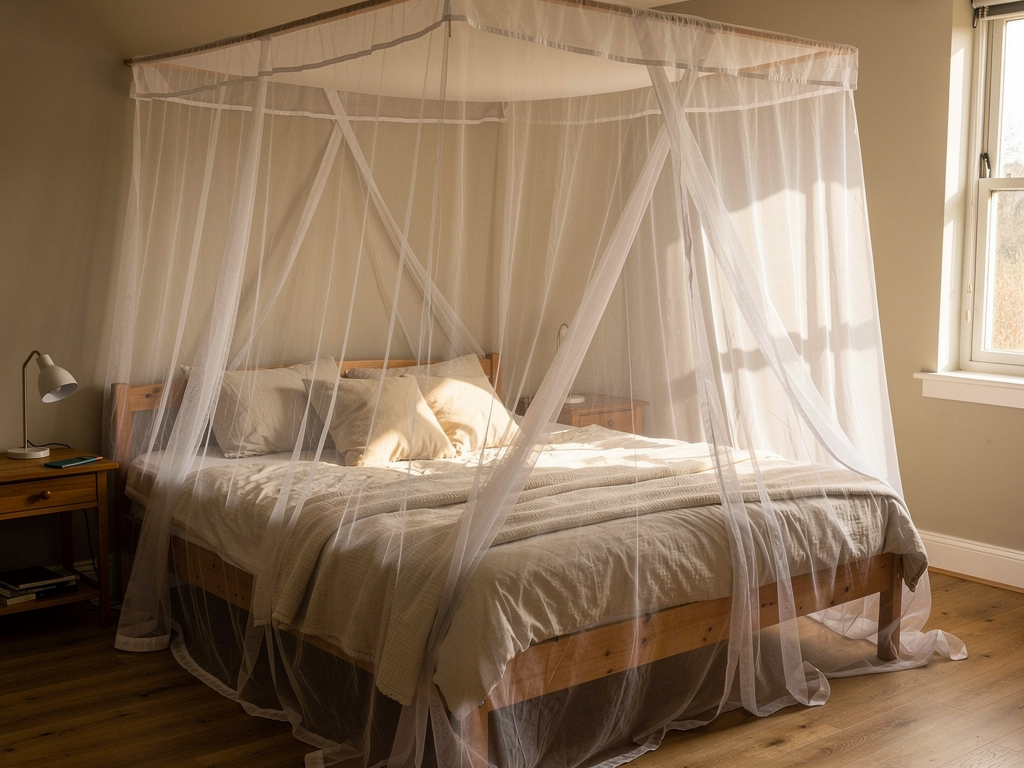
The placement of the bed also matters. If possible, avoid placing the bed against a regularly opened window, a thick curtain, or a wall where air circulates little. A slightly cleared bed facilitates inspection, limits accidental contacts with the mosquito net, and improves thermal comfort. Cover yourself with a light cloth if necessary: a simple thin layer on the most exposed areas can reduce bites without worsening the heat as much as a traditional blanket.
Properly Installing a Bed Mosquito Net
Choose a model adapted to the exact size of the bed: single bed, double bed, travel cot, or crib. A common mistake is to choose one too small, which creates tension, unintended openings, or permanent contact with the sleeper. For a baby’s bed, vigilance must be increased: the installation must remain stable, well ventilated, and checked every night. The general recommendations from the ANSES on the tiger mosquito also emphasize the importance of prioritizing physical protection measures.
Before sleeping, always perform a three-point check: lower edge well tucked or well pressed, no holes or incomplete closure, no objects pushing the net inward. These are details, but it is precisely there that the difference between a peaceful night and a night of getting up is made.
Good habits around sleeping areas
Around the bed, the logic is simple: the fewer resting zones there are and the more the air circulates, the better. Keep suspended objects or those too close to the face away, maintain easy access to the bed, and avoid letting the mosquito net or sheet touch the legs. If you are looking for other concrete answers about biting times or typical behaviors, this page on frequently asked questions about mosquitoes complements well the bedroom practices.
What routine to adopt every evening to sleep without mosquitoes in summer?
The most effective routine consists of five steps: filter or close openings, ventilate smartly, inspect hiding spots, secure the bed, then do not reopen the room. It is less the products than the regularity and order of actions that make the difference.
A routine works because it prevents forgetfulness. When it’s hot, we tend to improvise: we open, close again, turn on the light, go out again, then go to bed hoping everything will be fine. Yet mosquitoes take advantage precisely of these micro-openings. A simple sequence repeated every evening is more effective than an accumulation of solutions used irregularly.
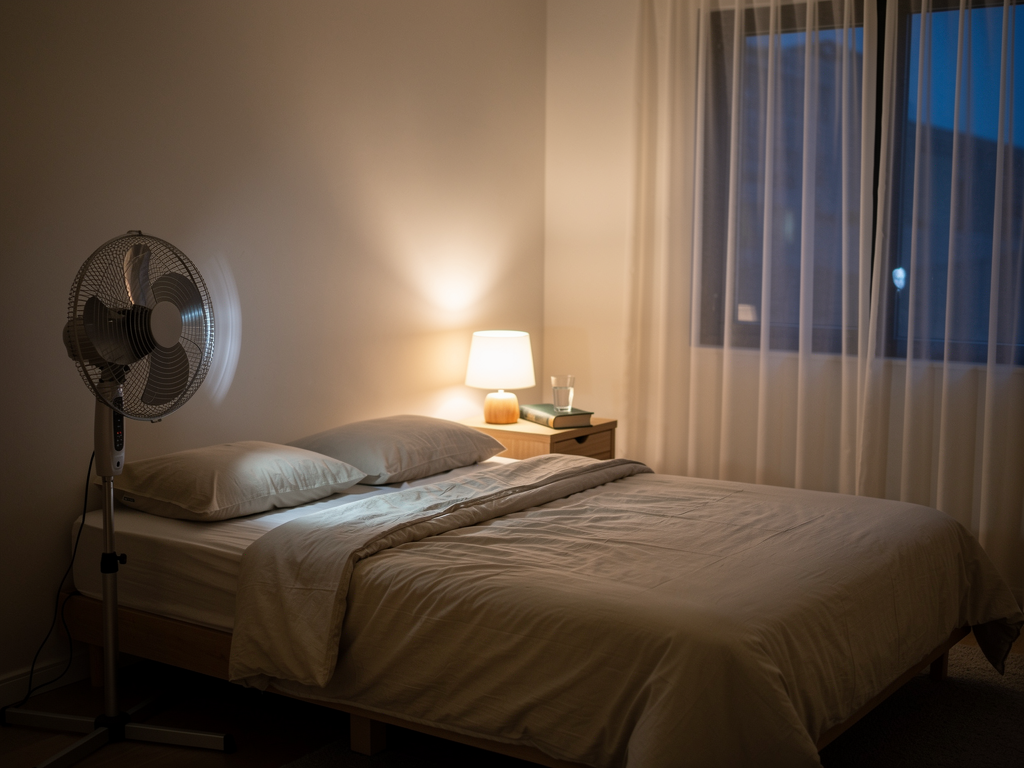
The correct order matters a lot. If you first activate bed protection but then reopen the window wide or leave the door open, you cancel part of the benefit. In practice, a family renting a summer home often says they sleep better by doing fewer things, but always in the same order: short airing, closing, checking, going to bed. This simplicity is often more sustainable over fifteen nights than an overly ambitious protocol.
Express routine in 5 steps
- Close or filter openings: window with mosquito net, door firmly closed, door draft stopper in place if needed.
- Turn on the fan: a few minutes before going to bed to cool down and create a useful airflow.
- Check the bed: sheets, bed surroundings, mosquito net if you use one.
- Deal with the last visible mosquito: do not postpone this step until the next day, it is often the one that wakes you at 2 a.m.
- Go to bed without reopening the room: this is the most neglected point and yet one of the most important.
The best protection against mosquitoes is not necessarily the most sophisticated: it is often the one you can maintain every evening without thinking about it.
If an insect is still flying around the room, it’s better to handle it immediately. Capture or local reduction solutions can help, especially in adjoining living areas; you will find some practical ideas in these homemade mosquito traps, but for the bedroom, the priority always remains the physical barrier and the routine.
What to do depending on your bedroom situation?
There is no single ideal method for all bedrooms. An attic room, a child’s bedroom, or a summer rental do not have the same constraints. The most effective approach is to combine few actions but choose them according to the actual configuration of the place.
This adaptation is essential, because a very hot bedroom poorly tolerates a total closure too early, whereas a better-insulated bedroom will more easily support a strategy based on quick closure. The advice below helps to decide without complicating life.
Attic or very hot bedroom
In a room that accumulates heat, the dilemma is classic: open to breathe or close to avoid bites. Here, the good combination is often ventilation + bed protection. Air out earlier, or more briefly in the evening, then close before going to bed. If the window must remain open, the window mosquito net becomes almost essential. Sleeping with the window wide open without a barrier in an overheated room is one of the scenarios most favorable to mosquitoes.
The fan then takes on a dual value: thermal comfort and mechanical nuisance for the insect. In Nice, Montpellier, or other hot coastal cities, this type of combination is often more realistic than complete closure throughout the evening. According to Santé publique France, prevention is primarily based on avoiding bites and reducing exposure.
Child or baby’s room
In a child’s room, priority goes to physical protections. A properly installed bed or crib mosquito net, a room prepared early, and careful checking before lights out are generally the simplest options to maintain. Avoid makeshift solutions that touch the face or overly reduce ventilation. Here, “almost well installed” is not enough: daily verification is essential.
For young children, routine stability is particularly helpful. Always preparing the room at the same time reduces the risk of forgetting and limits nighttime awakenings caused by bites or the noise of an insect. If you add plants near the window or on an adjacent balcony, keep in mind that their effect remains secondary; to sort them out, this comparison on effective mosquito-repellent plants helps distinguish the useful from the decorative.
Summer rental or temporary accommodation
In a seasonal rental, you do not always have control over the equipment. The most cost-effective is then to opt for solutions that are easy to install and remove: portable bed mosquito net, removable fixing tape for small mosquito nets, simple door bottom seal, auxiliary fan if the accommodation has one. Upon arrival, inspect the openings: a room may seem fine during the day but reveal its weaknesses at the first bedtime.
In this context, it is better to have modest but reliable protection than a set of scattered tricks. A temporary room mainly requires saving time and quickly securing the sleeping area, as you will neither have the tools nor the desire to optimize the entire accommodation.
FAQ: useful answers for better sleep despite mosquitoes
Is sleeping with the window open a bad idea?
Not necessarily, but only if the opening is protected. An open window without a mosquito net when mosquitoes are active significantly increases the risk of intrusion. If the room is very hot, it is better to combine early ventilation, mosquito net, and fan rather than leave everything open without a barrier.
Fan or mosquito net: which to prioritize?
The mosquito net remains a priority because it physically blocks access. The fan improves comfort and can hinder flight, but it does not replace a barrier. In a room difficult to cool, the ideal is often the combination of both.
What to do if a mosquito is already in the room?
The most effective is to spot it before turning off the lights. Look at the walls, curtains, dark corners, and behind the bed. Once in bed, do not reopen the room widely to look for it, otherwise you risk letting another one in.
How to avoid getting bitten without turning the room into a fortress?
Focus on three points: a filtered opening, a protected bed, and a short routine repeated every evening. In practice, this trio is often enough to significantly reduce bites without multiplying equipment. The idea is not to lock everything down, but to secure the truly strategic passages.
Do mosquitoes stay hidden in the room all day?
Yes, it is common. They can rest for several hours in a dark corner, behind a curtain, or under furniture, then become bothersome again later. That is why a targeted inspection in the evening is useful even if you have heard nothing during the day.
Are scented solutions enough to sleep peacefully?
Their effect is variable and often less consistent than a well-installed physical protection. They can complement a strategy, but rarely replace it alone in a room. If the goal is a calm night, the barrier around the bed or openings remains the most reliable choice.