
Sommaire
Commissioning a heat pump: steps, fluids, pressurization, start-up
TL;DR: The commissioning of a heat pump must be carried out by a certified refrigeration technician: mechanical/electrical checks, nitrogen pressurization, deep vacuum pumping (~500 microns), and regulation adjustments. The fluid (R32 A2L, R290 A3…) requires safety conditions (EN 378, F-Gas 2024/573). A reception file documents all values.
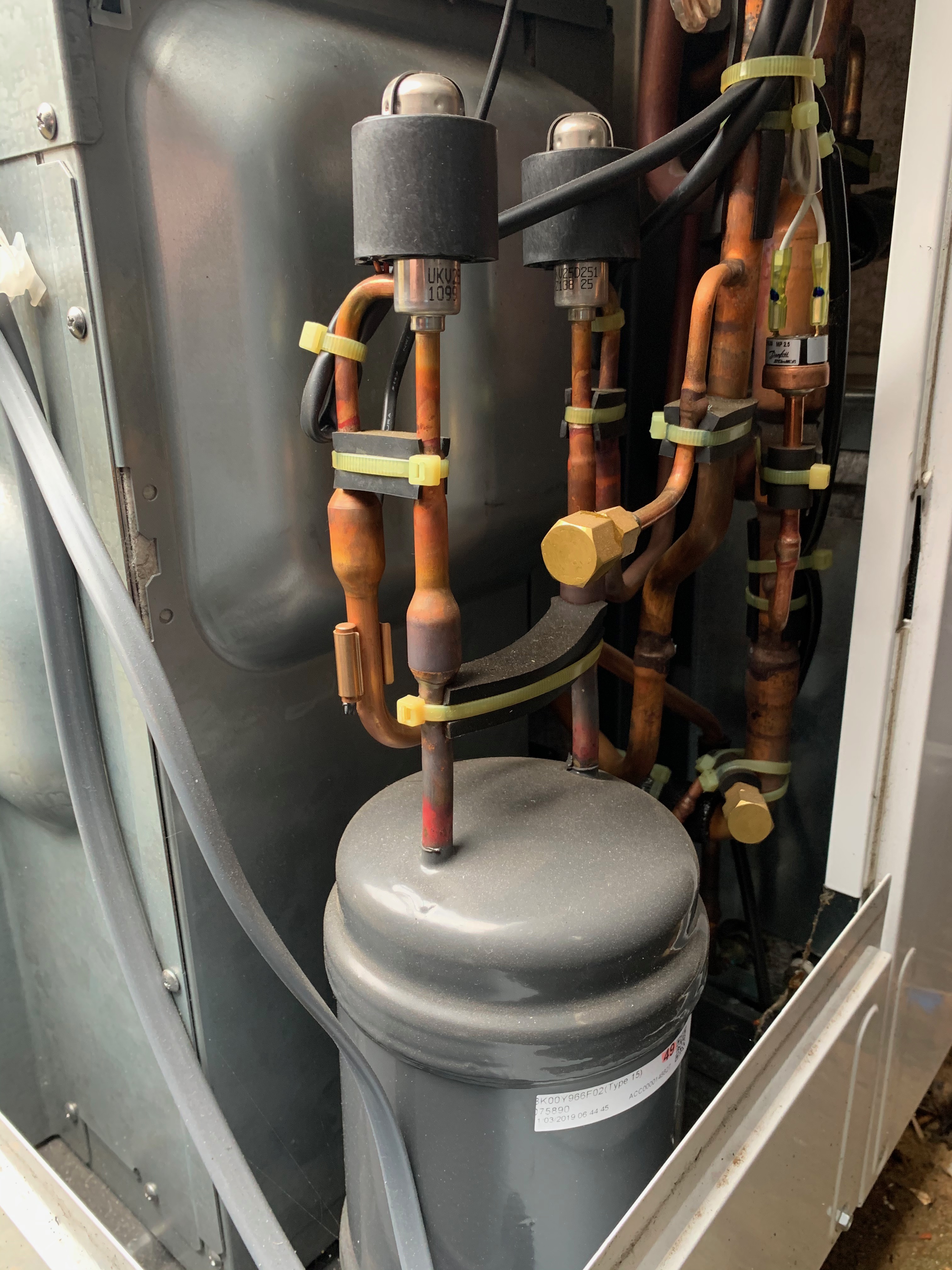
1. Commissioning: objectives & stakeholders
The commissioning (COM) is the sequence of tests, adjustments, and checks that validate a heat pump (air-air, air-water, water-water). It ensures proper operation, the manufacturer’s warranty, and operational safety. It includes: visual inspection, electrical/hydraulic checks, circuit tightness, vacuum pumping, valve opening, configuration, heating/DHW tests, and delivery of a signed report.
- Refrigeration technician with certification for handling refrigerants.
- Electrician/Heating technician for wiring, hydraulics, adjustments.
- Client: acceptance, explanations, maintenance log.
2. Safety & 2025 regulations (F-Gas, EN 378)
- F-Gas 2024/573: HFC quotas, traceability, mandatory skills, promotion of low GWP (R290/R744…).
- EN 378 (NF EN 378): charge limits by safety class (A1/A2L/A3), ventilation requirements, detection, ATEX zones if required.
- Electricity: dedicated circuits, 30 mA RCD adapted (Type F recommended/required for single-phase drives according to guides), compliance with NF C 15-100.
3. Essential tools & instruments
- Dry nitrogen bottle (OFN) + two-stage regulator.
- Efficient vacuum pump + independent micron gauge.
- Manifold (ideally digital), dedicated hoses, electronic scale.
- Leak detector (electronic) + foam, thermometers/probes.
- Copper tools (flaring, nitrogen brazing), PPE.


4. Detailed steps: from pre-commissioning to start-up
4.1 Pre-commissioning
- Visual: fixings, drains, clearances, antivibration mounts, cleanliness.
- Refrigeration: brazing under nitrogen purge, bending radius, continuous insulation, valves closed.
- Hydraulic (air-water): flushing, Y-filter, purging, expansion vessel, cold pressure, water quality.
- Electrical: grounding, polarity, tightening, MCB rating & curve, adapted 30 mA RCD type, surge protector if required.
- Docs: manuals, schematics, refrigerant safety data sheets, prevention plan (R290).
4.2 Nitrogen pressurization
- Increase pressure according to the manual via two-stage regulator.
- Maintain and detect leaks (foam + detector).
- Repair if necessary, then re-test pressure holding.
- Purge nitrogen before vacuum pumping.
4.3 Deep vacuum pumping & rise test
- Properly sized vacuum pump, new oil, short/sealed hoses.
- Measurement with micron gauge on the system (not at the pump).
- Typical target: ≈ 500 microns, then rise test: stability < 1000 microns = OK.
- Rise too fast? Repeat triple evacuation with nitrogen break.
4.4 Charging & valve opening
- Monobloc: factory charge, hydraulics only.
- Split/VRF: charge by weight (supplement according to lengths), valve opening per manufacturer sequence.
- R290: zone without ignition source, ventilation, adapted tools.
4.5 Start-up & tests
- Configure controls (water curve, DHW setpoints, schedules).
- Check flows (air/water) and ΔT.
- Test cycles (heating/DHW, defrost).
- Check currents/voltages and absence of RCD trips.
- Record T°, P, SH/SC (if applicable) and compare to manual ranges.

5. Refrigerants: classes, GWP & trends
| Refrigerant | Class (ISO 817) | GWP ~ | Usage | Commissioning points |
|---|---|---|---|---|
| R410A | A1 | ≈2088 | Older heat pumps | Transition underway, standard commissioning. |
| R32 | A2L | ≈675 | Recent splits/heat pumps | Charge limits, ventilation, A2L procedures. |
| R454B | A2L | ≈466 | R410A replacement | Instructions similar to R32. |
| R290 | A3 | ≈3 | Monobloc heat pumps | High flammability: safe zone and dedicated tools. |
6. Key settings: water curve, flows, SH/SC, defrost
Water curve & setpoints
- Adapt the curve to the building and emitters (floor heating 30–40 °C; low-temp radiators 40–50 °C).
- Enable climate compensation (outdoor sensor) and optimize DHW ranges.
Flows & ΔT
Respect manufacturer flow rates; aim for a ΔT of 5–10 K in heating (variable by system).
SH/SC (if applicable)
- Superheat (SH) to protect the compressor.
- Subcooling (SC) to monitor charge/exchange.
Defrost
Validate activation, duration, and condensate drainage; avoid ice buildup at the unit base.

7. Commissioning file & quality
- Identification: site, models/numbers, refrigerant, charge, lengths.
- Pre-checks: visual, hydraulic, electrical (RCD), ventilation (A2L/A3).
- Nitrogen: pressure, duration, detection results.
- Vacuum: final value (e.g. ~500 microns), rise (microns after X min).
- Charge: added mass, calibrated scale, final tightness.
- Tests: T°, P, SH/SC, ΔT, currents, defrost.
- Settings: water curve, schedules, protections.
- User information: modes, eco-gestures, maintenance.
8. Start-up faults: quick diagnosis
| Symptom | Cause | Action |
|---|---|---|
| RCD trips | Drive profile, unsuitable RCD | Check wiring/selectivity; prefer Type F 30 mA if prescribed. |
| No stable vacuum | Leak/moisture | Leak search + triple evacuation with nitrogen break. |
| Too frequent defrosts | Airflow, sensors | Clean filters, clear unit, check sensors/settings. |
| Noise/vibrations | Fixings/pads | Tighten, isolate, direct airflow, antivibration mounts. |
| Warm DHW | Settings/priorities | Adjust setpoints/schedules, check 3-way valve & flow. |
Also read: Air-to-water heat pump installation: 2025 guide and Diagram & wiring air-to-air heat pump.
FAQ — Commissioning a heat pump
Who can perform the commissioning?
A certified professional (fluids capacity certificate). Pressure/vacuum/charging operations are strictly professional.
Why aim for ~500 microns?
To effectively remove moisture and non-condensables; stability < 1000 microns after stopping the pump is a good indicator.
Differences R32 vs R290 during commissioning?
R32 (A2L): controlled charging/ventilation; R290 (A3): high flammability → ignition-free zone, ventilation, suitable tools.
Is brazing under nitrogen necessary?
Yes. Nitrogen purge prevents soot, protects oil and expansion valves/EEV.
Which documents to provide?
Commissioning report (pressure/time values, microns, masses), capacity certificate, fluid SDS, maintenance logbook and user instructions.
Reliable sources
- EUR-Lex — Regulation (EU) 2024/573 (F-Gas)
- AREA — Introduction to EN 378 (A2L/A3)
- AFNOR — NF EN 378-1 (ref.)
- Daikin — Installation Instructions (vacuum & rise test)
- Daikin — VRV Commissioning (vacuum procedure)
- Mitsubishi Electric — Installation Manual
- Promotelec — NF C 15-100 (reminders)
- ADEME — Heat pumps: guide & maintenance
{
“@context”: “https://schema.org”,
“@graph”: [
{
“@type”: “Article”,
“headline”: “Commissioning a heat pump: steps, fluids, pressurization, start-up (2025 Guide)”,
“description”: “Complete and safe commissioning procedure for a heat pump: checks, nitrogen pressurization, vacuum pulling (~500 microns), R32/R290 safety according to EN 378 and F-Gas 2024/573, adjustments and checklist.”,
“inLanguage”: “fr”,
“author”: {
“@type”: “Person”,
“name”: “SEO Article Writer”
},
“publisher”: {
“@type”: “Organization”,
“name”: “https://www.pcsm-idf.fr”,
“logo”: {
“@type”: “ImageObject”,
“url”: “https://upload.wikimedia.org/wikipedia/commons/6/6b/Ecodan_outdoor_unit_Internal_view.jpg”,
“width”: 1200,
“height”: 1600
}
},
“image”: [
“https://upload.wikimedia.org/wikipedia/commons/6/6b/Ecodan_outdoor_unit_Internal_view.jpg”,
“https://upload.wikimedia.org/wikipedia/commons/7/79/A_nitrogen_gas_cylinder_with_pressure-relief_devices.jpg”,
“https://upload.wikimedia.org/wikipedia/commons/1/1b/Pirani_01.jpg”,
“https://upload.wikimedia.org/wikipedia/commons/e/e2/Ecodan_outdoor_unit_in_the_snow.jpg”,
“https://upload.wikimedia.org/wikipedia/commons/d/d8/Inside_of_split_type_ac_outdoor_unit.jpg”
],
“datePublished”: “2025-09-07”,
“dateModified”: “2025-09-07”,
“mainEntityOfPage”: {
“@type”: “WebPage”,
“@id”: “https://www.pcsm-idf.fr/blog/mise-en-service-pompe-a-chaleur-etapes-fluides-pression-mise-en-route”
}
},
{
“@type”: “FAQPage”,
“mainEntity”: [
{
“@type”: “Question”,
“name”: “Who can perform the commissioning?”,
“acceptedAnswer”: {
“@type”: “Answer”,
“text”: “A professional certified in handling refrigerant fluids (capacity certificate). Pressurization, vacuum, and charging operations are strictly reserved for professionals.”
}
},
{
“@type”: “Question”,
“name”: “Why aim for about 500 microns?”,
“acceptedAnswer”: {
“@type”: “Answer”,
“text”: “This vacuum level ensures the extraction of moisture and non-condensable gases. Stability below 1000 microns after stopping the pump is a good validation criterion.”
}
},
{
“@type”: “Question”,
“name”: “R32 vs R290 during commissioning?”,
“acceptedAnswer”: {
“@type”: “Answer”,
“text”: “R32 (A2L): charge limits and ventilation; R290 (A3): high flammability, area free of ignition sources and appropriate tools. Always follow the manufacturer’s instructions and EN 378.”
}
},
{
“@type”: “Question”,
“name”: “Is brazing under nitrogen necessary?”,
“acceptedAnswer”: {
“@type”: “Answer”,
“text”: “Yes, purging with nitrogen during brazing prevents the formation of internal oxides (scale) which harm the oil and the expansion valves/EEVs.”
}
},
{
“@type”: “Question”,
“name”: “What documents to provide after commissioning?”,
“acceptedAnswer”: {
“@type”: “Answer”,
“text”: “Commissioning report (values and settings), capacity certificate, safety data sheets of fluids, maintenance logbook, and user instructions.”
}
}
]
}
]
}