
Sommaire
Really Effective Mosquito-Repellent Plants: Comparison of Useful Varieties
| 📌 | Definition: a mosquito-repellent plant mainly acts as an olfactory aid, not as a total barrier. |
| 🌿 | Most useful varieties: lemon-scented geranium, basil, lemon balm, lavender, rosemary, and lemon thyme. |
| ⚠️ | Main limitation: a plant simply placed in a room rarely protects on its own. |
| 🏡 | Best use: pots placed close to living areas, especially on balconies, terraces, and window sills. |
| 💡 | Key criterion: fresh aromatic foliage, well maintained, properly exposed, and sometimes slightly crushed. |
| 📊 | Verdict: useful for reducing mild to moderate annoyance, insufficient if mosquito pressure is high. |
On a summer terrace, some plants seem to keep MOSQUITOES at bay, while others only add a decorative touch. This is where the confusion begins: between marketing promises, grandmother’s tips, and truly interesting aromatic plants, it is not always easy to know what really works. Here is a clear comparison to distinguish the often real light repellent effect from effective protection, which is much more limited than commonly believed.
What can we really expect from mosquito-repellent plants?
The essential point is not to confuse light repellent effect with real protection against bites. Many aromatic plants release volatile molecules, such as citronellal, geraniol, linalool, or citral, which disrupt mosquito orientation or make the area less attractive. In practice, this effect exists, but remains modest if the plant is distant, weakly scented, or simply decorative.
Mosquitoes mainly detect carbon dioxide, body heat, and certain skin odors. A plant does not block these strong signals. That is why a pot of lavender at the back of a balcony is not enough to prevent bites during a dinner. However, a group of aromatic plants placed near seating can make the environment a little less favorable, especially when the foliage is dense and vigorous.
The limits are even clearer indoors. In a bedroom, a plant placed on a dresser generally has only a very weak effect. For real nighttime protection, it is better to think in terms of a global strategy: elimination of stagnant water, closing access points, mosquito nets, and, if needed, complementary solutions. This is precisely what this guide on mosquito solutions details, useful for placing plants within a coherent whole.
How to assess if a mosquito-repellent plant is truly effective?
The first thing to compare is not the label, but the actual olfactory strength. Many plants sold as mosquito repellents are mainly chosen for their image. However, what matters is the richness of the foliage in essential oils and the plant’s ability to diffuse a clear scent when the leaves are brushed. A fragrant geranium in good health, for example, often has more concrete value than an exotic plant poorly adapted to your climate.
You must then consider the exact variety, the exposure, and the condition of the plant. A lemon balm grown in partial shade with young foliage will be more expressive than a tired, dried-out, or cramped plant in a small pot. The same logic applies to basil: well-watered, regularly pinched, and placed near a sunny window, it diffuses more than a pot forgotten in a warm corner. Field observations show that the most useful plants are often those that are genuinely cared for, not necessarily the most “marketable.”
Practical criteria to compare
To compare mosquito-repellent plants without error, a few simple criteria suffice:
- Intensity of the scent when crushed: the clearer it is, the higher the potential interest.
- Foliage density: a lush plant diffuses better than a thin or stretched one.
- Ease of maintenance: a variety easy to keep in shape is often more useful daily.
- Adaptation to the pot: on a balcony or windowsill, this is a decisive criterion.
- Compatibility with use: culinary, decorative, or compact plant depending on available space.
In a small urban space, the most convincing mosquito-repellent plants are often those that combine fragrance, ease of cultivation, and versatile use. Basil, lemon balm, or lemon thyme fit well into this logic. Conversely, some larger or more demanding varieties show good results on paper but become disappointing daily due to lack of maintenance or suitable location.
The most common evaluation mistakes
The most common mistake is to believe that a scented ornamental plant is automatically mosquito-repellent. It’s not that simple. Some species smell good to us but diffuse too little or none of the compounds most effective at truly bothering mosquitoes. Conversely, a less visually spectacular plant can be more useful if its foliage is rich in essential oils.
Another frequent mistake: overestimating a plant simply placed in a room. Indoors, air circulates little, but mosquitoes always locate human presence through breathing and heat. A mere decorative presence does not change much. If you seek a more comprehensive logic for the home, the causes of mosquito entry and presence in the house are often more important to address than the choice of a single aromatic pot.
Finally, the season and foliage vigor are often neglected. A plant stressed by lack of water, depleted soil, or unsuitable exposure quickly loses interest. A garden center agent often observes that customers judge a plant “ineffective” when it has spent three weeks dry, away from light, with very depleted foliage.
Comparison of the most useful mosquito-repellent plants
Not all mosquito-repellent plants are equal. The most useful are those combining strong fragrance, simple cultivation, and good behavior in pots. The table below allows comparison of their real value, without yielding to the exaggerated promises often surrounding citronella and its derivatives.
| Plant | Real usefulness against mosquitoes | Main advantage | Limitation to know |
|---|---|---|---|
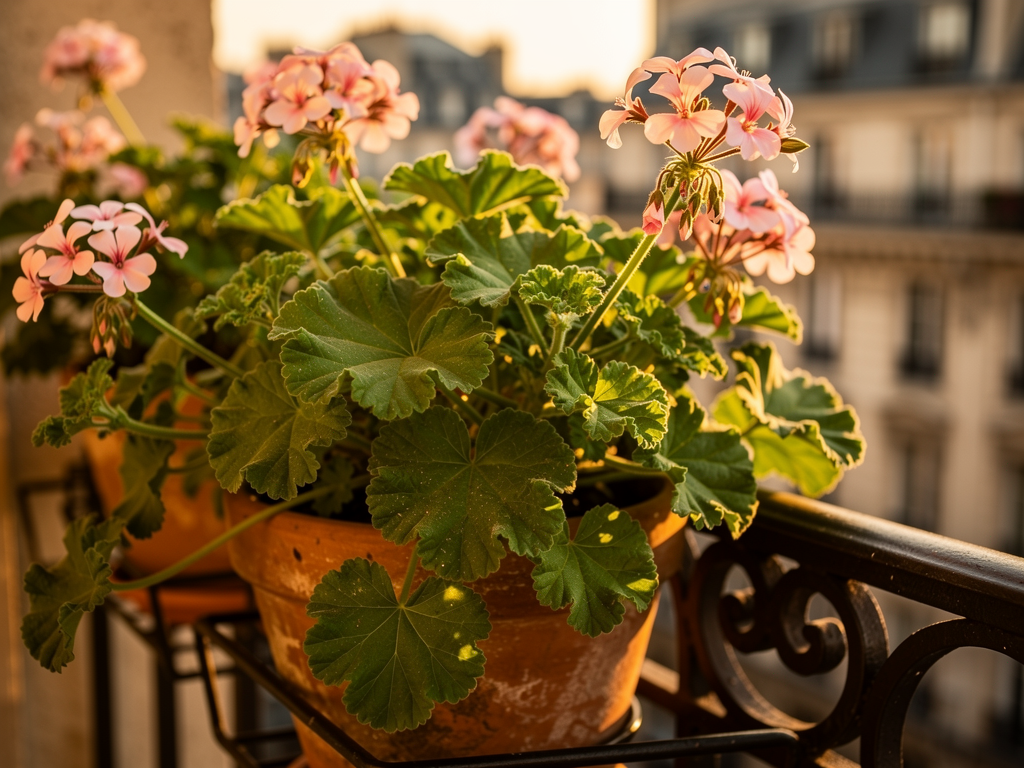
| Lemon-scented geranium | Good as a supplement nearby | Very suitable for pots and balconies | Local effect, sensitive to cold |
| Basil | Moderate but interesting | Dual culinary use | Requires regular watering |
| Lemon balm | Moderate | Pleasant lemon scent | Can spread quickly |
| Lavender | Moderate in dry outdoor conditions | Very robust in the sun | Less expressive in waterlogged pots |
| Rosemary / lemon thyme | Moderate | Undemanding and compact | Limited action if distant |
| Lemongrass | Variable depending on climate and cultivation | Interesting aromatic foliage | Often less practical than imagined |
Lemongrass, lemon grass and lemon-scented geranium
Confusion is common between the true lemongrass in the botanical sense, lemongrass, and the lemon-scented geranium. In domestic uses, it is often the latter that gives the most convincing results, simply because it grows well in pots and develops very fragrant foliage when touched. On a balcony, at table height or near a window, it is a pragmatic choice.
Lemongrass itself is mainly interesting for its scent and aromatic foliage, but it requires a mild climate or attentive cultivation. In many French regions, its maintenance is less simple than commercial promises suggest. As for the true tropical lemongrass, it is not always the best candidate for common use in apartments or on temperate terraces. In other words, the name “lemongrass” sells well, but it is not always the easiest or most useful plant.
Basil, mint and lemon balm
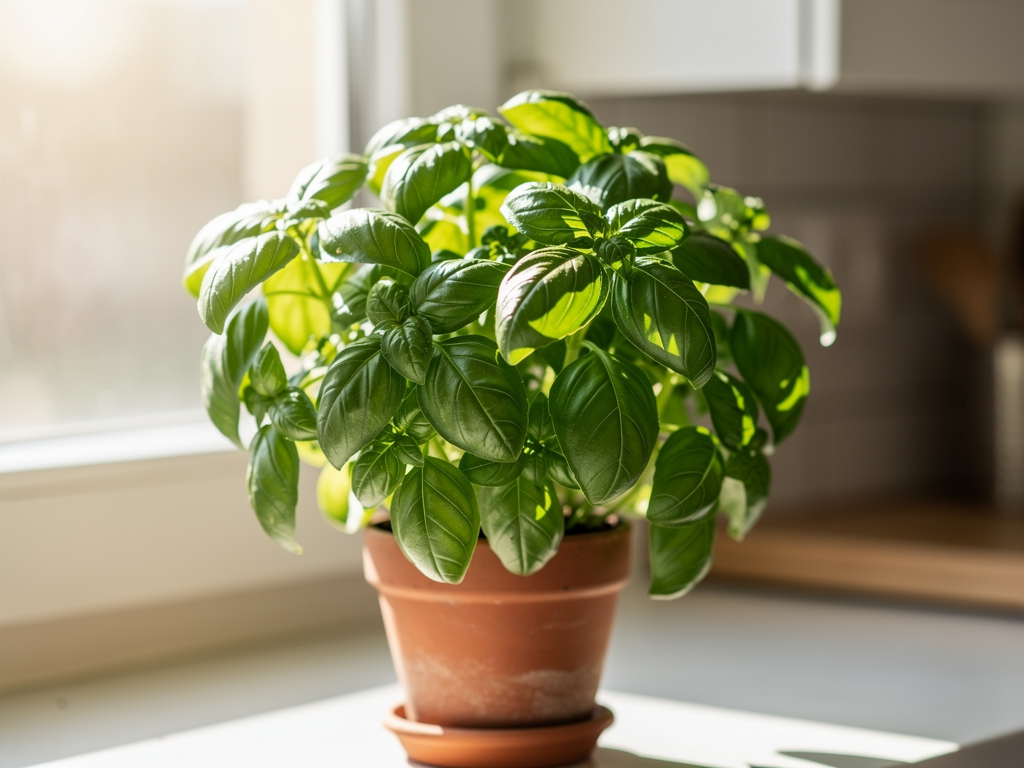
Basil has an interesting profile because it combines culinary use and moderate repellent effect. Its main advantage is its natural presence near windows, summer kitchens, or tables. If it is well supplied, regularly pinched, and placed in a bright spot, it emits a clear scent. Mint, on the other hand, grows vigorously and can be useful, but it quickly becomes invasive in open ground; it is often better contained in a pot.
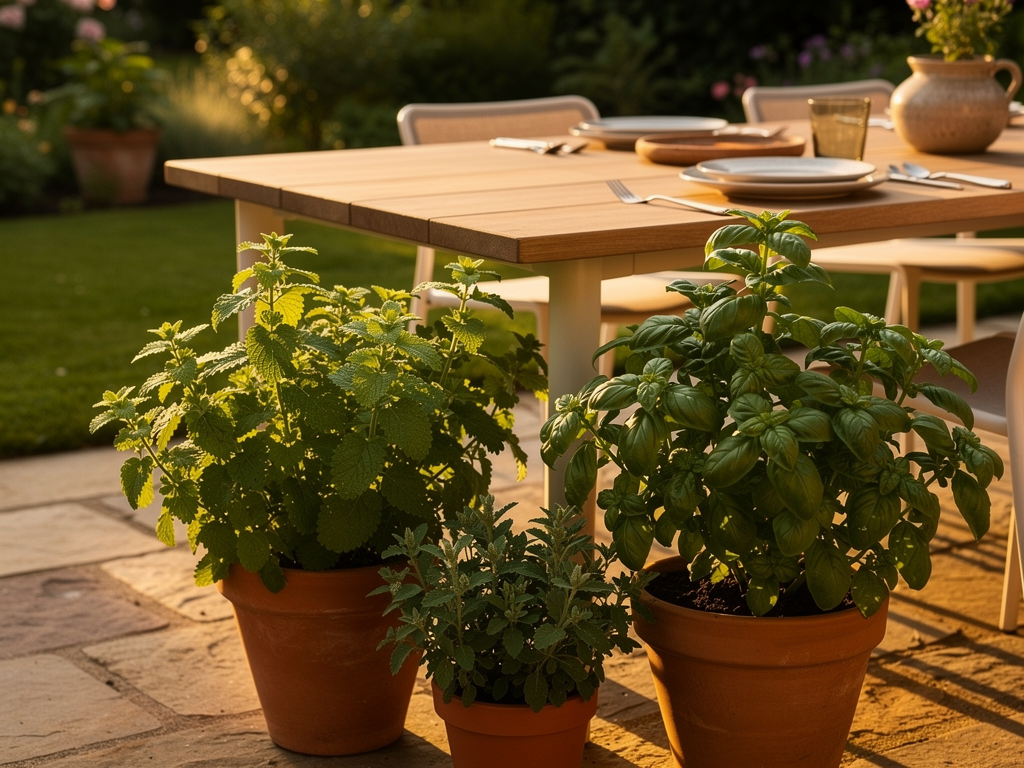
Lemon balm deserves a special place. Its lemon scent is pleasant, its maintenance remains simple, and it tolerates container cultivation quite well. A family living in a house with a terrace often reports that a group of lemon balm, basil, and scented geranium near the summer table makes meals more comfortable, without making all mosquitoes disappear. This nuance is important: we are talking about a coherent sensory supplement, not absolute protection.
Lavender, rosemary and lemon thyme
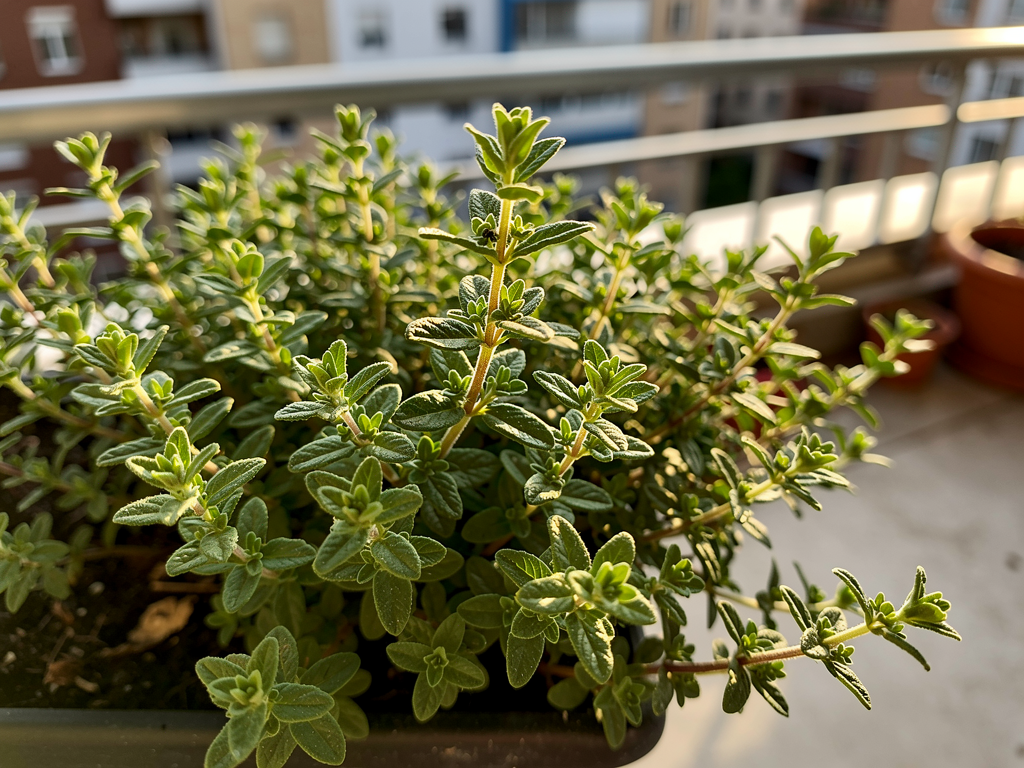
Lavender is very suitable for hot, sunny, and rather dry areas. On a south-facing balcony, it has two advantages: it withstands heat well and remains decorative for much of the season. Rosemary follows the same logic, often with better hardiness and reduced maintenance. Lemon thyme, finally, offers an excellent compromise for small containers thanks to its low bulk and concentrated scent.
These three plants are particularly useful when looking for a durable composition in a planter. They require less water than basil and perform well in windy or very bright situations. However, their effectiveness is always linked to proximity. A planter placed 3 or 4 meters from the occupied area will have limited benefit. To complete this picture, the frequently asked questions about mosquitoes also help to correct several misconceptions about what plants can really do.
Which plants to choose depending on the area to protect?
For a windowsill or a small space
In a small space, it is better to aim for practical efficiency rather than a botanical collection. Basil, lemon thyme, and scented geranium adapt well to this context because they remain mobile and can be brought closer to the opening or passage area. The right approach is to use pots that are easy to move to follow the times of day when the nuisance is most pronounced.
On the other hand, avoid plants that are too bulky indoors or those that require constant heat which is difficult to maintain. In a bedroom, their interest remains secondary. If your real need concerns the night, it is wiser to combine plants with a sleep-oriented strategy, as explained in this guide for sleeping without mosquitoes in summer, because the plant alone generally does not do the job.

For a terrace, balcony, or summer table
On a terrace, the most interesting plants are those that withstand real conditions: heat, wind, occasional watering neglect, and sometimes intense exposure. Lavender, rosemary, lemon balm, and scented geranium are among the most coherent choices. Ideally, create groups of plants around seating areas rather than scattering them randomly along a railing.
A triangular or semicircular arrangement around a table often yields better results than a single line. In practice, urban balcony dwellers find that simply bringing pots within less than a meter of the chairs changes perception more than adding an extra plant left at the back of the balcony. Regular pruning is also beneficial: it stimulates foliage renewal, hence the fragrance.
How to use these plants to achieve the best result?
Placement and maintenance
Placement is more important than quantity. A single well-placed planter can be more useful than three distant pots. Install plants in the immediate vicinity of occupied areas: table, deckchair, frequently open window, dining corner, or door threshold. Their basic needs must also be respected. An overwatered plant, deprived of sunlight, or conversely completely dried out, quickly loses density and fragrance.
The best indicator remains the scent released when lightly handling the foliage. For some varieties, such as scented geranium, lemon balm, or basil, a slight crushing of the leaves temporarily increases the aromatic perception. Without overdoing it, this habit can be useful before an outdoor meal. However, permanently damaged foliage eventually tires the plant, so moderation is necessary.
Useful combinations without false promises
Combining several plants makes more sense than betting everything on a single variety. A set composed of lemon geranium, basil, lavender, and lemon thyme covers different aromatic profiles and enhances the olfactory presence around the living area. This does not create a “mosquito-proof wall,” but the overall effect is more coherent than a single pot. If the pressure is strong, it is necessary to complement with simple actions: avoid saucers full of water, eliminate small larval breeding sites, and reduce the attractiveness of the area.
On this point, health authorities emphasize environmental prevention more than the plants themselves. Santé publique France regularly reminds the importance of limiting stagnant water to curb the presence of the tiger mosquito. Meanwhile, ANSES on the tiger mosquito mainly highlights the issues related to vector control. The logic is clear: plants can help, but they do not replace basic measures. To go further with complementary solutions, a homemade mosquito trap can sometimes be tested in parallel, provided expectations remain realistic.
Anti-mosquito plants are mainly valuable for their sensible use: well chosen and well placed, they improve a situation; poorly positioned, they mostly feed a marketing promise.
FAQ on truly effective anti-mosquito plants
Is one plant enough in a bedroom?
Generally no. In a bedroom, a single plant has too limited an effect to prevent bites, especially if the window remains open or if a mosquito is already present. Mosquito nets, closing access in the evening, and eliminating stagnant water remain more effective.
What is the best anti-mosquito plant for a balcony?
Lemon geranium is often the most practical, as it combines a strong scent when touched, good pot cultivation, and reasonable size. For a very sunny balcony, lavender and rosemary are also good choices. In windy areas, prefer grouped and stable pots rather than a single isolated plant.
Are fresh plants more useful than dried versions?
Yes, in most cases. Living foliage releases its aromatic compounds better, especially when the plant is vigorous and recently pruned. Dried plants may smell good, but their repellent interest is generally weaker and shorter-lasting.
Do anti-mosquito plants also work against the tiger mosquito?
They can slightly bother the tiger mosquito as well as other species, but they do not constitute a specific or sufficient solution. The tiger mosquito often bites during the day and takes advantage of small water breeding sites around homes. Eliminating these sites remains a much more important lever than the mere presence of plants.
Should the leaves be crushed for it to be effective?
For certain plants, yes, a slight crushing can temporarily strengthen the scent. This is especially true for lemon geranium, lemon balm, mint, or basil. However, the plant should not be systematically damaged, as stressed or sparse foliage becomes less interesting in the medium term.
Can you use only plants if you are often bitten?
If you are highly exposed, this will rarely be sufficient. Plants are useful as a comfort supplement, especially on terraces or balconies, but not as the main protection. In case of a strong presence of mosquitoes, it is better to combine several methods validated by the recommendations of Service-Public.fr on the tiger mosquito and health authorities.