
Sommaire
Fungus Gnats in Plants: Complete FAQ to Identify and Get Rid of Them
| 🪴 | Definition: plant fungus gnats are most often sciarids, small black insects attracted to moist soil. |
| 🔎 | Key sign: they fly above the pot after watering or when you lightly disturb the surface of the substrate. |
| 💧 | Main cause: soil that stays wet for too long encourages egg laying and larval development. |
| ⚠️ | Real risk: adults are mainly a nuisance, but larvae can weaken seedlings, cuttings, and young roots. |
| ✅ | Effective solution: you need to act on moisture, larvae in the substrate, and visible adults around the pots. |
| 📅 | Typical timeframe: a clear improvement often appears within 7 to 14 days if actions are consistent and regular. |
FUNGUS GNATS flying around a pot are almost never there by chance. When they appear after watering, emerge from the soil at the slightest touch, and return despite your efforts, the problem often comes from the substrate itself. Good news: it is possible to identify them quite precisely, then eliminate them without harming your plants. Here are useful markers to understand what is happening, distinguish true fungus gnats from other flying insects, and choose the most appropriate solutions depending on the level of infestation.
Fungus Gnats in Plants: Exactly Which Insects Are We Talking About?
In most cases, when talking about fungus gnats in houseplants, we mean sciarids. Their cycle is quite simple: adults lay eggs in moist soil, eggs hatch quickly, then larvae develop before becoming new flying insects. Indoors, at temperatures around 20 to 24 °C, a full cycle can complete in 3 to 4 weeks, sometimes less if the air is warm and the substrate constantly moist.
Typical Signs of Fungus Gnats in Soil
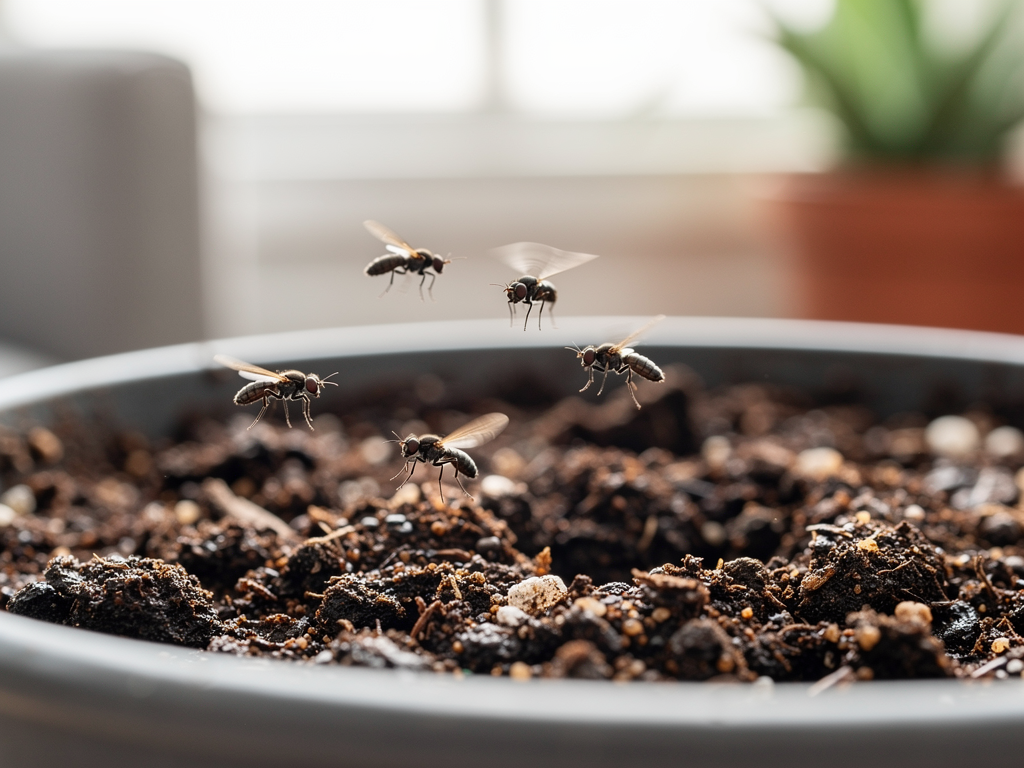
The first clue is visual: you see small black insects flying low, almost at pot level. They often become more visible just after watering or when you touch the top layer of soil. The larvae are discreet: thin, whitish, sometimes translucent with a dark head, they are usually found in the first centimeters of the substrate. On a healthy mature plant, they are rarely noticed with the naked eye without close inspection.
What Differentiates Them from Other Plant Pests
They are often confused with fruit flies, insects attracted to the sink, or small flies coming from a trash bin. The most useful difference is this: fungus gnats remain linked to the pot and its moisture. They do not form fixed colonies like aphids on stems, nor do they concentrate on ripe fruit like drosophilids. If you are still unsure between several possible sources, a guide on fungus gnats in the home helps compare causes according to rooms and moisture sources.
Why do I have fungus gnats in my plants?
Soil is not just a support for roots: it is also a living environment. When it remains constantly moist, it becomes favorable for egg-laying and indirectly nourishes larvae thanks to decomposing organic matter, plant debris, and microorganisms. This is especially true in winter, when plants consume less water but watering habits remain the same as during a period of strong growth.
The most common causes in pots
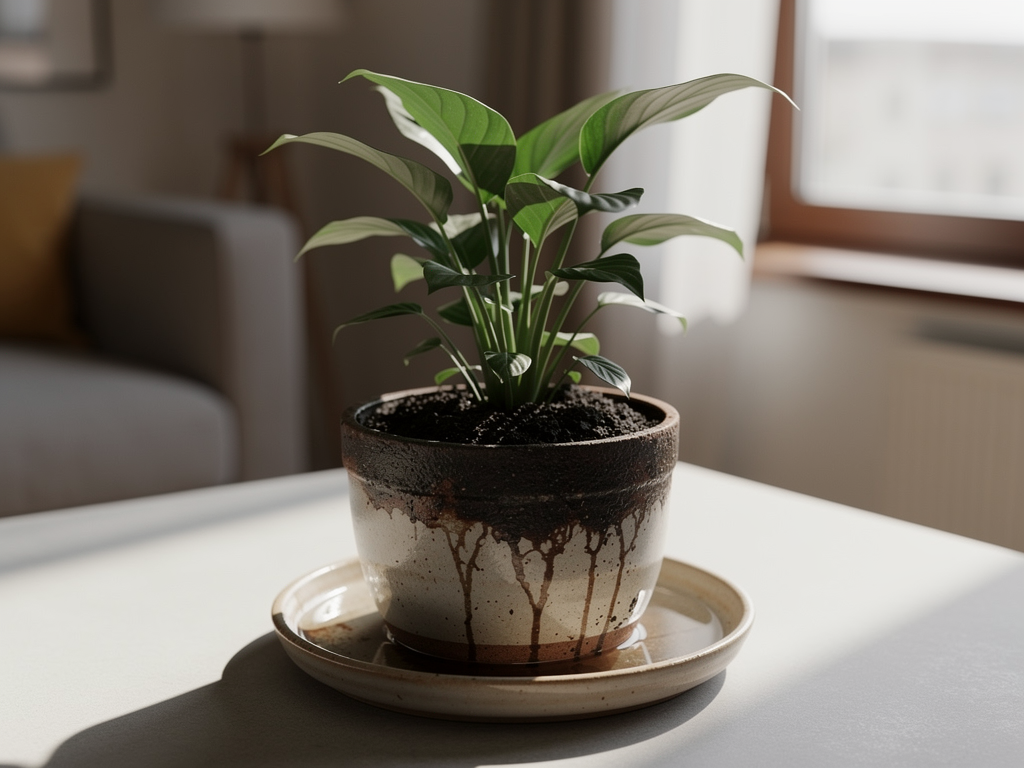
The classic scenario is simple: watering too frequently, poorly draining pot, forgotten saucer with stagnant water, and soil surface never really dry. A recently opened bag of soil can also already contain eggs or larvae, especially if it has been stored in a warm and humid place. In practice, infestations often appear on plants that receive “a little water” very often rather than spaced out but better adjusted watering.
Situations that favor an invasion
A poorly ventilated room with many plants grouped together creates a favorable microclimate. Under a mini-greenhouse, under a cloche, or near a poorly ventilated window, the soil dries more slowly. Seedlings and cuttings are even more exposed, as they often require regular humidity. The ADEME reminds the importance of good home ventilation to limit indoor humidity, a factor that also affects the drying rate of substrates.
How to precisely identify the source in your plants?
A good diagnosis avoids treating all plants randomly. The goal is to identify the pot or pots that really serve as the source, then assess the actual moisture level of the substrate over several days. This is often where the success of the treatment lies: if you target the wrong place, the adults disappear for a time, then the colony restarts.
Quick diagnostic checklist
- Shake the pot very gently: if several adults fly away, the source is probably in the substrate.
- Observe after watering: an increase in activity in the hours following is a strong clue.
- Check the drainage holes: larvae or persistent moisture may concentrate there.
- Compare several plants: a single heavily affected pot does not call for the same response as a widespread problem.
- Check the soil depth: at 3 or 4 cm, it should not remain waterlogged permanently for a typical indoor plant.
When the problem comes from elsewhere
It is also necessary to be cautious: flying insects in the same room do not always come from the plants. An organic trash can, a clogged siphon, or overripe fruits can sustain a nearby population. If fungus gnats concentrate near the sink, rather consult a guide on fungus gnats in the sink. Conversely, if the cloud stays above a single pot, the soil hypothesis is very strong.
How to effectively get rid of fungus gnats in plants?
The logic is simple: adults are annoying, but the larvae ensure the next generation. So you need to break the cycle. Start by letting the top layer of soil dry out between waterings, without putting the plant under water stress. Many indoor plants tolerate drying out the top 2 to 3 centimeters before the next watering without difficulty. This is sometimes enough to strongly slow down egg laying.
The first actions to take
Systematically empty saucers after watering, remove dead leaves and organic debris on the surface, then space out watering intervals. If the pot is very compact, poorly drilled, or filled with a substrate that has become spongy, improve drainage. For a light infestation, these well-applied steps over one to two weeks can already make a real difference. If you are looking for a quick method to rapidly reduce the visible population, you can compare these solutions against fungus gnats in 24 hours, provided you adapt them to the plants and not just an empty room.
The most useful solutions against larvae and adults
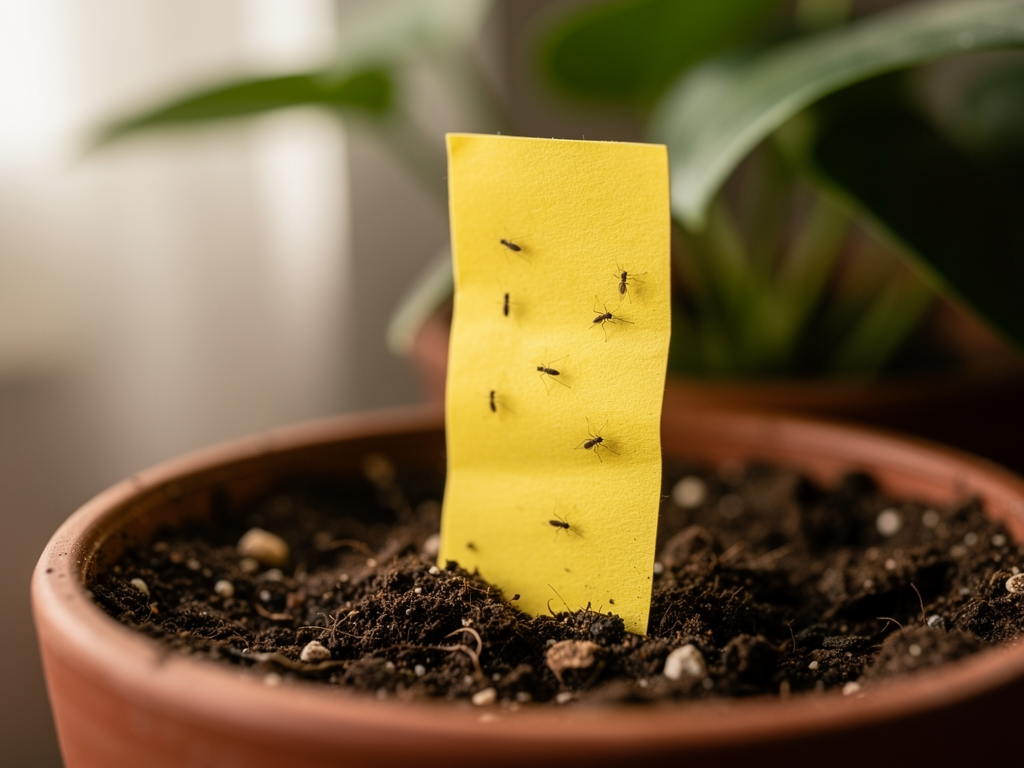
Sticky yellow traps are useful for capturing adults and measuring the intensity of the infestation. They do not solve everything, but they reduce future egg laying. If the soil is heavily infested, remove the top layer or repot in a more aerated substrate. In biological treatment, some gardeners use nematodes adapted to fungus gnat larvae. The principle is consistent, especially on several affected pots, but you must follow the manufacturer’s application conditions.
The Ministry of Agriculture presents biocontrol as an approach aiming to use natural mechanisms rather than multiplying classic chemical products. For indoor plants, this logic is often more relevant than a series of poorly targeted sprays. If you hesitate about homemade traps, the vinegar trap for fungus gnats can help against adults, but it is generally less decisive when larvae remain active in the substrate.
What to avoid during treatment
The first mistake is watering “a little” too early, which immediately reactivates favorable conditions. The second is moving all the plants without knowing which one is causing the problem. Finally, it is better to avoid accumulating approximate remedies on an already weakened plant. A partial solution poorly repeated can give the impression of acting, while the infestation remains intact below the surface.
Which solutions to choose depending on the type of plant and infestation level?
Not all plants are managed the same way when facing FUNGUS GNATS. On a well-established adult plant, you can often start by correcting the watering and observing. On seedlings, cuttings, or young roots, you need to be quicker, as larvae can hinder rooting and slow recovery.
Indoor plants installed for a long time
On a monstera, pothos, or spathiphyllum already vigorous, the priority is to rebalance the watering-ventilation pair. Place a yellow trap, monitor the decrease in the number of adults, and check the moisture deep down with a finger or a small stick. If, after 10 to 14 days, the pot remains abnormally wet and the catches remain significant, repotting becomes more relevant.
Seedlings, cuttings, and young plants
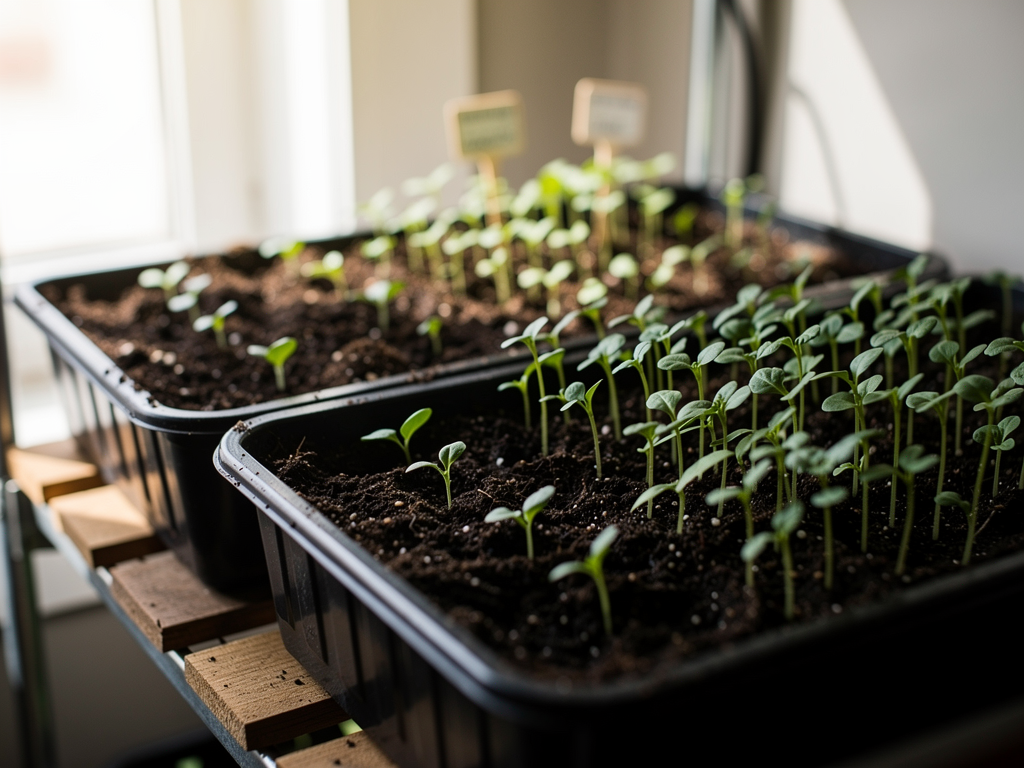
These cases are more sensitive. Young root tissues poorly tolerate continuous larval pressure, especially in a humid mini-greenhouse. Therefore, it is necessary to reduce excess moisture without letting the seedlings dry out abruptly. A clean surface layer, good drainage, and daily monitoring are often more effective than heavy treatment. To go further on identifying secondary hotspots in living rooms, the file on gnats in the kitchen also helps to avoid confusing multiple sources simultaneously.
Concrete examples: what to do depending on the situation encountered?
In practice, everything depends on the number of pots affected, the level of moisture, and the state of the plant. A simple adjustment is sometimes enough. In other cases, it is necessary to combine gradual drying, trapping, and replacing the most contaminated substrate. Here are common scenarios to decide faster.
You see a few gnats on a single plant
Temporarily isolate the pot if possible, reduce watering for a few days, and place a yellow trap. If the catches decrease quickly and the plant remains healthy, you are probably dealing with a light infestation. There is no need to repot systematically at this stage. The main goal is to prevent the colony from establishing itself permanently.
Several plants are affected at the same time
When several containers are concerned, look for a common habit: watering too frequently, potting soil stored nearby, a warm and poorly ventilated room. Also check opened substrate bags. If they are wet and have been open for a long time, it is better to inspect them carefully before reusing. In this configuration, treating only the room without acting pot by pot rarely gives good results.
Gnats return after a first attempt
The return of adults often means that larvae are still present or that the actual moisture in the heart of the pot has been underestimated. Reassess the diagnosis, check the drainage, see if the surface has been cleaned, and ask yourself if the watering frequency has really changed. Repotting becomes useful when the substrate remains compact, foul-smelling, or persistently wet despite good practices.
FAQ about gnats in plants
Are gnats dangerous for plants?
Adults are mainly visually annoying and bothersome in the room. The risk concerns larvae more, which can nibble on organic matter and, in some cases, irritate young roots. On a robust adult plant, the impact often remains limited. On seedlings or cuttings, it can be more sensitive.
Should the potting soil be thrown away or repotting done systematically?
No, not necessarily. In case of a light infestation, correcting watering, removing surface debris, and trapping adults is often enough. Repotting is mainly useful if the substrate remains compact, waterlogged, or clearly infested despite initial measures.
Are yellow traps sufficient on their own?
They are very useful to reduce adults and monitor progress, but they do not eliminate larvae deep down. Therefore, they must be combined with drier substrate management and, if necessary, substrate treatment. Used alone, they improve the situation without always resolving it permanently.
Why do fungus gnats come back after a few days?
Because the cycle has not been completely broken. The visible adults can disappear quickly, while the eggs and larvae remain in the soil. If the pot becomes wet again too quickly, a new generation appears and the infestation resumes almost at the same pace.
Can plant fungus gnats come from a new bag of potting soil?
Yes, it happens. A bag stored in a warm and humid environment can already contain eggs or larvae. Upon opening, the problem sometimes remains discreet, then becomes visible after a few waterings. It is better to keep the potting soil dry, well sealed, and avoid old stocks.
How to prevent their return permanently?
The best reflex is to adapt watering to the real needs of each plant, rather than following a fixed routine. Keep pots well-drained, empty saucers, remove surface debris, and monitor any new plant or new bag of substrate during the first two weeks.
For additional guidance on plant protection and integrated pest management approaches, you can consult the resources of INRAE as well as the practical information from Service-Public.fr on the use of biocidal and insecticidal products. They emphasize an essential point: a precise diagnosis and targeted action are better than an accumulation of inappropriate products in the home.